
Introduction
Compression set failures are not always process problems. They are often network architecture problems.
A foam plant may adjust catalyst, increase crosslinker, raise the index, check cure temperature, and review density. Each adjustment may give a small improvement, but the compression set problem keeps returning.
When that happens, the root cause may be polyol functionality.
Polyol functionality controls how many reactive hydroxyl groups each molecule contributes to the foam network. More importantly, it controls how many junction points the polyol can create inside the polymer structure.
- OHV tells you how much isocyanate the polyol needs.
- Functionality tells you what kind of network the polyol can build.
That distinction is critical.
A formula can have the correct OHV, correct equivalent weight, and correct index — but still fail compression set if the polyol system does not provide enough branching to build a strong network.
This article explains how polyol functionality controls crosslink density, why it affects compression set, and why low-functionality polyol systems can create foam problems that process adjustments cannot fully fix.
What Crosslink Density Means in PU Foam
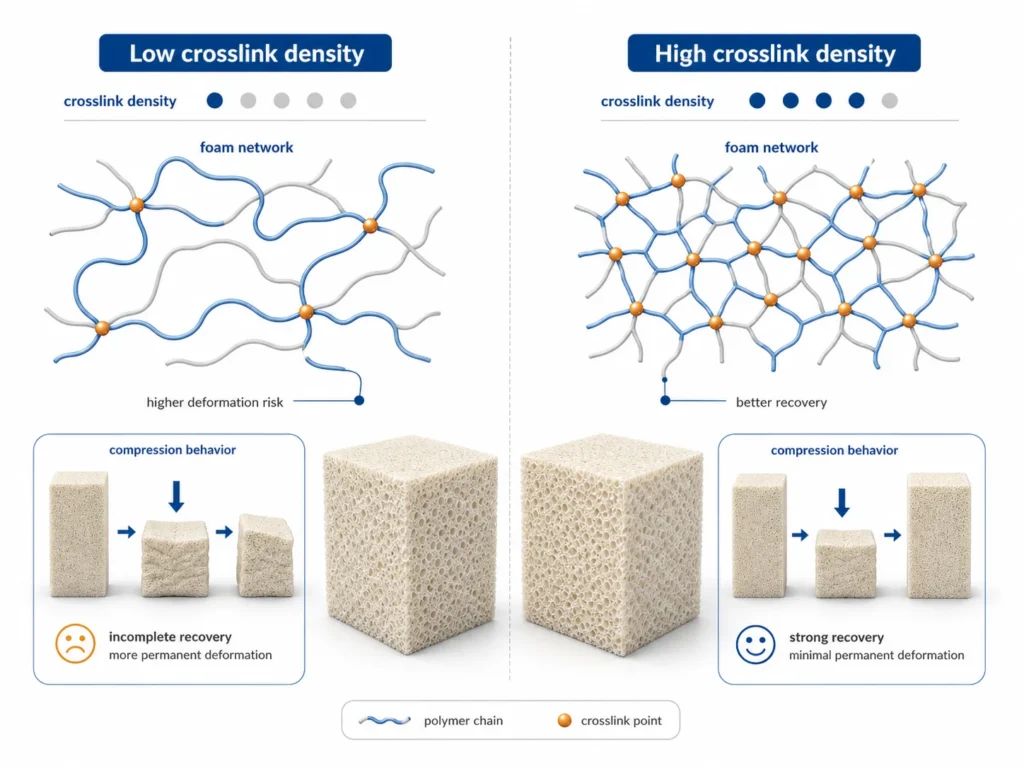
Crosslink density describes how strongly the polymer chains are connected inside the foam network.
A foam with low crosslink density has fewer effective junction points. The chains can move, creep, and deform more easily under sustained load.
A foam with higher crosslink density has more network junctions. The polymer structure resists deformation better and usually recovers more effectively after compression.
Crosslink density affects:
- Compression set
- Creep resistance
- Recovery
- Load-bearing stability
- Dimensional stability
- Long-term durability
- Foam feel under sustained use
In polyurethane foam, crosslink density is influenced by many variables — isocyanate index, crosslinker level, water level, and catalyst balance. But one of the most important structural variables is polyol functionality.
Functionality determines how many connection points each polyol molecule can contribute to the network.
How Functionality Creates Network Junction Points
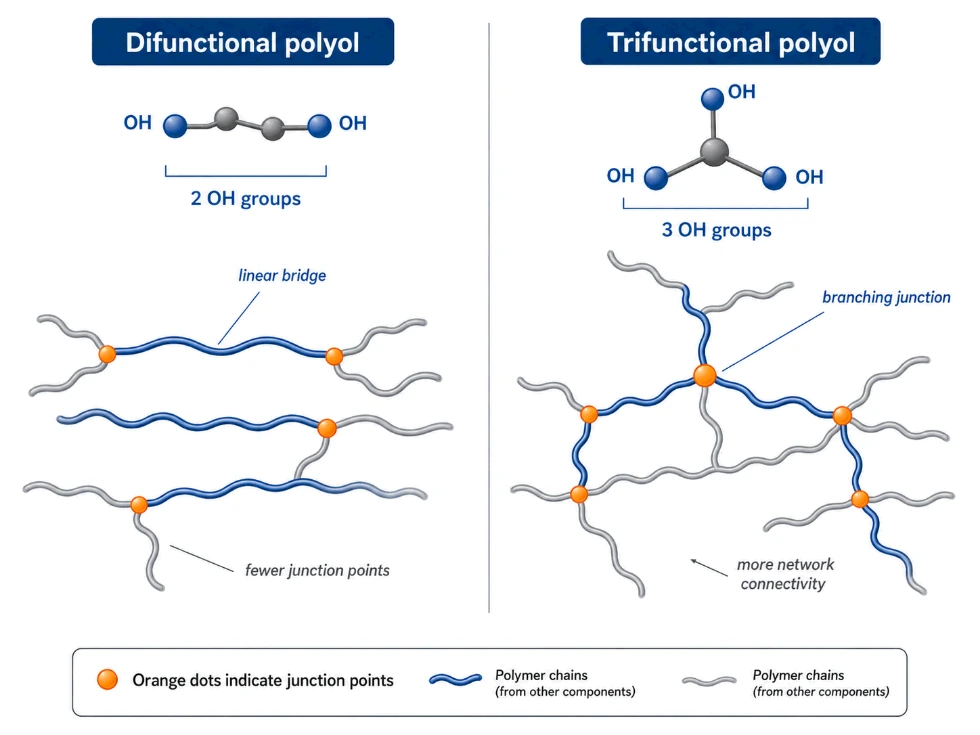
Polyol functionality is the average number of reactive hydroxyl groups per polyol molecule.
- A difunctional polyol has two reactive hydroxyl groups.
- A trifunctional polyol has three reactive hydroxyl groups.
This difference changes the network.
A difunctional polyol can react at both ends, forming a linear chain segment between two points. It contributes mass and flexibility, but it does not create a true branch point.
A trifunctional polyol can react at three points. It creates a branching junction inside the network.
This is why functionality is an architecture variable. It controls how many branch points each molecule can create.
| Functionality | Network Contribution |
|---|---|
| 2.0 | Mostly linear chain extension |
| 2.4–2.8 | Partially branched network |
| 2.8–3.0 | Standard flexible foam network |
| 3.0+ | More branched, stronger network |
The higher the effective functionality, the more complete the network structure becomes.
Why Low Functionality Causes Compression Set Problems
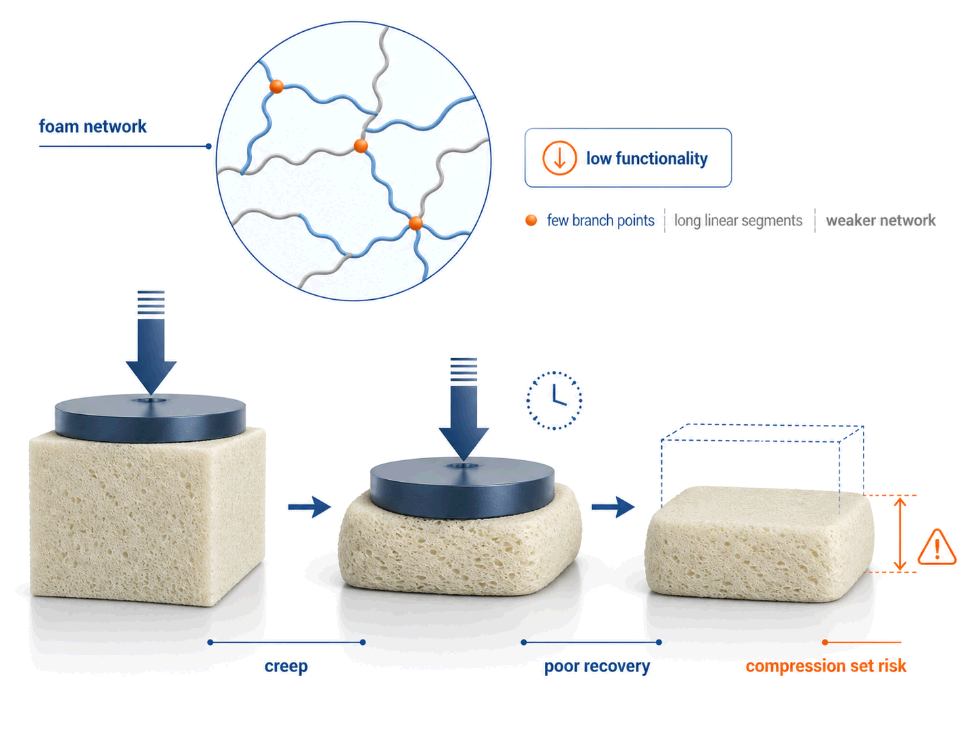
Compression set measures how much permanent deformation remains after foam has been held under compression.
- A foam with a strong network can recover after sustained load.
- A foam with weak network architecture creeps and does not fully recover.
Low-functionality polyol systems can increase compression set because they create more linear segments and fewer branch points. Those linear segments can behave like internal soft zones in the network. Under load, they stretch, move, and creep more easily.
This can show up as:
- Higher permanent deformation
- Lower recovery
- Poorer durability
- Cushion or mattress sagging
- Customer complaints after use
- Compression set values above specification
This is why compression set is not only a cure issue, not only an index issue, and not only a crosslinker issue. It can be a polyol architecture issue.
If the polyol system does not provide enough average functionality, the foam network may be structurally weak before the process even starts.
Functionality and Compression Set Reference Table
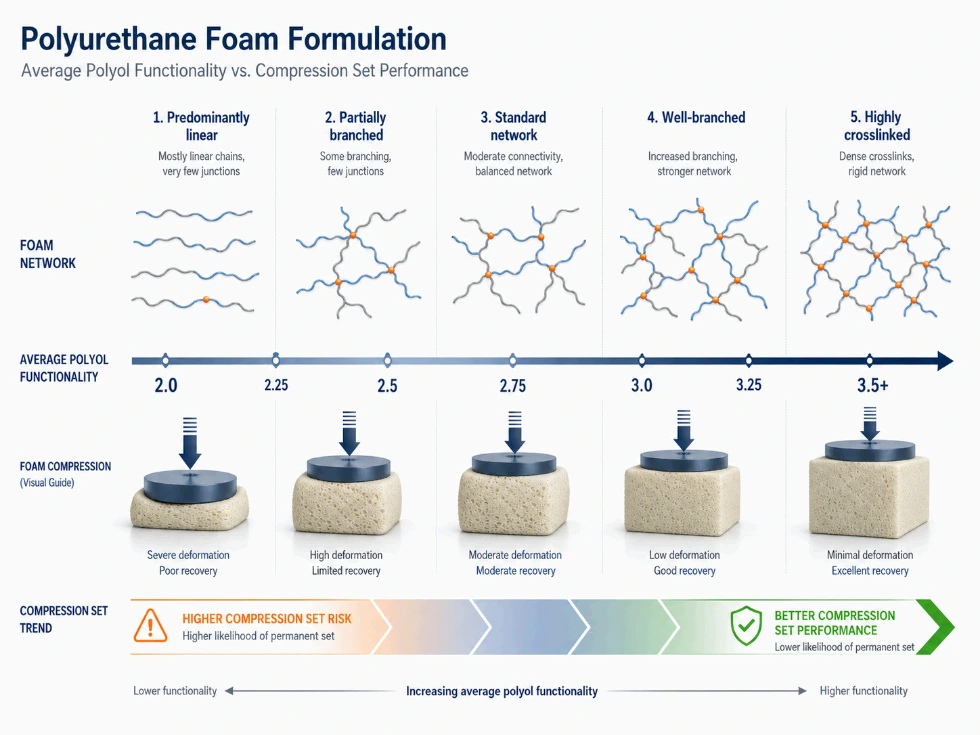
The table below gives a practical guide to how average functionality can affect network type and compression set behaviour.
Actual results depend on the full formulation, density, index, water level, crosslinker package, cure profile, and test conditions. But the directional relationship is important.
| Average Functionality | Network Type | Typical Compression Set Behaviour |
|---|---|---|
| 2.0–2.4 | Predominantly linear | High compression set risk |
| 2.4–2.8 | Partially branched | Marginal to moderate performance |
| 2.8–3.0 | Standard flexible foam network | Generally acceptable if formulation is balanced |
| 3.0–3.5 | Well-branched network | Better compression set resistance |
| 3.5+ | Highly crosslinked / HR-type systems | Strong recovery when properly formulated |
For many standard flexible foam applications, compression set requirements are often tight enough that average functionality below the proper range can become a structural limitation.
This is why functionality should be reviewed early when compression set problems persist.
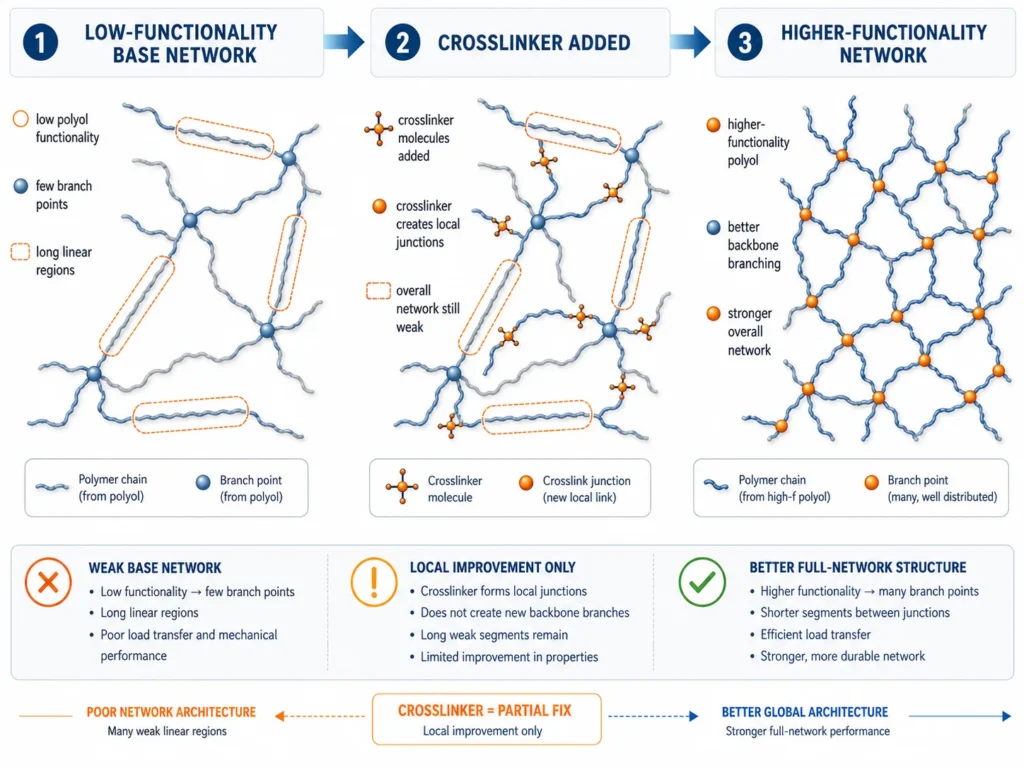
Why Crosslinker Cannot Fully Fix Low Functionality
When compression set fails, engineers often increase crosslinker. That can help in some cases.
Crosslinkers such as DEOA, glycerol, or TEA add local junction density. They can improve firmness, cure response, and network reinforcement.
But crosslinker cannot fully replace the architecture of the base polyol system.
If the base polyol has insufficient functionality, the network contains too many linear or weakly branched chains. Adding crosslinker creates additional short junctions, but it does not change the structure of every long polyol backbone already present in the formula.
In simple terms:
Crosslinker can add local reinforcement. It cannot rebuild a poorly branched base network.
This is why compression set failures may improve slightly after crosslinker adjustment but not disappear.
If the root cause is low average functionality, the real correction may require:
- Higher-functionality base polyol
- Different polymer polyol selection
- Blend ratio adjustment
- Supplier review
- Full average functionality calculation
The process can only do so much if the network architecture is under-specified.
When to Suspect a Functionality Problem
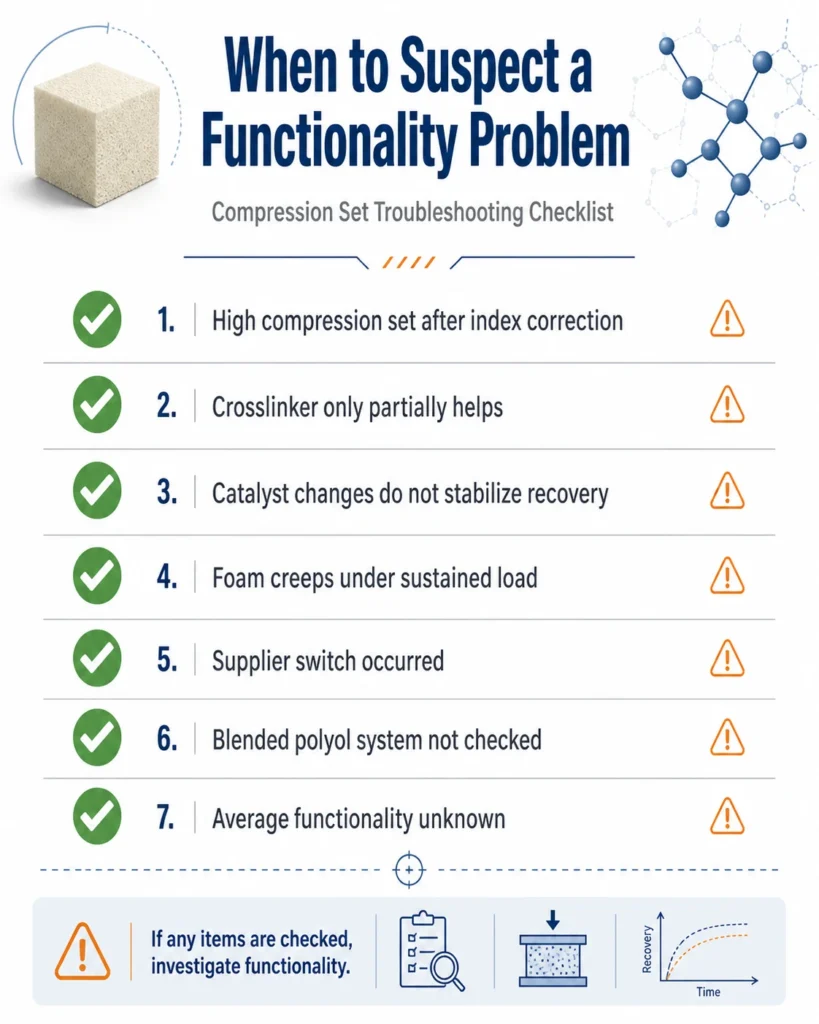
A functionality problem should be suspected when compression set or recovery issues persist even after standard process corrections.
Common signs include:
- Compression set remains high after index correction
- Crosslinker increase gives only partial improvement
- Catalyst adjustment does not stabilize recovery
- Cure temperature changes do not solve long-term deformation
- Foam feels acceptable initially but creeps under sustained load
- Field returns show sagging or permanent deformation
- Supplier switch occurred before the issue appeared
- Formula uses blended polyol systems without average functionality calculation
The key diagnostic question is:
Does the polyol system provide enough average functionality for the compression set target?
If that question is never asked, the plant may keep adjusting process variables that cannot solve the architecture problem.
Practical Review Workflow for Functionality and Compression Set
When compression set fails, use a structured review instead of only making process changes.
A good workflow:
- Confirm the test method and compression set result.
- Verify density, index, water level, and cure condition.
- Confirm OHV and equivalent weight are correct.
- Review base polyol functionality.
- Review polymer polyol or specialty polyol functionality.
- Calculate average functionality if the system is blended.
- Compare average functionality with the compression set target.
- Check whether a supplier or grade change occurred.
- Review whether crosslinker is compensating for an architecture problem.
- Decide whether the correction should be process-based or formulation-based.
This prevents the common mistake of treating a network architecture problem as a process adjustment problem.
Use the PolymerIQ Calculators
Functionality and equivalent weight must be reviewed together.
The PolymersIQ Equivalent Weight Calculator helps calculate EW from OHV, which is needed when comparing polyol grades and preparing average functionality calculations. Use it when reviewing a polyol grade, comparing OHV and EW, checking formula stoichiometry, preparing average functionality calculations, or reviewing blended polyol systems.
Open the Equivalent Weight Calculator →
Network structure can also influence foam density behaviour, cell stability, and load-bearing response. Use the PolymerIQ Foam Density Estimator when reviewing how formulation changes may affect density targets and production performance.
Open the Foam Density Estimator →
For the foundation explanation of functionality, read Polyol Functionality in Polyurethane Foam: What It Means and Why It Matters.
For the troubleshooting article, read 4 Polyol Functionality Mistakes That Cause PU Foam Compression Set Problems.
For the OHV explanation, read Hydroxyl Value in Polyurethane Foam: What OHV Means and How to Calculate Equivalent Weight.
FAQs
What is crosslink density in polyurethane foam?
Crosslink density describes how strongly the polymer chains are connected inside the foam network. Higher crosslink density means more network junctions, which generally improves compression set, recovery, creep resistance, and dimensional stability. Lower crosslink density means fewer junction points, which makes the foam more prone to permanent deformation under sustained load.
How does polyol functionality control crosslink density?
Functionality determines how many reactive points each polyol molecule contributes to the network. A difunctional polyol forms linear bridges between two points. A trifunctional polyol creates branching junctions where three chains meet. Higher functionality produces more branch points per molecule, which directly increases the achievable crosslink density of the foam.
Why does low polyol functionality cause compression set failure?
Low-functionality polyol systems create more linear chain segments and fewer branch points. Under sustained compression, linear segments can stretch and move more easily than branched junctions, leading to creep and permanent deformation. This is a structural problem with the network, not a process problem — which is why catalyst, index, and crosslinker adjustments often give only partial improvement.
Can crosslinker compensate for a low-functionality base polyol?
Crosslinkers like DEOA, glycerol, or TEA can add local junction density and provide some improvement, but they cannot fully replace the architecture of the base polyol system. The long polyol chains in the formula still carry their original structure. Crosslinker tweaks add local reinforcement but cannot rebuild a poorly branched base network. For persistent compression set problems caused by low functionality, the better fix is base polyol or blend adjustment.
What is the typical functionality range for flexible foam polyols?
Standard flexible slabstock polyols typically operate around 2.8–3.0 average functionality. HR foam and high-load systems may sit higher (3.0–3.5+). Below 2.8 average functionality, network branching is reduced and compression set risk increases for many standard applications. The exact target depends on the foam grade, density, application, and required performance specifications.
How do I calculate average functionality in a blended polyol system?
Average functionality is calculated as a weighted mean across all polyols in the blend, using either weight fractions or mole fractions of OH groups depending on the calculation convention. The simplest approach is (Σ parts × functionality) ÷ Σ parts for each polyol. For more accurate work, the calculation can be weighted by equivalent weight to reflect the actual contribution of OH groups to the network.
When should I suspect a functionality problem instead of a process problem?
Suspect functionality when compression set remains high after correcting index, water, catalyst, and cure variables; when crosslinker increases give only partial improvement; when the foam feels acceptable initially but creeps over time; when a supplier switch preceded the issue; or when a blended polyol system has never had its average functionality verified. These signs point to network architecture, not process settings.
Does polyol functionality affect properties other than compression set?
Yes. Higher functionality generally improves creep resistance, recovery after sustained load, dimensional stability, load-bearing consistency, and long-term durability. It can also affect foam stiffness — too much functionality can make foam too rigid for flexible applications. Functionality is a core architecture variable that influences many performance properties together.
Can I increase functionality without changing my polyol grade?
Partially. Adding more crosslinker adds local junction density, and certain polymer polyols or specialty polyols can shift the average functionality of the blend. But the base polyol architecture sets the foundation. If the foundation is too low in functionality, blend adjustments and crosslinker tweaks can only do so much. For tight-spec products, base polyol selection is usually the more reliable path.
Why is functionality often missed during PU foam troubleshooting?
Because most production troubleshooting focuses on visible variables — catalyst dosage, water level, index, cure temperature, machine settings. These are easy to measure and adjust. Functionality is structural and lives at the polyol level, which is rarely the first place engineers look. When standard process corrections give only partial improvement, that is the signal to step back and review whether the network architecture itself is the problem.
Key Takeaways
Polyol functionality controls network architecture. It determines how many junction points each polyol molecule contributes to the foam structure.
Crosslink density is not controlled only by reactive sites per gram. It is strongly affected by reactive sites per molecule.
- Difunctional polyols mainly create linear chain segments.
- Trifunctional polyols create branching and stronger three-dimensional networks.
Low average functionality can increase creep and compression set risk.
Crosslinker can improve local junction density, but it cannot fully correct a base polyol system with insufficient branching.
If compression set failures persist after catalyst, index, cure, and crosslinker adjustments, polyol functionality should be reviewed.
The question is not only whether the formula is stoichiometrically correct. The question is whether the polymer network architecture is strong enough for the performance target.
Conclusion
If your foam is failing compression set even after index correction, crosslinker increase, and process adjustment, the issue may be network architecture.
PolymersIQ can help review base polyol functionality, blended system average functionality, and crosslink density risk to identify whether the formulation is structurally capable of meeting the compression set target.
To get accurate support, please share:
- Polyol grade(s) and supplier(s) currently in use
- OHV and reported functionality of each polyol
- Blend ratios if a blended system is used
- Current crosslinker type and level
- Target compression set and observed test results
- Description of the foam quality issue and adjustments already tried
Contact PolymerIQ for a polyol functionality review →