
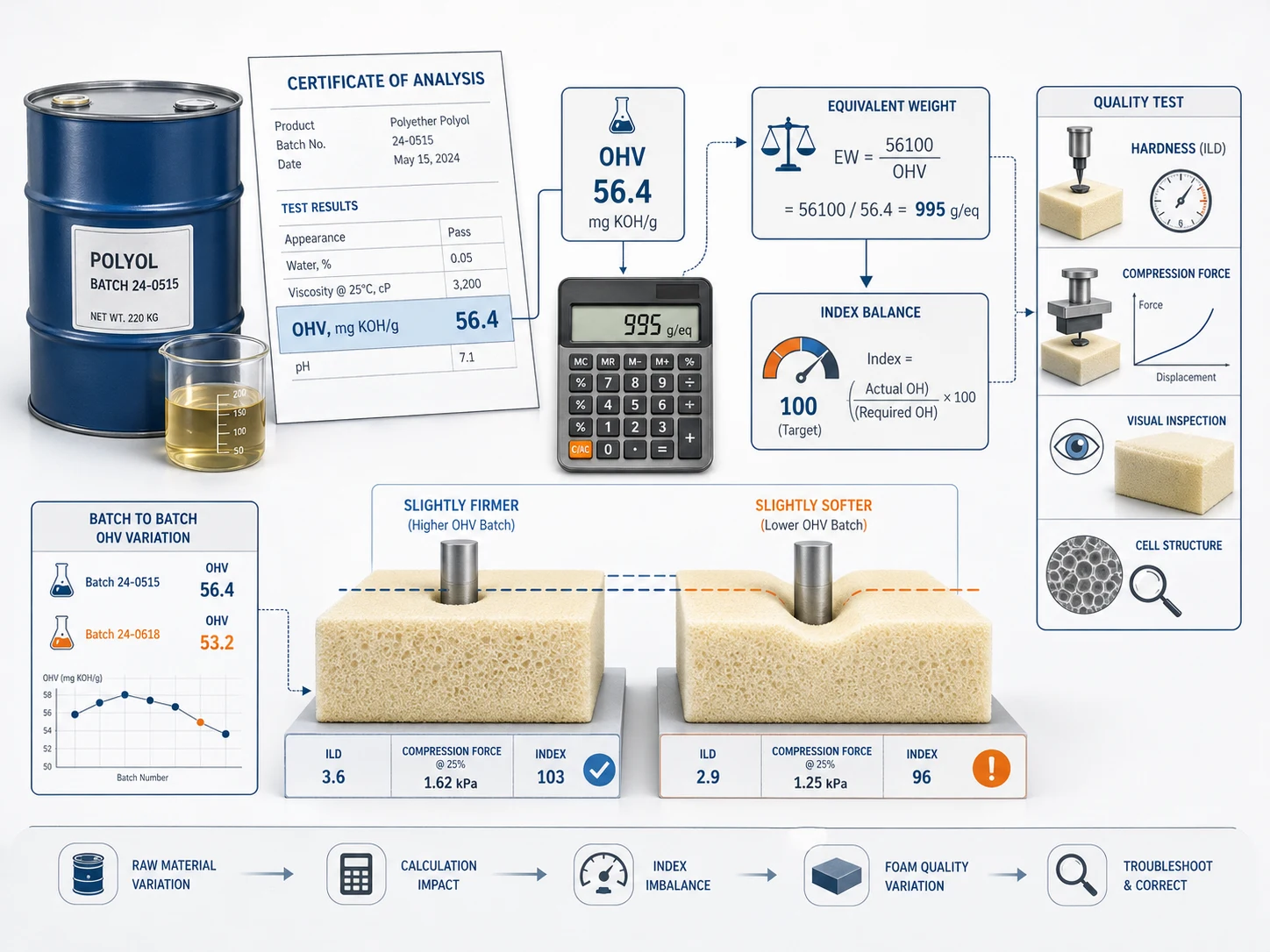
Tag: Foam Quality

  • Why Polyol OHV Variation Causes PU Foam Quality Issues

    Why Polyol OHV Variation Causes PU Foam Quality Issues


    Introduction

    Most foam quality problems are blamed on the machine.

    Sometimes the machine is not the problem.

    A foam plant may spend days adjusting catalyst levels, checking temperature, reviewing silicone performance, and inspecting machine calibration. The foam may be harder or softer than expected, but nothing in the process seems to explain the change.

    The cause may be sitting in the raw material documents.

    A new polyol batch arrives with a hydroxyl value slightly different from the value used in the original formulation. The OHV may still be inside the supplier’s TDS range. It may pass incoming QC. It may not trigger any warning.

    But if nobody recalculates the equivalent weight, the formula is no longer running at the same chemical balance. The formula looks unchanged on paper. In production, it is not unchanged.

    Polyol OHV variation changes equivalent weight. Equivalent weight changes the reactive balance. The reactive balance affects the isocyanate index. And the index affects foam hardness, compression set, resilience, and long-term consistency.

    This article explains why polyol OHV variation creates PU foam quality problems and how foam plants can control it before it becomes off-spec production.

    Why OHV Variation Matters in PU Foam Production

    Hydroxyl value, or OHV, measures the concentration of reactive hydroxyl groups in a polyol.

    When OHV changes, equivalent weight changes. The formula is:

    Equivalent Weight = 56,100 ÷ OHV

    This means OHV and equivalent weight move in opposite directions:

    • If OHV decreases, equivalent weight increases.
    • If OHV increases, equivalent weight decreases.

    This matters because the isocyanate requirement is calculated from reactive equivalents, not just from the weight of raw materials.

    A foam formula developed at one OHV value may not behave the same when the next polyol batch arrives at a different OHV value. Even if the difference looks small, the formulation effect can be large enough to move foam properties outside the target range.

    That is why OHV should not be treated as a fixed number. It is a batch-specific formulation value.

    The TDS Range Problem

    Every polyol Technical Data Sheet gives a specification range.

    For example, a flexible foam polyol may have a TDS hydroxyl value range such as 45–55 mg KOH/g.

    Many engineers use the midpoint of this range during formula development. They calculate equivalent weight once and then continue using that value for months or years.

    This is risky.

    The TDS range is a commercial conformance window. It tells you what the supplier is allowed to ship. It does not tell you the actual OHV of the batch in your plant today.

    A batch at OHV 47 and a batch at OHV 55 may both be inside the same TDS range. But they do not have the same equivalent weight. They do not create the same isocyanate balance. They may not produce the same foam properties.

    The Certificate of Analysis gives the actual batch OHV. That value should be used for production calculation.

    TDS hydroxyl value range versus Certificate of Analysis actual OHV for polyol
    The TDS gives the allowed OHV range, but the CoA gives the actual batch value needed for formulation control.

    How OHV Variation Changes Equivalent Weight

    Equivalent weight is calculated directly from OHV using EW = 56,100 ÷ OHV.

    Now compare equivalent weight across a typical flexible foam polyol range:

    OHV (mg KOH/g)Equivalent Weight (g/eq)
    451,247
    471,194
    511,100
    531,058
    551,020

    A change from OHV 45 to OHV 55 creates an equivalent weight swing of more than 200 g/eq.

    That is not a small formulation difference. It can change the real isocyanate balance even when the formula sheet still shows the same parts of polyol, water, and isocyanate.

    This is why a polyol batch can pass incoming QC and still create a production shift if the formula is not recalculated. The raw material is within specification. The formulation control is not.

    OHV variation changing equivalent weight in polyurethane polyol formulation
    As OHV increases, equivalent weight decreases. As OHV decreases, equivalent weight increases.

    How OHV Drift Changes Foam Hardness

    OHV drift affects foam hardness through its effect on equivalent weight and isocyanate index.

    Assume a foam formula was designed using a polyol OHV of 51.

    At OHV 51: EW = 56,100 ÷ 51 = 1,100 g/eq

    Now assume the next batch arrives at OHV 47.

    At OHV 47: EW = 56,100 ÷ 47 = 1,194 g/eq

    This means there are fewer reactive hydroxyl equivalents per 100 parts of polyol than the formula originally assumed. If the isocyanate amount is not adjusted, the actual index can move higher. The foam may become harder than expected.

    Now reverse the situation.

    If the batch arrives at OHV 55: EW = 56,100 ÷ 55 = 1,020 g/eq

    There are more reactive hydroxyl equivalents per 100 parts of polyol than the formula originally assumed. If the isocyanate amount is not adjusted, the actual index can move lower. The foam may become softer than expected.

    The diagnostic direction is important:

    OHV low → EW high → actual index can rise → foam can become harder

    OHV high → EW low → actual index can drop → foam can become softer

    This is one of the most useful troubleshooting relationships in flexible PU foam production.

    Diagram showing OHV drift direction and its effect on PU foam hardness
    The direction of OHV drift helps predict whether foam may trend harder or softer.

    Foam Quality Problems Caused by OHV Variation

    OHV variation can show up as foam quality problems that look like machine or process issues.

    If OHV is lower than the design value and the formula is not recalculated, the actual index can rise. The foam may show:

    • Higher hardness
    • Stiffer hand feel
    • Higher ILD than target
    • Possible brittleness if the shift is large
    • Reduced comfort in flexible foam grades
    • Customer complaints about firm feel

    If OHV is higher than the design value and the formula is not recalculated, the actual index can drop. The foam may show:

    • Softer hardness
    • Lower ILD than target
    • Poorer compression set
    • Weaker recovery
    • Moisture sensitivity
    • Reduced long-term property stability

    This is why OHV variation is often confused with catalyst or machine problems.

    A plant may adjust amine catalyst, silicone, temperature, or water level to correct the symptom. But if the root cause is incoming polyol OHV, those adjustments are only treating the effect, not the cause.

    The first question should be: Did the latest polyol batch arrive with a different OHV than the formulation design value?

    Low and high polyol OHV variation causing hard foam or soft foam quality problems
    Low OHV and high OHV variation can push foam quality in opposite directions if the formula is not recalculated.

    Why Supplier Patterns Matter

    OHV variation is not always random.

    Some suppliers may consistently deliver near the lower end of the TDS range. Others may deliver close to the midpoint. Others may show wider batch-to-batch spread.

    Every delivery may still be inside specification.

    But your production does not care only about whether the batch is inside specification. Your production cares whether the batch matches the formulation baseline.

    For example, if your formula was designed around OHV 51, but the supplier repeatedly delivers batches around OHV 47, your plant may be running a different equivalent weight from the design value for weeks or months. This can create a repeated foam property shift that appears to be a production problem.

    In reality, it is a raw material data problem.

    The solution is to build a supplier OHV profile.

    For every batch, record:

    • Supplier name
    • Polyol grade
    • Batch number
    • Date received
    • CoA OHV
    • In-house OHV test result, if available
    • Calculated equivalent weight
    • Production comments or foam property observations

    After 15 to 20 batches, patterns usually become visible. A good supplier profile can show whether a supplier is tight, drifting, or using the full allowed specification range.

    Supplier OHV profile showing batch-by-batch polyol hydroxyl value variation
    Batch-by-batch OHV logging helps reveal supplier delivery patterns before they become production problems.

    Incoming QC Should Treat OHV as a Production-Control Value

    Incoming QC often checks whether the polyol batch is inside the TDS specification range.

    That is necessary, but it is not enough.

    For formulation control, the plant should also ask:

    • What is the actual OHV?
    • How far is it from the design OHV?
    • What is the calculated equivalent weight?
    • Does the equivalent weight difference affect the index?
    • Should the isocyanate quantity be recalculated before production?

    A batch can be acceptable commercially and still require a formulation adjustment. That distinction is important.

    QuestionWhat It Confirms
    Is the batch within TDS range?The supplier delivered acceptable material
    Does the batch match my design OHV?The formula will run as originally calculated

    The foam plant must answer both questions.

    Practical OHV Variation Control Workflow

    Use this workflow for every incoming polyol batch:

    1. Review the Certificate of Analysis.
    2. Record the actual OHV value.
    3. Calculate equivalent weight using EW = 56,100 ÷ OHV.
    4. Compare the new EW against the formula design EW.
    5. Estimate the index impact.
    6. Decide whether the formulation needs adjustment.
    7. Record the batch in a supplier OHV log.
    8. For critical products, verify OHV in-house using an approved test method.

    A simple decision table can help:

    EW Difference from DesignAction Required
    ≤30 g/eqRecord and monitor
    30–70 g/eqRecalculate index impact and review adjustment
    >70 g/eqAdjust formula before production

    These thresholds are most suitable for standard flexible slabstock systems. Higher-specification products, HR foam, and rigid systems may need tighter limits.

    The important principle is this: do not wait for foam failure before checking OHV impact.

    OHV variation control workflow for incoming polyol QC and PU foam formulation adjustment
    A simple OHV control workflow helps prevent raw material variation from becoming foam quality variation.

    Use the PolymerIQ Equivalent Weight Calculator

    Polyol OHV variation becomes easier to control when equivalent weight is calculated immediately for every batch.

    The PolymerIQ Equivalent Weight Calculator helps you convert OHV into equivalent weight quickly and consistently.

    Use it when:

    • A new polyol batch arrives
    • The CoA OHV differs from your design value
    • Foam hardness changes without a clear process reason
    • You need to check whether index drift is possible
    • You are preparing a formulation correction

    Open the Equivalent Weight Calculator →

    For the basic explanation of hydroxyl value and equivalent weight calculation, read Hydroxyl Value in Polyurethane Foam: What OHV Means and How to Calculate Equivalent Weight.

    For the full isocyanate index calculation method, read Isocyanate Index Calculation Guide for PU Foam Engineers.

    FAQs

    What is polyol OHV variation?

    Polyol OHV variation is the batch-to-batch difference in hydroxyl value of the polyol delivered to your plant. Even when every batch is within the supplier’s TDS specification range, the actual OHV can shift by several mg KOH/g between deliveries. This changes the polyol equivalent weight and can affect the isocyanate balance if the formula is not recalculated.

    Why does polyol OHV vary between batches even when it’s within TDS specification?

    The TDS range is a commercial conformance window — the supplier is allowed to ship anything inside that range. Production conditions, raw material variation, and process control at the polyol manufacturing site can all cause real OHV variation between batches. A polyol with a TDS range of 45–55 mg KOH/g could legitimately deliver one batch at 47 and another at 55, both fully compliant.

    Can polyol OHV variation cause foam hardness problems?

    Yes. If OHV is lower than the design value and the formula is not recalculated, the actual running index can rise and foam may become harder. If OHV is higher than the design value, the actual index can drop and foam may become softer. The direction of foam property change often reveals the direction of OHV drift.

    Should I use OHV from the TDS or the Certificate of Analysis?

    Always use the actual OHV from the Certificate of Analysis for the specific batch in production. The TDS range only confirms commercial acceptability — it does not tell you what the batch in your plant today actually contains. Equivalent weight is calculated directly from OHV, so a wrong OHV creates a wrong EW and a wrong isocyanate balance.

    How much OHV variation is acceptable without adjusting the formula?

    This depends on the product specification, but a practical guideline for standard flexible slabstock is: EW difference ≤30 g/eq can usually be monitored, 30–70 g/eq should be reviewed for index impact, and >70 g/eq generally requires formula adjustment. HR foam, rigid systems, and tight-spec products may need stricter limits.

    What’s the first thing to check when foam hardness varies batch to batch?

    Check whether the latest polyol batch arrived with a different OHV than the formulation design value. Many plants spend time adjusting catalysts, silicones, temperature, or water levels before realizing the root cause was incoming polyol variation. OHV review should come early in the troubleshooting sequence, not late.

    How do I build a supplier OHV profile?

    Record every incoming batch with: supplier name, polyol grade, batch number, date received, CoA OHV, in-house OHV (if tested), calculated equivalent weight, and any production observations. After 15–20 batches, patterns usually become visible — whether the supplier delivers tight, drifts in one direction, or uses the full allowed specification range.

    Should incoming QC verify OHV in-house?

    For critical or high-volume products, yes. CoA values are normally accurate, but in-house verification using an approved method (such as ASTM D4274 or ISO 14900) gives an independent check and helps build trust in the supplier’s data over time. For lower-risk products, CoA values may be sufficient if combined with batch logging and EW recalculation.

    Can polyol OHV variation affect compression set?

    Yes. If OHV variation causes the actual index to drop below the design target, crosslink density can decrease, leading to poorer compression set, weaker recovery, and aging instability. If the index rises too far, the foam can become brittle and lose elongation. Compression set problems are often a sign that index drift — caused by OHV or other reactive component variation — is present.

    Is OHV variation only a problem for flexible foam?

    No. Rigid foam, HR foam, semi-rigid foam, and elastomer systems are all affected by polyol OHV variation. The relative impact may be larger or smaller depending on the system, but the principle is the same: OHV controls equivalent weight, equivalent weight controls reactive equivalents, and reactive equivalents control the isocyanate balance.

    Key Takeaways

    • Polyol OHV variation is one of the most common hidden causes of PU foam quality variation.
    • The TDS range only tells you the supplier’s allowed specification window. It does not tell you the exact OHV value of the batch in your plant.
    • The Certificate of Analysis gives the batch-specific OHV, and that value should be used to calculate equivalent weight.
    • When OHV changes, equivalent weight changes. When equivalent weight changes, the isocyanate balance can change. If the isocyanate quantity is not recalculated, the actual running index may shift even though the formula sheet looks unchanged.
    • The diagnostic direction is clear: OHV low → EW high → actual index can rise → foam may become harder. OHV high → EW low → actual index can drop → foam may become softer.
    • To control this problem, foam plants should record every CoA OHV, calculate equivalent weight for every batch, build supplier OHV profiles, and review whether formula adjustment is required before production.

    Conclusion

    If your foam hardness is varying batch to batch and your machine settings have not changed, incoming polyol OHV variation should be checked early.

    PolymersIQ can help review your raw material data, calculate the equivalent weight impact, and identify whether OHV variation is shifting your production baseline.

    To get accurate support, please share:

    • Polyol grade and supplier
    • CoA OHV values for recent batches (last 5–10 if available)
    • Design OHV used in your original formulation
    • Isocyanate type and %NCO
    • Target index and any observed foam property changes
    • Description of the quality issue you are facing

    Contact PolymerIQ for a formulation audit →
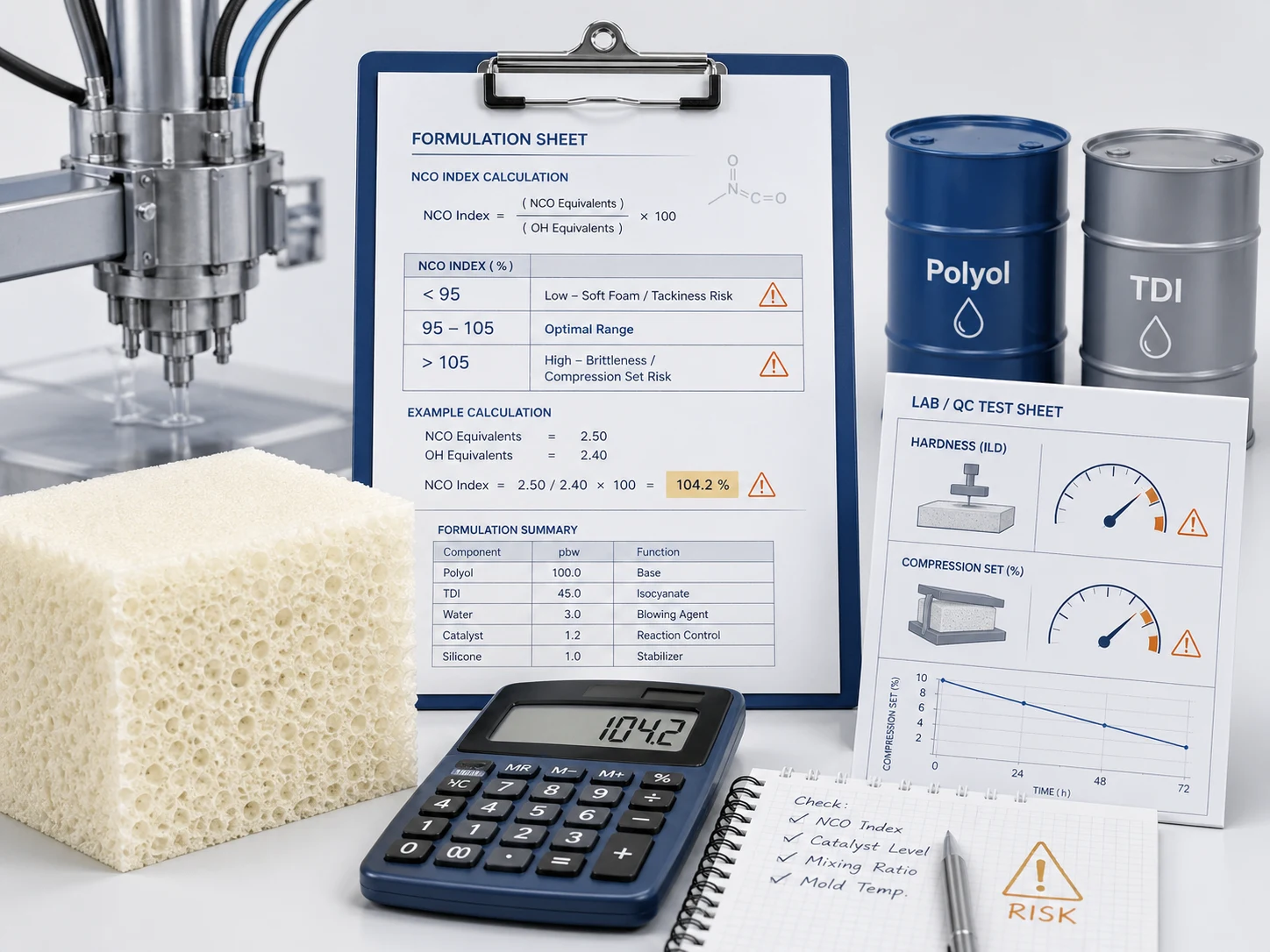

  • 5 Isocyanate Index Calculation Mistakes That Cause PU Foam Quality Problems

    5 Isocyanate Index Calculation Mistakes That Cause PU Foam Quality Problems


    Introduction

    In polyurethane foam production, the isocyanate index is one of the most important control numbers in the formulation. It affects hardness, compression set, resilience, aging behaviour, cell structure, and batch-to-batch consistency.

    The problem is that index errors are often silent.

    The foam may still rise normally. The block may look acceptable. The density may stay within range. Operators may not see anything unusual at the machine. But when the foam reaches testing, the properties can be outside specification.

    A small calculation mistake can create months of production problems.

    The team may adjust catalyst. They may change silicone. They may question the polyol supplier. They may check temperature, mixing pressure, and humidity. But the real problem may be sitting inside the formula sheet — the index calculation itself.

    This article explains five isocyanate index calculation mistakes that commonly cause PU foam quality problems in production, and how to avoid each one.

    Mistake 1: Using TDS %NCO Instead of Certificate of Analysis

    The first mistake is using the %NCO value from the Technical Data Sheet instead of the Certificate of Analysis.

    The Technical Data Sheet usually gives a specification range. For example, a TDI grade may show a typical %NCO range. Many formulators take the middle of that range and use it in every calculation.

    That is not the best production practice.

    The Certificate of Analysis (CoA) tells you the actual %NCO value of the specific batch or drum being used in production. If the calculation is based on a general TDS value instead of the real CoA value, the formula may not be running at the index written on the sheet.

    The difference may look small. But in continuous production, small errors repeated over many drums can create unexplained batch-to-batch variation.

    Source%NCO Used in CalculationRisk
    TDS range midpointApproximate valueMay not match actual drum
    Certificate of AnalysisActual batch valueBetter production accuracy

    The fix is simple:

    • Check the Certificate of Analysis for every batch.
    • Enter the actual %NCO value into the calculation.
    • Update the calculation when the isocyanate batch changes.
    • Do not rely only on the TDS midpoint for production control.

    The formula for isocyanate equivalent weight is:

    Isocyanate Equivalent Weight = 4,200 ÷ %NCO

    So if the %NCO changes, the equivalent weight changes. If the equivalent weight changes, the isocyanate parts required for the target index also change.

    This is why %NCO should be treated as a live production value, not a fixed number copied permanently into the formula sheet.

    Technical infographic comparing TDS %NCO and Certificate of Analysis %NCO for isocyanate index calculation Caption: The TDS gives a specification range, but the CoA gives the actual %NCO value for the batch used in production.
    The TDS gives a specification range, but the CoA gives the actual %NCO value for the batch used in production.

    Mistake 2: Using Water Equivalent Weight as 18 Instead of 9

    This is one of the most common and dangerous calculation mistakes in PU foam formulation.

    Water has a molecular weight of 18 g/mol. Because of that, some people mistakenly use 18 as the equivalent weight of water.

    That is wrong for isocyanate index calculation.

    In polyurethane foam chemistry, water has two reactive hydrogens. One water molecule consumes two NCO groups during the blowing reaction sequence. Therefore, the equivalent weight of water is:

    Water Equivalent Weight = 18 ÷ 2 = 9 g/eq

    So the correct value is Water EW = 9, not 18.

    This mistake creates a serious calculation error because water is usually one of the largest contributors to reactive hydrogen equivalents in flexible foam.

    Example:

    Water LevelEquivalent Weight UsedWater Equivalents
    3.5 PPHP9 (correct)0.3889
    3.5 PPHP18 (incorrect)0.1944

    Using 18 cuts the calculated water contribution in half.

    That means the formula sheet may show an index value that does not represent the real stoichiometric balance. If the isocyanate amount is calculated from the wrong water equivalent weight, the foam can run at the wrong actual index even though the calculation looks neat on paper.

    The result can appear as:

    • Unexpected hardness shift
    • Compression set problems
    • Poor recovery
    • Aging instability
    • Inconsistent foam feel
    • Confusing production troubleshooting

    The most important rule is simple:

    Never use 18 as the water equivalent weight in PU foam index calculation. Use 9.

    Infographic explaining why water equivalent weight is 9 instead of 18 in PU foam index calculation
    Water has two reactive hydrogens, so one water molecule consumes two NCO groups. Its equivalent weight is 9, not 18.

    Mistake 3: Not Recalculating After Formula Adjustments

    This mistake happens in almost every foam plant.

    A batch runs slightly hard or slightly soft. Someone adjusts water, catalyst, crosslinker, or another component at the machine. The adjustment helps the production run, so the new value is added to the formula sheet.

    But the isocyanate index is not recalculated.

    The old TDI or MDI value stays in the formula. This is how formula drift begins.

    For example, assume a formula was originally calculated at:

    • Water = 3.5 PPHP
    • TDI = 45.64 PPHP
    • Target Index = 105

    Later, water is increased from 3.5 to 3.7 PPHP, but the TDI quantity is not updated.

    That extra water increases the reactive hydrogen demand. If the isocyanate is not recalculated, the actual index drops. In the original calculation example, this type of water change can move the actual index from approximately 105 down to around 100.5 if TDI remains unchanged.

    That is a major change.

    The problem is not always visible immediately. The foam may still rise normally, but the final properties can shift.

    Possible symptoms include:

    • Softer foam than expected
    • Lower crosslink density
    • Compression set deterioration
    • Batch-to-batch property drift
    • Formula sheet no longer matching production reality

    This is why a formulation sheet must be treated as a live technical document.

    Any change to a reactive component should trigger a full index recalculation before the next production run. Reactive components include:

    • Water
    • Polyol
    • Crosslinker
    • Chain extender
    • Amine-functional additive
    • Isocyanate %NCO value

    A formula sheet that has been adjusted several times without recalculating the index is no longer a reliable formulation document. It becomes a historical record of changes.

    PU foam formula adjustment showing index drift when water changes without recalculating TDI
    Every reactive formulation adjustment should trigger a fresh isocyanate index calculation.

    Mistake 4: Excluding Crosslinkers from the Denominator

    Crosslinkers are often described as hardness additives, processing aids, or feel modifiers.

    That language can create a problem.

    A crosslinker is not a passive additive. If it carries active hydrogen groups, it reacts with isocyanate and must be included in the index calculation.

    DEOA (diethanolamine) is a common example. Even at low parts per hundred polyol, it can meaningfully affect the reactive hydrogen total. If the crosslinker is excluded from the denominator, the calculated index will not match the real chemical balance.

    Approximate index error when DEOA is excluded:

    DEOA Level (PPHP)Approximate Index Error if Excluded
    0.5~2.4 index points
    1.0~4.5 index points
    1.5~6.5 index points

    A 2-point error may already be important in a tight specification. A 5- or 6-point error can move a foam grade into a completely different property zone.

    If a formula is targeting Index 105 but excludes a meaningful amount of crosslinker from the calculation, the production line may be running at a much lower actual index than the formulator believes.

    This can cause:

    • Softer foam
    • Poor compression set
    • Lower recovery
    • Moisture-sensitive aging
    • Reduced dimensional stability
    • Customer complaints on foam performance

    The rule is simple: every active hydrogen source belongs in the denominator.

    That includes:

    • Main polyol
    • Water
    • Crosslinker
    • Chain extender
    • Reactive amine additives
    • Any other active hydrogen component

    If it reacts with NCO, it belongs in the calculation.

    Infographic showing index calculation error when DEOA crosslinker is excluded from reactive hydrogen total
    Crosslinkers are reactive components. Excluding them from the denominator changes the real index

    Mistake 5: Running the Same Index Target Across Different Machines

    The fifth mistake is less obvious, but it is very important in real production.

    A formula may be developed on one machine, approved on that machine, and then copied to another production line. The assumption is: same formula = same foam.

    But in production, that is not always true.

    The chemistry may be the same, but the machine delivery may not be the same. Different machines can have different:

    • Metering pump accuracy
    • Isocyanate delivery rate
    • Polyol delivery rate
    • Mixing pressure
    • Head temperature
    • Throughput rate
    • Calibration condition
    • Maintenance history

    If one metering pump delivers slightly more isocyanate than expected, the real index increases. If another pump delivers slightly less polyol than expected, the index also changes.

    A formula that runs correctly on Line 1 may run several index points higher or lower on Line 2.

    Production LineFormula Sheet TargetReal Production Condition
    Line 1Index 105Pumps calibrated correctly
    Line 2Index 105Isocyanate pump delivering high
    ResultSame formulaDifferent actual foam properties

    This is why production teams should not rely only on the formula sheet. They should verify actual pump delivery against the calculated requirement.

    The fix is a metering audit.

    A proper metering audit checks whether the machine is delivering the actual parts required by the formula. If the machine is not delivering correctly, the team must either correct the pump calibration or create a line-specific adjustment.

    Different machines in the same plant may need different settings to deliver the same actual index. That is not a formulation failure — that is production control.

    Infographic showing same PU foam formula producing different actual index on different production machines
    The same formula can produce different foam properties if machine metering accuracy is different.

    How These Mistakes Show Up in Foam Quality

    Isocyanate index mistakes do not always appear as obvious production failures. The foam may rise, cure, and cut normally. The problem usually appears later in physical properties.

    Common symptoms include:

    • Hardness above target
    • Hardness below target
    • ILD variation between batches
    • Compression set failure
    • Poor recovery
    • Brittleness
    • Aging instability
    • Moisture sensitivity
    • Customer complaints about feel
    • Different results on different machines

    This is why index verification should be one of the first troubleshooting steps when foam properties are wrong but the process looks normal.

    Do not begin by changing every catalyst or calling every raw material supplier. First, check the calculation.

    Production Checklist for Avoiding Index Calculation Errors

    Use this checklist before approving or changing any PU foam formula:

    CheckpointQuestion
    %NCO valueAre you using the actual CoA value?
    Water EWIs water equivalent weight entered as 9?
    CrosslinkersAre all crosslinkers included?
    Chain extendersAre all chain extenders included?
    Formula changesWas the index recalculated after every reactive change?
    Machine deliveryHas actual pump output been verified?
    Line transferWas the formula validated on this specific machine?

    This checklist is simple, but it prevents many production problems. A good index calculation is not only a laboratory exercise — it is a production discipline.

    Checklist for avoiding isocyanate index calculation mistakes in PU foam production
    A simple index calculation checklist can prevent repeated foam quality problems.

    Use the PolymerIQ Isocyanate Index Calculator

    Manual calculation is important because engineers should understand the chemistry behind the formula. But in production, speed and consistency matter.

    The PolymerIQ Isocyanate Index Calculator can help production teams verify:

    • Polyol equivalent weight
    • Water contribution
    • Isocyanate equivalent weight
    • Crosslinker contribution
    • Required TDI or MDI parts
    • Actual running index
    • Effect of formulation changes

    Use it when creating a new formula, adjusting water level, changing crosslinker, switching isocyanate batch, or transferring a formula from one machine to another.

    Open the Isocyanate Index Calculator →

    For the full calculation method, worked example, and equivalent weight formulas, read our companion guide: Isocyanate Index Calculation Guide for PU Foam Engineers.

    FAQs

    What are the most common isocyanate index calculation mistakes?

    The five most common mistakes are: using TDS %NCO instead of the Certificate of Analysis, using water equivalent weight as 18 instead of 9, not recalculating after formula adjustments, excluding crosslinkers from the denominator, and running the same index target across different machines without verifying pump delivery.

    Why should I use %NCO from the Certificate of Analysis instead of the TDS?

    The TDS gives a specification range, while the CoA gives the actual %NCO value of the specific batch or drum in use. Using the TDS midpoint can introduce error when the actual batch %NCO sits at the edge of the range. Since isocyanate equivalent weight = 4,200 ÷ %NCO, even a small %NCO difference changes the required isocyanate parts.

    Why is water equivalent weight 9 and not 18?

    Water has a molecular weight of 18, but each water molecule has two reactive hydrogens and consumes two NCO groups during the blowing reaction. So the equivalent weight is 18 ÷ 2 = 9 g/eq. Using 18 cuts the water contribution in half and can shift the real running index by many points.

    Do I need to recalculate the isocyanate index after every formula change?

    Yes, every time a reactive component changes — water, polyol, crosslinker, chain extender, or isocyanate %NCO. If the isocyanate parts are not updated, the actual running index will drift away from the formula sheet target.

    Should crosslinkers like DEOA be included in the index calculation?

    Yes. Crosslinkers carry active hydrogen groups and react with isocyanate. Excluding them from the denominator can cause errors of 2 to 6 index points or more, depending on the level used. Every active hydrogen source belongs in the calculation.

    Can the same formula give different foam properties on different machines?

    Yes. Even with the same formula, different machines can deliver different actual ratios because of pump calibration, mixing pressure, throughput, and maintenance condition. A formula that runs at Index 105 on one line may run several points higher or lower on another. A metering audit is needed to verify actual delivery.

    What is the first thing I should check if foam properties are off-spec but the process looks normal?

    Check the isocyanate index calculation. Verify that the %NCO value is from the CoA, water EW is 9, all reactive components are included, and the formula has been recalculated after recent adjustments. This should be done before changing catalysts, silicones, or raw material suppliers.

    How do I troubleshoot unexplained foam hardness variation?

    Start with the formula sheet. Confirm the index is correctly calculated using current CoA values. Then verify pump delivery on the production line. If both are correct, move on to catalyst, silicone, polyol, and process variables. Index errors are silent and easy to miss, so they should be ruled out first.

    What is a metering audit?

    A metering audit is a verification of actual pump delivery against the formula requirement. It checks whether the machine is delivering the parts of polyol, isocyanate, water, and additives that the calculation specifies. Without this check, formula sheet values may not reflect what is actually entering the mixing head.

    Key Takeaways

    Isocyanate index calculation mistakes can create serious PU foam quality problems even when production appears normal.

    The five most important mistakes are:

    1. Using TDS %NCO instead of the Certificate of Analysis.
    2. Using water equivalent weight as 18 instead of 9.
    3. Not recalculating after formula adjustments.
    4. Excluding crosslinkers from the denominator.
    5. Running the same index target across different machines.

    The main lesson is simple: the isocyanate index is not a fixed number. It is a live control parameter.

    Every reactive component must be included. Every formulation change must be recalculated. Every isocyanate batch must use its actual %NCO value. Every machine must be verified for real delivery.

    When unexplained foam hardness, compression set, or batch variation appears, the index calculation should be checked before making random process changes.

    A small calculation error can quietly create a large production cost.

    Conclusion

    If your foam plant has unexplained hardness variation, compression set failure, or different results between production lines, the formula sheet may not reflect the real running index.

    PolymersIQ can help review your formulation, check the index calculation, and identify whether stoichiometric imbalance or metering variation is causing the issue.

    To get accurate support, please share:

    • Polyol grade and OH value
    • Water level and any other reactive components
    • Isocyanate type and %NCO from the Certificate of Analysis
    • Target index and observed foam properties (ILD, compression set, density)
    • Any recent formula adjustments or machine changes
    • Description of the quality issue you are facing

    Contact PolymerIQ for a formulation audit →