
Introduction
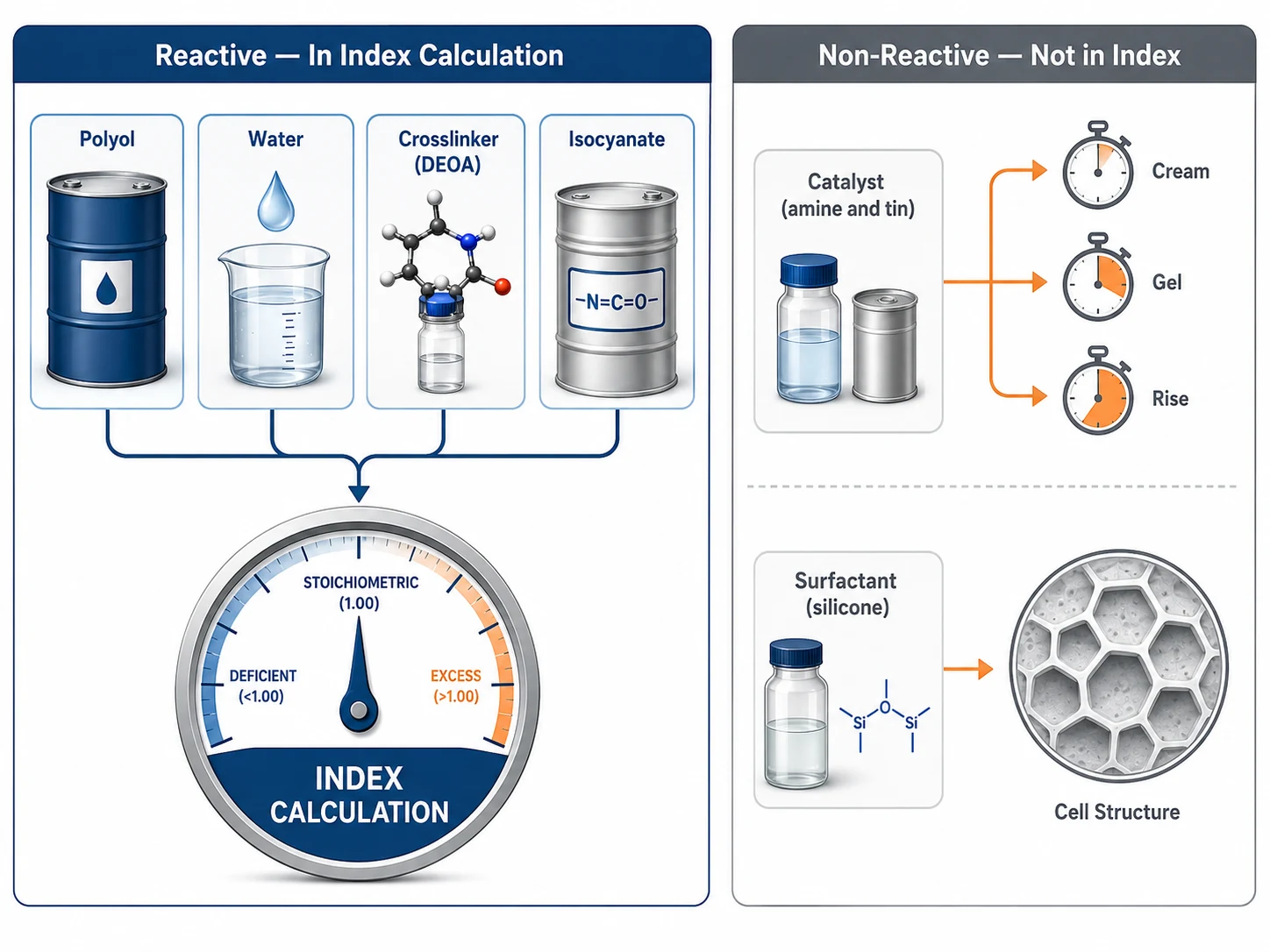
Reactive components in polyurethane foam are the raw materials that chemically enter the isocyanate index calculation. A polyurethane foam formula contains six raw-material families, but not all of them belong in the same calculation.
This is one of the most important distinctions in PU foam formulation: some raw materials enter the isocyanate index calculation, and some do not.
The reactive components — polyol, water, crosslinker, and isocyanate — contribute reactive equivalents to the stoichiometric balance of the foam. Their parts, equivalent weights, and equivalents must be tracked carefully because every change to one of them can shift the index.
The non-reactive components — catalyst and surfactant — control reaction timing and cell structure. They are essential for foam quality, but they do not contribute reactive equivalents. They cannot fix a wrong index, a wrong water level, or a wrong %NCO.
When this distinction is not understood, troubleshooting often goes in the wrong direction. A formulator may try to fix a hardness problem by adjusting catalyst, when the actual cause is index drift. A production team may increase surfactant when the real problem is a missing crosslinker correction. Catalyst and surfactant get blamed for problems they cannot solve.
This article explains how each of the four key non-foundation components — water, catalyst, surfactant, and crosslinker — fits into the formulation calculation, and why the reactive vs non-reactive line is the most important distinction in PU foam stoichiometry.
The Reactive vs Non-Reactive Line
The line between reactive and non-reactive components is set by chemistry. A material is reactive in PU foam stoichiometry if it contributes hydroxyl groups, amine hydrogens, water hydrogens, or NCO groups that participate in the polyurethane reaction.
| Component | Enters Index Calculation? | Why |
|---|---|---|
| Polyol | Yes | Contains reactive OH groups |
| Isocyanate | Yes | Contains reactive NCO groups |
| Water | Yes | Reacts with NCO and contributes reactive hydrogen equivalents |
| Crosslinker | Yes | Contains reactive OH or amine groups |
| Catalyst | Normally no | Controls reaction speed, not stoichiometric equivalents |
| Surfactant | Normally no | Controls cell structure, not index |
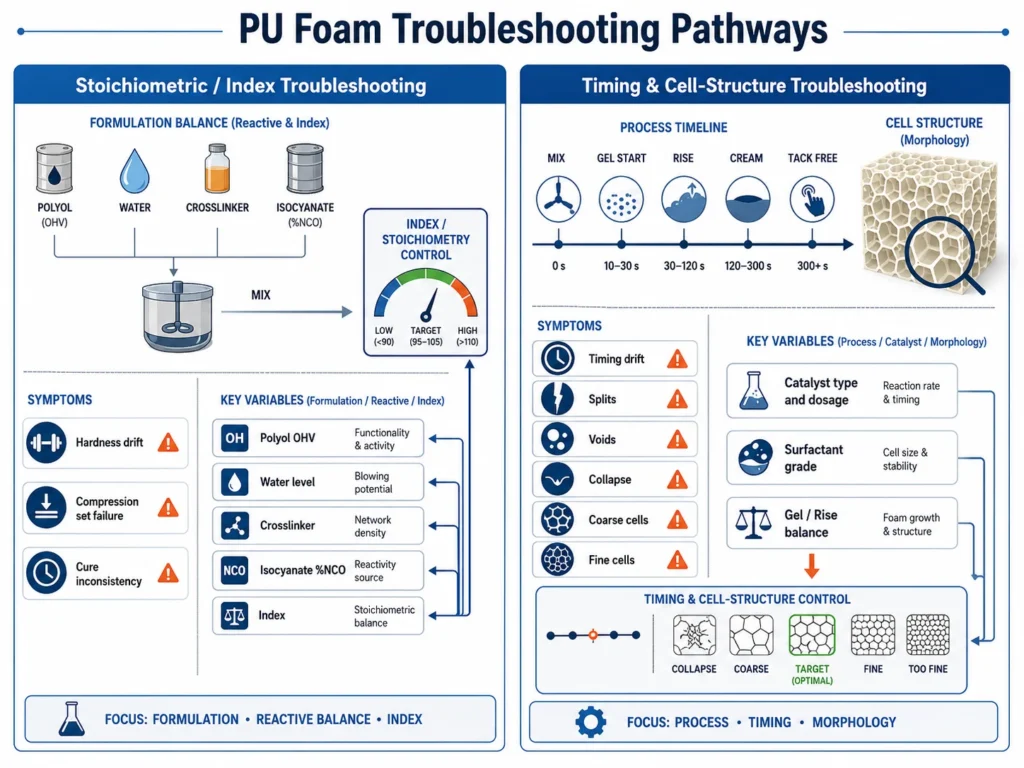
This table is the single most useful tool for separating two different types of foam troubleshooting:
- Stoichiometric / index troubleshooting — review polyol, water, crosslinker, and isocyanate. Recalculate equivalents. Verify the index.
- Timing and cell-structure troubleshooting — review catalyst balance and surfactant package. Adjust gel/rise timing. Tune cell size and cell opening.
These are different problems with different solutions. Mixing them — for example, adjusting catalyst to fix a stoichiometric error — does not work.
Water: A Reactive Component, Not Just a Blowing Agent
Water is one of the smallest ingredients by weight in many flexible foam formulas. But chemically, it is one of the most powerful.
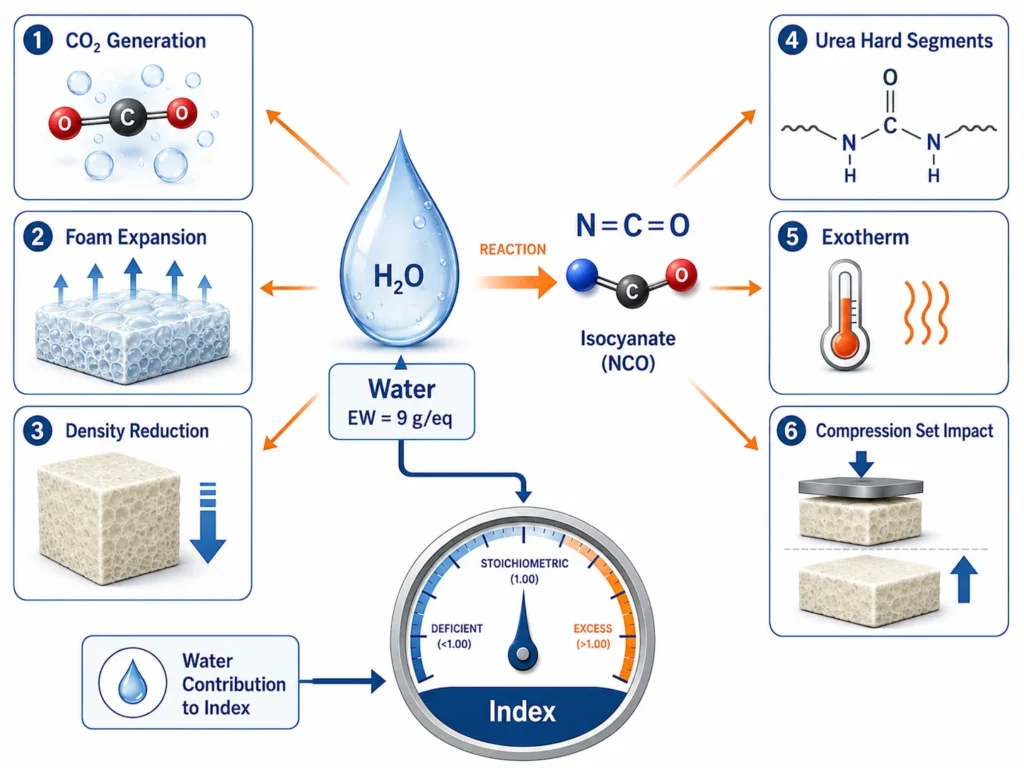
Water is the main chemical blowing agent in many flexible polyurethane foam systems. It reacts with isocyanate to generate CO₂ gas. That CO₂ expands the foam and creates the cellular structure.
But water does more than reduce density. Water affects four major properties at the same time:
- Density
- Hardness
- Exotherm
- Compression set behavior
The reason is that water has two linked roles. First, it reacts with NCO to generate CO₂. Second, the reaction forms amine, which reacts with more NCO to create urea linkages. Those urea linkages act as hard segments in the foam structure.
That is why changing water level is not just a density adjustment. It changes the chemistry.
Water has a very low equivalent weight:
Water EW = 9 g/eq
That means a small amount of water can contribute a large share of reactive hydrogen equivalents in a flexible foam formula. In one common flexible foam example, water may be only a few percent by weight but contribute the majority of reactive hydrogen equivalents.
This is why every water change must be recalculated.
| Water Increase Usually Causes | Why |
|---|---|
| Lower density | More CO₂ generation |
| Higher urea content | More water-NCO reaction |
| Higher exotherm | More reactive heat generation |
| Higher NCO demand | More reactive hydrogen equivalents |
| Possible scorch risk at high levels | Higher internal heat in large blocks |
| Compression set change | Urea network and balance shift |
Water is not only a blowing agent. It is a reactive component, and it must enter the index calculation alongside polyol and crosslinker.
Catalyst: The Timing Controller, Not an Index Component
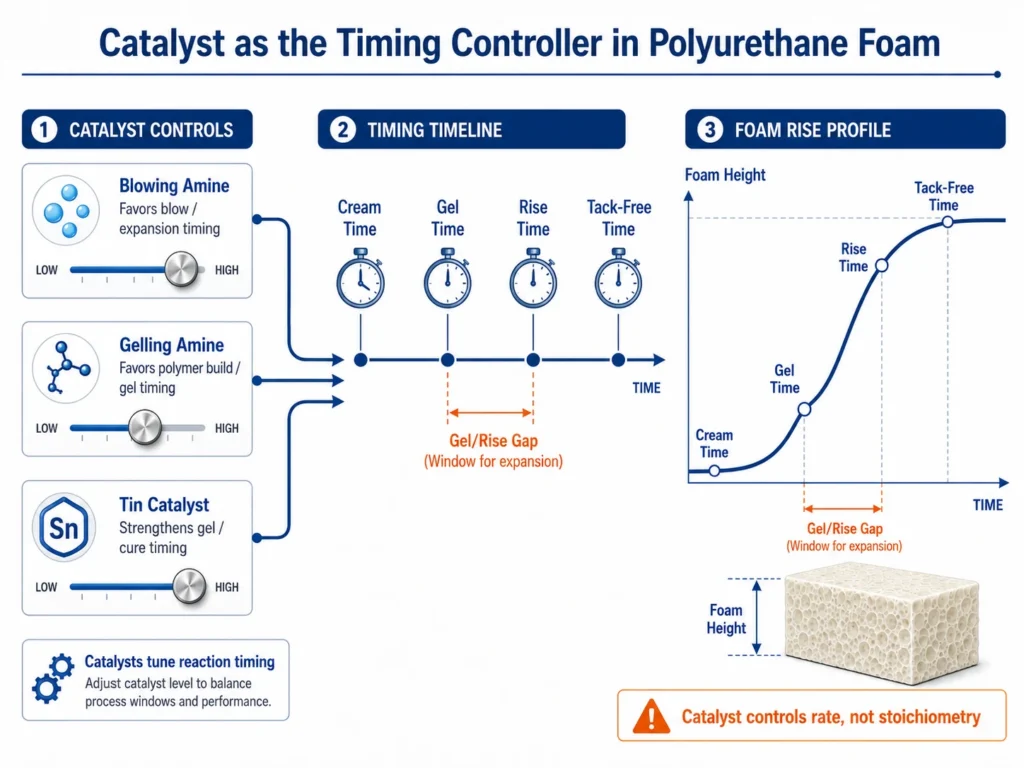
Catalyst controls reaction timing. It does not change the stoichiometric ratio of the formula.
This distinction is critical. A catalyst changes how fast reactions happen. It does not correct wrong equivalent weight, wrong water level, wrong %NCO, or wrong index.
In polyurethane foam, catalyst balance controls cream time, gel time, rise time, tack-free time, gelling reaction speed, blowing reaction speed, surface cure, foam stability, and processing window.
There are two major catalyst categories in flexible foam:
Amine catalysts
Amine catalysts can accelerate the blowing reaction, the gelling reaction, or both, depending on the grade.
- Blowing amines push the water-isocyanate reaction and move cream and rise behavior.
- Gelling amines support urethane formation and viscosity build.
Tin catalysts
Tin catalysts mainly accelerate the gelling reaction. They help move gel time earlier and build network strength faster. This gives formulators another way to adjust the gel/rise balance.
Catalyst does not enter the index calculation in normal PU foam formulation. It is still extremely important:
- If gelling runs too slowly, the foam may rise before the network can hold it.
- If gelling runs too fast, the foam may lock before full expansion.
- If blowing runs too fast, collapse risk increases.
- If blowing runs too slowly, the foam may under-rise or become tight.
The best catalyst adjustment starts with timing data. Do not adjust catalyst before checking index, water level, equivalent weight, raw material temperature, and gel/rise balance.
Surfactant: The Cell Structure Architect, Not an Index Component
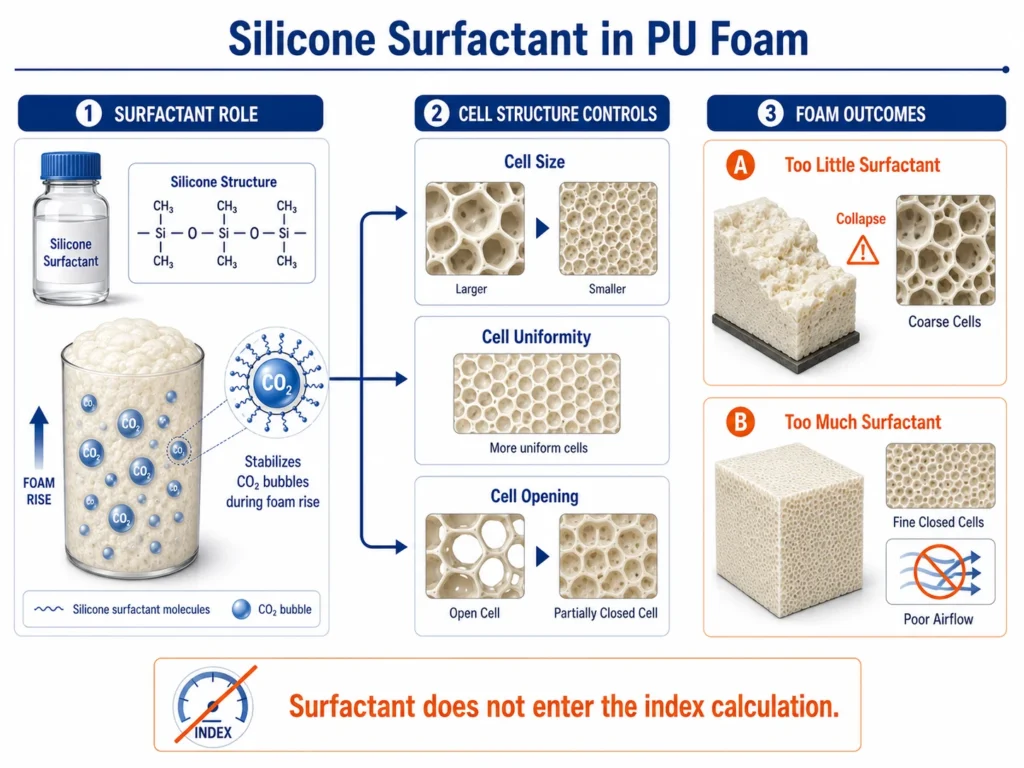
Surfactant controls foam cell structure. In polyurethane foam, the surfactant is usually a silicone-based additive. It stabilizes bubbles while the foam rises.
Without surfactant, CO₂ bubbles can merge, rupture, or escape before the polymer network has enough strength to hold the foam. That can lead to collapse, coarse cells, holes, or irregular structure.
Surfactant controls three key cell variables: cell size, cell uniformity, and cell opening.
Too little surfactant can cause:
- Collapse
- Coarse cells
- Voids
- Poor rise stability
- Irregular cell structure
- Weak surface quality
Too much surfactant can cause:
- Very fine cells
- Closed cells
- Poor airflow
- Higher apparent tightness
- Dense or poorly ventilated foam
- Comfort performance problems
Surfactant grade selection matters. A slabstock surfactant is not automatically suitable for molded foam. A rigid foam surfactant is not automatically suitable for flexible foam. A spray foam surfactant is chosen for a different processing and cell-stability requirement.
Surfactant normally does not enter the index calculation. It changes cell structure, foam stability, and surface behavior. That makes it different from reactive components such as polyol, water, crosslinker, and isocyanate.
Surfactant is invisible when it works. It is obvious when it fails.
Crosslinker: A Reactive Component That Must Be Counted
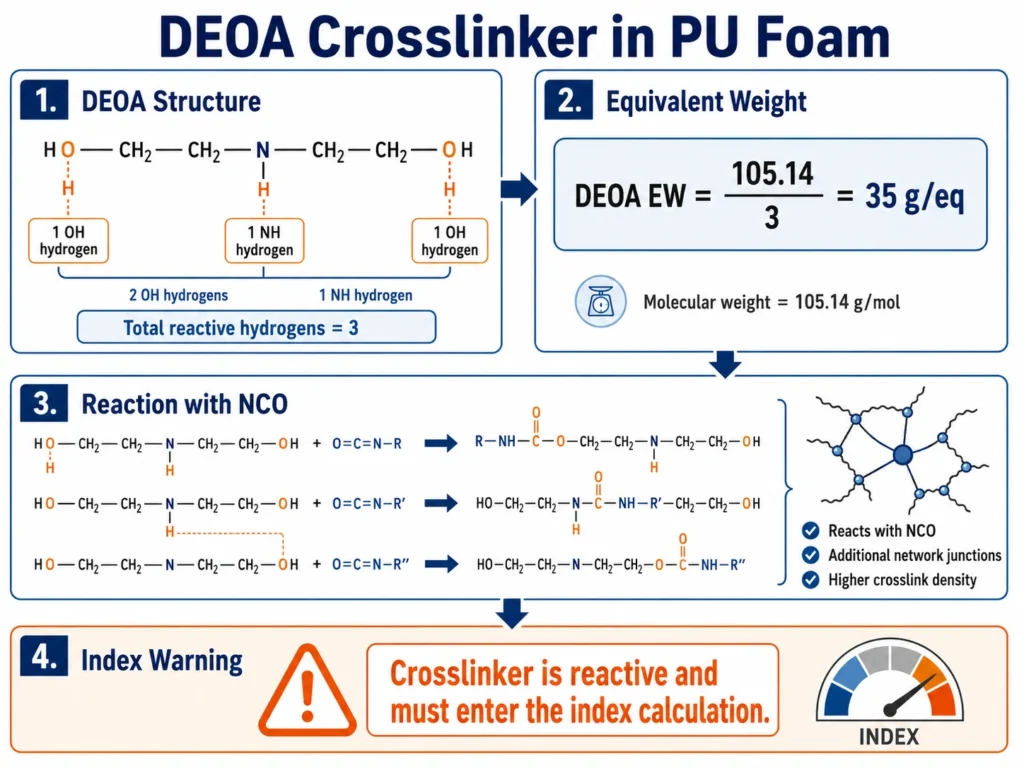
A crosslinker is a small reactive molecule that adds network junctions. It usually contains multiple hydroxyl or amine groups. Because it has reactive groups, it must be included in equivalent and index calculations.
Crosslinker can improve:
- Hardness
- ILD
- Compression set
- Load-bearing
- Network strength
- Cure response
- Dimensional stability
The most common flexible foam crosslinker is DEOA (diethanolamine). DEOA has three reactive groups (two OH and one NH). Its equivalent weight is commonly calculated as:
DEOA EW = 105.14 ÷ 3 = 35.0 g/eq
This matters because using the wrong EW creates an index error. If a formulator counts only the two OH groups and uses EW = 52.6 instead of 35.0, the index calculation under-counts DEOA’s contribution and the actual running index drifts.
Crosslinker is powerful because small additions can change network architecture. Typical flexible foam dosage may be low, but the effect can be meaningful because the equivalent weight is low.
However, crosslinker has a limit. Too little crosslinker may not give enough network support. Too much crosslinker can make the network too tight.
Over-crosslinking can cause:
- Tight cells
- Reduced elasticity
- Harsh feel
- Poor recovery
- Higher compression set in some systems
- Processing sensitivity
- Cell structure problems
A crosslinker is not just an additive. It is a reactive component. Every crosslinker addition should be recalculated in the formula.
How These Components Connect to the Index Calculation
The isocyanate index is calculated from reactive equivalents only.
Index = NCO equivalents ÷ Total reactive H equivalents × 100
Where total reactive H equivalents is the sum of:
- Polyol equivalents (parts ÷ polyol EW)
- Water equivalents (parts ÷ 9)
- Crosslinker equivalents (parts ÷ crosslinker EW)
- Any other reactive hydrogen contributors (chain extenders, amine modifiers, reactive flame retardants if present)
Catalyst and surfactant do not appear anywhere in this calculation.
That means:
- Adding more catalyst does not change the index — only the timing.
- Adding more surfactant does not change the index — only the cell structure.
- But adding more water, more crosslinker, more polyol, or changing the isocyanate level always changes the index.
A common mistake is treating catalyst dosage as a control variable for cure or hardness. Cure is partly a timing issue (which catalyst affects) but also an index issue (which catalyst does not affect). Hardness is partly a network density issue (which involves polyol functionality, water, and crosslinker — all reactive) and partly a cell-structure issue (which surfactant affects). Mixing the two leads to long, frustrating troubleshooting cycles.
Two Different Troubleshooting Pathways
Once the reactive vs non-reactive line is clear, foam quality problems can be sorted into two pathways:
Pathway 1: Stoichiometric / Index Troubleshooting
Symptoms include hardness drift, compression set failure, cure inconsistency, density-vs-hardness mismatch, and unexpected foam behavior after a raw material change.
Variables to check:
- Polyol OHV (current, not historical)
- Polyol functionality
- Water level (and whether it has drifted)
- Crosslinker dosage and EW
- Isocyanate %NCO (from CoA, not TDS)
- Calculated index vs target index
- Equivalent weight values for every reactive component
Pathway 2: Timing and Cell-Structure Troubleshooting
Symptoms include cream/gel/rise timing drift, surface defects, splits, voids, collapse, coarse cells, fine cells, poor airflow, or rise instability.
Variables to check:
- Amine catalyst type and dosage
- Tin catalyst dosage and balance with amine
- Gel/rise balance
- Silicone surfactant grade and dosage
- Mix temperature and raw material temperature
- Mixing efficiency
These pathways are different because they correspond to different chemistry. Use the right one based on the symptom. Catalyst and surfactant changes will not solve a stoichiometric problem. Index recalculation will not solve a cell-collapse problem.
Practical Component Reference
This table consolidates the role of each non-foundation component for quick reference during formulation review.
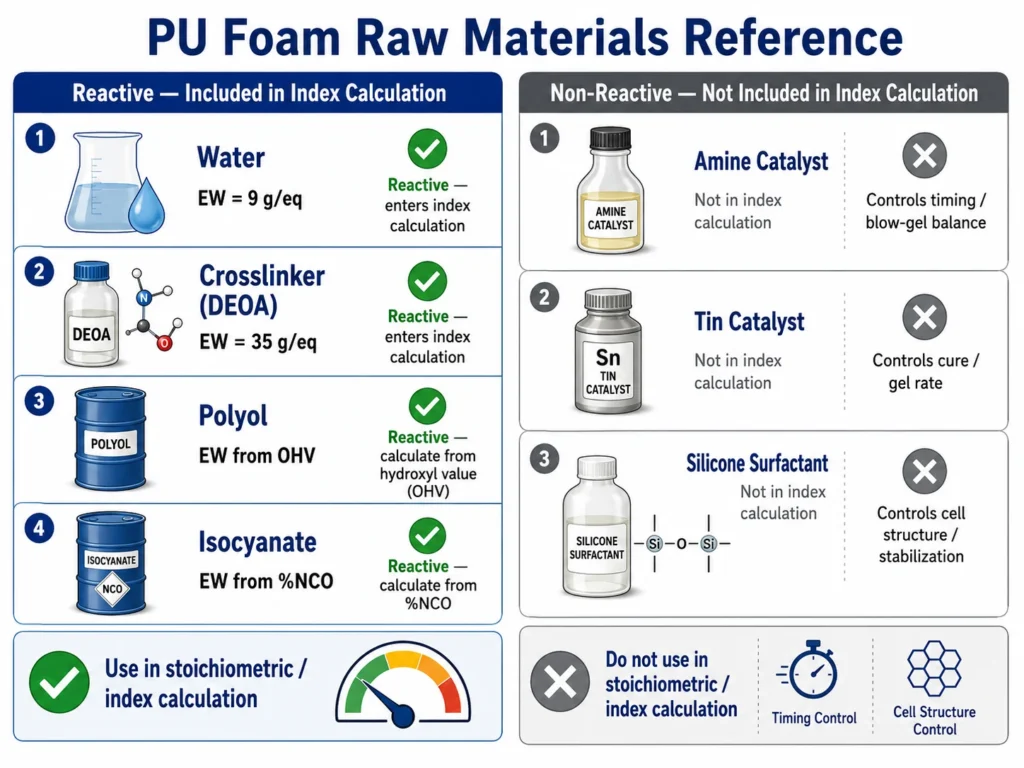
| Component | Type | EW | Index Role | Main Property Controlled |
|---|---|---|---|---|
| Water | Reactive | 9 g/eq | Yes — enters index | Density, urea, hardness, exotherm |
| Crosslinker (DEOA) | Reactive | 35.0 g/eq | Yes — enters index | Network junctions, hardness, compression set |
| Amine catalyst | Non-reactive | — | No | Cream/gel/rise timing, blowing-gelling balance |
| Tin catalyst | Non-reactive | — | No | Gel time, network strength build |
| Silicone surfactant | Non-reactive | — | No | Cell size, cell uniformity, cell opening |
The four reactive components (polyol, water, crosslinker, isocyanate) together define the chemistry. The two non-reactive components (catalyst, surfactant) together define the process and structure. Both are essential. Neither group can substitute for the other.
Use the PolymersIQ Calculators
Equivalent weight values are the foundation of correct index calculation. The PolymersIQ Equivalent Weight Calculator helps verify EW for water (9), DEOA (35.0), polyol (56,100 ÷ OHV), and isocyanate (4,200 ÷ %NCO). Use it when reviewing crosslinker dosage, updating water level, or verifying that the formula sheet uses correct EW values.
Open the Equivalent Weight Calculator →
The PolymerIQ NCO / TDI Index Calculator helps confirm the index calculation includes all reactive components. Use it when changing water level, adjusting crosslinker dosage, switching isocyanate grade, or auditing whether catalyst and surfactant adjustments have masked an index error.
Open the NCO / TDI Index Calculator →
Water level and foam density are tightly connected. Use the PolymersIQ Foam Density Estimator when changing water level, reviewing density targets, or checking density impact before a production trial.
Open the Foam Density Estimator →
For the foundation article on the six raw materials, read The Six Raw Materials Behind Every Polyurethane Foam.
For the troubleshooting article on raw material interactions, read Why Changing One PU Foam Raw Material Changes the Whole Formula.
For the deep guide on water, read The Dual Role of Water in Polyurethane Foam: Blowing Agent and Urea Network Builder.
For the article on water level effects, read How Water Level Affects PU Foam Density, Hardness, Exotherm, and Compression Set.
For the equivalent weight guide, read Equivalent Weight in Polyurethane Foam: Complete Calculation Guide.
For the formulation sheet guide, read How to Read a Polyurethane Formulation Sheet.
FAQs
Which PU foam raw materials enter the isocyanate index calculation?
Polyol, water, crosslinker, and isocyanate enter the index calculation because they contribute reactive equivalents — hydroxyl groups (polyol, crosslinker), water hydrogens, amine hydrogens (DEOA, amine modifiers), or NCO groups (isocyanate). Catalyst and surfactant normally do not enter the index calculation. They control reaction timing and cell structure but do not contribute reactive equivalents.
Why is water considered a reactive component and not just a blowing agent?
Water reacts directly with isocyanate (NCO + H₂O → CO₂ + amine), and the amine reacts again with NCO to form urea linkages. Both reactions consume NCO equivalents. Water has an equivalent weight of 9 g/eq — far lower than polyol — so even a few parts of water can contribute the majority of reactive hydrogen equivalents in a flexible foam formula. Every water-level change must be recalculated in the index.
Why doesn’t catalyst affect the isocyanate index?
Catalyst accelerates chemical reactions but does not contribute the OH, NH, or NCO groups that the index calculation tracks. Amine catalysts and tin catalysts change reaction speed and gel/rise balance, but they do not provide reactive equivalents. Catalyst is essential for foam quality and timing, but it cannot fix a wrong index, wrong water level, or wrong %NCO. The most common formulation mistake is increasing catalyst to compensate for a stoichiometric problem.
What is DEOA’s equivalent weight and why does it matter?
DEOA (diethanolamine) has a molecular weight of 105.14 g/mol and three reactive hydrogens — two OH groups and one NH group. Its equivalent weight is 105.14 ÷ 3 = 35.0 g/eq. Using the correct EW matters because if a formulator counts only the two OH groups, EW becomes 52.6 instead of 35.0, and the index calculation under-counts DEOA’s reactive contribution. The actual running index then drifts away from the target.
Can I fix a hardness problem by adjusting the catalyst package?
Hardness has both a chemistry component (network density, polyol functionality, water level, crosslinker) and a process component (cure timing, cell structure). Catalyst affects timing and cure, so it can change apparent hardness slightly. But if the underlying network is wrong — wrong index, low functionality, missing crosslinker contribution — catalyst tweaks treat the symptom while leaving the cause in place. Always check stoichiometry first.
How does surfactant affect foam cell structure if it doesn’t react?
Silicone surfactant works by reducing surface tension and stabilizing the polymer-air interface during foam rise. It is physically active but chemically inert in the polyurethane reaction. Too little surfactant and bubbles merge or rupture (collapse, voids, coarse cells). Too much surfactant and bubbles become very small and remain closed (fine cells, poor airflow). The surfactant grade must match the application — slabstock, molded, rigid, or spray foam each require different surfactants.
Should I include catalyst or surfactant when calculating the formula’s reactive equivalents?
No. The formal index calculation includes only reactive components — polyol, water, crosslinker, and isocyanate. Catalyst and surfactant should be listed in the formula sheet (with parts and weight percentage) but excluded from the equivalents and equivalent percentage columns. This separation makes the formula sheet self-verifying: if the calculated index from reactive components alone matches the target index, the stoichiometry is correct.
What’s the difference between stoichiometric troubleshooting and process troubleshooting?
Stoichiometric troubleshooting focuses on reactive components: polyol OHV, water level, crosslinker EW, isocyanate %NCO, and the index calculation. It addresses problems like hardness drift, compression set failure, cure inconsistency, and unexpected behavior after a raw material change. Process troubleshooting focuses on non-reactive components and machine variables: catalyst type and dosage, surfactant grade and dosage, gel/rise balance, mixing, and temperature. It addresses problems like timing drift, surface defects, splits, voids, and cell-structure issues. Different symptoms point to different pathways.
What happens if I increase water without adjusting isocyanate?
The actual running index drops. Water has EW = 9 g/eq, so each part of water added increases reactive hydrogen equivalents substantially. If the isocyanate level stays the same, NCO equivalents are now divided by a larger reactive H denominator — the index falls. The foam may run at a lower index than the formula sheet states, with possible consequences for hardness, cure, and compression set. Every water change requires an isocyanate adjustment to maintain the target index.
Why is this distinction so important for PU foam formulation?
Because most foam quality problems are misdiagnosed when this line is unclear. A formulator who does not separate reactive from non-reactive components may keep adjusting catalyst or surfactant for a stoichiometric problem, getting partial improvement but never solving it. Recognizing that polyol, water, crosslinker, and isocyanate are the four index components — and that catalyst and surfactant control different things — is the foundation of disciplined PU foam troubleshooting.
Key Takeaways
The isocyanate index calculation includes only reactive components:
- Polyol — provides OH groups
- Water — provides reactive hydrogen (EW = 9)
- Crosslinker (DEOA) — provides reactive OH and NH groups (EW = 35.0)
- Isocyanate — provides NCO groups
Catalyst and surfactant normally do not enter the index calculation. They control reaction timing and cell structure but do not contribute reactive equivalents.
This distinction creates two different troubleshooting pathways:
- Stoichiometric / index troubleshooting — review polyol, water, crosslinker, isocyanate, and the index calculation.
- Timing and cell-structure troubleshooting — review catalyst balance and surfactant package.
Mixing the two pathways — for example, adjusting catalyst to fix a stoichiometric error — wastes time and produces inconsistent results.
Crosslinker must always be included in the index calculation. Its low equivalent weight (35.0 g/eq for DEOA) means small dosage changes have meaningful index impact.
Water must always be included in the index calculation. Its very low equivalent weight (9 g/eq) means it dominates the reactive hydrogen side of the formula even at low parts.
A correct formulation sheet treats reactive and non-reactive components differently — both are essential, but neither can substitute for the other.
Conclusion
If your foam quality problem has resisted catalyst and surfactant adjustments, the cause may be in the reactive components — water level drift, missing crosslinker contribution, wrong polyol EW, or outdated isocyanate %NCO.
PolymesrIQ can help review which components are entering your index calculation correctly, verify equivalent weights, and identify whether catalyst or surfactant changes have masked a stoichiometric error.
To get accurate support, please share:
- Polyol grade, OHV, and supplier
- Isocyanate type and current CoA %NCO
- Water level (current and recent)
- Crosslinker type, dosage, and EW used in the formula
- Catalyst package and dosages
- Surfactant grade and level
- Target and observed foam properties
- Description of the issue and adjustments already tried
Contact PolymerIQ for a reactive component audit →