Tag: Formulation Sheet

  • What a PU Formulation Sheet Cannot Tell You

    What a PU Formulation Sheet Cannot Tell You


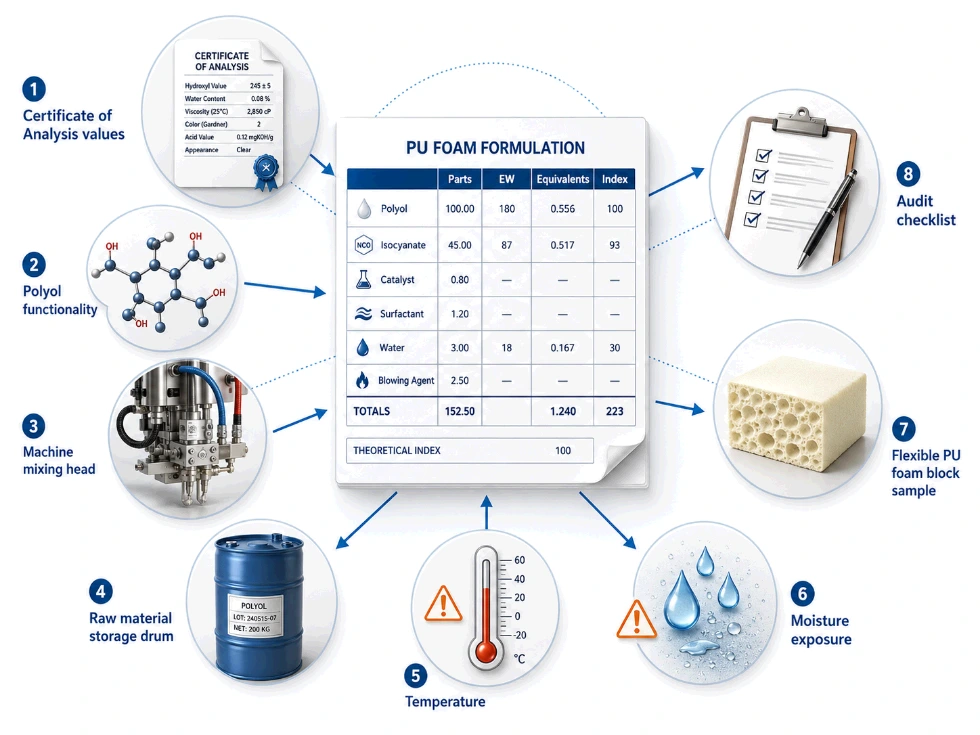
    Polyurethane formulation sheet audit showing missing CoA values, machine factors, and raw material condition

    Introduction

    A polyurethane formulation sheet can tell you a lot.

    It can show component names, parts by weight, equivalent weights, reactive equivalents, weight percentages, equivalent percentages, and the calculated isocyanate index. If the sheet is built correctly, it can prove whether the formula is stoichiometrically consistent.

    But a formulation sheet cannot tell you everything.

    That is where many foam plants get into trouble.

    A formula sheet shows what the formula intends. It does not always show what production is actually delivering today.

    Raw material batches change. Certificates of Analysis change. Isocyanate drums age. Polyol functionality may not be visible on the sheet. A formula developed on one machine may behave differently on another. A copied or inherited spreadsheet may contain assumptions that nobody remembers.

    The sheet may look complete. The foam may still be wrong.

    This article explains what a polyurethane formulation sheet cannot tell you, why legacy and inherited formulas become risky, and when a formulation sheet should be treated as a diagnostic document instead of a production document.

    A Formulation Sheet Shows the Formula Intention, Not the Full Production Reality

    A formulation sheet is a technical document. But it is not the whole production system.

    It shows the formula as designed or recorded. It does not automatically show whether the raw materials currently in use match the assumptions used when the formula was written.

    For example, a sheet may show:

    • Polyol EW = 1,100
    • TDI EW = 86.96
    • Water EW = 9
    • Target index = 105

    Those numbers may have been correct when the formula was created. But are they still correct today?

    That depends on current raw material data and production conditions.

    The current polyol batch may have a different OHV. The current TDI drum may have a different %NCO. A crosslinker may have been changed. The formula may have been transferred to another machine. The isocyanate drum may have been exposed to moisture.

    The sheet tells you what should happen. Production data tells you what is actually happening. A good audit compares both.
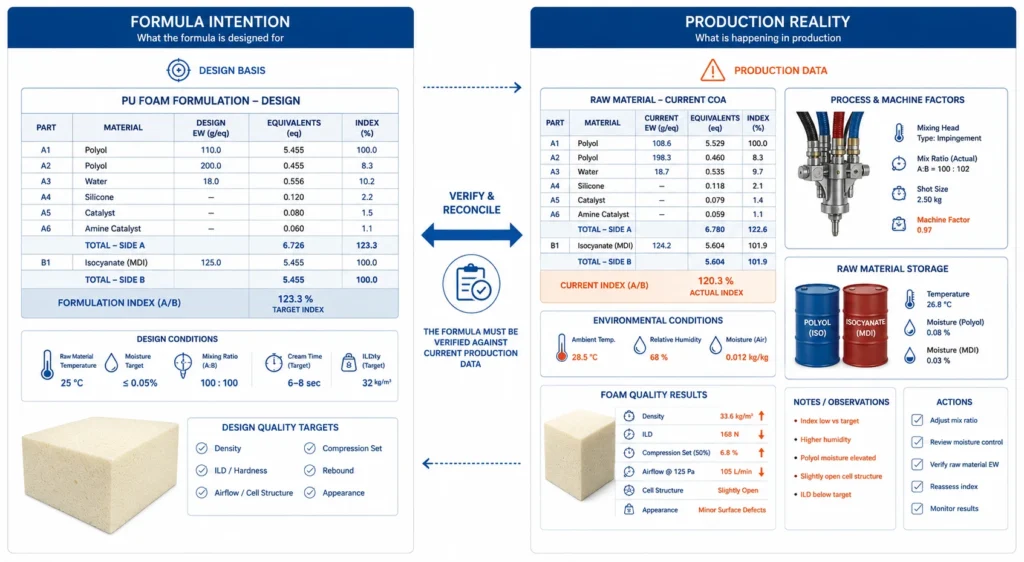
    PU foam formulation intention versus actual production reality comparison

    Missing Variable 1: Polyol Functionality

    A formulation sheet usually shows polyol OHV. It may not show polyol functionality. That is a major limitation.

    OHV and functionality are not the same:

    • OHV tells you how many reactive hydroxyl groups exist per gram of polyol. It is used to calculate equivalent weight and isocyanate demand.
    • Functionality tells you how many reactive hydroxyl groups exist per molecule. It controls network architecture, branching, crosslink density, creep resistance, and compression set behaviour.

    A sheet may show Polyol OHV = 51. From this, the equivalent weight can be calculated:

    EW = 56,100 ÷ 51 = 1,100

    But that does not tell you whether the polyol functionality is 2.4, 2.8, 3.0, or another value.

    Two polyols can have the same OHV and equivalent weight but build different foam networks. This matters when the issue is compression set, recovery, or long-term durability.

    A formulation sheet can prove the stoichiometry is correct and still miss the network architecture problem. That is why a formula audit should review functionality, not only OHV.

    [IMAGE 3 — POLYOL FUNCTIONALITY MISSING] Placement: After the section “Missing Variable 1: Polyol Functionality”, before “Missing Variable 2”. Filename: polyol-functionality-missing-from-formulation-sheet.jpg ALT text: Polyol functionality missing from polyurethane formulation sheet while OHV is shown Caption: A formulation sheet may show OHV and EW but still miss the polyol functionality that controls network architecture. ChatGPT image prompt: “Create a clean technical infographic showing that polyol OHV is visible on a formulation sheet but polyol functionality may be missing. Show a formula row with OHV 51 and EW 1100 highlighted, then show a hidden layer below labeled functionality and network architecture. Include two network diagrams: low functionality with weak branching and higher functionality with stronger branching. Professional industrial consultancy style, white background, blue and grey palette with subtle orange highlights. No logos. No brand names.”
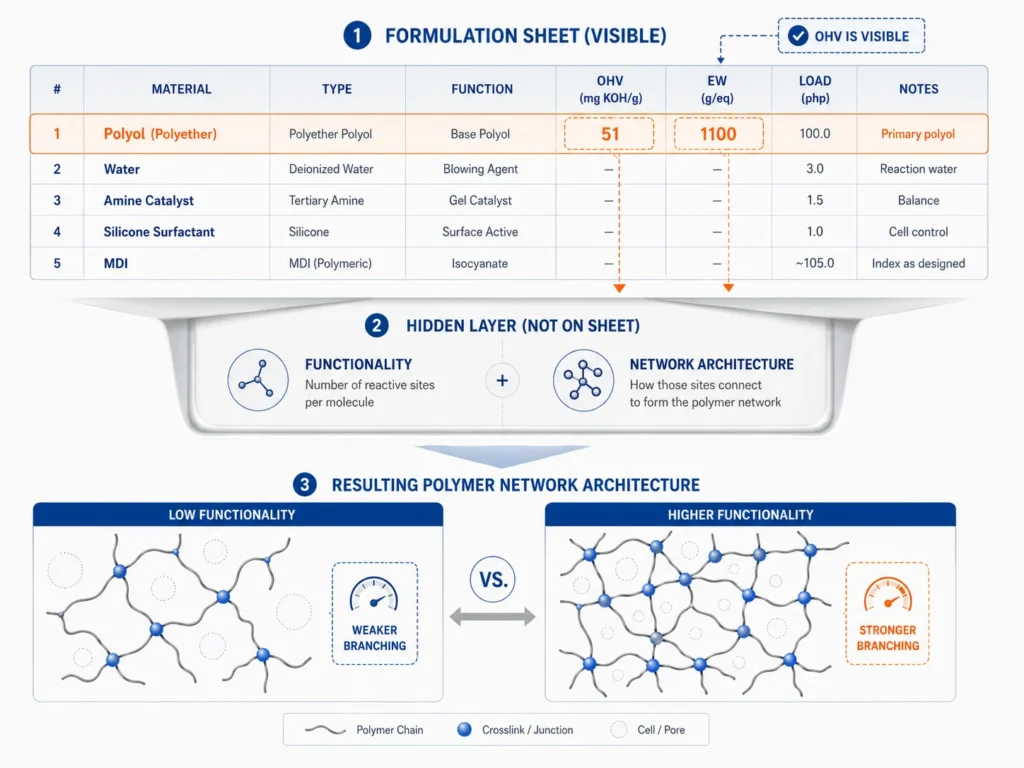
    Polyol functionality missing from polyurethane formulation sheet while OHV is shown

    Missing Variable 2: Current CoA Batch Values

    A formulation sheet often contains design equivalent weights. Those values may have been calculated from raw material data available at the time of formula development. But raw material values change.

    • Polyol OHV can vary batch to batch.
    • Isocyanate %NCO can vary drum to drum.

    If the formula sheet is not updated with current Certificate of Analysis values, the calculated equivalent weights may no longer match the materials actually used in production. This affects polyol equivalent weight, isocyanate equivalent weight, reactive equivalents, NCO equivalents, actual index, foam hardness, compression set, and batch consistency.

    For example:

    • Design polyol OHV: 51
    • Current CoA OHV: 47

    The sheet may still show EW = 1,100. But the current batch EW should be:

    56,100 ÷ 47 = 1,194

    That difference changes the formula calculation.

    The same problem happens with isocyanate. If the sheet assumes TDI %NCO = 48.3 but the drum CoA shows 46.8 or 49.8, the isocyanate EW changes.

    A formulation sheet without current CoA verification is only a historical calculation. It is not proof of current production chemistry.
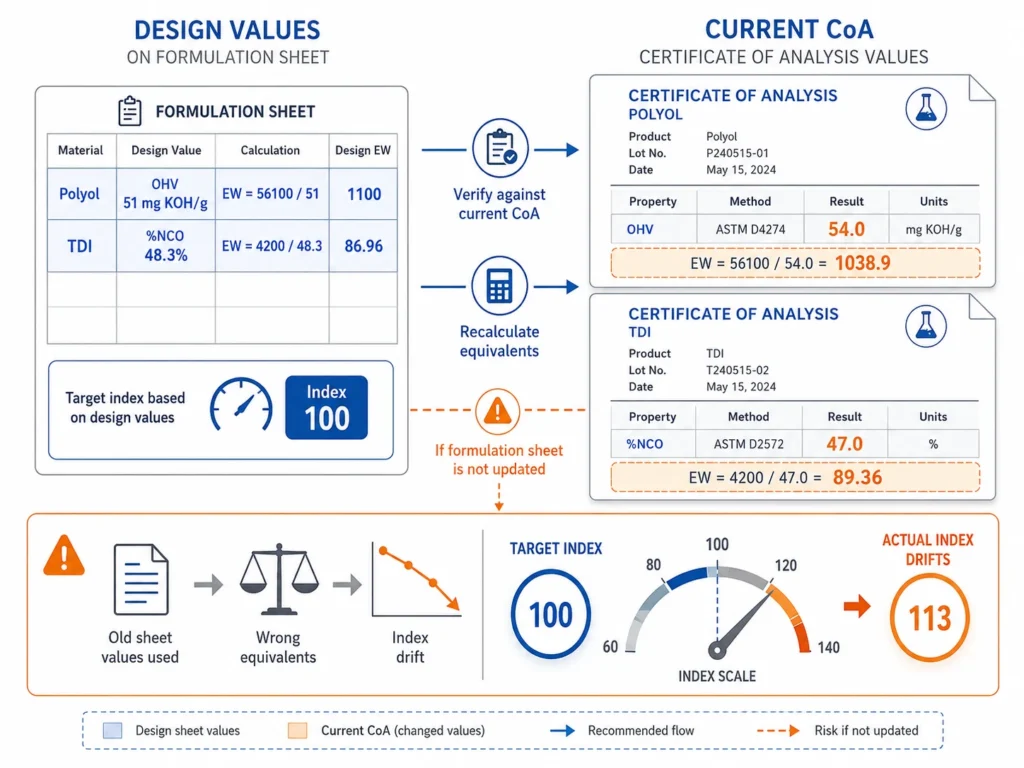
    Current CoA values missing from polyurethane formulation sheet causing equivalent weight drift

    Missing Variable 3: Machine Factor

    A formulation sheet does not show the machine. That matters.

    The same formula can behave differently on two machines because the production system is not identical.

    Machine-related variables include:

    • Metering pump accuracy
    • Polyol delivery rate
    • Isocyanate delivery rate
    • Mixing pressure
    • Mixing head condition
    • Throughput rate
    • Raw material temperature
    • Line speed
    • Pour pattern
    • Head maintenance condition

    A formula may be chemically correct on paper. But if the machine delivers slightly more or less isocyanate than expected, the actual index changes. If the mixing head condition is poor, cell structure may change. If throughput, temperature, or pressure differs, the same formula can produce different foam properties.

    This is especially important when formulas are copied from one line to another. The parts may be identical. The index may be identical. The foam may not be identical.

    That does not mean the formula sheet is useless. It means the formula sheet must be validated against actual machine delivery and production conditions.
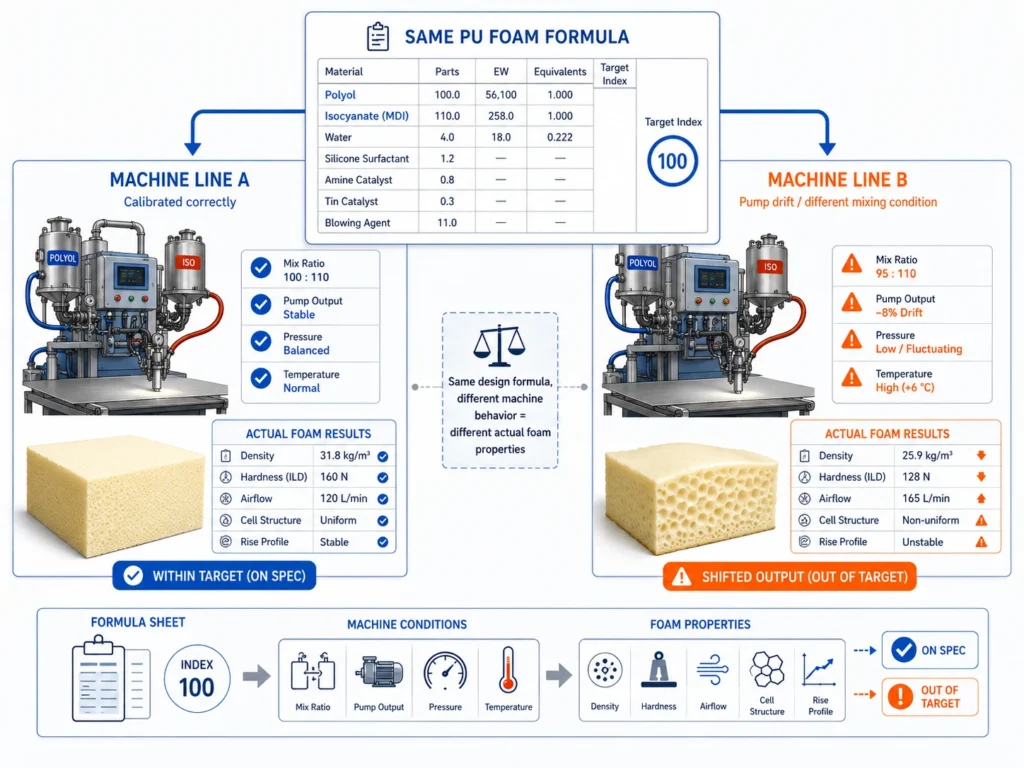
     Machine factor missing from PU foam formulation sheet causing different production results

    Missing Variable 4: Raw Material Condition

    A formulation sheet may list a material name and equivalent weight. It does not show the current condition of that raw material.

    Raw material condition can change due to moisture exposure, poor sealing, long storage time, temperature exposure, drum damage, repeated opening and closing, contamination, or incorrect handling.

    Isocyanate is especially sensitive because NCO groups react with moisture. A TDI or MDI drum may have had a valid CoA when it left the supplier, but if it is stored poorly or exposed to atmospheric moisture, the active %NCO may change before production.

    Polyol can also vary by batch, storage condition, contamination, or handling.

    The formula sheet does not record this. It does not know whether a drum was opened last week, resealed badly, stored in a humid area, or used after a long delay.

    That is why formulation review and raw material control must work together. A formula sheet is not a substitute for incoming QC and storage discipline.
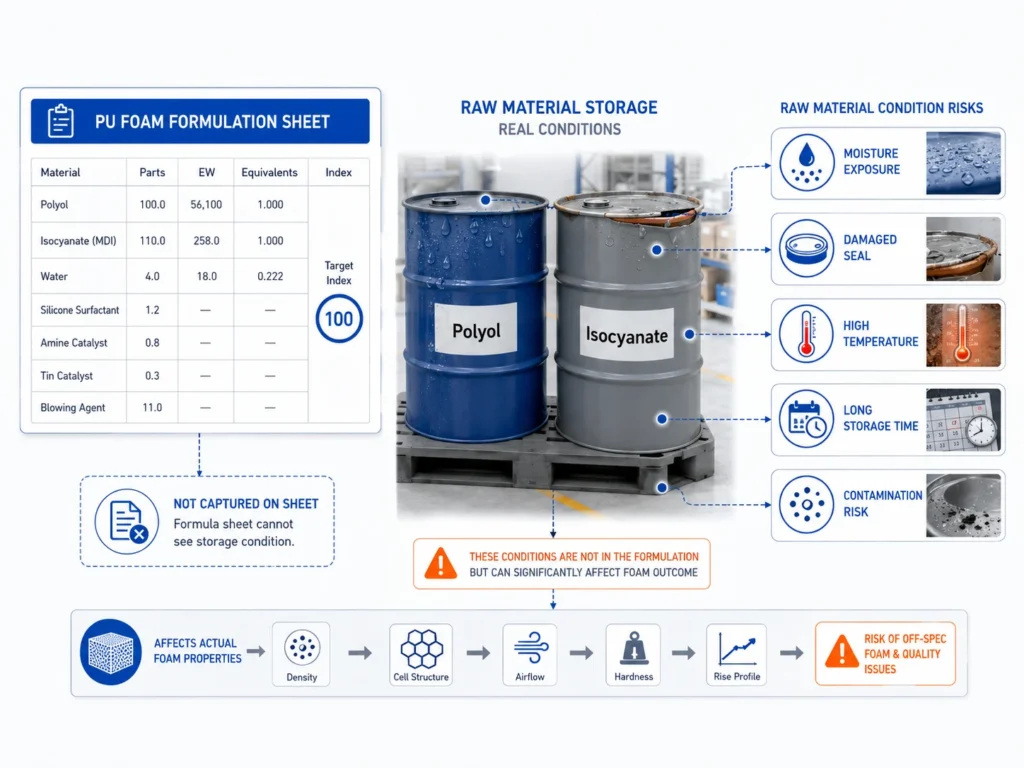
    Raw material condition missing from polyurethane formulation sheet including moisture and storage risk

    When a Formulation Sheet Becomes a Consulting Problem

    A formulation sheet becomes a consulting problem when it carries assumptions nobody has verified recently. This often happens in three situations.

    The Legacy Formula

    A legacy formula may have been written three to five years ago. At the time, the equivalent weights may have been calculated correctly. The index may have been verified. The foam may have passed approval.

    But raw materials change. Suppliers change. CoA values drift. Machine conditions change. The formula may keep running, but that does not mean the formula is still optimized or even fully correct.

    Acceptable foam is not always correct foam. And in a competitive market, acceptable may not be good enough.

    The Copied Formula

    A copied formula is developed on one production line and moved to another plant or machine. The parts are copied. The index is copied. The foam is different.

    This happens because the sheet does not contain all production variables. The new site may have different suppliers, raw material CoA values, humidity, storage conditions, machine calibration, or operator practice.

    The sheet looks the same. The production system is not the same.

    The Inherited Formula

    An inherited formula is a spreadsheet without memory. The engineer who built it may have left. The current team may not know which CoA values were used, why certain adjustments were made, or whether catalyst and crosslinker changes were original design choices or later corrections.

    The formula runs. But nobody can explain why every number is there.

    That is when a formulation sheet becomes a diagnostic document. It needs to be audited, not just followed.
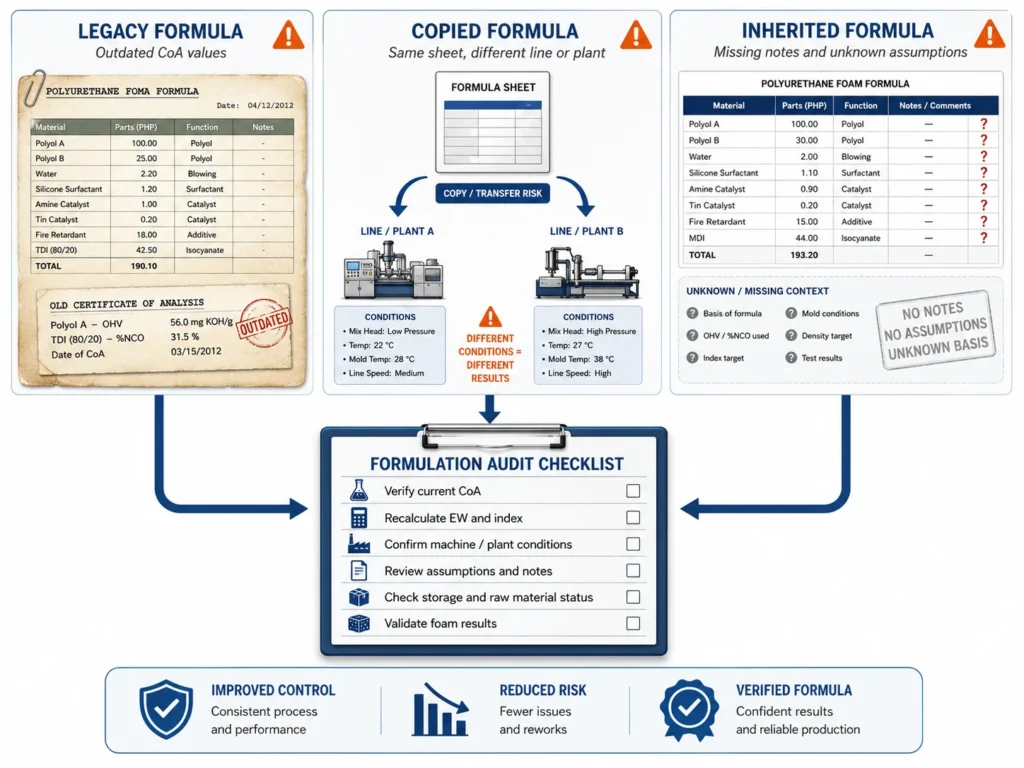
     Legacy copied and inherited PU foam formulas requiring formulation sheet audit

    Warning Signs That a Formula Sheet Needs an Audit

    A formulation sheet should be audited when quality problems keep appearing without a clear process cause.

    Common warning signs include:

    • Foam hardness varies between batches
    • Compression set fails after no obvious formula change
    • Density is stable but feel changes
    • Same formula behaves differently on another machine
    • A supplier was changed recently
    • A formula was copied from another plant
    • CoA values are not recorded in the sheet
    • EW values have not been updated for years
    • Water changes were made without recalculating index
    • TDI or MDI %NCO is still based on TDS midpoint
    • The formula contains unexplained catalyst or crosslinker corrections
    • Nobody knows why certain numbers are in the sheet

    The most important warning sign is simple:

    The formula runs, but nobody can fully explain it.

    That is not a safe production baseline.

    What a Formulation Sheet Audit Should Check

    A proper audit should verify the formula from first principles. It should not only check whether the parts look familiar.

    A strong formulation sheet audit should check:

    Audit AreaWhat to Verify
    Reactive componentsAll reactive materials are identified
    Polyol EWCalculated from current CoA OHV
    Isocyanate EWCalculated from current CoA %NCO
    Water EWConfirmed as 9
    Crosslinker EWAll active hydrogens counted
    EquivalentsParts divided correctly by EW
    Total reactive HSum is correct
    IndexCalculated from NCO equivalents and total H equivalents
    FunctionalityPolyol architecture reviewed where needed
    CoA dataCurrent batch values compared with design values
    Machine deliveryActual pump output checked against formula
    Raw material conditionStorage and moisture exposure reviewed
    Formula historyOld empirical corrections understood

    The purpose is not to rewrite the formula immediately. The purpose is to find whether the formula sheet still matches the chemistry and production reality.

    Use the PolymersIQ Calculators During a Formula Audit

    A formulation sheet audit should be supported by calculation tools.

    The PolymersIQ Equivalent Weight Calculator helps check polyol EW from OHV, crosslinker EW, updated EW after CoA changes, and formula values copied from older sheets.

    Open the Equivalent Weight Calculator →

    The PolymerIQ NCO / TDI Index Calculator helps check isocyanate EW from %NCO, actual index, correct TDI or MDI parts, the effect of updated CoA values, and water or crosslinker changes.

    Open the NCO / TDI Index Calculator →

    The PolymerIQ Foam Density Estimator helps review water-level changes, density targets, formula changes that affect blowing, and whether a density correction may create other risks.

    Open the Foam Density Estimator →

    For the main guide to reading formula sheets, read How to Read a Polyurethane Formulation Sheet.

    For the column-by-column explanation, read Parts, Equivalent Weight, and Equivalents in a PU Foam Formula: What Each Column Means.

    For the full equivalent weight guide, read Equivalent Weight in Polyurethane Foam: Complete Calculation Guide.

    For polyol functionality and network architecture, read Polyol Functionality in Polyurethane Foam: What It Means and Why It Matters.

    For NCO content and CoA values, read TDS %NCO vs CoA %NCO: Why Your PU Foam Formula Must Use the Drum Value.

    FAQs

    What does a polyurethane formulation sheet not show?

    A formulation sheet does not automatically show polyol functionality, current Certificate of Analysis (CoA) batch values, machine delivery accuracy, raw material storage condition, moisture exposure history, mixing head condition, or production-line-specific factors. It shows the formula’s design intention, not the full production reality. Even a stoichiometrically correct sheet can produce off-spec foam if the underlying assumptions are no longer valid.

    Why is polyol functionality often missing from a formulation sheet?

    Most formulation sheets focus on stoichiometric values needed for the index calculation — OHV, EW, parts, equivalents — because these are required to calculate isocyanate demand. Functionality is a structural property that controls network architecture but is not part of the basic index math. Many sheets list the polyol grade and OHV without recording functionality, which means problems related to compression set, recovery, and durability can be invisible on the sheet.

    How often should current CoA values be compared with the formulation sheet?

    For tight-tolerance products, every new batch or drum should be checked against the design EW values on the sheet. For standard production, a periodic review (monthly or quarterly) catches most drift before it accumulates. For supplier changes or grade switches, the comparison should happen before the new material enters production. The exact frequency depends on product specification tightness and supplier batch-to-batch consistency.

    Why can the same formula behave differently on two machines?

    A formulation sheet does not capture machine-specific variables — pump accuracy, polyol/isocyanate delivery rates, mixing head condition, mixing pressure, throughput, raw material temperature, line speed, or pour pattern. Two machines can deliver the same nominal formula at slightly different actual ratios, which shifts the running index. Mixing head condition affects cell structure independently. The same parts and the same index can produce different foam if the production systems are not equivalent.

    What is a “legacy formula” and why is it risky?

    A legacy formula is one that was developed years ago and has continued running without major review. The original equivalent weights may have been correct at the time, but raw material CoA values, suppliers, machine conditions, and storage practices may have all changed. The formula may still produce acceptable foam, but acceptable is not always correct — and in a competitive market, drift that built up over years can produce subtle quality losses or efficiency problems that are invisible until something breaks.

    Why are copied formulas often unreliable?

    A copied formula is developed on one production line and moved to another plant or machine. The parts and index are copied, but the production system is not. The new site may have different suppliers (different CoA ranges), different humidity and storage conditions, different machine calibration, and different operator practices. The formula sheet looks identical to the source, but the foam often is not. A copied formula should be validated, not just transferred.

    What makes inherited formulas a special audit risk?

    An inherited formula is a spreadsheet that the current team did not build. The original engineer may have left. The reasons behind specific catalyst dosages, crosslinker corrections, or unusual EW values may be unknown. The formula runs, but the team cannot explain it. When quality problems appear, troubleshooting is difficult because the team cannot tell which numbers are original design choices and which are old empirical corrections to problems that may no longer exist.

    How do I know my formulation sheet needs an audit?

    Common warning signs include hardness varying between batches without obvious cause, compression set failing after no formula change, the same formula behaving differently on another machine, recent supplier changes, formulas copied from another plant, CoA values not recorded in the sheet, EW values that have not been updated in years, water changes made without recalculating the index, and unexplained historical catalyst or crosslinker adjustments. The biggest warning sign is when nobody on the team can fully explain why every number is in the sheet.

    Should an audit lead to a formula rewrite?

    Not necessarily. The purpose of an audit is to find whether the formula sheet still matches the chemistry and production reality. Often the formula is still close to correct, and the audit identifies a few drift points (an EW value that needs updating, a missing functionality review, an outdated %NCO assumption). Sometimes a single correction restores the original design intent. A full rewrite is only necessary if the audit reveals systemic compound errors or if the production target itself has changed.

    What should I share when requesting a formulation sheet audit?

    Share the current formulation sheet with all columns (parts, EW, equivalents, weight %, equivalent %, index), the polyol grade with OHV and reported functionality, the isocyanate type with current CoA %NCO, the water level, crosslinker type and dosage, catalyst package and surfactant grade, target foam properties (density, hardness, compression set), and a description of any current quality issues plus the history of recent adjustments. The more complete the data, the more useful the audit.

    Key Takeaways

    A polyurethane formulation sheet is powerful, but it is not complete production truth.

    It shows the formula intention. It does not automatically show current CoA values, polyol functionality, machine delivery, or raw material condition.

    The four major things missing from most formulation sheets are:

    1. Polyol functionality
    2. Current CoA batch values
    3. Machine factor
    4. Raw material condition

    Legacy formulas can contain outdated EW values. Copied formulas can fail because the production system changed. Inherited formulas can carry old assumptions nobody understands.

    A formula that runs is not always a formula that is correct.

    A formulation sheet audit should verify every reactive component, every equivalent weight, every equivalent, and the final index from current data.

    When foam quality problems appear without a clear process cause, the formulation sheet should be audited before more empirical corrections are added.

    Conclusion

    If your current formulation sheet has been copied, inherited, or adjusted over years without full verification, it may contain silent assumptions that no longer match production reality.

    PolymersIQ can help audit the sheet from first principles — current CoA values, equivalent weights, reactive equivalents, index, functionality, machine delivery, and formula history — so your team can separate real formulation errors from process noise.

    To get accurate support, please share:

    • Current formulation sheet (with all columns)
    • Polyol grade, OHV, and reported functionality
    • Isocyanate type and current CoA %NCO
    • Water level, crosslinker type, and dosage
    • Catalyst and surfactant package details
    • Target foam properties (density, hardness, compression set)
    • Recent supplier changes or grade switches
    • Description of current quality issues and adjustment history

    Contact PolymerIQ for a formulation sheet audit →
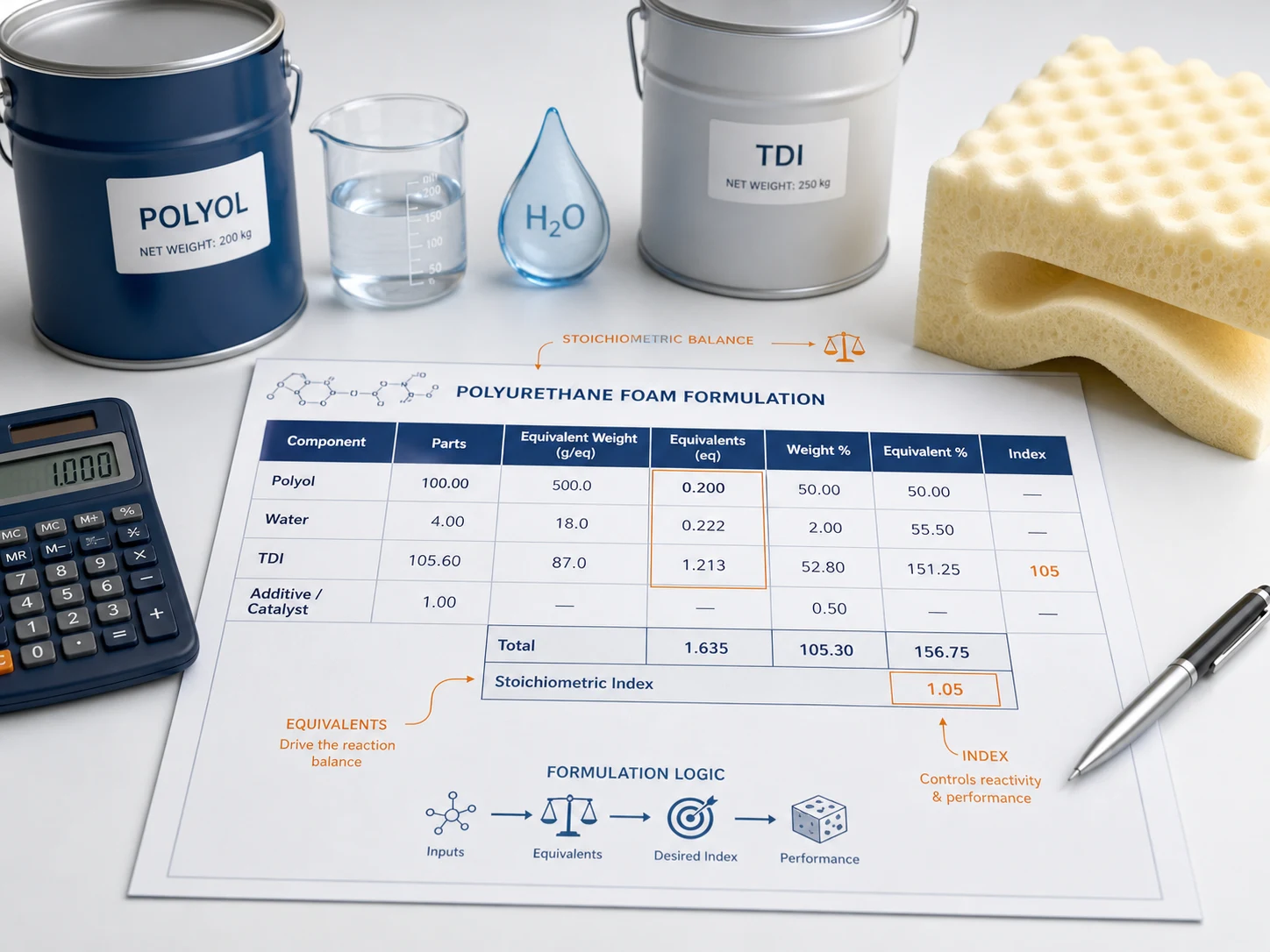

  • How to Read a Polyurethane Formulation Sheet

    How to Read a Polyurethane Formulation Sheet


    Introduction

    A polyurethane formulation sheet looks like a recipe.

    Component names are listed in one column. Quantities are written in another. A target index may appear at the bottom. At first glance, it looks like a simple list of raw materials.

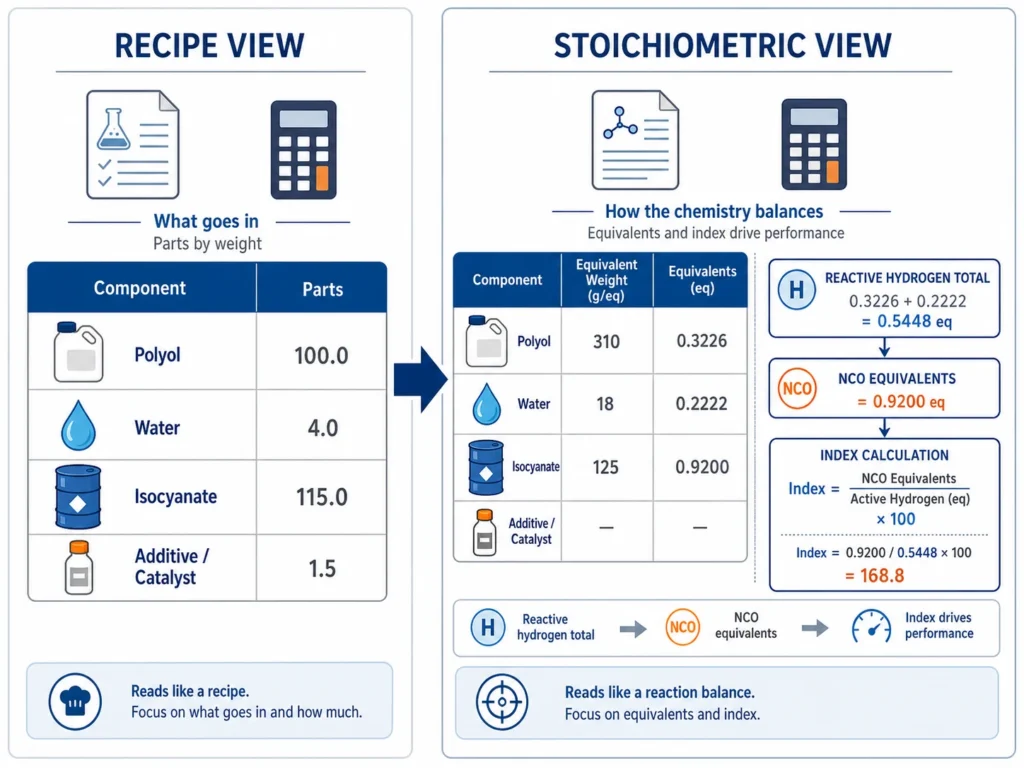
    But a good polyurethane formulation sheet is much more than a recipe. It is a stoichiometric document.

    Every reactive component connects to every other reactive component through equivalent weight, reactive equivalents, and the isocyanate index. The sheet does not only tell you what goes into the foam. It tells you whether the chemistry is balanced.

    Most people read only part of the sheet.

    Operators often read the parts column. Buyers usually read component names and quantities. Engineers may check the index, but sometimes ignore equivalent percentages or whether the equivalent weights still match current raw material data.

    That is risky.

    A polyurethane formulation sheet contains enough information to verify whether the formula is chemically consistent — but only if every column is read correctly.

    This guide explains what each column means, how reactive and non-reactive components should be read differently, and why the index line is a verification tool, not just a target number.

    What a Polyurethane Formulation Sheet Actually Tells You

    A polyurethane formulation sheet tells you two different things at the same time.

    First, it tells you the recipe — component names, parts by weight, catalyst levels, surfactant levels, isocyanate quantity, target index.

    Second, it tells you the stoichiometry — equivalent weight, reactive equivalents, total reactive hydrogen equivalents, NCO equivalents, actual index, and chemical balance between components.

    The recipe tells production what to add. The stoichiometry tells the engineer whether the formula makes chemical sense.

    That difference is important. A formula can look correct as a recipe and still be wrong as a stoichiometric calculation.

    For example, a sheet may show the correct component names and familiar parts. But if water equivalent weight is entered incorrectly, or if the isocyanate %NCO value is outdated, the index calculation may be wrong.

    The formula sheet looks normal. The foam chemistry is not normal.

    Polyurethane formulation sheet showing recipe view versus stoichiometric calculation view

    Reactive and Non-Reactive Components Are Not Read the Same Way

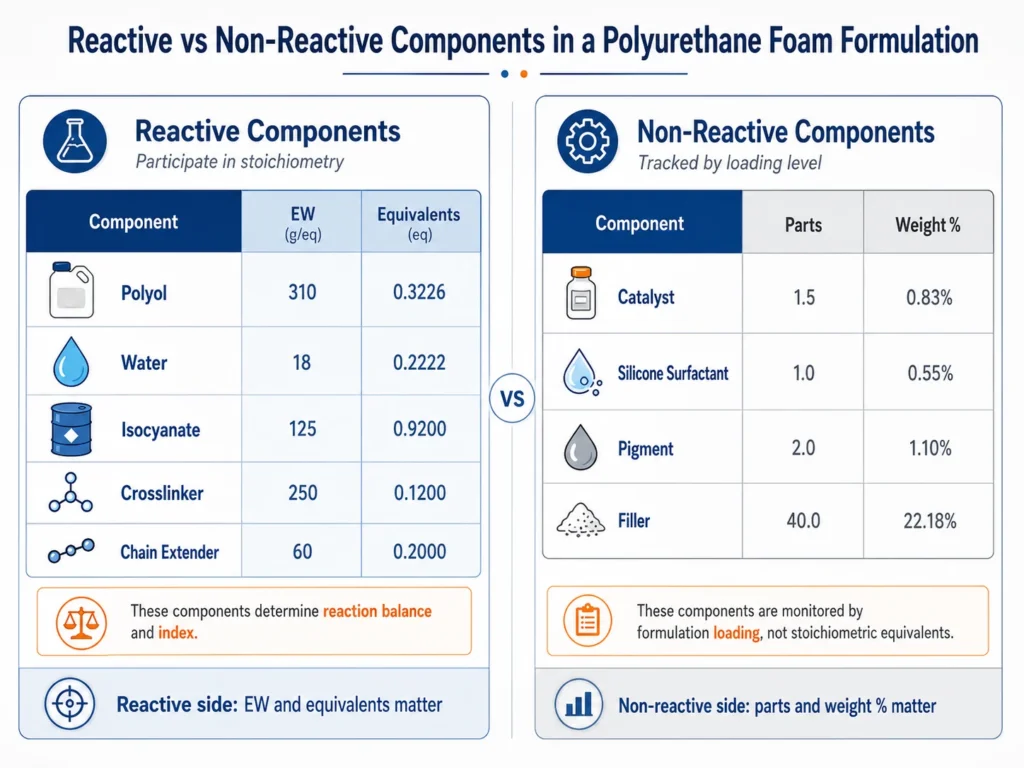
    The first step in reading a polyurethane formulation sheet is separating reactive components from non-reactive components.

    Reactive components participate directly in the stoichiometric calculation. They include polyol, water, isocyanate, crosslinkers, chain extenders, and amine-functional reactive additives. Reactive components need equivalent weight and equivalent calculations.

    Non-reactive components do not normally appear in the index calculation. They include catalysts, silicone surfactants, some flame retardants, pigments, fillers, and processing aids.

    Non-reactive components still matter — they affect reaction speed, cell structure, processing, surface quality, and sometimes regulatory or cost calculations. But they do not contribute reactive equivalents to the isocyanate index.

    This means they should not be read the same way as reactive components. A catalyst at 0.30 parts may strongly affect cream time and rise profile, but it does not have an equivalent weight in the index calculation. A surfactant at 1.00 part may control cell stability, but it does not determine stoichiometric balance.

    Reactive components define the chemistry. Non-reactive components control how the chemistry behaves in production.

    Reactive and non-reactive components in a polyurethane foam formulation sheet

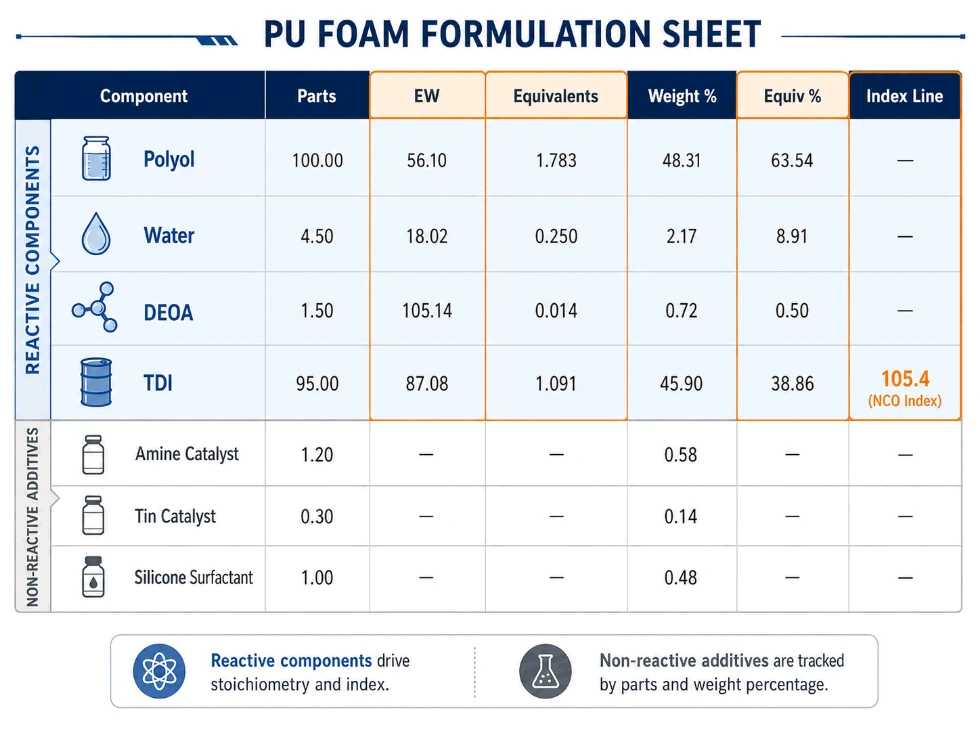
    Example Polyurethane Formulation Sheet

    Below is a simplified flexible polyurethane foam formulation example.

    ComponentPartsEWEquivalentsWeight %Equiv %
    Polyol, OHV 51100.001,1000.0909164.05%16.54%
    Water4.0090.444442.56%80.86%
    DEOA crosslinker0.5035.00.014290.32%2.60%
    Total reactive H0.54964100%
    Amine catalyst0.300.19%
    Tin catalyst0.150.10%
    Silicone surfactant1.000.64%
    TDI 80/20, 48.3% NCO50.1786.960.5769532.14%
    Total formula156.12100%

    Index calculation:

    Index = NCO equivalents ÷ Total reactive H equivalents × 100

    Index = 0.57695 ÷ 0.54964 × 100 = 105.0

    This table contains five important numbers for each reactive component:

    1. Parts
    2. Equivalent weight
    3. Equivalents
    4. Weight percentage
    5. Equivalent percentage

    The index line then verifies whether the reactive balance matches the stated target.

    PU foam formulation sheet columns showing parts equivalent weight equivalents weight percent and equivalent percent

    Column 1: Parts by Weight

    Parts by weight are usually expressed relative to 100 parts of polyol. This is the standard convention in PU foam formulation.

    For example: Polyol = 100 parts, Water = 4 parts, DEOA = 0.5 parts, TDI = 50.17 parts.

    This allows formulas to be scaled easily. If production needs a larger batch, the ratio can be increased while keeping the same formula structure.

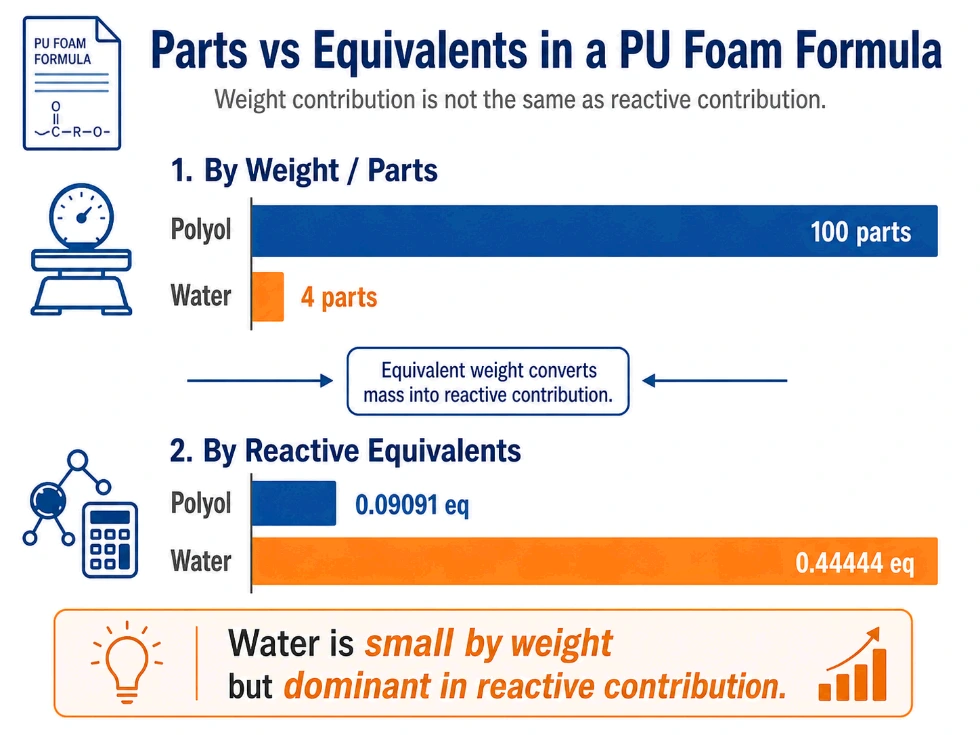
    Parts are useful for production. But parts alone do not tell you reactivity. This is a major mistake.

    At first glance, 100 parts polyol and 4 parts water look like the polyol dominates the formula. By mass, it does. But chemically, water contributes far more reactive equivalents because its equivalent weight is much lower.

    So the parts column tells you how much material is added. It does not tell you how much reactive chemistry that material contributes.

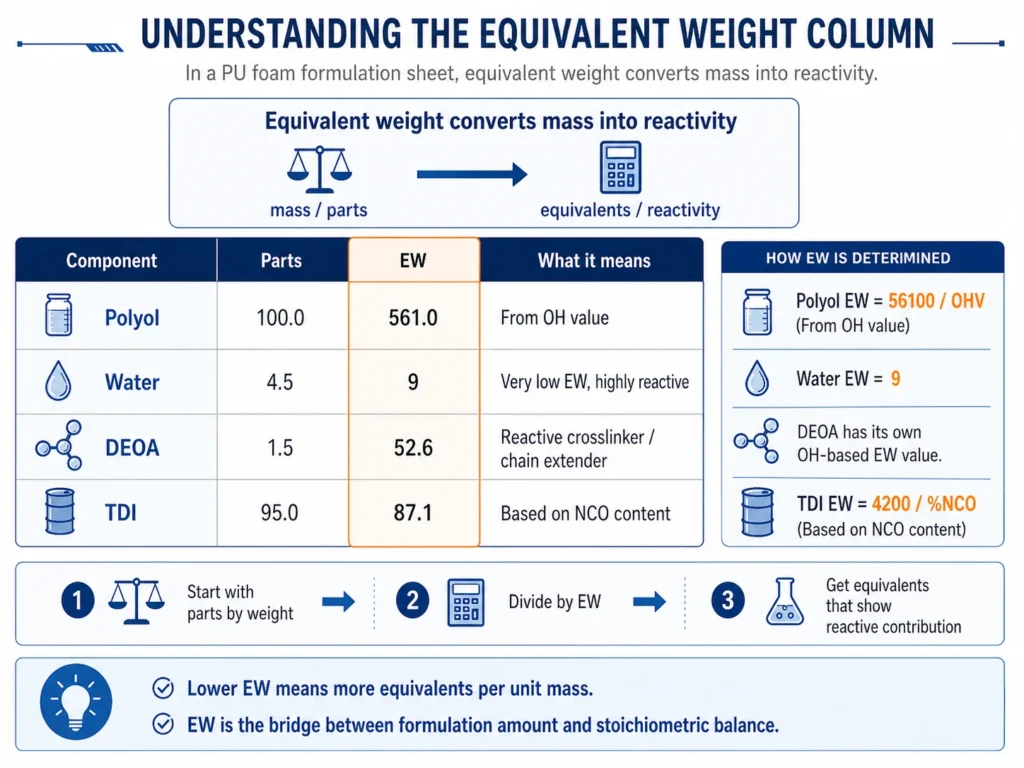
    Column 2: Equivalent Weight

    Equivalent weight converts mass into reactivity. It tells you how many grams of a component contain one equivalent of reactive groups.

    Each reactive component has its own equivalent weight. Typical calculations include:

    Polyol EW = 56,100 ÷ OHV → For OHV 51: Polyol EW = 56,100 ÷ 51 = 1,100

    Water EW = 18 ÷ 2 = 9

    DEOA EW = Molecular Weight ÷ Reactive Groups → DEOA EW = 105.14 ÷ 3 = 35.0

    TDI EW = 4,200 ÷ %NCO → For TDI at 48.3% NCO: TDI EW = 4,200 ÷ 48.3 = 86.96

    Equivalent weight is one of the most important columns in the sheet. If the EW value is wrong, every downstream calculation becomes wrong.

    A formulation sheet should never use outdated equivalent weights copied from old raw material data.

     Equivalent weight column in PU foam formulation sheet converting mass into reactivity

    Column 3: Equivalents

    The equivalents column is where the formula becomes chemically readable.

    The calculation is:

    Equivalents = Parts ÷ Equivalent Weight

    This converts every reactive component onto the same stoichiometric basis.

    ComponentPartsEWEquivalents
    Polyol100.001,1000.09091
    Water4.0090.44444
    DEOA0.5035.00.01429
    TDI50.1786.960.57695

    This column reveals something that the parts column hides.

    • Water is only 4 parts, but contributes 0.44444 reactive equivalents.
    • Polyol is 100 parts, but contributes only 0.09091 reactive equivalents.

    That means water is a small component by weight but a dominant reactive component in the formula.

    This is why water level is so powerful in flexible foam formulation. A small water change can move the chemistry more than the parts column suggests.

    Parts versus equivalents in polyurethane foam formula showing water as dominant reactive component

    Column 4: Weight Percentage

    Weight percentage tells you how much each component contributes to the total formula mass.

    The calculation is:

    Weight % = Component parts ÷ Total formula parts × 100

    In the example formula, total formula weight is 156.12 parts.

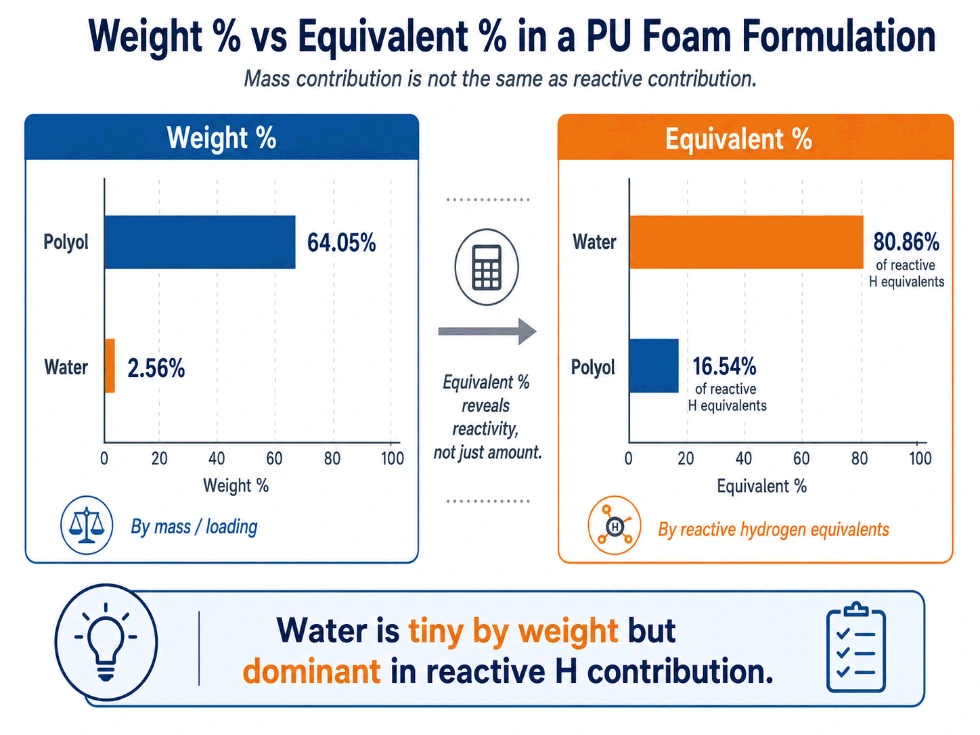
    • Polyol weight % = 100 ÷ 156.12 × 100 = 64.05%
    • Water weight % = 4 ÷ 156.12 × 100 = 2.56%
    • TDI weight % = 50.17 ÷ 156.12 × 100 = 32.14%

    Weight percentage matters for cost calculation, raw material usage, regulatory limits, flame retardant loading, VOC review, production costing, and procurement analysis.

    Weight percentage is important, but it should not be confused with reactive contribution. A component can have low weight percentage and high equivalent percentage. Water is the clearest example.

    Column 5: Equivalent Percentage

    Equivalent percentage shows each reactive component’s share of total reactive hydrogen equivalents.

    For reactive hydrogen components:

    Equivalent % = Component equivalents ÷ Total reactive H equivalents × 100

    ComponentEquivalentsEquivalent %
    Polyol0.0909116.54%
    Water0.4444480.86%
    DEOA0.014292.60%
    Total0.54964100%

    This is one of the most important views in the sheet. It shows which components dominate the reactive chemistry.

    In this example, water is only 2.56% by weight, but it contributes 80.86% of the reactive hydrogen equivalents.

    That is why water adjustments are powerful. The equivalent percentage column helps engineers see the formula chemically, not just by mass.

    Weight percentage versus equivalent percentage in polyurethane foam formulation sheet

    The Index Line: Verification, Not Just a Target

    The isocyanate index is calculated from the equivalents column.

    Index = NCO equivalents ÷ Total reactive H equivalents × 100

    Using the example: Index = 0.57695 ÷ 0.54964 × 100 = 105.0

    This line verifies whether the formula is chemically balanced at the intended index.

    If the sheet states Index 105 but the equivalents calculate to another value, the formula contains an error. Possible causes include:

    • Wrong polyol EW
    • Wrong water EW
    • Wrong DEOA EW
    • Wrong TDI %NCO
    • Outdated CoA values
    • Incorrect parts
    • Copied formula values
    • Manual spreadsheet error

    The index line should not be trusted blindly. It should be recalculated.

    A good formulation sheet self-verifies when every column is correct.

    How to Read Non-Reactive Components

    Non-reactive components are read differently. Catalysts and surfactants do not usually contribute equivalents to the index calculation.

    ComponentPartsFunction
    Amine catalyst0.30Blowing / gelling balance
    Tin catalyst0.15Gelling rate and cure
    Silicone surfactant1.00Cell nucleation and stability

    These materials are not unimportant. They are extremely important for process control. But they do not fix stoichiometric errors.

    A catalyst package can make a wrong formula react faster or slower. It cannot make a wrong index correct. A surfactant can improve cell structure. It cannot correct a missing equivalent calculation.

    This is one of the most important formulation-reading rules:

    Do not use process additives to fix stoichiometric errors. First verify the reactive calculation. Then tune the process additives.

    Practical Checklist for Reading a PU Foam Formulation Sheet

    Use this checklist when reviewing a formulation sheet:

    CheckpointQuestion
    Reactive componentsAre polyol, water, crosslinkers, chain extenders, and isocyanate clearly identified?
    Non-reactive componentsAre catalysts, surfactants, and additives separated from index calculation?
    PartsAre all parts based on 100 parts polyol?
    Polyol EWIs EW calculated from actual OHV?
    Water EWIs water entered as 9?
    Isocyanate EWIs EW calculated from actual %NCO?
    Crosslinker EWAre all reactive groups included?
    EquivalentsAre parts divided by correct EW?
    Total reactive HIs the total correct?
    IndexDoes calculated index match the stated index?
    Weight %Does total formula weight equal 100% after conversion?
    Equivalent %Does the reactive contribution make chemical sense?

    This checklist turns the sheet from a recipe into a verifiable technical document.

    Use the PolymerIQ Calculators

    Equivalent weight values must be correct before the formulation sheet can be trusted. The PolymerIQ Equivalent Weight Calculator helps verify EW from OHV and other raw material values. Use it when reviewing a new formula, checking a copied formula, updating polyol OHV, checking crosslinker EW, or auditing old formula sheets.

    Open the Equivalent Weight Calculator →

    The index line should always be verified from actual equivalents. The PolymerIQ NCO / TDI Index Calculator helps check whether the formula is really running at the intended index. Use it when reviewing a formulation sheet, updating isocyanate %NCO, changing water level, checking CoA values, auditing legacy formulas, or confirming TDI or MDI parts.

    Open the NCO / TDI Index Calculator →

    For the full equivalent weight guide, read Equivalent Weight in Polyurethane Foam: Complete Calculation Guide.

    For water’s role in the formula, read The Dual Role of Water in Polyurethane Foam: Blowing Agent and Urea Network Builder.

    For the NCO content explanation, read NCO Content in Isocyanate: What %NCO Means in PU Foam Formulation.

    For the next article on formula columns, read Parts, Equivalent Weight, and Equivalents in a PU Foam Formula: What Each Column Means.

    For the audit article, read What a Polyurethane Formulation Sheet Cannot Tell You.

    FAQs

    What does a polyurethane formulation sheet contain?

    A polyurethane formulation sheet contains both a recipe (component names, parts by weight, target index) and a stoichiometric calculation (equivalent weight, reactive equivalents, total reactive H, NCO equivalents, actual index). The recipe tells production what to add. The stoichiometry tells the engineer whether the chemistry is balanced. A complete sheet contains both, with one verifying the other.

    What’s the difference between reactive and non-reactive components on a formulation sheet?

    Reactive components (polyol, water, isocyanate, crosslinkers, chain extenders) participate in the polyurethane reaction and contribute reactive equivalents to the isocyanate index calculation. Non-reactive components (catalysts, silicone surfactants, pigments, fillers) affect process behaviour, cell structure, and properties but do not contribute equivalents. They should be read differently — reactive components need EW and equivalents, non-reactive components need only parts and weight percentage.

    Why does a formulation sheet show parts based on 100 parts polyol?

    Using 100 parts polyol as the reference base is a standard PU foam convention. It allows easy scaling — production can multiply the formula to any batch size while keeping the same ratios. It also makes formulas easier to compare across products and suppliers since polyol is the largest reactive component by mass.

    How do I calculate equivalents from parts in a formula?

    Use Equivalents = Parts ÷ Equivalent Weight for each reactive component. For example, 4 parts of water with EW = 9 gives 4 ÷ 9 = 0.44444 equivalents. 100 parts of polyol with EW = 1,100 gives 100 ÷ 1,100 = 0.09091 equivalents. Sum the reactive hydrogen equivalents to get the total used in the index calculation.

    Why is water dominant in the equivalent percentage column even though it’s only a few parts by weight?

    Water has a very low equivalent weight (9 g/eq) compared to polyol (around 1,000–1,200 g/eq). Even though water makes up only 2–4% of the formula by weight, it contributes a much larger share of total reactive hydrogen equivalents — often 70–85% in flexible foam. This is why a small water change creates a large stoichiometric effect, and why water adjustments are so powerful.

    What does the equivalent percentage column tell me?

    Equivalent percentage shows each reactive component’s share of total reactive hydrogen equivalents. It reveals which components actually dominate the reactive chemistry, which is often very different from what the parts or weight percentage columns suggest. For example, water can be 2–3% by weight but 80% by equivalent percentage. Reading this column helps engineers see the formula chemically, not just by mass.

    Should I trust the index value printed on the formulation sheet?

    No — the index line should be recalculated, not trusted blindly. Calculate Index = NCO equivalents ÷ Total reactive H equivalents × 100 and compare with the stated value. If they don’t match, the formula contains an error somewhere — wrong EW, outdated %NCO, missing reactive component, copied values, or a spreadsheet error. The index line is a verification tool, not just a target.

    Can I fix a formulation problem by adjusting catalyst or silicone?

    Catalysts and silicones are powerful for process control — they affect reaction speed, cell structure, and surface quality. But they cannot fix stoichiometric errors. If the index is wrong because of incorrect EW values, missing reactive components, or outdated %NCO, no amount of catalyst tuning will restore the network the missing or excess NCO would have built. First verify the reactive calculation, then tune the process additives.

    What are the most common errors in a polyurethane formulation sheet?

    Common errors include: water EW entered as 18 instead of 9, polyol EW based on outdated OHV, isocyanate EW based on TDS midpoint instead of actual CoA %NCO, crosslinker (especially DEOA) calculated from OHV alone without including amine hydrogens, missing reactive components from the index calculation, and copied formula values that no longer match current raw material data. Any one of these can corrupt the entire stoichiometric calculation while the sheet still looks correct.

    How often should I audit a formulation sheet?

    Audit any time the formula has been adjusted, copied, inherited from another plant, or used for many production runs without verification. Also audit when foam properties drift unexpectedly, when a new supplier or grade is introduced, when CoA values change meaningfully, or when persistent quality problems do not respond to standard process corrections. A formulation sheet that has not been audited in years often contains accumulated errors.

    Key Takeaways

    A polyurethane formulation sheet is not just a recipe. It is a stoichiometric document.

    Reactive and non-reactive components must be read differently:

    • Reactive components need equivalent weight, equivalents, and index calculation.
    • Non-reactive components affect process, cell structure, and performance, but they do not normally contribute to the index.

    For each reactive component, the key numbers are:

    1. Parts
    2. Equivalent weight
    3. Equivalents
    4. Weight percentage
    5. Equivalent percentage

    The index line then verifies whether the reactive balance matches the intended target.

    • Parts show how much material is added.
    • Equivalent weight converts mass into reactivity.
    • Equivalents show chemical contribution.
    • Weight percentage supports cost and compliance.
    • Equivalent percentage shows which components dominate the reactive chemistry.

    The index line should be recalculated, not trusted blindly.

    If a formulation sheet cannot be verified from its own numbers, it should not be treated as production-ready.

    Conclusion

    If your formulation sheet has been copied, inherited, or adjusted over time, the numbers may no longer reflect the actual chemistry being run in production.

    PolymersIQ can help verify every reactive component, every equivalent weight, every equivalent value, and the final index calculation to identify silent formulation errors before they become foam quality problems.

    To get accurate support, please share:

    • Your current formulation sheet (with EW values)
    • Polyol grade, OHV, and supplier
    • Isocyanate type and current CoA %NCO
    • Water level, crosslinker, and chain extender data
    • Target index and any observed foam quality issues
    • Description of the problem and adjustments already tried

    Contact PolymerIQ for a formulation sheet audit →