Tag: Exotherm

  • 4 Water Adjustment Mistakes in PU Foam Production

    4 Water Adjustment Mistakes in PU Foam Production


    Introduction

    Water is one of the most powerful variables in flexible polyurethane foam formulation. It is also one of the most misunderstood.

    Many foam plants treat water as a density control dial. If density is too high, water is increased. If density is too low, water is reduced. The adjustment looks simple, and in many cases, the density moves in the expected direction.

    But water does not only control density.

    Water generates CO₂, consumes NCO, forms amine intermediates, creates urea linkages, changes the isocyanate index, affects hardness, influences compression set, and increases exotherm. That means every water adjustment affects several foam properties at once.

    A plant may reduce water to fix density and later face compression set failures. Another plant may increase water for low-density foam and later see core discoloration or scorch risk. A production team may change water without recalculating the index and then spend weeks troubleshooting soft foam or hardness drift.

    The mistake is not adjusting water. Water adjustment is part of normal foam formulation. The mistake is treating water as an independent single-function variable.

    This article explains four common water adjustment mistakes that cause PU foam quality problems and how to control them before they reach the customer.

    Why Water Adjustments Create Hidden Problems

    Water has two connected roles in polyurethane foam.

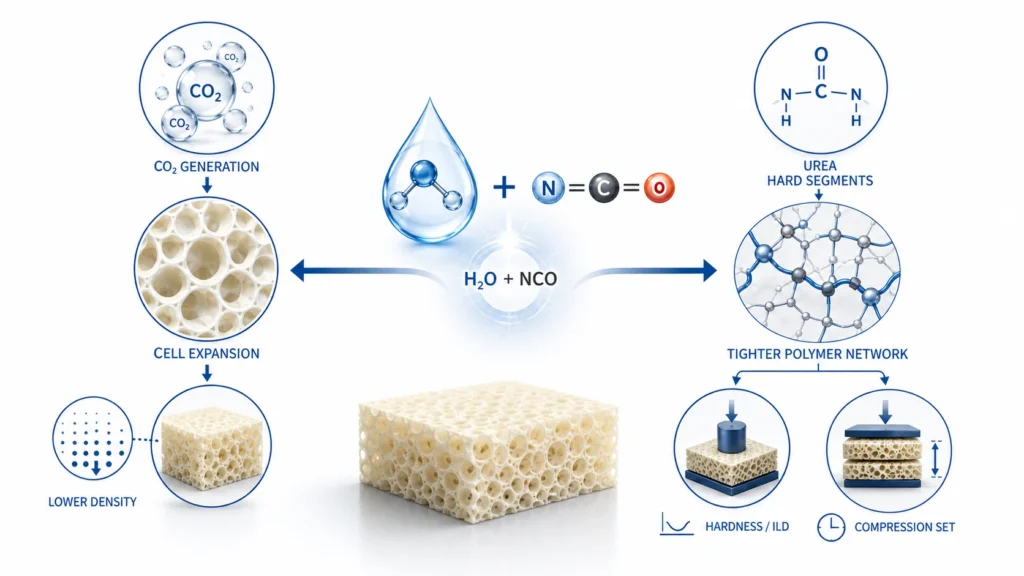
    First, it reacts with isocyanate to generate CO₂. This gas expands the foam and affects density. Second, the same reaction produces an amine, which reacts with another isocyanate group to form a urea linkage. These urea hard segments affect the foam network.

    So every water adjustment changes:

    • CO₂ generation
    • Foam expansion and density
    • NCO consumption and isocyanate index
    • Urea formation
    • Hardness / ILD
    • Compression set
    • Exotherm

    This is why a water change can appear successful at first and still create a delayed quality problem. The production team may only measure the immediate result, such as density. But the network-related effects may appear later through compression set, recovery, hardness drift, or customer complaints.

    Water should be treated as a reactive formulation variable, not just a blowing-agent adjustment.

    Mistake 1: Changing Water Level Without Recalculating the Index

    Water consumes NCO. That means water is part of the isocyanate index calculation.

    The equivalent weight of water in polyurethane foam is 9 g/eq. So when water level changes, total reactive hydrogen equivalents change. If the isocyanate amount is not recalculated, the real running index changes immediately.

    For example, if a standard flexible slabstock formula increases water from 4.0 parts to 4.5 parts but the isocyanate quantity is left unchanged, the actual index can drop significantly. This type of change can move the index from 105 to about 95.4.

    That is not a small adjustment. The engineer may think only water was changed. In reality, the formula now has a different index.

    Possible results include:

    • Softer foam than expected
    • Lower ILD
    • Poorer compression set
    • Weaker recovery
    • Slower cure
    • Different foam feel
    • Confusing production troubleshooting

    Every water change requires a fresh index calculation. No exception.
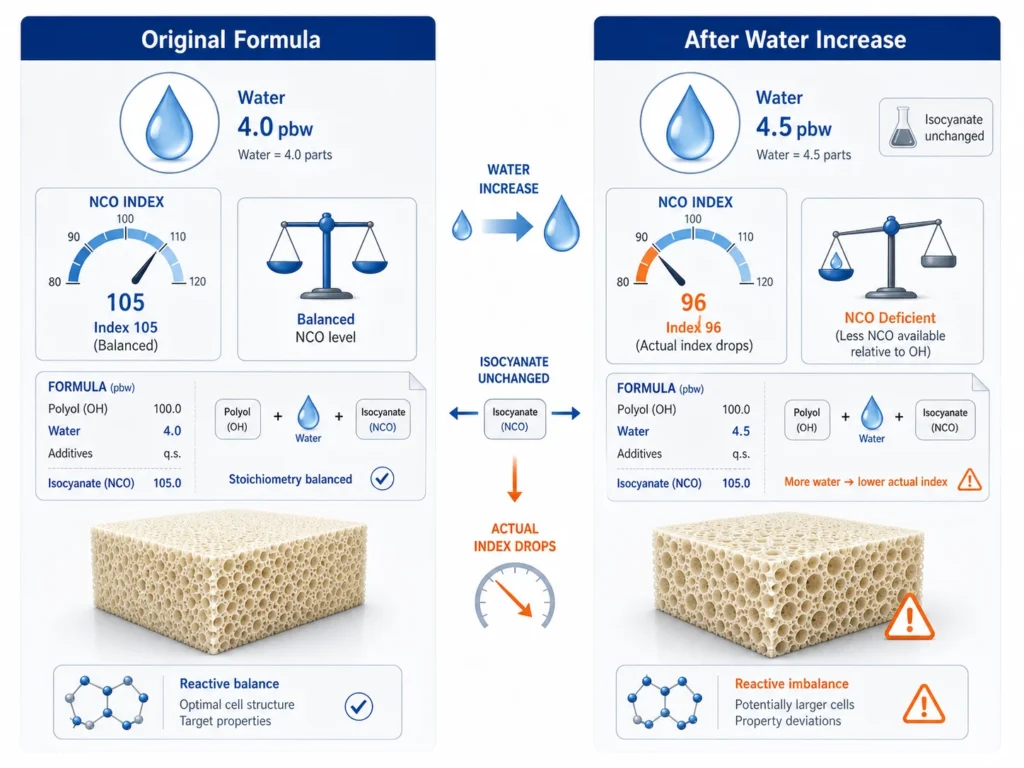
    Water level change causing isocyanate index shift in PU foam formulation

    Mistake 2: Correcting Density with Water but Ignoring Compression Set

    Density correction is one of the most common reasons engineers adjust water.

    If the foam is too dense, increasing water may lower density. If the foam is too light, reducing water may increase density. That part is understandable.

    The mistake is stopping the evaluation at density.

    Water also affects urea formation. Urea linkages help build the hard-segment network that supports recovery and compression set performance. If water is reduced to correct density, urea formation also decreases.

    The foam may pass production density checks. It may cut normally. It may look acceptable on the floor. But the reduced urea network can weaken long-term recovery.

    The problem may appear later as:

    • Higher compression set
    • Poorer recovery after sustained load
    • Mattress or cushion returns
    • Field complaints
    • Customer reports of permanent deformation

    This is dangerous because the failure may appear weeks or months after the original water adjustment. By then, the water change may be forgotten. The plant may treat compression set failure as a new problem — but chemically, it may be connected to the earlier water adjustment.

    A density correction should always be validated against compression set.
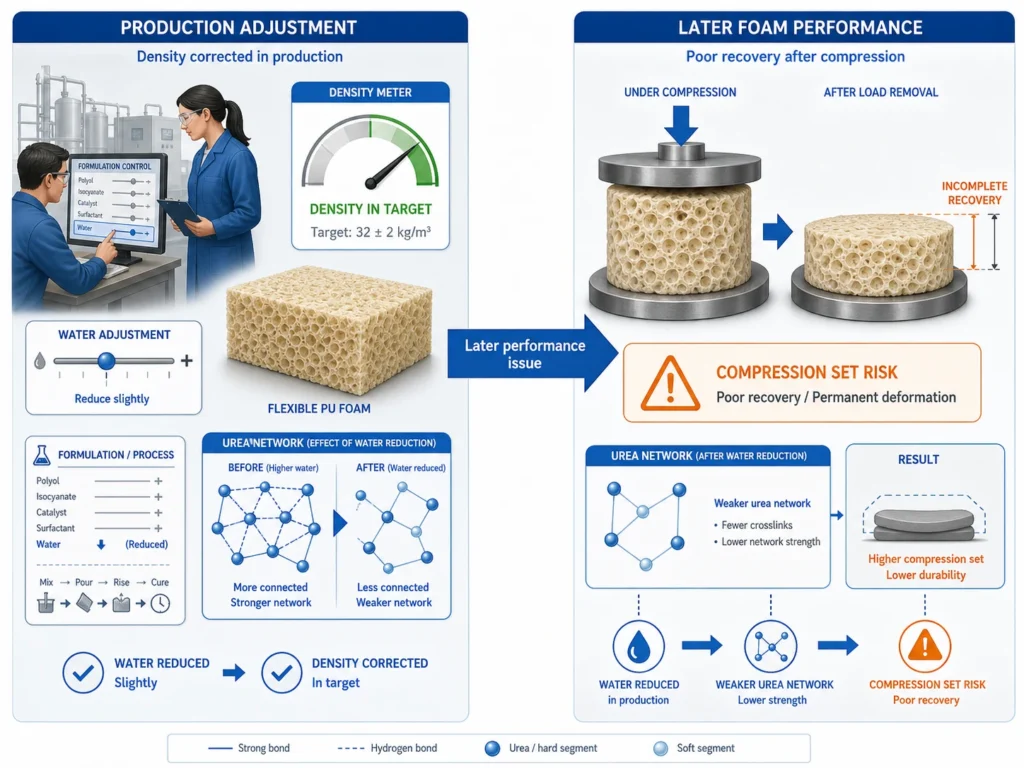
    Water reduction fixing foam density but increasing compression set risk in polyurethane foam

    Mistake 3: Running High Water Levels Without Managing Exotherm

    High water levels can help produce lower-density foam.

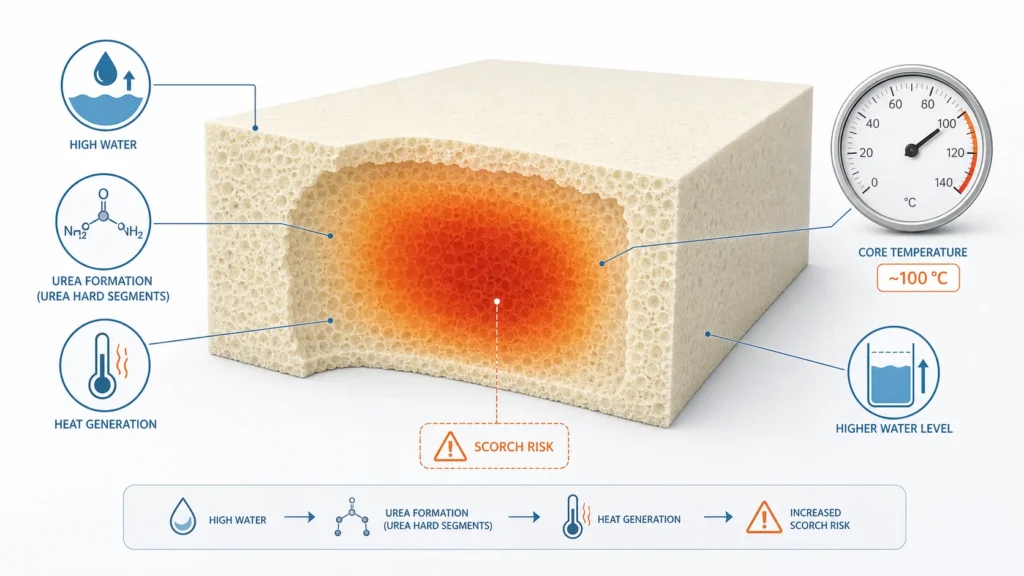
    But higher water also increases urea formation and heat release. At higher water levels — especially around and above 4.5 parts — exotherm can become a serious risk in flexible slabstock foam, depending on the formula and block geometry.

    Large blocks are especially sensitive because heat dissipates slowly from the core. The surface may look normal while the center of the block experiences excessive temperature.

    Possible signs of high exotherm include:

    • Core discoloration
    • Scorch risk
    • Internal cell irregularity
    • Reduced tensile strength in the core
    • Uneven physical properties
    • Processing instability
    • Odor or degradation symptoms in severe cases

    High water formulas need more than a density target — they require thermal management.

    Important checks include block height, pour profile, water level, catalyst balance, foam density, ventilation, raw material temperature, cooling time, and core temperature risk.

    Pushing water to achieve ultra-low density without considering exotherm can create a core-quality problem that is not visible from the outside.
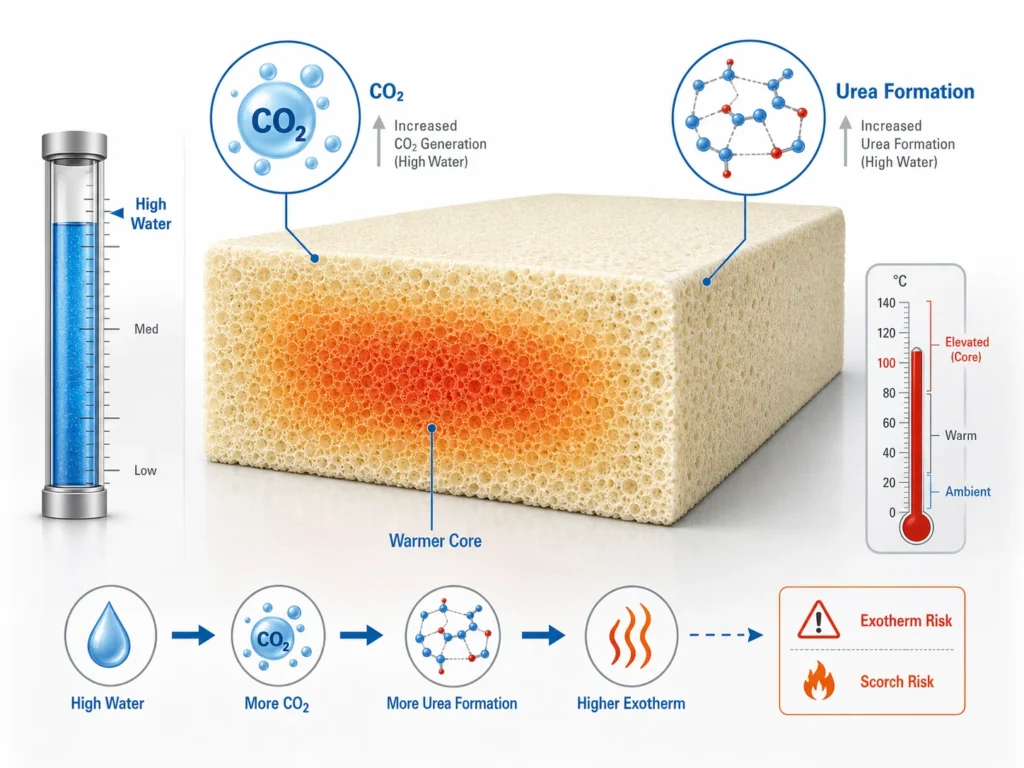
    High water level causing exotherm and scorch risk in polyurethane foam slabstock core

    Mistake 4: Treating Water as an Independent Variable

    There is no such thing as “just changing water” in polyurethane foam.

    Every water adjustment changes multiple formulation relationships at once.

    ChangeWhat Happens
    Water increasesMore CO₂, lower density, higher NCO demand, index drops if iso is unchanged, more urea formation, more exotherm, complex hardness response
    Water decreasesLess CO₂, higher density, lower NCO demand, index rises if iso is unchanged, less urea formation, compression set risk, recovery may change

    Water is connected to the whole foam system. It interacts with isocyanate index, catalyst balance, silicone surfactant, polyol functionality, crosslinker level, density target, compression set requirement, and block size / exotherm management.

    This is why water should never be adjusted in isolation. A correct water adjustment requires a formulation review, not just a machine setting change.
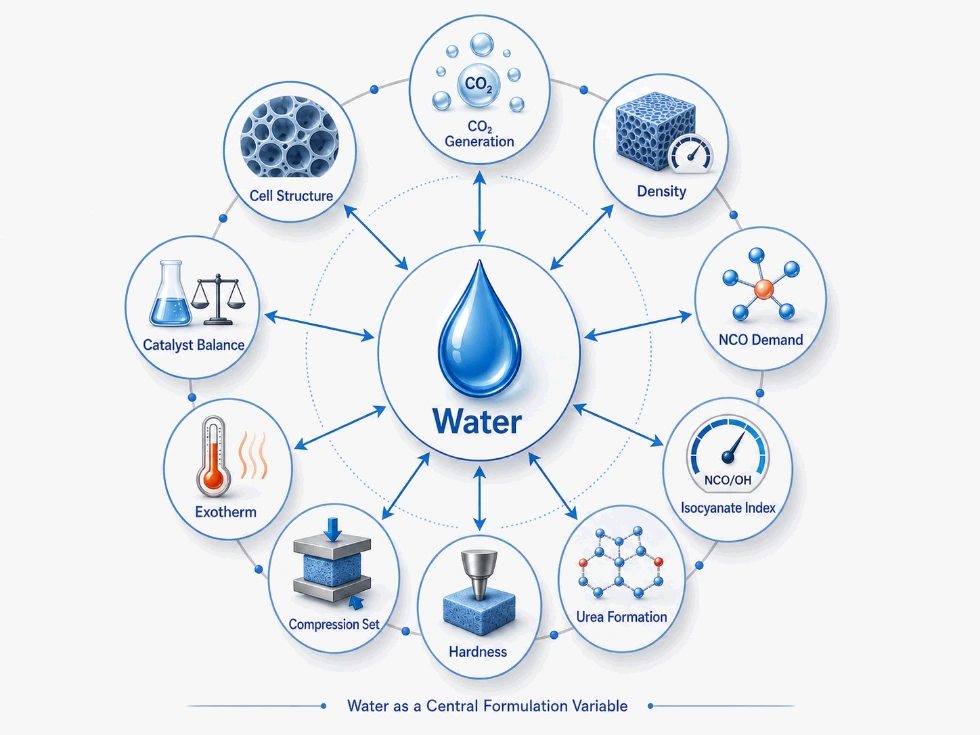
    Water is not an independent variable in PU foam formulation because it affects index, density, hardness, compression set, and exotherm

    What Water Adjustment Problems Look Like in Production

    Water adjustment mistakes can look like unrelated production problems. That is why they are often misdiagnosed.

    A plant may experience:

    • Density corrected but compression set later failing
    • Foam becoming softer after a water increase
    • Hardness changing more than expected
    • High-water formula showing core discoloration
    • Catalyst changes giving only temporary improvement
    • Foam passing density but failing long-term recovery
    • Different results after small water changes
    • Customer complaints appearing weeks after production adjustment

    These problems can be confusing because the original water change may not look suspicious. The team may say “the formula did not change.”

    But the formula did change. Water changed. And water is a reactive formulation component.

    The first troubleshooting question should be: Was water changed recently, and was the index recalculated afterward?
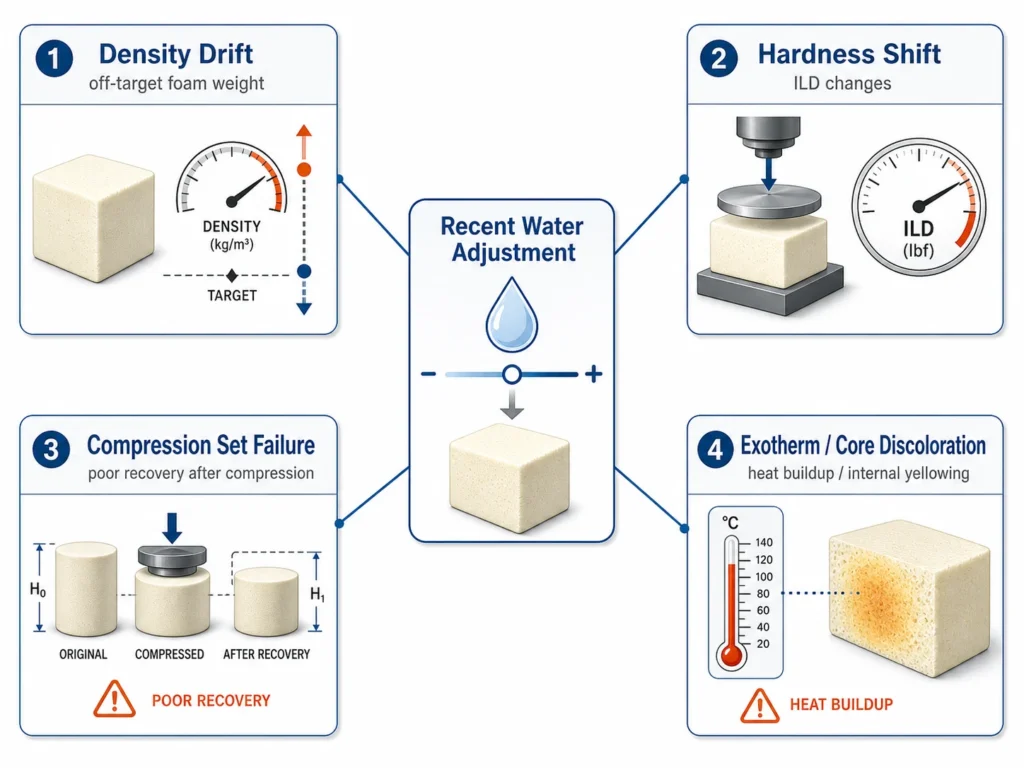
    PU foam troubleshooting symptoms caused by water adjustment mistakes

    Production Checklist Before Changing Water Level

    Before changing water in a PU foam formulation, review the full effect using this checklist:

    CheckpointQuestion
    Density targetWhat density change is expected?
    Water EWIs water calculated as EW = 9?
    Index recalculationHas TDI or MDI demand been recalculated?
    Hardness / ILDWill hardness still meet target?
    Compression setWill recovery performance remain acceptable?
    Urea formationDoes the change reduce or increase network contribution?
    ExothermIs core temperature risk acceptable?
    Catalyst balanceDoes the reaction profile still match the new water level?
    Cell structureCan the surfactant system support the new expansion?
    Trial validationWill density, ILD, compression set, and core condition be tested?
    DocumentationHas the water change been recorded with date and reason?

    A water change should never be approved only because density improved. It should be approved because the full foam property balance remains acceptable.
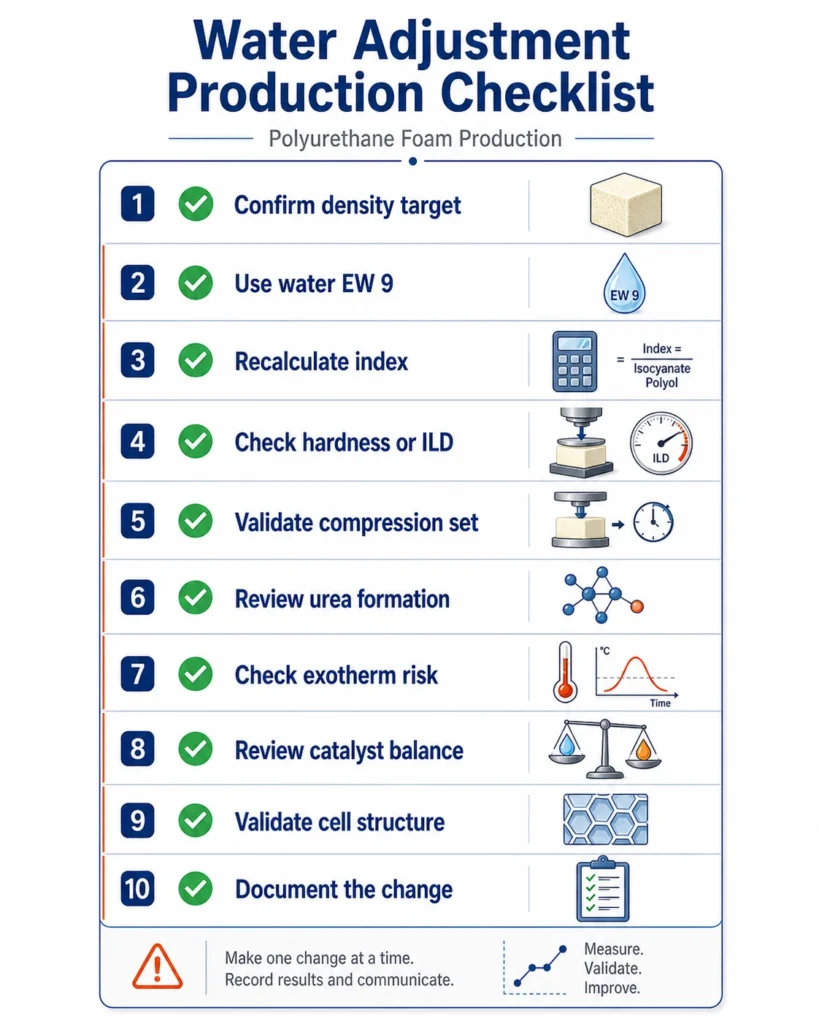
    Water adjustment production checklist for polyurethane foam formulation

    Correct Workflow for Water Adjustment

    A safer water adjustment workflow follows this sequence:

    1. Define the reason for the water change.
    2. Estimate the density effect.
    3. Calculate water reactive equivalents using EW = 9.
    4. Recalculate total reactive hydrogen equivalents.
    5. Recalculate required isocyanate for the target index.
    6. Review hardness and ILD risk.
    7. Review compression set risk.
    8. Review exotherm risk, especially for high-water formulas.
    9. Run a controlled production trial.
    10. Test density, ILD, compression set, and core condition.
    11. Document the final formula and reason for the change.

    This keeps water changes controlled and traceable. It also prevents the common problem of solving one visible issue while creating a hidden performance issue.

    Use the PolymerIQ Calculators

    Because water consumes NCO, every water adjustment should be checked through the index calculation. The PolymersIQ Isocyanate Index Calculator helps verify the corrected isocyanate requirement after changing water level. Use it when water level changes, TDI or MDI parts need recalculation, foam becomes softer or harder after adjustment, compression set changes after density correction, or a legacy formula has undocumented water changes.

    Open the Isocyanate Index Calculator →

    Water is often changed to correct density. The PolymersIQ Foam Density Estimator helps estimate density impact before a water adjustment reaches production. Use it when increasing or reducing water, comparing water level options, reviewing low-density grades, or checking whether a density correction may create additional formulation risks.

    Open the Foam Density Estimator →

    For the chemistry behind water’s dual role, read The Dual Role of Water in Polyurethane Foam: Blowing Agent and Urea Network Builder.

    For water’s effect on density, hardness, compression set, and exotherm, read How Water Level Affects PU Foam Density, Hardness, Compression Set, and Exotherm.

    For the water equivalent weight calculation, read Why the Equivalent Weight of Water Is 9 in Polyurethane Foam.

    FAQs

    What are the most common water adjustment mistakes in PU foam production?

    The four most common mistakes are: changing water level without recalculating the index, correcting density with water but ignoring compression set, running high water levels without managing exotherm, and treating water as an independent variable when it actually affects density, index, hardness, compression set, and exotherm at once.

    Why does changing water affect the isocyanate index?

    Water reacts with isocyanate and consumes NCO during the blowing reaction. Water’s equivalent weight is 9, which makes it a major contributor to total reactive hydrogen equivalents. When water level changes, reactive equivalents change, and the isocyanate quantity required to maintain the target index changes too. Leaving the isocyanate unchanged after a water adjustment shifts the actual running index.

    Can a water reduction cause compression set failure later?

    Yes. Reducing water reduces both CO₂ generation and urea formation. Urea hard segments help build the network that supports recovery. If water is reduced to fix density but the formula is not rebalanced, the network may be weaker — and compression set complaints can appear weeks or months later.

    How much can the index change if I increase water by 0.5 parts and don’t adjust isocyanate?

    The shift can be significant. For a typical flexible slabstock formula, increasing water from 4.0 to 4.5 parts without changing isocyanate can drop the actual index from around 105 to about 95.4. That’s not a small drift — it can move the foam well below the target performance window.

    When does high water become an exotherm risk?

    At water levels around and above 4.5 parts, the urea-forming reaction releases enough heat that core temperature can become a concern, especially in large slabstock blocks. The exact threshold depends on block size, density, formulation, ventilation, and ambient conditions. Larger blocks dissipate heat more slowly from the core, which makes them more sensitive.

    What are the signs of high exotherm in slabstock foam?

    Core discoloration (yellowing or browning at the center), scorch marks, internal cell irregularity, reduced tensile strength in the core, uneven physical properties between surface and center, processing instability, and in severe cases odor or degradation symptoms. The outside of the block may look completely normal while the core is compromised.

    Why is water described as a “reactive formulation variable” instead of a blowing agent?

    Because water does both jobs at once — it reacts chemically with isocyanate (consuming NCO and creating urea linkages) and also generates CO₂ for foam expansion. Calling it just a blowing agent suggests it only affects density, which understates its role. Treating water as a reactive component reminds engineers that it changes the whole foam system, not just the cell structure.

    Should water adjustments be documented?

    Yes. Water changes should be recorded with date, reason for the change, old and new water levels, recalculated index, recalculated isocyanate quantity, and trial results (density, ILD, compression set, core condition). Without documentation, undocumented water changes can become a hidden source of formulation drift months later.

    What’s the first thing to check when foam properties drift after recent production adjustments?

    Check whether water level was changed recently. If yes, check whether the index was recalculated and the isocyanate quantity adjusted. Many “mysterious” foam quality problems trace back to a water change that was made for one reason (often density) but didn’t include a full formulation review.

    Can I just adjust catalyst to compensate for a water change?

    No — catalyst adjustment cannot fix a stoichiometric imbalance. If water changed and the index drifted, no amount of catalyst tuning will restore the network structure that the missing or excess NCO would have built. Catalyst adjustments may temporarily mask one symptom while leaving the underlying chemistry unbalanced. The correct fix is to recalculate the index and adjust isocyanate.

    Key Takeaways

    Water adjustment is never a single-property change.

    The four most common mistakes are:

    1. Changing water level without recalculating the index.
    2. Correcting density with water but ignoring compression set.
    3. Running high water levels without managing exotherm.
    4. Treating water as an independent variable.

    Water generates CO₂, consumes NCO, forms urea linkages, changes index balance, affects hardness, influences compression set, and increases thermal load. If water changes, the formula changes.

    Every water adjustment should be recalculated, documented, and validated through density, ILD, compression set, and exotherm review. A density fix is not complete until the rest of the foam property balance is confirmed.

    Conclusion

    If your plant has used water changes to correct density but later faced compression set failure, hardness drift, or core heat problems, the issue may not be random.

    Water may have solved one problem while creating another.

    PolymersIQ can help review your water adjustment history, recalculate the index impact, evaluate density and compression set risk, and identify whether your current formulation balance needs correction.

    To get accurate support, please share:

    • Current water level and any recent changes (with dates if possible)
    • Foam density target and recent density results
    • Polyol grade, OHV, and isocyanate %NCO
    • Target index and observed foam properties (ILD, compression set)
    • Block size and any core temperature observations
    • Description of the production issue and any adjustments already tried

    Contact PolymerIQ for a water-level formulation audit →

  • How Water Level Effects PU Foam Properties

    How Water Level Effects PU Foam Properties


    Introduction

    Water level is one of the most powerful variables in flexible polyurethane foam formulation.

    Most engineers understand its effect on density. Increase water — more carbon dioxide is generated, more gas expands the foam matrix, density usually decreases. Reduce water — less CO₂, less expansion, density usually increases.

    That part is simple.

    The problem is that water does not control only density.

    Water also affects urea formation, hardness, compression set, resilience, exotherm, and isocyanate demand. A water adjustment made for one reason can quietly create a second problem somewhere else in the foam. This is why a density correction can later become a compression set complaint.

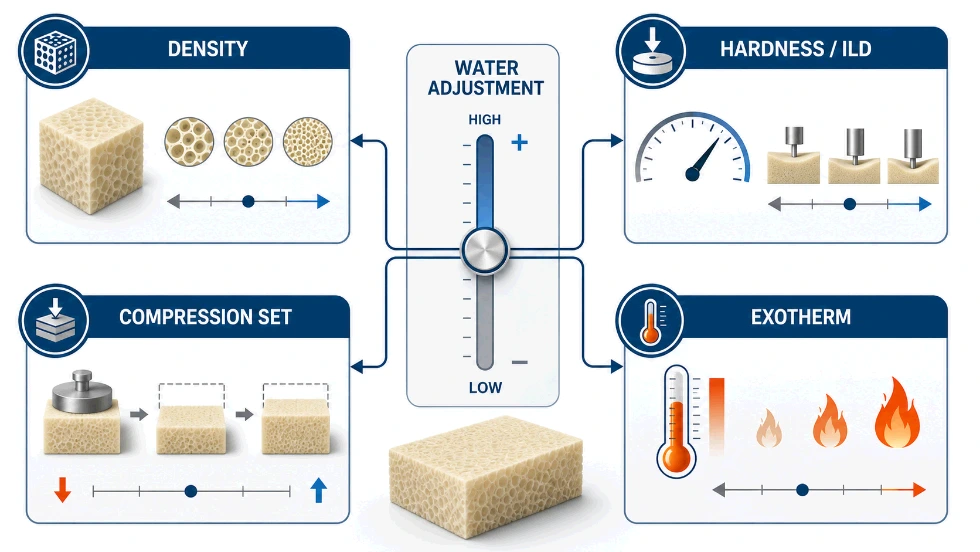
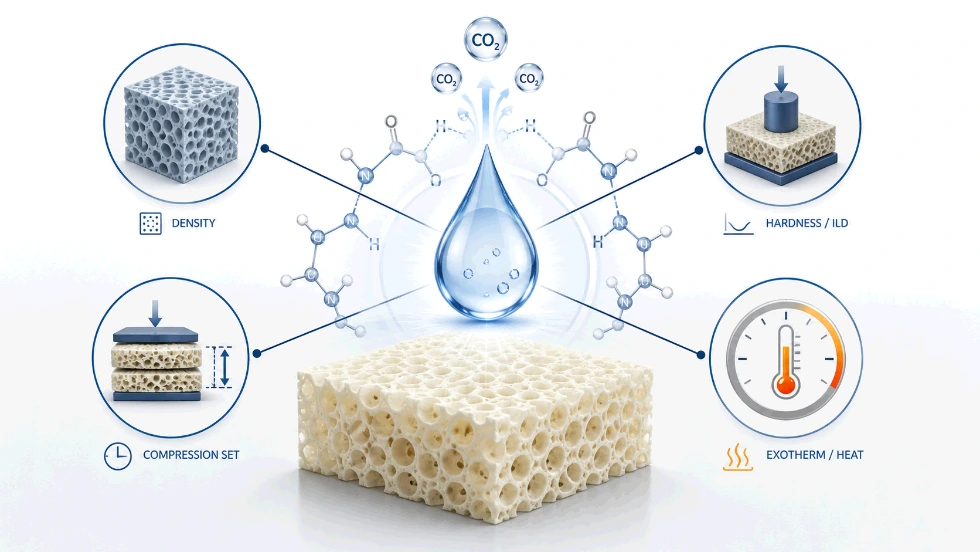
    Water level changes four major properties at the same time:

    1. Density
    2. Hardness / ILD
    3. Compression set
    4. Exotherm

    This article explains how each property responds to water level and why water should never be treated as a single-function density control variable.

    Water Controls More Than Density

    Water is often adjusted to control foam density. That is understandable, because water reacts with isocyanate to generate carbon dioxide. The CO₂ expands the foam and helps create the cellular structure.

    But water also produces an amine intermediate, which reacts with another isocyanate group to form urea linkages. Those urea linkages become hard segments in the foam network.

    So every water change has two chemical consequences:

    • It changes gas generation (affecting density).
    • It changes urea formation (affecting hardness, recovery, compression set, and heat generation).

    This means water is not just a blowing-agent variable — it is also a structure-building variable.

    A plant that watches only density after a water change is only watching half of the effect.

    Water level in polyurethane foam changing CO2 generation and urea network formation

    Property 1: Density

    Density is the most visible property affected by water level.

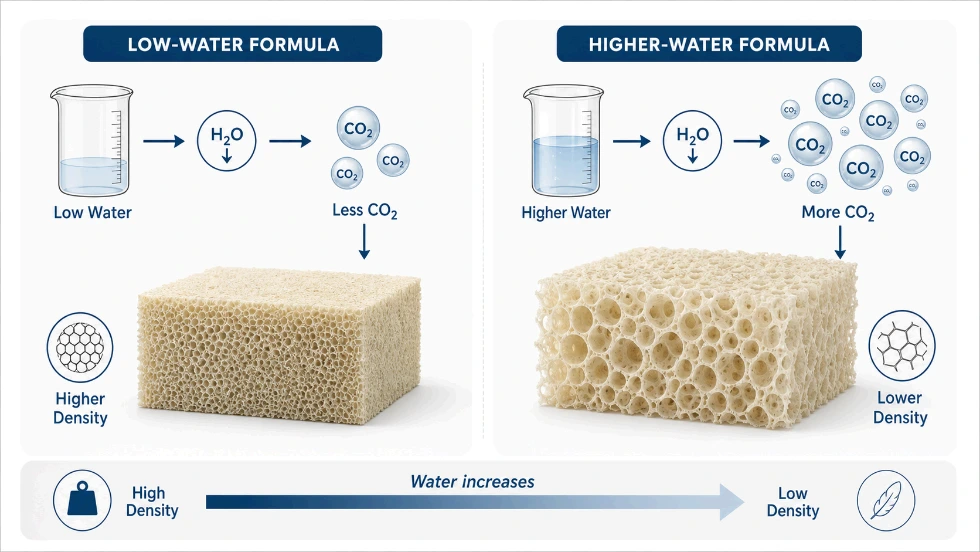
    When water reacts with isocyanate, carbon dioxide is released. This gas expands the foam mass and creates the cellular structure.

    • More water → more CO₂ → more expansion → lower density
    • Less water → less CO₂ → less expansion → higher density

    In flexible slabstock foam, a water increase can noticeably reduce density. As a practical rule, each 0.5 part increase in water may produce a meaningful density reduction, often in the range of several percent depending on the full formulation and process conditions.

    However, density response is not controlled by water alone. It also depends on:

    • Polyol type
    • Isocyanate index
    • Catalyst balance
    • Silicone surfactant
    • Cream time and rise profile
    • Cell opening
    • Block height
    • Production temperature
    • Machine mixing efficiency

    Water can be used to adjust density, but it should not be treated as a simple linear dial. A density correction must also be checked against the other property changes caused by water.

    Water level effect on polyurethane foam density through CO2 generation

    Property 2: Hardness / ILD

    Water also affects foam hardness. This is where troubleshooting often becomes confusing.

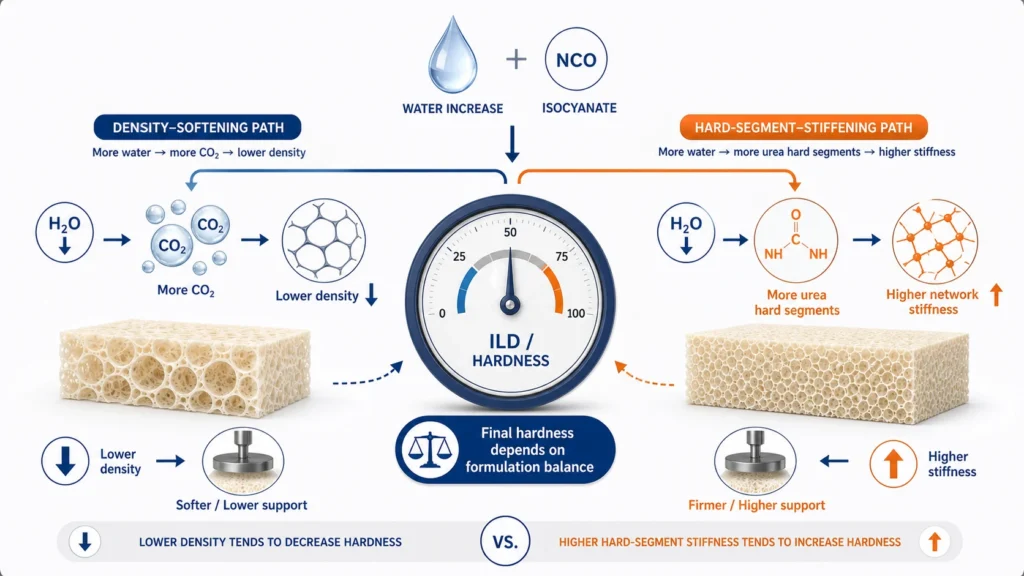
    When water level increases, density usually decreases — and lower density often tends to reduce load-bearing. But water also increases urea formation, and urea hard segments can stiffen the polymer network and raise hardness or ILD.

    So water can create two opposing effects:

    • More CO₂ → lower density (tends to reduce hardness)
    • More urea formation → stiffer network (tends to increase hardness)

    Which effect dominates depends on the formulation. The final hardness response depends on:

    • Index
    • Polyol functionality
    • Water level
    • Crosslinker level
    • Catalyst balance
    • Foam density
    • Cell structure
    • Cure condition

    This is why two formulas may respond differently to the same water adjustment. In one formula, increasing water may mainly reduce density and soften the foam. In another formula, the increased urea formation may partially offset the density effect and keep ILD higher than expected.

    Hardness should be tested after every meaningful water adjustment. Do not assume density movement alone predicts hardness movement.

    Water level effect on PU foam hardness and ILD through density and urea formation

    Property 3: Compression Set

    Compression set is one of the most important long-term performance properties affected by water level.

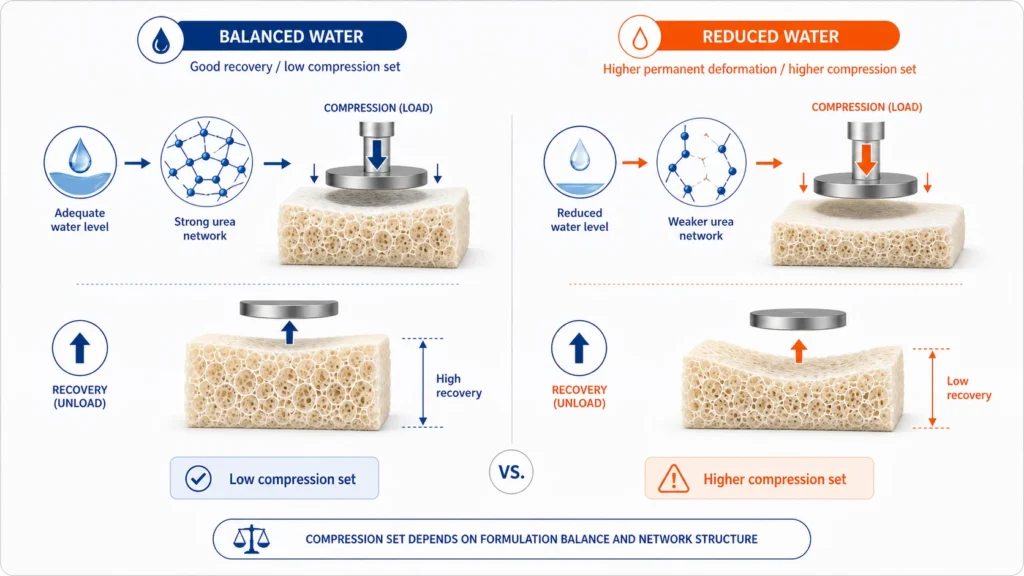
    Compression set measures how well foam recovers after being held under compression for a defined time and condition. Water affects compression set because water contributes to urea hard-segment formation. Urea linkages help build the foam network, and a stronger network usually improves resistance to permanent deformation.

    If water is reduced to fix a density issue, urea formation is also reduced. The foam may meet density target, and it may look acceptable during production, but the network may be weaker than intended.

    That weakness may appear later as:

    • Higher permanent deformation
    • Poorer recovery
    • Mattress or cushion complaints
    • Field returns after sustained load
    • Compression set values above specification

    This is why water reductions should be reviewed carefully. A water reduction can solve a density problem today and create a compression set problem later. The two problems may appear separated by weeks or months, but chemically they are connected.

    Water level affecting compression set in polyurethane foam through urea network formation

    Property 4: Exotherm

    Water also affects exotherm.

    The reaction sequence that forms urea linkages releases heat. As water level increases, the amount of urea formation increases, and the thermal load in the foam block can increase as well.

    This becomes especially important in high-water flexible slabstock formulas. At higher water levels — particularly around and above 4.5 parts — the risk of excessive core temperature becomes more serious, depending on block size, density, formulation, and ventilation.

    High exotherm can contribute to:

    • Core discoloration
    • Scorch risk
    • Cell structure irregularities
    • Reduced tensile strength in the block center
    • Internal property variation
    • Processing instability

    Large slabstock blocks are especially sensitive because heat dissipates slowly from the core. The outside of the block may look normal while the center experiences a much higher thermal load.

    This is why high-water formulas require thermal management, not only density calculation. Important factors include water level, block height, pour profile, catalyst package, foam density, ambient temperature, ventilation, cooling time, and raw material temperature.

    Water level is therefore also a heat-management variable.

    High water level causing exotherm and scorch risk in polyurethane foam slabstock core

    Why One Water Adjustment Moves Four Properties

    The four effects of water are connected because they come from the same chemistry.

    PropertyMain Reason
    DensityCO₂ generation changes foam expansion
    Hardness / ILDUrea hard segments change network stiffness
    Compression setUrea network affects long-term recovery
    ExothermUrea-forming reaction increases heat generation

    This is why “just changing water” is never just changing water. A small adjustment may be necessary and correct, but it should be treated as a full formulation change.

    When water is increased, check: Density reduction, index impact, hardness response, compression set, exotherm risk, and cell structure stability.

    When water is reduced, check: Density increase, index impact, urea network reduction, compression set risk, recovery and resilience, and customer performance requirements.

    Water can solve one production issue and create another if only one property is monitored.

    One water adjustment changing four polyurethane foam properties at once

    Practical Water Adjustment Checklist

    Before changing water level in a PU foam formula, review the full formulation impact.

    CheckpointQuestion
    DensityWhat density change is expected?
    IndexHas the isocyanate requirement been recalculated?
    Water EWIs water treated as EW = 9?
    Hardness / ILDWill the urea change affect hardness?
    Compression setWill the network still meet recovery requirements?
    ExothermIs the water level high enough to create core heat risk?
    Cell structureWill the surfactant and catalyst package still support stable cells?
    Production validationWill the trial include hardness, density, compression set, and core inspection?

    This checklist prevents a common production mistake: fixing the visible issue while creating a hidden performance problem.

    Example: A Density Fix That Creates Compression Set Risk

    A production team reduces water by 0.3 parts to correct a density issue.

    The next run looks better. Density is closer to target. The adjustment is considered successful.

    But the water reduction also reduces urea formation. If the formula is not rebalanced, the foam network may become weaker. The effect may not show up immediately during production.

    Weeks later, compression set complaints appear.

    The team may treat this as a new problem, but it is connected to the earlier water adjustment. This is why water changes should be documented, recalculated, and validated against more than density.

    A water adjustment should be accepted only after checking density, ILD, compression set, index, cure behaviour, exotherm, and customer application requirement.

    Use the PolymerIQ Calculators

    The PolymerIQ Foam Density Estimator can help estimate the density impact of water level changes before they reach production. Use it when increasing or reducing water, comparing different water levels, reviewing low-density foam formulas, or checking whether a density correction may create other risks.

    Open the Foam Density Estimator →

    Because water consumes NCO, every water change affects the index. The PolymerIQ Isocyanate Index Calculator helps verify the corrected isocyanate requirement after a water adjustment. Use it when water level changes, TDI or MDI quantity needs recalculation, compression set changes after a water adjustment, foam hardness changes unexpectedly, or a formula has been adjusted without full recalculation.

    Open the Isocyanate Index Calculator →

    For the chemistry behind water’s dual role, read The Dual Role of Water in Polyurethane Foam: Blowing Agent and Urea Network Builder.

    For the water equivalent weight calculation, read Why the Equivalent Weight of Water Is 9 in Polyurethane Foam.

    For the full index calculation guide, read Isocyanate Index Calculation Guide for PU Foam Engineers.

    FAQs

    How does water level affect PU foam density?

    Water reacts with isocyanate to generate CO₂. More water generates more CO₂, which increases foam expansion and lowers density. As a practical rule, each 0.5 part increase in water can produce a meaningful density reduction, but the exact response depends on polyol type, index, catalyst balance, silicone, block height, and process conditions.

    Why does water affect foam hardness in two directions?

    Water has two opposing effects. More water lowers density (which tends to reduce hardness), but more water also increases urea hard-segment formation (which tends to stiffen the network and raise hardness). Which effect dominates depends on the full formulation. This is why hardness should be tested after every water adjustment — density alone does not predict it.

    How does water level affect compression set?

    Water contributes to urea linkage formation, and urea hard segments help build the foam network. A stronger network resists permanent deformation better. If water is reduced to fix density, urea formation also drops, and the network may be weaker. Compression set problems can appear weeks or months later as a result.

    Why does high water level increase exotherm risk?

    The reaction sequence that forms urea linkages releases heat. More water means more urea formation, which means more heat generated during the rise and cure. In large slabstock blocks, this heat dissipates slowly from the core, and at high water levels (particularly around or above 4.5 parts) the core can reach temperatures that risk discoloration, scorch, or cell structure problems.

    Can a water reduction cause compression set failure?

    Yes. Reducing water reduces both CO₂ generation and urea formation. If the isocyanate level and overall formulation are not rebalanced, the foam network can be weaker than intended. The density may meet target, but compression set, recovery, and long-term performance may suffer. This is one of the most common hidden consequences of a “simple” density correction.

    Should I recalculate the isocyanate index every time I change water?

    Yes. Water is a reactive component. Every water change alters the total reactive hydrogen equivalents in the formula, which means the isocyanate demand changes. If the isocyanate quantity is not recalculated, the actual running index drifts away from the target — even if the formula sheet still shows the original number.

    Why does the same water adjustment behave differently in different formulas?

    Because water’s effects depend on the rest of the formulation. Polyol type, functionality, crosslinker level, catalyst balance, silicone, density, and cure conditions all influence how the foam responds to a water change. A formula that softens with more water may stiffen in another system where urea formation dominates.

    What’s the maximum safe water level in flexible slabstock?

    There is no universal limit — it depends on block size, density target, formulation, ventilation, and process conditions. Many flexible slabstock formulas operate up to around 4.0–4.5 parts water without major exotherm concerns. Above this level, thermal management becomes increasingly important. The combination of high water, large block size, and low density poses the highest scorch risk.

    How do I troubleshoot foam that’s too soft after a water change?

    First, check whether the actual running index is correct after the water adjustment — water consumes NCO, so an unadjusted isocyanate quantity creates an under-indexed system. Second, check whether the urea contribution change is large enough to affect network stiffness. Third, verify that catalyst, silicone, and crosslinker levels still match the new water level.

    What should I check before increasing water to lower density?

    Check density target, expected index after recalculation, hardness response, compression set requirements, exotherm and core heat risk, surfactant and catalyst compatibility at the new water level, and customer performance specifications. A water increase is rarely a single-property change — it should be approached as a full formulation review.

    Key Takeaways

    Water level affects much more than foam density. It controls four major foam properties at the same time:

    1. Density — through CO₂ generation
    2. Hardness / ILD — through urea hard-segment formation
    3. Compression set — through urea network contribution
    4. Exotherm — through heat from the urea-forming reaction

    Water generates CO₂, which affects foam expansion and density. Water also creates urea linkages, which affect hardness, recovery, compression set, and heat generation.

    A water adjustment made only for density can change foam performance in ways that appear later. Higher water can reduce density but increase urea formation and exotherm risk. Lower water can increase density but reduce urea network contribution and increase compression set risk if the formula is not rebalanced.

    Every water adjustment should include index recalculation, density review, hardness testing, compression set validation, and exotherm awareness.

    Conclusion

    If your plant has used water adjustments to fix density but later faced hardness drift, compression set failure, or core heat problems, the issue may not be random.

    Water moves several properties at once.

    PolymersIQ can help review your water level, index balance, density target, compression set performance, and exotherm risk to identify where the formulation balance is off.

    To get accurate support, please share:

    • Current and target foam density
    • Water level (recent and historical)
    • Polyol grade, OHV, and isocyanate %NCO
    • Target index and observed foam properties (ILD, compression set)
    • Block size and any core temperature observations
    • Description of the production issue and any adjustments already tried

    Contact PolymerIQ for a water-level formulation audit →