
Introduction
A polyurethane foam plant had been running the same flexible slabstock formula for months. The foam looked normal. It rose properly, the block size was within tolerance, and the machine settings had not changed. But the final product was consistently harder than the target specification.
ILD values were coming out 15 to 20 percent above the design grade. Compression set was marginal. Customers started complaining that the foam felt too stiff after unpacking.
The production team investigated the usual suspects. They changed the polyol lot. They adjusted amine catalyst levels. They reviewed silicone performance. They checked temperature conditions. Nothing solved the problem.
The formula sheet said the foam was running at Index 105. In reality, it was running at Index 112.
The issue was not the polyol, the catalyst, or the silicone. The problem was the isocyanate index calculation. One reactive component had been missed, and the isocyanate quantity had not been recalculated after a water adjustment.
This is why the isocyanate index is one of the most important control numbers in polyurethane foam production. It affects hardness, compression set, resilience, aging behaviour, dimensional stability, and batch consistency. When it is calculated incorrectly, the foam may still rise and look acceptable, but the final properties can move far outside specification.
What Is Isocyanate Index in Polyurethane Foam?
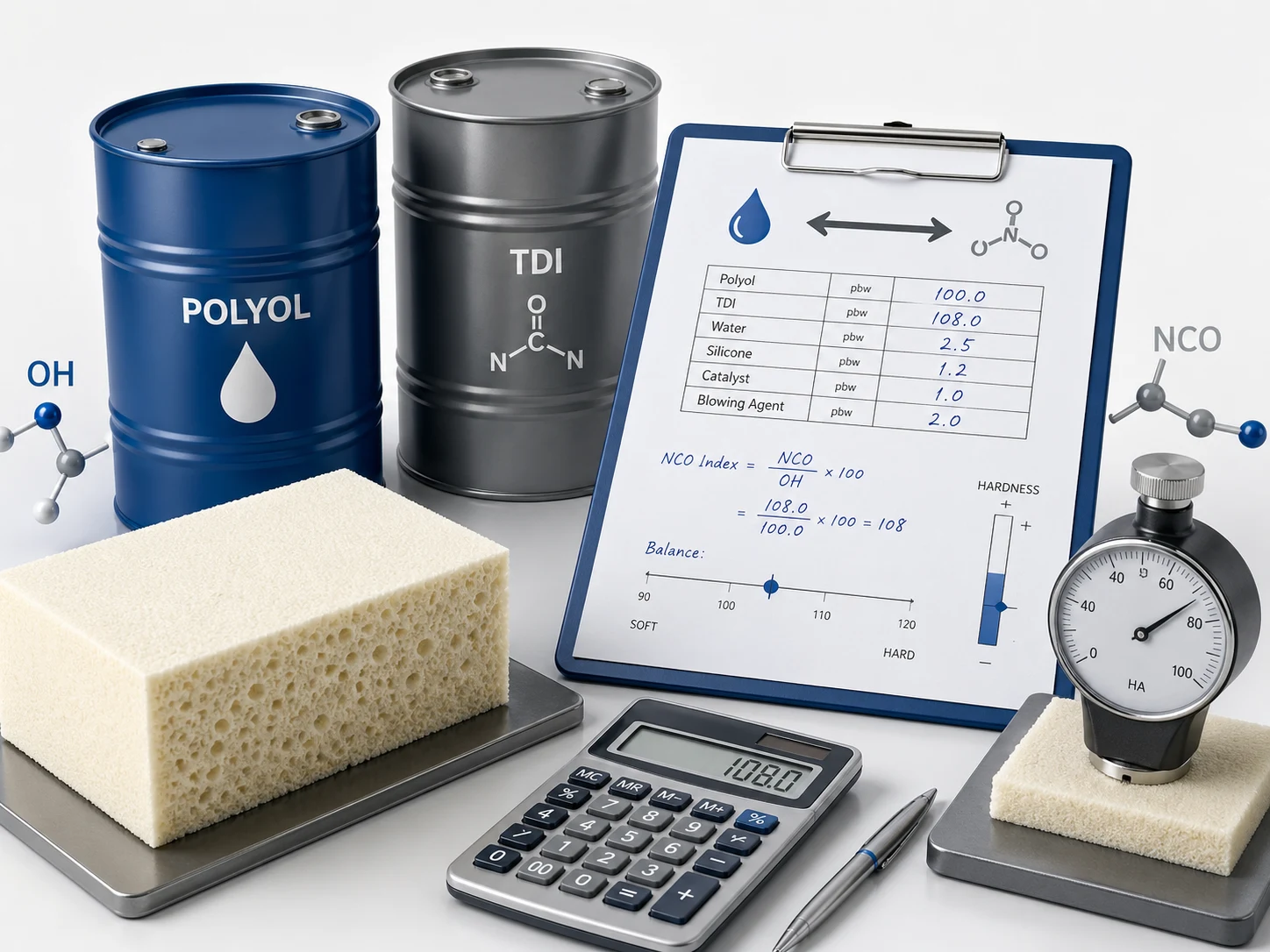
The isocyanate index is the ratio between the actual NCO equivalents used in a formulation and the theoretical NCO equivalents required for exact stoichiometric balance.
In simple terms:
Isocyanate Index = (Actual NCO equivalents ÷ Theoretical NCO equivalents required) × 100
At Index 100, the formulation has exactly enough NCO groups to react with all active hydrogen groups in the system. In theory, every NCO group has a matching reactive hydrogen partner.
But in real polyurethane foam production, Index 100 is rarely the practical target.

Why Index 100 Is Usually Not the Target
Perfect stoichiometric balance sounds logical, but polyurethane chemistry does not stop at the main polyol-isocyanate reaction.
During foam formation, NCO groups can also react with:
- Water
- Urea linkages
- Urethane linkages
- Crosslinkers
- Chain extenders
- Atmospheric moisture
- Other NCO groups under heat
These secondary reactions consume additional NCO beyond the basic theoretical requirement.
If a flexible foam formula is run exactly at Index 100, these extra reactions may effectively pull the system below the desired balance. The result can be lower crosslink density, softer foam, poorer compression set, and weaker aging performance.
This is why flexible slabstock foam commonly runs above Index 100. Many flexible foam systems are developed in the range of approximately Index 105 to 115, depending on the required hardness, density, resilience, and compression set performance.
The correct target index is not selected from theory alone. It is established through practical formulation trials and production validation.

What the Index Is Actually Measuring
The isocyanate index measures how much NCO is available compared with all reactive hydrogen sources in the formulation.
Reactive hydrogen sources include:
- Hydroxyl groups from polyol
- Hydrogen atoms from water
- Hydroxyl groups from crosslinkers
- Amine groups from chain extenders
- Any additive with active hydrogen functionality
This is where many calculation errors happen.
Most engineers include polyol and water because they are the main reactive components. But crosslinkers, chain extenders, and other active hydrogen additives are sometimes missed. Even small quantities can shift the real index by several points.
For example, a crosslinker at only 0.5 to 1.5 parts per hundred polyol can create a meaningful index difference if it is excluded from the denominator.
That difference may not be visible during foaming, but it can appear later as hardness drift, compression set failure, poor recovery, or batch-to-batch inconsistency.
Isocyanate Index Is a Control Parameter, Not Just a Recipe Number
A formulation sheet may show polyol, water, catalyst, silicone, crosslinker, and TDI or MDI levels. These are recipe components.
The index is different.
The index describes the chemical balance between reactive components. It is a control parameter.
This means the index changes whenever any reactive component changes:
| Change in Formulation | Effect on Index |
|---|---|
| Increase water | Index changes |
| Add or remove crosslinker | Index changes |
| Change polyol OH value | Index changes |
| New isocyanate batch with different %NCO | Index changes |
| Adjust chain extender | Index changes |
The isocyanate parts cannot remain fixed after reactive formulation changes. Every adjustment to a reactive component requires a fresh index calculation.
This is one of the most important rules in polyurethane formulation discipline.

The Basic Calculation Method
To calculate isocyanate index correctly, you need to calculate the equivalent contribution of each reactive component.
The process is:
- Calculate the equivalent weight of the polyol.
- Calculate the equivalent weight of water.
- Calculate the equivalent weight of the isocyanate.
- Calculate the equivalent weight of crosslinkers or chain extenders.
- Convert each component into equivalents.
- Add the total reactive hydrogen equivalents.
- Calculate the NCO required for the target index.
- Convert the required NCO equivalents into isocyanate parts.
The calculation is not difficult, but every reactive component must be included.
Step 1: Calculate Polyol Equivalent Weight
For a polyol, equivalent weight is calculated from the hydroxyl value.
Polyol Equivalent Weight = 56,100 ÷ OH Value
Where OH value is measured in mg KOH/g.
Example:
- Polyol OH value = 56 mg KOH/g
- Calculation: 56,100 ÷ 56 = 1,001.8 g/eq
The number 56,100 comes from the molecular weight of potassium hydroxide multiplied by 1,000 for unit conversion.
Step 2: Calculate Water Equivalent Weight
Water is the component most often calculated incorrectly.
Water has a molecular weight of 18 g/mol, but its equivalent weight in polyurethane formulation is not 18.
Water has two reactive hydrogen atoms. One water molecule consumes two NCO groups during the polyurethane blowing reaction.
Therefore:
Water Equivalent Weight = 18 ÷ 2 = 9 g/eq
So the correct equivalent weight of water is always 9 g/eq.
This is a critical rule. Using 18 instead of 9 cuts the water contribution in half and can create a major index error. In flexible foam, this mistake can shift the real running index by many points and produce foam that is much harder than expected.

Step 3: Calculate Isocyanate Equivalent Weight
For isocyanate, equivalent weight is calculated from the %NCO value.
Isocyanate Equivalent Weight = 4,200 ÷ %NCO
Example using TDI 80/20:
- TDI %NCO = 48.3%
- Calculation: 4,200 ÷ 48.3 = 86.96 g/eq
Important note: Use the actual %NCO from the Certificate of Analysis for the drum or batch being used. Do not simply use the general range from the Technical Data Sheet.
Step 4: Calculate Crosslinker or Chain Extender Equivalent Weight
Any reactive crosslinker or chain extender must also be included.
For hydroxyl-based crosslinkers, the same formula used for polyol can be applied:
Equivalent Weight = 56,100 ÷ OH Value
Example using DEOA:
- DEOA OH value = approximately 1,260 mg KOH/g
- Calculation: 56,100 ÷ 1,260 = 44.5 g/eq
Even when used at low levels, crosslinkers can strongly affect the index calculation because their equivalent weight is much lower than that of the main polyol.
Step 5: Convert Each Component Into Equivalents
Now convert each reactive component into equivalents.
Equivalents = Parts in Formula ÷ Equivalent Weight
Example formulation:
| Component | Parts | Equivalent Weight | Equivalents |
|---|---|---|---|
| Polyol | 100.0 | 1,001.8 | 0.09982 |
| Water | 3.5 | 9.0 | 0.38889 |
| DEOA crosslinker | 0.5 | 44.5 | 0.01124 |
| Total Reactive H | 0.49995 |
Total reactive hydrogen equivalents: 0.49995
This total becomes the denominator for the isocyanate index calculation.
Step 6: Calculate Required NCO Equivalents for Target Index
Now apply the target index.
Required NCO Equivalents = Total Reactive H Equivalents × Target Index ÷ 100
Target Index = 105
Calculation: 0.49995 × 10⁵ ÷ 100 = 0.52495 eq
So the formulation requires 0.52495 NCO equivalents to run at Index 105.
Step 7: Convert NCO Equivalents Into Isocyanate Parts
Finally, multiply the required NCO equivalents by the equivalent weight of the isocyanate.
Isocyanate Parts = Required NCO Equivalents × Isocyanate Equivalent Weight
Using TDI EW = 86.96:
0.52495 × 86.96 = 45.64 parts
So the correct TDI quantity is 45.64 PPHP.
Final formula at Index 105:
| Component | Parts |
|---|---|
| Polyol | 100.00 |
| Water | 3.50 |
| DEOA | 0.50 |
| TDI 80/20 | 45.64 |

What Happens If You Miss a Reactive Component?
Now let’s see what happens if the DEOA crosslinker is excluded from the calculation.
Without DEOA, the reactive hydrogen total becomes:
| Component | Equivalents |
|---|---|
| Polyol | 0.09982 |
| Water | 0.38889 |
| DEOA | Excluded |
| Total Reactive H | 0.48871 |
Using the incorrect total:
0.48871 × 1.05 × 86.96 = 44.62 PPHP TDI
But the correct TDI amount is 45.64 PPHP TDI.
That difference may look small, but chemically it matters.
The formulator believes the foam is running at Index 105. In reality, the actual index is lower because the reactive crosslinker was not included.
This can affect:
- Foam hardness
- Compression set
- Recovery
- Crosslink density
- Aging behaviour
- Batch consistency
At higher crosslinker levels, the error becomes much larger. A formula with 1.0 to 1.5 parts of crosslinker can shift several index points if the component is missed.
This is why every active hydrogen source must be included in the calculation.

Common Signs of Index Calculation Problems
A wrong isocyanate index can create symptoms that look like other production problems.
Common signs include:
- Foam consistently harder than target
- Foam consistently softer than target
- ILD variation between batches
- Compression set failure
- Poor resilience
- Brittleness at higher index
- Moisture sensitivity at lower index
- Different foam properties on different machines
- No clear improvement after catalyst or silicone adjustments
When foam properties are wrong but the process looks normal, the index calculation should be one of the first things checked.
Practical Rules for Production
Use these rules for safer formulation control:
- Use water equivalent weight as 9, not 18. This is one of the most important calculation rules in PU foam.
- Use actual %NCO from the Certificate of Analysis. Do not rely only on the TDS range.
- Include every reactive component. Polyol, water, crosslinkers, chain extenders, and active hydrogen additives must be included.
- Recalculate after every formulation change. Any change in water, polyol, crosslinker, chain extender, or isocyanate quality changes the index.
- Do not treat index as a fixed recipe number. Index is a stoichiometric control parameter and must be managed like one.
Use the PolymerIQ Isocyanate Index Calculator
Manual calculations are useful for understanding the chemistry, but production teams need a fast way to verify formulas.
The PolymerIQ Isocyanate Index Calculator helps you check:
- Polyol equivalent weight
- Water contribution
- Isocyanate equivalent weight
- Crosslinker contribution
- Required TDI or MDI parts
- Actual running index
Use it to verify new formulations, check existing formula sheets, or audit production adjustments before they create quality problems.
Open the Isocyanate Index Calculator →
FAQs
What is the isocyanate index in polyurethane foam?
The isocyanate index is the ratio of actual NCO equivalents used in a formulation to the theoretical NCO equivalents required for stoichiometric balance, multiplied by 100. It is a control parameter that describes the chemical balance between NCO groups and all reactive hydrogen sources in the system.
Why is the equivalent weight of water 9 and not 18?
Water has a molecular weight of 18, but each water molecule has two reactive hydrogen atoms and consumes two NCO groups during the blowing reaction. So the equivalent weight is 18 ÷ 2 = 9 g/eq. Using 18 in the calculation cuts the water contribution in half and can shift the real index by many points.
What is the typical isocyanate index for flexible foam?
Flexible slabstock foam is commonly developed in the range of approximately Index 105 to 115, depending on the required hardness, density, resilience, and compression set performance. The exact target should be established through formulation trials and production validation, not selected from theory alone.
Should I use %NCO from the TDS or the Certificate of Analysis?
Always use the actual %NCO from the Certificate of Analysis for the specific drum or batch being used. The Technical Data Sheet typically shows a range, and using the range value instead of the actual COA value can introduce calculation errors when the batch %NCO sits at the edge of the range.
Do I need to include crosslinkers in the index calculation?
Yes. Crosslinkers, chain extenders, and any additive with active hydrogen functionality must be included in the reactive hydrogen total. Even small amounts (0.5 to 1.5 parts per hundred polyol) can shift the real index by several points if excluded.
What happens if I run a formula at exactly Index 100?
Index 100 represents theoretical stoichiometric balance, but in real foam chemistry, NCO groups are also consumed by secondary reactions (urea, urethane, atmospheric moisture, crosslinkers). Running at Index 100 can effectively pull the system below balance, leading to lower crosslink density, softer foam, and weaker aging performance.
How do I calculate polyol equivalent weight?
Polyol equivalent weight is calculated from the hydroxyl value: Equivalent Weight = 56,100 ÷ OH Value (mg KOH/g). For a polyol with OH value of 56 mg KOH/g, the equivalent weight is 56,100 ÷ 56 = 1,001.8 g/eq.
Why does my foam keep coming out harder than target even though the formula has not changed?
If the foam is consistently harder than expected and process variables are normal, the running index is likely higher than the formula sheet shows. Common causes include: a reactive component (such as a crosslinker) was added but not included in a fresh index calculation, the %NCO of the new isocyanate batch is higher than the previous one, or the water level was adjusted without recalculating the TDI quantity.
How often should I recalculate the index?
Every time any reactive component changes — water, polyol OH value, crosslinker, chain extender, or isocyanate %NCO. The isocyanate index is not a fixed recipe number and cannot be treated as one.
Key Takeaways
The isocyanate index is one of the most important control parameters in polyurethane foam formulation. It is not just a number written at the top of a formula sheet — it represents the chemical balance between NCO groups and all reactive hydrogen sources in the system.
The most important points are:
- Index 100 means theoretical stoichiometric balance.
- Flexible foam often runs above Index 100 because of secondary NCO reactions.
- Water equivalent weight is 9, not 18.
- Every reactive component must be included in the denominator.
- Crosslinkers and chain extenders are not passive additives.
- The %NCO should come from the Certificate of Analysis.
- Any formulation adjustment requires a fresh index calculation.
If a foam plant is facing unexplained hardness, compression set, or batch variation problems, the isocyanate index calculation is one of the first places to investigate.
A small calculation error can silently create months of off-spec production.
Conclusion
If your formulation sheet has been adjusted over time without recalculating the isocyanate index, the number written on the sheet may no longer reflect production reality.
PolymerIQ can help review your formulation, check your index calculation, and identify whether stoichiometric imbalance is contributing to foam quality problems.
To get accurate support, please share:
- Polyol grade and OH value
- Water level and any other reactive components
- Isocyanate type and %NCO from the Certificate of Analysis
- Target index and observed foam properties (ILD, compression set, density)
- Description of the quality issue you are facing
Contact PolymerIQ for a formulation audit →
Comments
One response to “Isocyanate Index Calculation Guide for PU Foam Engineers”
[…] For the full calculation method, worked example, and equivalent weight formulas, read our companion guide: Isocyanate Index Calculation Guide for PU Foam Engineers. […]