
Tag: Foam Hardness

  • How Water Level Effects PU Foam Properties

    How Water Level Effects PU Foam Properties


    Introduction

    Water level is one of the most powerful variables in flexible polyurethane foam formulation.

    Most engineers understand its effect on density. Increase water — more carbon dioxide is generated, more gas expands the foam matrix, density usually decreases. Reduce water — less CO₂, less expansion, density usually increases.

    That part is simple.

    The problem is that water does not control only density.

    Water also affects urea formation, hardness, compression set, resilience, exotherm, and isocyanate demand. A water adjustment made for one reason can quietly create a second problem somewhere else in the foam. This is why a density correction can later become a compression set complaint.

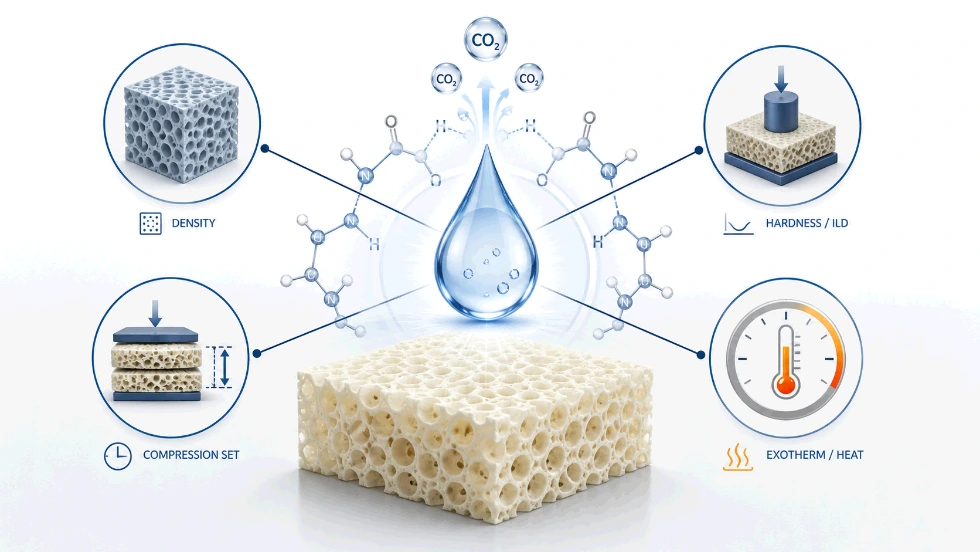
    Water level changes four major properties at the same time:

    1. Density
    2. Hardness / ILD
    3. Compression set
    4. Exotherm

    This article explains how each property responds to water level and why water should never be treated as a single-function density control variable.

    Water Controls More Than Density

    Water is often adjusted to control foam density. That is understandable, because water reacts with isocyanate to generate carbon dioxide. The CO₂ expands the foam and helps create the cellular structure.

    But water also produces an amine intermediate, which reacts with another isocyanate group to form urea linkages. Those urea linkages become hard segments in the foam network.

    So every water change has two chemical consequences:

    • It changes gas generation (affecting density).
    • It changes urea formation (affecting hardness, recovery, compression set, and heat generation).

    This means water is not just a blowing-agent variable — it is also a structure-building variable.

    A plant that watches only density after a water change is only watching half of the effect.
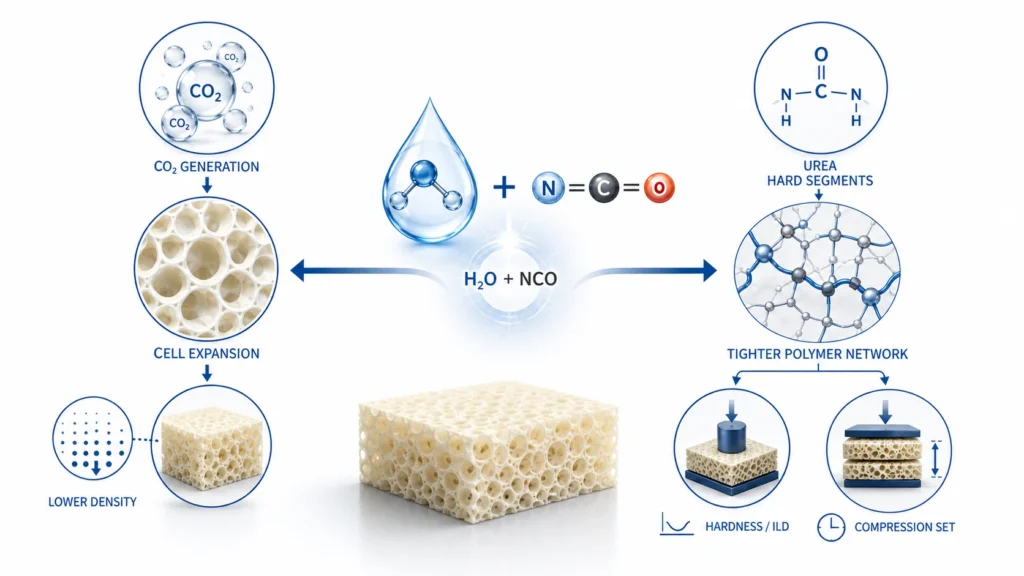
    Water level in polyurethane foam changing CO2 generation and urea network formation

    Property 1: Density

    Density is the most visible property affected by water level.

    When water reacts with isocyanate, carbon dioxide is released. This gas expands the foam mass and creates the cellular structure.

    • More water → more CO₂ → more expansion → lower density
    • Less water → less CO₂ → less expansion → higher density

    In flexible slabstock foam, a water increase can noticeably reduce density. As a practical rule, each 0.5 part increase in water may produce a meaningful density reduction, often in the range of several percent depending on the full formulation and process conditions.

    However, density response is not controlled by water alone. It also depends on:

    • Polyol type
    • Isocyanate index
    • Catalyst balance
    • Silicone surfactant
    • Cream time and rise profile
    • Cell opening
    • Block height
    • Production temperature
    • Machine mixing efficiency

    Water can be used to adjust density, but it should not be treated as a simple linear dial. A density correction must also be checked against the other property changes caused by water.
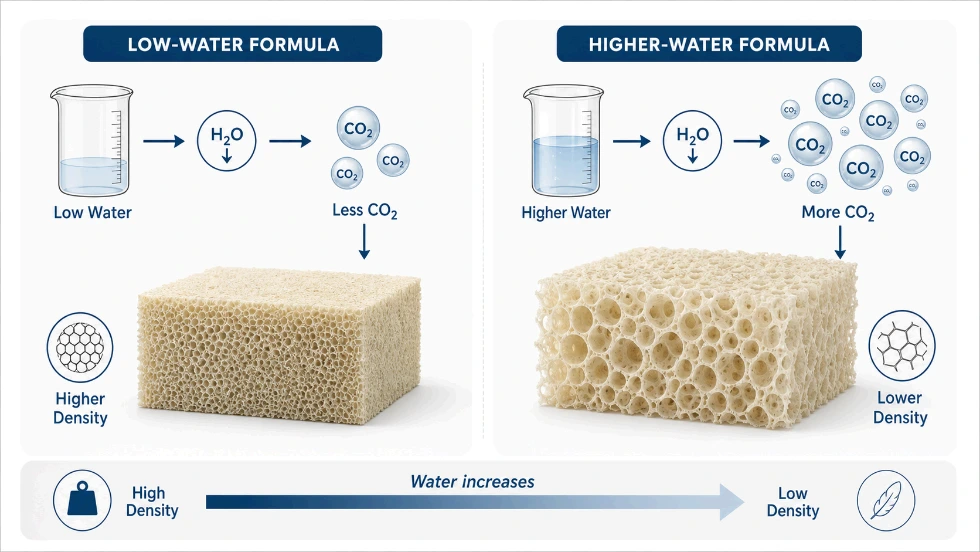
    Water level effect on polyurethane foam density through CO2 generation

    Property 2: Hardness / ILD

    Water also affects foam hardness. This is where troubleshooting often becomes confusing.

    When water level increases, density usually decreases — and lower density often tends to reduce load-bearing. But water also increases urea formation, and urea hard segments can stiffen the polymer network and raise hardness or ILD.

    So water can create two opposing effects:

    • More CO₂ → lower density (tends to reduce hardness)
    • More urea formation → stiffer network (tends to increase hardness)

    Which effect dominates depends on the formulation. The final hardness response depends on:

    • Index
    • Polyol functionality
    • Water level
    • Crosslinker level
    • Catalyst balance
    • Foam density
    • Cell structure
    • Cure condition

    This is why two formulas may respond differently to the same water adjustment. In one formula, increasing water may mainly reduce density and soften the foam. In another formula, the increased urea formation may partially offset the density effect and keep ILD higher than expected.

    Hardness should be tested after every meaningful water adjustment. Do not assume density movement alone predicts hardness movement.
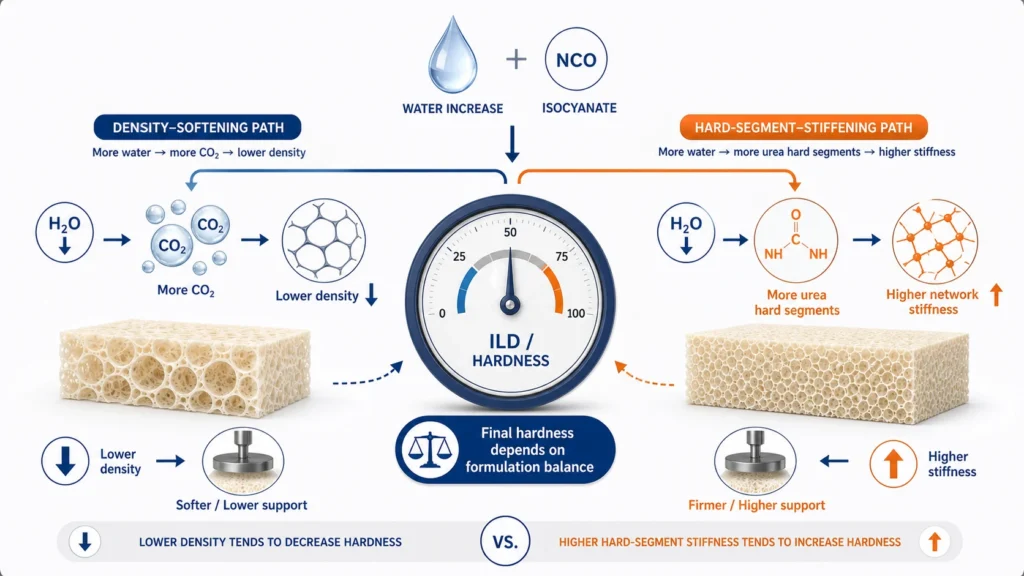
    Water level effect on PU foam hardness and ILD through density and urea formation

    Property 3: Compression Set

    Compression set is one of the most important long-term performance properties affected by water level.

    Compression set measures how well foam recovers after being held under compression for a defined time and condition. Water affects compression set because water contributes to urea hard-segment formation. Urea linkages help build the foam network, and a stronger network usually improves resistance to permanent deformation.

    If water is reduced to fix a density issue, urea formation is also reduced. The foam may meet density target, and it may look acceptable during production, but the network may be weaker than intended.

    That weakness may appear later as:

    • Higher permanent deformation
    • Poorer recovery
    • Mattress or cushion complaints
    • Field returns after sustained load
    • Compression set values above specification

    This is why water reductions should be reviewed carefully. A water reduction can solve a density problem today and create a compression set problem later. The two problems may appear separated by weeks or months, but chemically they are connected.
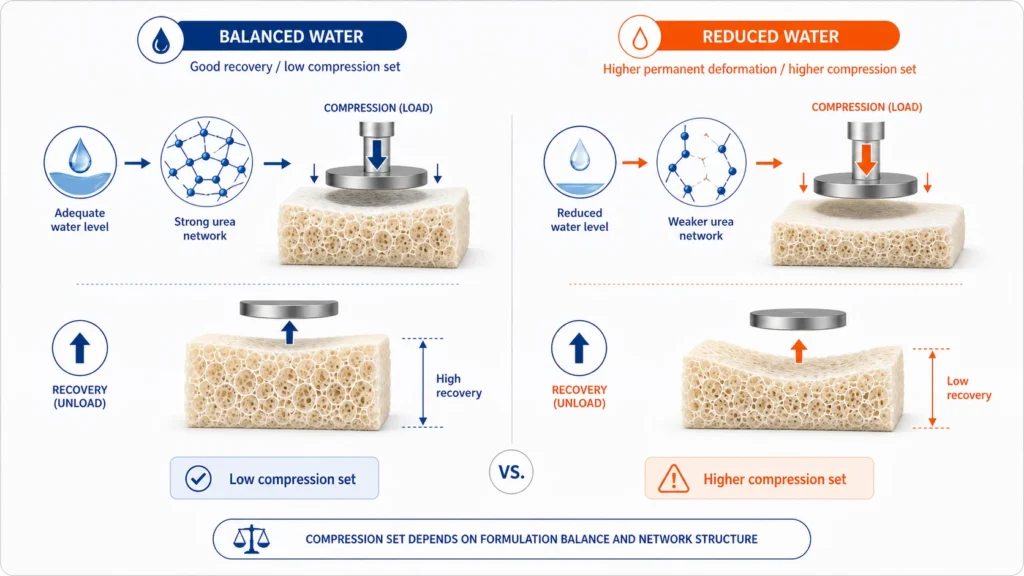
    Water level affecting compression set in polyurethane foam through urea network formation

    Property 4: Exotherm

    Water also affects exotherm.

    The reaction sequence that forms urea linkages releases heat. As water level increases, the amount of urea formation increases, and the thermal load in the foam block can increase as well.

    This becomes especially important in high-water flexible slabstock formulas. At higher water levels — particularly around and above 4.5 parts — the risk of excessive core temperature becomes more serious, depending on block size, density, formulation, and ventilation.

    High exotherm can contribute to:

    • Core discoloration
    • Scorch risk
    • Cell structure irregularities
    • Reduced tensile strength in the block center
    • Internal property variation
    • Processing instability

    Large slabstock blocks are especially sensitive because heat dissipates slowly from the core. The outside of the block may look normal while the center experiences a much higher thermal load.

    This is why high-water formulas require thermal management, not only density calculation. Important factors include water level, block height, pour profile, catalyst package, foam density, ambient temperature, ventilation, cooling time, and raw material temperature.

    Water level is therefore also a heat-management variable.
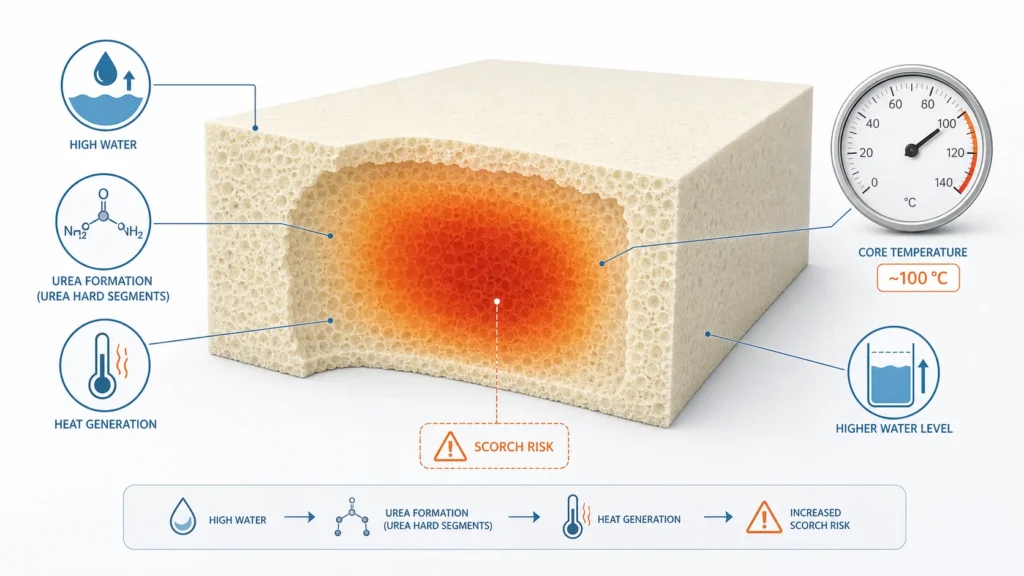
    High water level causing exotherm and scorch risk in polyurethane foam slabstock core

    Why One Water Adjustment Moves Four Properties

    The four effects of water are connected because they come from the same chemistry.

    PropertyMain Reason
    DensityCO₂ generation changes foam expansion
    Hardness / ILDUrea hard segments change network stiffness
    Compression setUrea network affects long-term recovery
    ExothermUrea-forming reaction increases heat generation

    This is why “just changing water” is never just changing water. A small adjustment may be necessary and correct, but it should be treated as a full formulation change.

    When water is increased, check: Density reduction, index impact, hardness response, compression set, exotherm risk, and cell structure stability.

    When water is reduced, check: Density increase, index impact, urea network reduction, compression set risk, recovery and resilience, and customer performance requirements.

    Water can solve one production issue and create another if only one property is monitored.
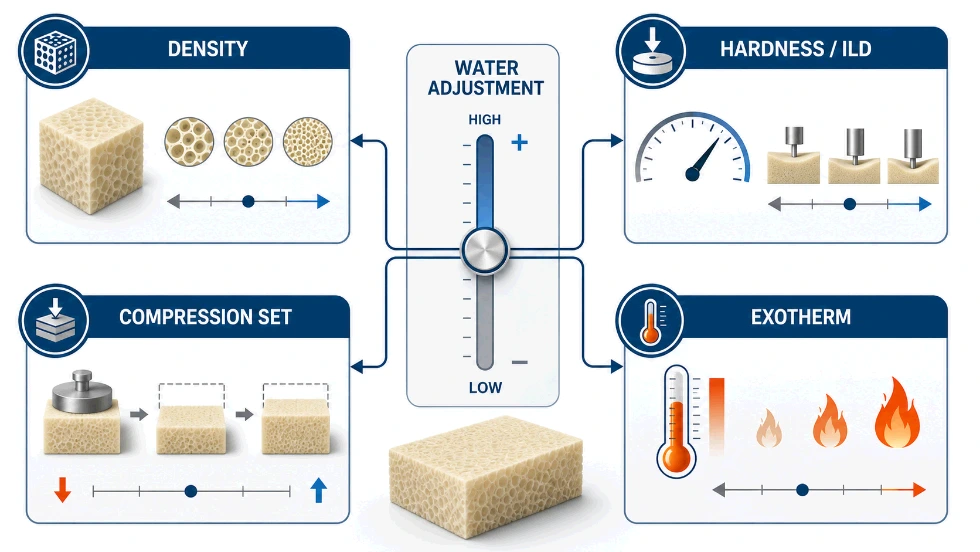
    One water adjustment changing four polyurethane foam properties at once

    Practical Water Adjustment Checklist

    Before changing water level in a PU foam formula, review the full formulation impact.

    CheckpointQuestion
    DensityWhat density change is expected?
    IndexHas the isocyanate requirement been recalculated?
    Water EWIs water treated as EW = 9?
    Hardness / ILDWill the urea change affect hardness?
    Compression setWill the network still meet recovery requirements?
    ExothermIs the water level high enough to create core heat risk?
    Cell structureWill the surfactant and catalyst package still support stable cells?
    Production validationWill the trial include hardness, density, compression set, and core inspection?

    This checklist prevents a common production mistake: fixing the visible issue while creating a hidden performance problem.

    Example: A Density Fix That Creates Compression Set Risk

    A production team reduces water by 0.3 parts to correct a density issue.

    The next run looks better. Density is closer to target. The adjustment is considered successful.

    But the water reduction also reduces urea formation. If the formula is not rebalanced, the foam network may become weaker. The effect may not show up immediately during production.

    Weeks later, compression set complaints appear.

    The team may treat this as a new problem, but it is connected to the earlier water adjustment. This is why water changes should be documented, recalculated, and validated against more than density.

    A water adjustment should be accepted only after checking density, ILD, compression set, index, cure behaviour, exotherm, and customer application requirement.

    Use the PolymerIQ Calculators

    The PolymerIQ Foam Density Estimator can help estimate the density impact of water level changes before they reach production. Use it when increasing or reducing water, comparing different water levels, reviewing low-density foam formulas, or checking whether a density correction may create other risks.

    Open the Foam Density Estimator →

    Because water consumes NCO, every water change affects the index. The PolymerIQ Isocyanate Index Calculator helps verify the corrected isocyanate requirement after a water adjustment. Use it when water level changes, TDI or MDI quantity needs recalculation, compression set changes after a water adjustment, foam hardness changes unexpectedly, or a formula has been adjusted without full recalculation.

    Open the Isocyanate Index Calculator →

    For the chemistry behind water’s dual role, read The Dual Role of Water in Polyurethane Foam: Blowing Agent and Urea Network Builder.

    For the water equivalent weight calculation, read Why the Equivalent Weight of Water Is 9 in Polyurethane Foam.

    For the full index calculation guide, read Isocyanate Index Calculation Guide for PU Foam Engineers.

    FAQs

    How does water level affect PU foam density?

    Water reacts with isocyanate to generate CO₂. More water generates more CO₂, which increases foam expansion and lowers density. As a practical rule, each 0.5 part increase in water can produce a meaningful density reduction, but the exact response depends on polyol type, index, catalyst balance, silicone, block height, and process conditions.

    Why does water affect foam hardness in two directions?

    Water has two opposing effects. More water lowers density (which tends to reduce hardness), but more water also increases urea hard-segment formation (which tends to stiffen the network and raise hardness). Which effect dominates depends on the full formulation. This is why hardness should be tested after every water adjustment — density alone does not predict it.

    How does water level affect compression set?

    Water contributes to urea linkage formation, and urea hard segments help build the foam network. A stronger network resists permanent deformation better. If water is reduced to fix density, urea formation also drops, and the network may be weaker. Compression set problems can appear weeks or months later as a result.

    Why does high water level increase exotherm risk?

    The reaction sequence that forms urea linkages releases heat. More water means more urea formation, which means more heat generated during the rise and cure. In large slabstock blocks, this heat dissipates slowly from the core, and at high water levels (particularly around or above 4.5 parts) the core can reach temperatures that risk discoloration, scorch, or cell structure problems.

    Can a water reduction cause compression set failure?

    Yes. Reducing water reduces both CO₂ generation and urea formation. If the isocyanate level and overall formulation are not rebalanced, the foam network can be weaker than intended. The density may meet target, but compression set, recovery, and long-term performance may suffer. This is one of the most common hidden consequences of a “simple” density correction.

    Should I recalculate the isocyanate index every time I change water?

    Yes. Water is a reactive component. Every water change alters the total reactive hydrogen equivalents in the formula, which means the isocyanate demand changes. If the isocyanate quantity is not recalculated, the actual running index drifts away from the target — even if the formula sheet still shows the original number.

    Why does the same water adjustment behave differently in different formulas?

    Because water’s effects depend on the rest of the formulation. Polyol type, functionality, crosslinker level, catalyst balance, silicone, density, and cure conditions all influence how the foam responds to a water change. A formula that softens with more water may stiffen in another system where urea formation dominates.

    What’s the maximum safe water level in flexible slabstock?

    There is no universal limit — it depends on block size, density target, formulation, ventilation, and process conditions. Many flexible slabstock formulas operate up to around 4.0–4.5 parts water without major exotherm concerns. Above this level, thermal management becomes increasingly important. The combination of high water, large block size, and low density poses the highest scorch risk.

    How do I troubleshoot foam that’s too soft after a water change?

    First, check whether the actual running index is correct after the water adjustment — water consumes NCO, so an unadjusted isocyanate quantity creates an under-indexed system. Second, check whether the urea contribution change is large enough to affect network stiffness. Third, verify that catalyst, silicone, and crosslinker levels still match the new water level.

    What should I check before increasing water to lower density?

    Check density target, expected index after recalculation, hardness response, compression set requirements, exotherm and core heat risk, surfactant and catalyst compatibility at the new water level, and customer performance specifications. A water increase is rarely a single-property change — it should be approached as a full formulation review.

    Key Takeaways

    Water level affects much more than foam density. It controls four major foam properties at the same time:

    1. Density — through CO₂ generation
    2. Hardness / ILD — through urea hard-segment formation
    3. Compression set — through urea network contribution
    4. Exotherm — through heat from the urea-forming reaction

    Water generates CO₂, which affects foam expansion and density. Water also creates urea linkages, which affect hardness, recovery, compression set, and heat generation.

    A water adjustment made only for density can change foam performance in ways that appear later. Higher water can reduce density but increase urea formation and exotherm risk. Lower water can increase density but reduce urea network contribution and increase compression set risk if the formula is not rebalanced.

    Every water adjustment should include index recalculation, density review, hardness testing, compression set validation, and exotherm awareness.

    Conclusion

    If your plant has used water adjustments to fix density but later faced hardness drift, compression set failure, or core heat problems, the issue may not be random.

    Water moves several properties at once.

    PolymersIQ can help review your water level, index balance, density target, compression set performance, and exotherm risk to identify where the formulation balance is off.

    To get accurate support, please share:

    • Current and target foam density
    • Water level (recent and historical)
    • Polyol grade, OHV, and isocyanate %NCO
    • Target index and observed foam properties (ILD, compression set)
    • Block size and any core temperature observations
    • Description of the production issue and any adjustments already tried

    Contact PolymerIQ for a water-level formulation audit →
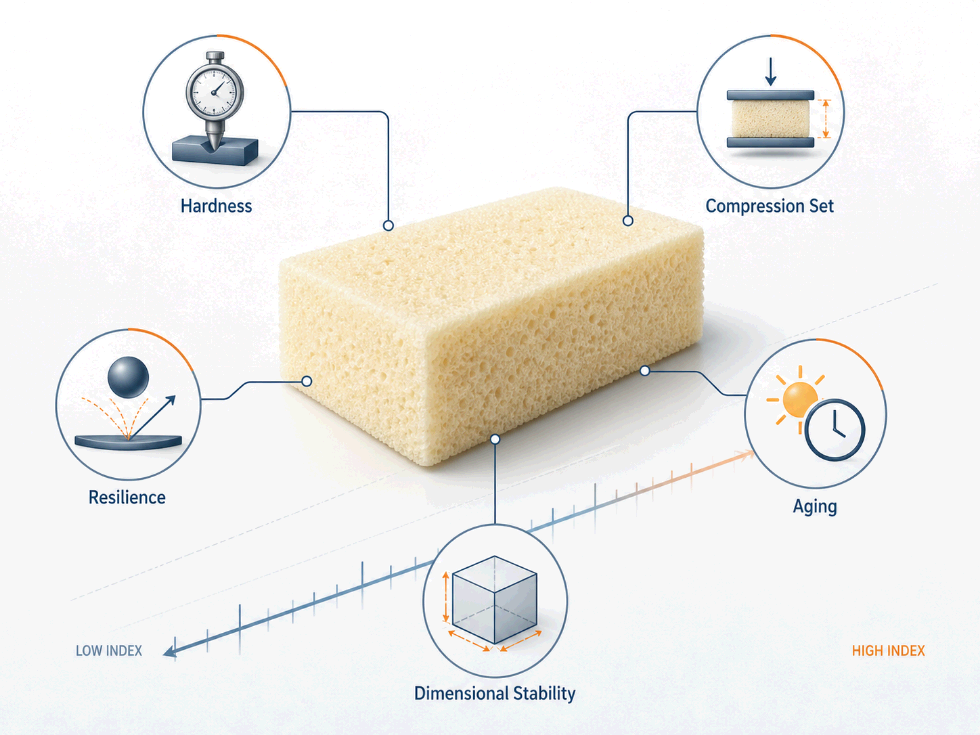

  • How Isocyanate Index Affects PU Foam Properties

    How Isocyanate Index Affects PU Foam Properties


    Introduction

    The isocyanate index is not just a calculation number. It directly affects the physical behaviour of polyurethane foam.

    When the index changes, the foam does not only become slightly harder or softer. The entire polymer network changes. Crosslink density changes. Elastic recovery changes. Compression set changes. Aging behaviour changes. In extreme cases, the foam can become unstable, brittle, weak, or outside customer specification.

    This is why experienced polyurethane formulators do not treat index as a simple recipe value. They treat it as a production control parameter.

    A foam block may look normal after rise. It may cut normally. It may even pass basic visual inspection. But if the index is outside the correct window, the final foam properties can fail during testing or during customer use.

    This article explains how different isocyanate index ranges affect PU foam properties, and why you should always design around an index window, not a single target point.

    Why Isocyanate Index Changes Foam Properties

    The isocyanate index changes the chemical balance between NCO groups and reactive hydrogen groups in the formulation.

    At a basic level:

    • Lower index means less available NCO compared with reactive hydrogen demand.
    • Higher index means more NCO is available than the theoretical requirement.
    • Correct index means the foam network develops with the intended balance of flexibility, strength, recovery, and durability.

    In flexible PU foam, the polymer network is built through urethane and urea linkages. These linkages form the structure that gives foam its physical properties.

    When the index is too low, the foam network can be underdeveloped. When the index is too high, the network can become too dense and rigid. This is why the same foam formula can produce very different results when the index is changed.

    The Molecular Mechanism Behind Index Effects

    At Index 100, every NCO group theoretically has one reactive hydrogen partner. The system is close to stoichiometric balance.

    In a simplified view, the polymer network contains:

    • Urethane linkages from polyol and isocyanate reaction
    • Urea linkages from water and isocyanate reaction
    • A balanced crosslink structure

    But real foam chemistry is more complex than the simple formula.

    Below Index 100, there may not be enough NCO to fully react with all active hydrogen sources. This can leave unreacted hydroxyl groups and reduce network continuity. The foam may become softer, weaker, more moisture-sensitive, and less stable during aging.

    Above Index 100, excess NCO does not simply stay unused. It can participate in secondary reactions. It can react with already-formed urethane or urea groups and create additional crosslinks. These extra crosslinks can increase hardness and improve compression set up to a useful point. But if the index becomes too high, the foam can lose elasticity and become brittle.

    This is why index effects are not always perfectly linear. A small increase may improve performance, but a large increase can create a different failure mode.

    Diagram comparing low index, balanced index, and high index PU foam polymer networks
    Low, balanced, and high isocyanate index levels create different polymer network structures inside PU foam.

    Low Isocyanate Index: Soft Foam and Weak Network Formation

    A low isocyanate index means the foam has insufficient NCO compared with the reactive hydrogen demand.

    In practical foam production, this can cause:

    • Lower hardness
    • Reduced load-bearing
    • Poorer compression set
    • Lower recovery
    • Moisture sensitivity
    • Aging-related hardness loss
    • Higher batch-to-batch variation

    The foam may feel soft at first, but the problem is not only softness. The deeper issue is weak network development.

    When the polymer network is underbuilt, the foam may not hold its properties over time. It may lose shape more easily under compression, recover more slowly, or show poor durability after aging.

    Low-index foam can be used intentionally in some specialty systems, but it must be designed carefully. If low index occurs unintentionally in standard flexible slabstock foam, it is usually a production or calculation problem.

    Common causes of unintentional low index:

    • Missing reactive components from the index calculation
    • Increasing water without recalculating isocyanate
    • Excluding crosslinkers or chain extenders
    • Using wrong polyol OH value
    • Isocyanate pump under-delivery
    • Incorrect %NCO value in the formula

    Low index should not be corrected blindly by changing catalysts. First, verify the actual index calculation and machine delivery.

    Low isocyanate index causing soft PU foam, poor recovery, and compression set problems
    Low isocyanate index can reduce crosslink density, causing softer foam and weaker recovery.

    Balanced Index: The Practical Operating Zone for Flexible Foam

    For many flexible foam systems, the most stable production zone is slightly above theoretical stoichiometric balance.

    This does not mean every formula should use the same index. The correct target depends on:

    • Foam density
    • Polyol type
    • Polyol functionality
    • Water level
    • Crosslinker level
    • Catalyst system
    • Required hardness
    • Compression set specification
    • Customer application

    However, standard flexible slabstock systems often operate in a practical index range where the foam has enough crosslink density for strength and recovery, without becoming overly rigid or brittle.

    In this balanced range, the foam typically shows:

    • Target hardness
    • Good compression set
    • Stable recovery
    • Acceptable resilience
    • Consistent cutting and handling
    • Better long-term property retention

    This is the zone where the index supports the intended foam grade instead of fighting against it.

    For many standard flexible foam grades, the useful range is often around Index 103 to 108, while higher-load grades may move higher depending on the application. The key is not to copy a number from another formula — the key is to validate the index against actual foam testing.

    Elevated isocyanate index increasing PU foam hardness and compression set performance
    A balanced index window helps maintain hardness, recovery, and compression set within specification.

    Elevated Index: Higher Hardness and Better Compression Set

    As the isocyanate index increases above the balanced zone, crosslink density increases.

    This can be useful when the foam needs:

    • Higher load-bearing
    • Higher hardness
    • Better compression set
    • Improved dimensional stability
    • Stronger support under repeated loading

    This is why some high-load seating, automotive, or industrial grades may use a higher index than standard comfort foam.

    But elevated index must be controlled carefully.

    If the index rises unintentionally, the foam may become harder than the customer specification. The foam can feel too stiff, even if density and dimensions are correct.

    Possible symptoms include:

    • ILD above target
    • Stiffer hand feel
    • Lower comfort
    • Customer complaints after unpacking
    • Edge brittleness in severe cases
    • Reduced elongation if pushed too high

    A higher index is not automatically better. It improves some properties while risking others.

    The correct question is not “Can we raise the index?” The correct question is “Does the application need the property changes created by a higher index?”

    Elevated isocyanate index increasing PU foam hardness and compression set performance
    Elevated index can improve load-bearing and compression set, but may create foam that feels too stiff if uncontrolled.

    High and Excessive Index: Brittleness and Elasticity Loss

    When the index becomes too high, the foam can move beyond useful firmness and into over-indexed behaviour.

    The polymer network becomes too dense. Elastic recovery becomes limited. Instead of behaving like flexible foam, the material may become brittle or friable.

    In flexible foam applications, excessive index can cause:

    • Edge brittleness
    • Crumbling under repeated compression
    • Poor elongation
    • Harsh hand feel
    • Reduced flexibility
    • Possible dimensional instability
    • Higher risk of customer rejection

    This type of failure can sometimes be confused with over-catalysis, poor mixing, raw material contamination, or curing issues. But the root cause may simply be that the foam is over-indexed.

    This is why troubleshooting should always include index verification before making multiple process changes.

    If the foam is too hard, brittle, or failing elongation, check:

    • Actual TDI or MDI delivery
    • Water level
    • Crosslinker level
    • %NCO from CoA
    • Pump calibration
    • Whether the formula was recently adjusted
    • Whether the same formula was transferred from another line

    High index is not only a formulation choice. It can also be created by metering error.

    Over-indexed PU foam showing brittleness and reduced elastic recovery risk
    Excessive isocyanate index can create a dense network that reduces elastic recovery and increases brittleness risk.

    Isocyanate Index Reference Table

    The table below gives a practical reference for how different index ranges can affect flexible polyether-based polyurethane foam.

    Actual results depend on formulation design, polyol type, functionality, molecular weight, water level, catalyst package, and production equipment. Use this table as a technical guide, not as a replacement for formulation testing.

    Index RangeCrosslink DensityILD / Hardness EffectCompression SetTypical ApplicationRisk if Unintentional
    Below 90Very low / deficientSignificantly below targetPoorAvoid in normal flexible foamCollapse, weak structure, aging problems
    90–98LowSoft, often below targetMarginalSpecialty soft or HR systems only when designedShort service life, moisture sensitivity
    98–103Near-stoichiometricAt or slightly below targetAcceptable but sensitiveLimited use in slabstockHigh batch-to-batch variation
    103–108BalancedUsually on targetGoodStandard flexible slabstock, furniture foamGenerally stable if controlled
    108–115ElevatedOften 10–20% above targetExcellentHigh-load seating, automotive foamStiff feel, customer complaints
    115–125HighSignificantly firmVery goodIndustrial grades, carpet underlayEdge brittleness, reduced comfort
    125–160Very highSemi-rigid behaviourExcellentPackaging, acoustics, structural usesFriability, elongation failure
    Above 200Full rigid networkRigid foam behaviourNot applicable to flexible foamPIR/PUR insulation boardsDimensional instability if uneven

    This table is especially useful during troubleshooting. If foam is soft and compression set is weak, the actual index may be lower than expected. If foam is too hard, stiff, or brittle, the actual index may be higher than expected.

    Why You Should Target an Index Window, Not a Single Point

    In real production, the index is not perfectly fixed.

    Even if the formula sheet says Index 105, the actual running index may move during the day. This can happen because of:

    • Metering pump variation
    • Pump calibration drift
    • Isocyanate temperature changes
    • Polyol temperature changes
    • Viscosity changes
    • Drum-to-drum %NCO variation
    • Small weighing or delivery errors
    • Mixing head condition
    • Production line differences

    On a well-controlled line, the actual index may vary by a few points around the target. On an older or poorly controlled line, the variation can be larger.

    This is why a target index should not be selected too close to the failure boundary.

    For example, if a foam grade needs at least Index 103 to consistently pass compression set, targeting exactly 103 is risky. If normal production variation moves the actual index down to 101 or 102, some batches may fail.

    A better approach is to design a practical safety margin.

    If the minimum acceptable index is 103, a production target around 106 or 107 may be more stable, depending on the line variation and customer specification.

    This is called designing around an index window.

    The goal is not to hit a perfect number on paper. The goal is to keep real production inside the acceptable property window.

    Isocyanate index window showing production tolerance around target index in PU foam manufacturing
    Real production index behaves like a tolerance window, not a single fixed point.

    Practical Troubleshooting Guide by Index Direction

    When foam properties are outside specification, index direction can help guide the investigation.

    If the foam is softer than expected

    Check whether the actual index is lower than the formula target.

    Possible causes:

    • Isocyanate under-delivery
    • Polyol over-delivery
    • Water increase without recalculation
    • Crosslinker excluded from calculation
    • Chain extender excluded from calculation
    • Wrong %NCO value
    • Wrong polyol OH value
    • Formula copied from another machine without validation

    If the foam is harder than expected

    Check whether the actual index is higher than the formula target.

    Possible causes:

    • Isocyanate over-delivery
    • Polyol under-delivery
    • Water equivalent weight entered incorrectly
    • Formula recalculated using wrong reactive component values
    • Actual %NCO higher than assumed
    • Line-specific metering drift
    • Uncontrolled process temperature effects

    If compression set is failing

    Check whether the index is too low or too close to the lower specification boundary.

    Possible causes:

    • Target index selected without safety margin
    • Actual production variation dipping below the acceptable range
    • Crosslinker or chain extender not included correctly
    • Isocyanate delivery instability
    • Formula adjusted over time without full recalculation

    The main point is simple: do not troubleshoot foam properties only by changing catalysts or silicone. First, verify whether the foam is actually running at the intended index.

    Use the PolymerIQ Isocyanate Index Calculator

    The PolymerIQ Isocyanate Index Calculator can help verify whether the formulation is running at the intended index.

    Use it to check:

    • Target index
    • Actual running index
    • Required TDI or MDI parts
    • Polyol equivalent weight
    • Water contribution
    • Crosslinker contribution
    • Effect of %NCO changes
    • Effect of formulation adjustments

    This is especially useful before changing catalysts, replacing raw materials, or blaming machine conditions.

    Open the Isocyanate Index Calculator →

    For the full calculation method and worked example, read Isocyanate Index Calculation Guide for PU Foam Engineers.

    For common production mistakes, read 5 Isocyanate Index Calculation Mistakes That Cause PU Foam Quality Problems.

    FAQs

    How does isocyanate index affect PU foam hardness?

    Higher isocyanate index generally increases crosslink density, which increases foam hardness and load-bearing capacity. Lower index reduces crosslink density, producing softer foam. The relationship is not perfectly linear — at very high index, the foam can become brittle and lose elasticity, while at very low index it becomes weak and unstable.

    What happens if the isocyanate index is too low?

    Low index means there is not enough NCO to fully react with all active hydrogen sources. The polymer network is underdeveloped, leading to softer foam, poor compression set, weaker recovery, moisture sensitivity, and aging-related hardness loss. In extreme cases, the foam can collapse or fail structurally.

    What happens if the isocyanate index is too high?

    Excessive index creates a dense, over-crosslinked polymer network. The foam can become brittle, friable, harsh in feel, and lose elongation. Edge brittleness, crumbling under repeated compression, and dimensional instability are common symptoms of over-indexed flexible foam.

    What is the typical isocyanate index range for flexible foam?

    Standard flexible slabstock foam often operates around Index 103 to 108, while high-load grades for seating, automotive, or industrial applications may run higher (108–115 or above). The exact target depends on density, polyol type, water level, crosslinker, catalyst system, and required foam properties. There is no universal index — it must be validated for each formulation.

    Why should I target an index window instead of a single point?

    Real production index varies because of pump calibration drift, %NCO variation between drums, temperature changes, viscosity changes, and metering accuracy. If the target is set exactly at the lower acceptance boundary, normal variation can push some batches below specification. Designing a safety margin keeps actual production inside the acceptable property window.

    How does isocyanate index affect compression set?

    Compression set generally improves as crosslink density increases, up to a point. A balanced or slightly elevated index usually gives the best compression set performance. Very low index produces poor compression set due to weak network development, while very high index can also reduce performance if the foam becomes too rigid.

    Can over-indexed foam become brittle?

    Yes. When index is significantly above the useful range, the polymer network becomes too dense and elastic recovery is limited. The foam can show edge brittleness, crumbling, harsh feel, and elongation failure. This is sometimes mistaken for over-catalysis or curing problems, when the actual root cause is the index.

    Does isocyanate index affect foam aging?

    Yes. Foam at low index often shows aging-related hardness loss and moisture sensitivity because the polymer network is underbuilt. Foam at very high index can also age poorly due to brittleness. Foam at a balanced index typically shows the best long-term property retention.

    How do I troubleshoot foam that is harder than expected?

    First, check whether the actual running index is higher than the formula target. Possible causes include isocyanate over-delivery, polyol under-delivery, wrong water equivalent weight (using 18 instead of 9), higher actual %NCO than assumed, or line-specific pump drift. Verify pump delivery and recalculate the index before making catalyst or silicone changes.

    Should I change catalysts first when foam properties are off-spec?

    No. Index verification should come first. Changing catalysts or silicones without confirming the actual running index can mask the real problem and create new ones. Confirm the index calculation and pump delivery, then move on to process variables if the index is correct.

    Key Takeaways

    The isocyanate index affects foam properties because it changes the polymer network inside the foam.

    • A low index can produce softer foam, weaker recovery, poorer compression set, and reduced aging stability.
    • A balanced index helps the foam achieve the intended hardness, recovery, and durability.
    • An elevated index can improve load-bearing and compression set, but may make the foam too stiff if uncontrolled.
    • An excessive index can create brittleness, friability, poor elongation, and reduced flexibility.

    The best production practice is not to target a single index point. The better approach is to design a safe index window that accounts for real production variation.

    When foam hardness, compression set, or resilience is outside specification, the actual isocyanate index should be checked early in the troubleshooting process.

    Conclusion

    If your foam plant is facing unexplained hardness variation, compression set failure, poor recovery, or different results between production lines, the actual running index may not match the formula sheet.

    PolymersIQ can help review your formulation, check index sensitivity, and identify whether the foam is operating inside the correct property window.

    To get accurate support, please share:

    • Polyol grade and OH value
    • Water level and any other reactive components
    • Isocyanate type and %NCO from the Certificate of Analysis
    • Target index and observed foam properties (ILD, compression set, density)
    • Description of the quality issue you are facing
    • Production line conditions and any recent formula adjustments

    Contact PolymerIQ for a formulation audit →