
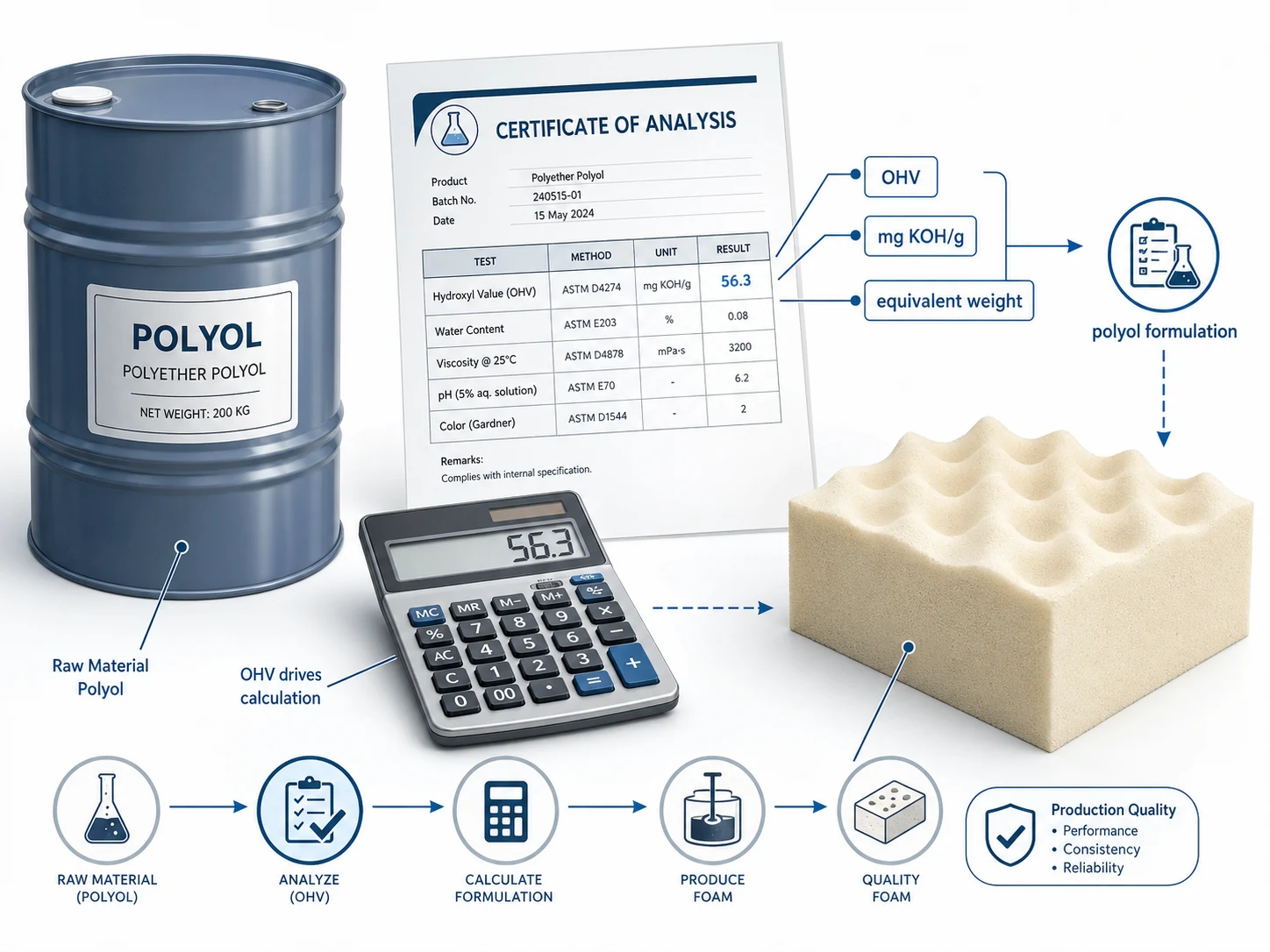
Introduction
Most polyurethane foam quality problems are blamed on the machine.
The machine is not always the problem.
In many foam plants, the real cause is sitting inside the raw material data — especially the hydroxyl value of the incoming polyol batch.
A formula may be developed using one polyol OHV value, but the next delivery may arrive with a slightly different OHV. The value may still be inside the supplier’s specification range. It may pass incoming QC. It may not trigger any alarm.
But if nobody recalculates the equivalent weight, the formulation is no longer running at the same chemical balance. The formula looks the same on paper, but it behaves differently in production.
This is why hydroxyl value is one of the most important numbers in polyurethane foam formulation. It controls the equivalent weight of the polyol, affects isocyanate demand, and directly influences the final foam properties.
This article explains what hydroxyl value means, how it relates to equivalent weight, and how to calculate it correctly for PU foam production.
What Is Hydroxyl Value?
Hydroxyl value, often written as OHV, measures how many reactive hydroxyl groups are present in one gram of polyol.
It is expressed as:
mg KOH/g
This means milligrams of potassium hydroxide equivalent per gram of sample.
The potassium hydroxide is not actually inside the polyol. It is part of the measurement convention used in titration chemistry. The value gives formulators a standard way to compare the hydroxyl content of different polyols.
In practical terms:
- Higher OHV means more reactive hydroxyl sites per gram.
- Lower OHV means fewer reactive hydroxyl sites per gram.
- Higher OHV usually means shorter polyol chains.
- Lower OHV usually means longer polyol chains.
- Higher OHV generally produces stiffer foam behaviour.
- Lower OHV generally produces softer, more flexible behaviour.
This is why OHV is not just a laboratory number — it is a formulation control value.
If OHV changes, the polyol equivalent weight changes. If equivalent weight changes, the isocyanate requirement changes. If the isocyanate requirement changes but the formulation is not recalculated, foam properties can shift.

Typical OHV Ranges for Different Foam Types
Different polyurethane foam systems use polyols with very different hydroxyl value ranges.
A flexible slabstock foam polyol is not the same as a rigid insulation foam polyol. The OHV range reflects the type of polymer network the formulation is designed to create.
| Foam Type | Typical OHV Range |
|---|---|
| HR flexible foam | 28–35 mg KOH/g |
| Flexible slabstock foam | 45–56 mg KOH/g |
| Semi-rigid foam | 100–200 mg KOH/g |
| Rigid / insulation foam | 350–550 mg KOH/g |
Flexible foams usually use lower-OHV polyols because they need longer, more elastic polymer chains.
Rigid foams use much higher-OHV polyols because they require a dense, highly crosslinked structure.
This is why OHV immediately tells you something about the intended application of a polyol. A polyol with OHV around 50 belongs to a very different formulation world than a polyol with OHV around 450.

How Hydroxyl Value Is Measured
Hydroxyl value is commonly measured using standard titration methods such as ASTM D4274 or ISO 14900. These are acetylation-based titration methods used to determine hydroxyl content in polyols.
In production, the OHV value usually appears on the supplier’s Certificate of Analysis. For serious formulation control, the incoming CoA value should not be ignored or treated as a fixed number.
The OHV value from each batch matters because every batch can have a slightly different hydroxyl value. Even if the value remains inside the supplier’s TDS specification range, it can still change the formulation balance.
OHV and Equivalent Weight: The Critical Link
Equivalent weight is the bridge between hydroxyl value and isocyanate stoichiometry.
The formula is:
Equivalent Weight = 56,100 ÷ OHV
Where:
- Equivalent weight is expressed in g/eq
- OHV is expressed in mg KOH/g
- 56,100 is the conversion constant based on potassium hydroxide molecular weight
Equivalent weight tells you how many grams of polyol contain one equivalent of reactive hydroxyl groups.
This value is essential because polyurethane formulation is based on equivalent relationships, not simply weight relationships.
- A polyol with a lower OHV has a higher equivalent weight.
- A polyol with a higher OHV has a lower equivalent weight.
That matters because isocyanate demand is calculated from reactive equivalents.
[IMAGE 4 — OHV TO EQUIVALENT WEIGHT FORMULA] Placement: After the section “OHV and Equivalent Weight”, before “Worked Example”. Filename:
ohv-equivalent-weight-formula-polyurethane.jpgALT text: Hydroxyl value to equivalent weight formula for polyurethane polyol calculation Caption: Equivalent weight is calculated from hydroxyl value using the formula EW = 56,100 ÷ OHV. ChatGPT image prompt: “Create a clean technical formula infographic on a white background showing the relationship between hydroxyl value and equivalent weight in polyurethane formulation. Display the formula: Equivalent Weight = 56,100 / OHV. Add simple labels: OHV in mg KOH/g, EW in g/eq, used for isocyanate stoichiometry. Include a polyol drum icon, calculator icon, and small OH group symbols. Professional engineering style, blue and grey color palette, clean and readable. No logos. No brand names.”

Worked Example: Calculating Polyol Equivalent Weight
Let’s calculate equivalent weight using a polyol OHV of 51 mg KOH/g.
Formula: EW = 56,100 ÷ OHV
Calculation: EW = 56,100 ÷ 51 = 1,100 g/eq
So a polyol with OHV 51 has an equivalent weight of approximately 1,100 g/eq. This means 1,100 grams of that polyol contains one equivalent of reactive hydroxyl groups.
Now compare that to different OHV values within a typical flexible foam range:
| OHV (mg KOH/g) | Equivalent Weight (g/eq) |
|---|---|
| 45 | 1,247 |
| 47 | 1,194 |
| 51 | 1,100 |
| 53 | 1,058 |
| 55 | 1,020 |
This table shows why OHV cannot be ignored.
A shift from OHV 45 to OHV 55 creates an equivalent weight change of more than 200 g/eq.
That is a large stoichiometric difference, even though the polyol may still be inside a normal supplier specification range.

Why OHV Changes Foam Behaviour
OHV affects foam behaviour because it changes the number of reactive sites available in the polyol.
If OHV is higher:
- There are more reactive sites per gram.
- Equivalent weight is lower.
- Isocyanate demand increases.
- The foam may trend softer if isocyanate is not adjusted correctly.
- The final network balance may shift.
If OHV is lower:
- There are fewer reactive sites per gram.
- Equivalent weight is higher.
- Isocyanate demand decreases.
- If isocyanate is not adjusted, the actual index can rise.
- The foam may become harder than expected.
This is one of the most important diagnostic relationships in PU foam formulation:
OHV low → equivalent weight high → actual index can increase → foam can become harder
OHV high → equivalent weight low → actual index can decrease → foam can become softer
This does not mean OHV is the only factor controlling hardness. Catalyst, water, silicone, crosslinker, density, temperature, and machine delivery also matter.
But if hardness changes batch to batch and the formulation looks unchanged, OHV should be checked early.

Why TDS OHV Is Not Enough
A polyol Technical Data Sheet gives a specification range.
That range tells you what the supplier considers acceptable for the product grade. It does not tell you the actual OHV of the batch sitting in your plant today.
For example, a TDS may show:
OHV range: 45–55 mg KOH/g
If the engineer uses the midpoint forever, the calculation may be wrong when the actual delivered batch is 47 or 55.
The Certificate of Analysis gives the batch-specific OHV value. That is the number that should be used for equivalent weight calculation.
The difference matters because equivalent weight is calculated directly from OHV. Using the wrong OHV means using the wrong equivalent weight. Using the wrong equivalent weight means the isocyanate requirement may not match the actual reactive demand.

Practical Calculation Workflow for Foam Plants
A simple OHV workflow can prevent many formulation errors.
Use this process for every incoming polyol batch:
- Receive the polyol Certificate of Analysis.
- Record the actual batch OHV.
- Calculate equivalent weight using EW = 56,100 ÷ OHV.
- Compare the new EW with your design value.
- Recalculate the isocyanate index if the difference is meaningful.
- Adjust the formula if required before production.
- Keep a batch-by-batch OHV log for each supplier and grade.
This workflow is simple, but it prevents one of the most common sources of hidden formulation drift.
The most important point is this: equivalent weight is not a one-time value. It changes when OHV changes.
Use the PolymerIQ Equivalent Weight Calculator
Manual calculation is useful because every foam engineer should understand the relationship between OHV and equivalent weight.
But in production, the calculation must be fast, repeatable, and error-free.
The PolymerIQ Equivalent Weight Calculator helps you convert OHV into equivalent weight instantly.
Use it when:
- A new polyol batch arrives
- The CoA OHV differs from your design value
- A formulation is being checked before production
- Foam hardness changes without a clear process reason
- You are preparing an isocyanate index calculation
Open the Equivalent Weight Calculator →
Hydroxyl value and equivalent weight are directly connected to isocyanate index. After calculating equivalent weight, the next step is to use it in the index calculation. For the full index calculation method, read Isocyanate Index Calculation Guide for PU Foam Engineers.
FAQs
What is hydroxyl value in polyurethane foam?
Hydroxyl value (OHV) measures how many reactive hydroxyl groups are present in one gram of polyol. It is expressed in mg KOH/g (milligrams of potassium hydroxide equivalent per gram of sample). The KOH is not actually in the polyol — it is part of the titration measurement convention. OHV is a key formulation control value because it determines polyol equivalent weight and isocyanate demand.
How is hydroxyl value measured?
OHV is commonly measured using standard titration methods such as ASTM D4274 or ISO 14900, which are acetylation-based titration techniques. The value is reported on the supplier’s Certificate of Analysis for each batch.
What is the difference between OHV and equivalent weight?
OHV expresses hydroxyl content in mg KOH/g. Equivalent weight expresses how many grams of polyol contain one equivalent of reactive hydroxyl groups (g/eq). They describe the same chemistry but in different units. The conversion is EW = 56,100 ÷ OHV.
Why is the equivalent weight formula 56,100 ÷ OHV?
The constant 56,100 comes from the molecular weight of potassium hydroxide (56.1 g/mol) multiplied by 1,000 for unit conversion. Since OHV is reported in mg KOH/g, dividing 56,100 by OHV gives the grams of polyol that contain one equivalent of OH groups.
What is the typical OHV range for flexible foam polyols?
Standard flexible slabstock foam polyols typically have OHV in the range of 45–56 mg KOH/g. HR flexible foam polyols are usually 28–35 mg KOH/g. Semi-rigid foam polyols sit at 100–200 mg KOH/g, and rigid insulation foam polyols are much higher at 350–550 mg KOH/g.
Should I use OHV from the TDS or the Certificate of Analysis?
Always use the actual OHV from the Certificate of Analysis for the specific batch in production. The TDS gives a specification range, and using the midpoint can introduce calculation error when the actual batch sits at the edge of the range. Equivalent weight is calculated directly from OHV, so a wrong OHV means a wrong EW.
How does OHV affect foam hardness?
OHV affects hardness indirectly through equivalent weight and isocyanate stoichiometry. If OHV is lower than design (and isocyanate is not adjusted), the actual running index can rise and foam may become harder. If OHV is higher than design, the actual index can drop and foam may become softer. This is why OHV should be checked early when batch-to-batch hardness variation appears.
What happens if I don’t recalculate equivalent weight when polyol batch changes?
The formula sheet will look correct, but the real reactive equivalents in the system will be different from what the calculation assumes. The isocyanate amount may no longer match the actual reactive demand, and the running index will drift away from the target. This can cause hidden hardness, compression set, or recovery problems that are hard to trace.
Can OHV variation cause batch-to-batch foam quality problems?
Yes. Even when OHV stays inside the supplier’s TDS range, batch-to-batch variation can shift the equivalent weight by tens or hundreds of g/eq. If the formula is not recalculated for each batch, the actual running index changes silently and foam properties can drift between deliveries.
How does OHV differ between flexible and rigid foam polyols?
Flexible foam polyols have low OHV (typically 28–56 mg KOH/g), which gives long, elastic polymer chains and a flexible network. Rigid foam polyols have high OHV (typically 350–550 mg KOH/g), which produces a dense, highly crosslinked network with stiff structural properties. The OHV range tells you immediately what kind of foam the polyol is designed for.
Key Takeaways
- Hydroxyl value (OHV) measures the concentration of reactive hydroxyl groups in a polyol.
- Higher OHV means more reactive sites per gram and lower equivalent weight.
- Lower OHV means fewer reactive sites per gram and higher equivalent weight.
- The equivalent weight formula is EW = 56,100 ÷ OHV.
- A change in OHV changes equivalent weight. A change in equivalent weight changes the isocyanate demand. If the formula is not recalculated, the actual running index can shift.
- The TDS range should not be used as a fixed formulation value. The batch-specific OHV from the Certificate of Analysis should be used for production calculation.
- For consistent PU foam production, every incoming polyol batch should have its OHV recorded, equivalent weight recalculated, and formulation impact reviewed before production.
Conclusion
If your foam hardness is changing from batch to batch and the machine settings look stable, the incoming polyol OHV may be one of the first values to check.
PolymersIQ can help review your formulation, calculate equivalent weight correctly, and identify whether raw material variation is affecting your production baseline.
To get accurate support, please share:
- Polyol grade and supplier
- Current OHV from the Certificate of Analysis
- Design OHV used in your original formulation
- Water level, crosslinker, and any other reactive components
- Isocyanate type and %NCO
- Description of the quality issue you are facing
Contact PolymerIQ for a formulation audit →