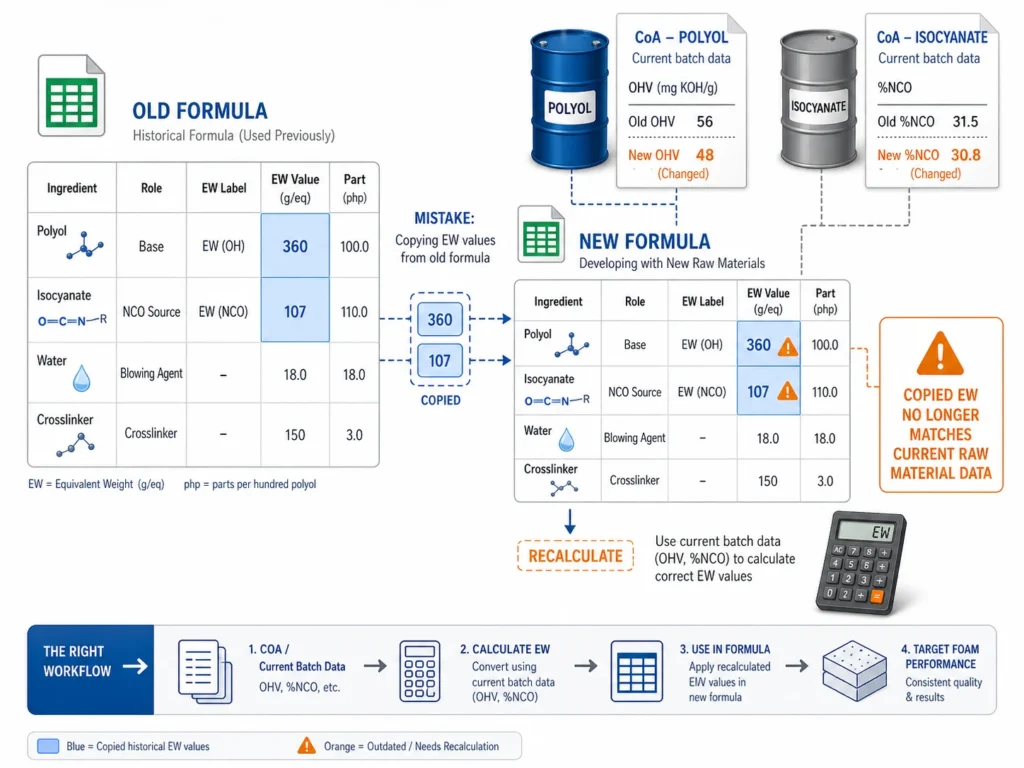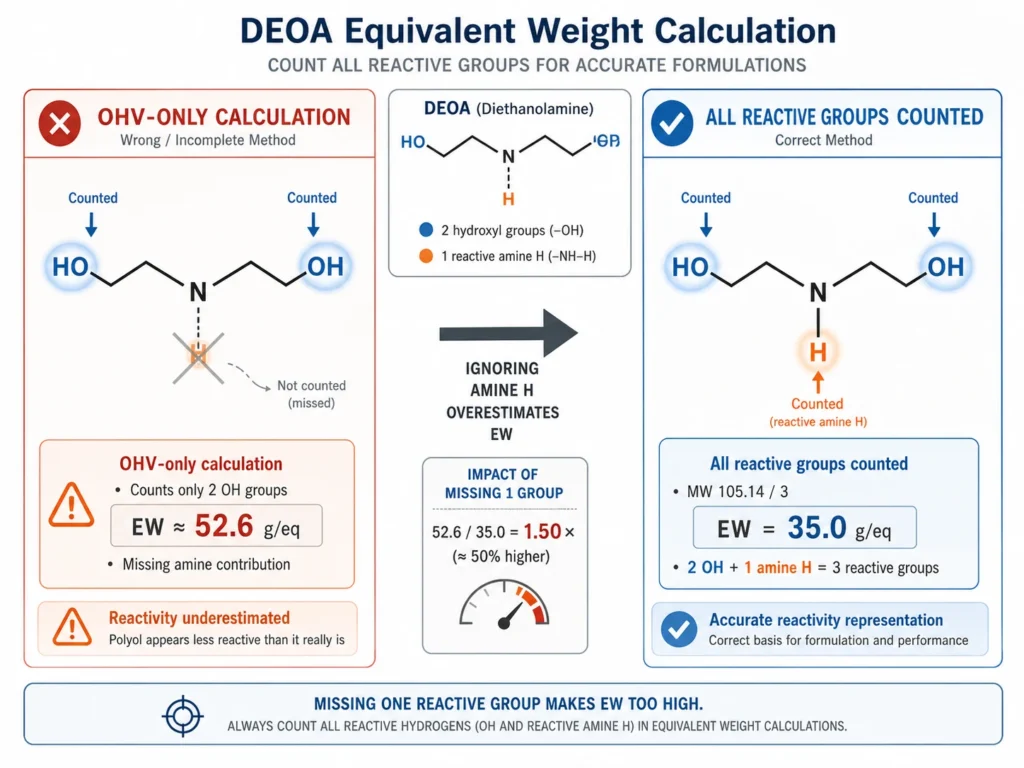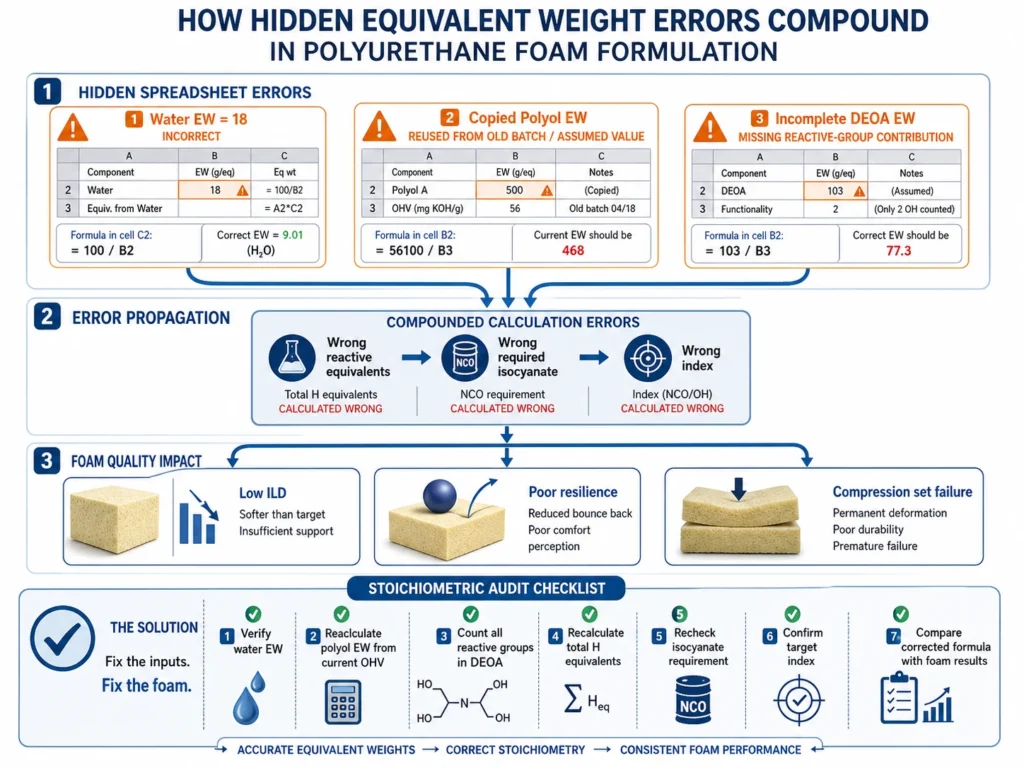
Tag: Polyurethane Foam

  • 4 NCO Content Mistakes That Corrupt PU Foam Index

    4 NCO Content Mistakes That Corrupt PU Foam Index


    Introduction

    NCO content mistakes are dangerous because they do not always look like NCO content mistakes.

    They usually appear as ordinary foam quality problems.

    One batch is firmer than expected. Another batch feels softer. Compression set moves close to the limit. The same formula behaves differently after a new isocyanate delivery. The production team checks catalyst, silicone, temperature, machine calibration, and raw material handling.

    But the cause may be one number in the formula spreadsheet: %NCO.

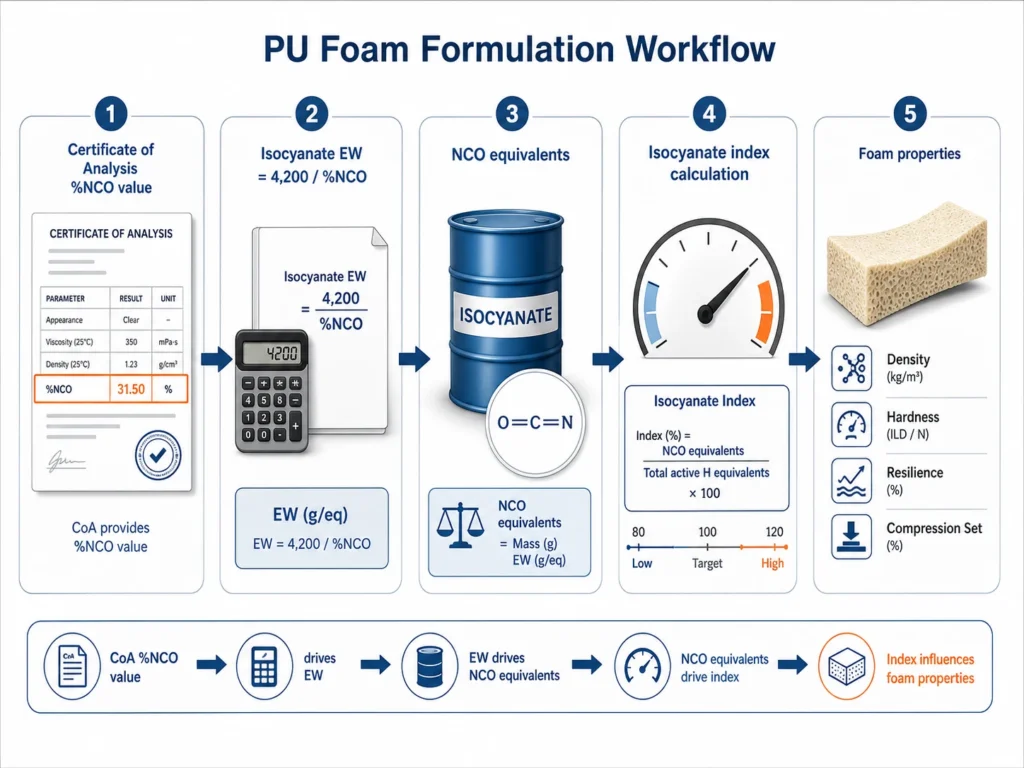
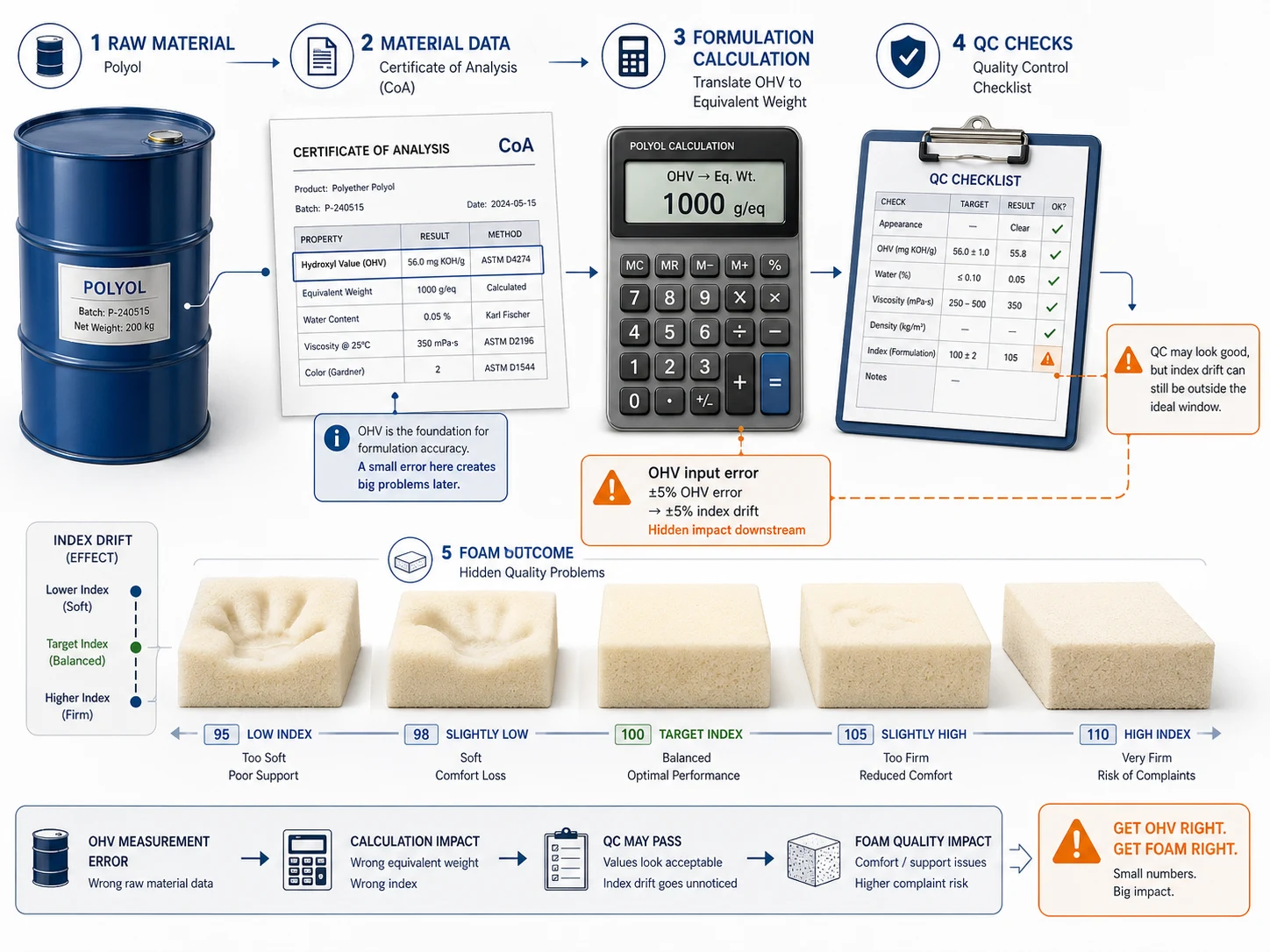
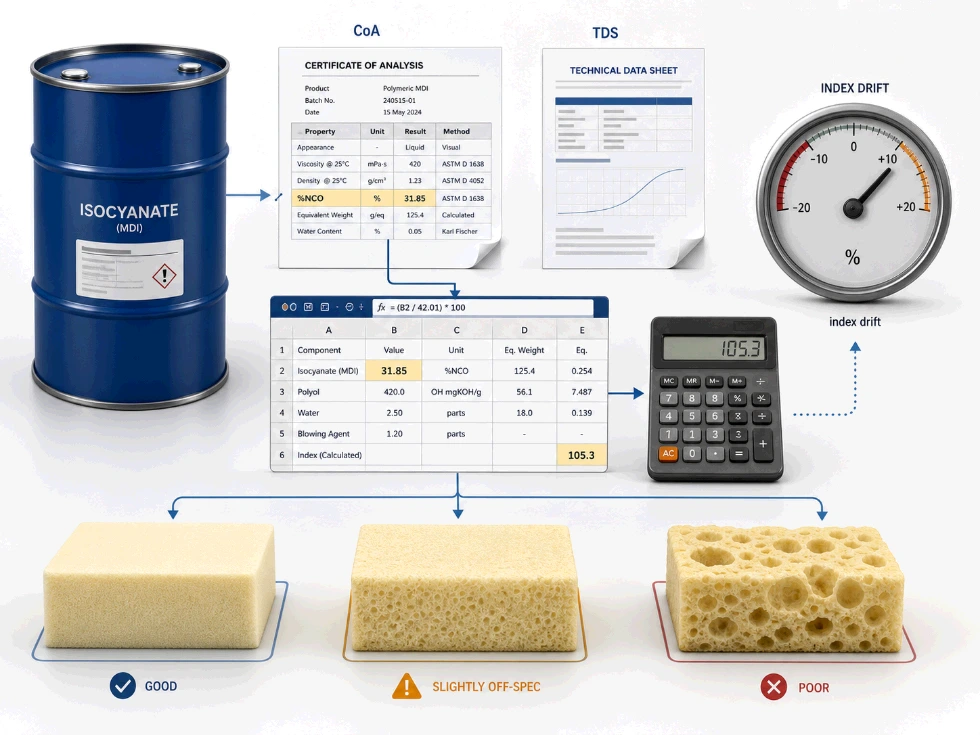
    The %NCO value controls isocyanate equivalent weight. Equivalent weight controls how many NCO equivalents are delivered by the TDI or MDI parts in the formula. NCO equivalents control the actual isocyanate index.

    If the formula uses the wrong %NCO value, the foam may not be running at the index shown on the sheet.

    This article explains four NCO content mistakes that commonly corrupt PU foam index calculations and how to control them before they become production quality problems.

    Why NCO Content Mistakes Are So Costly

    NCO content is not just a supplier data point. It is a formulation control value.

    The isocyanate equivalent weight is calculated as:

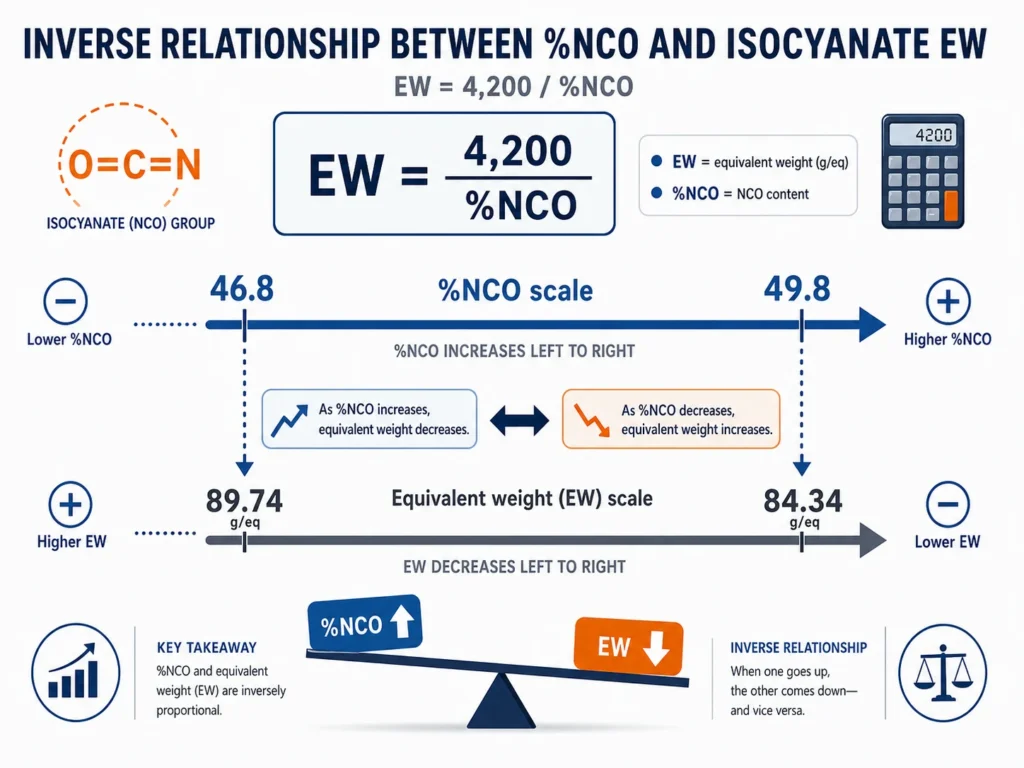
    Isocyanate EW = 4,200 ÷ %NCO

    If the %NCO value is wrong, the equivalent weight is wrong. If the equivalent weight is wrong, the NCO equivalents are wrong. If the NCO equivalents are wrong, the actual index is wrong.

    That means a simple %NCO mistake can affect:

    • Foam hardness
    • ILD
    • Compression set
    • Resilience
    • Cure behaviour
    • Crosslink density
    • Batch-to-batch consistency
    • Customer feel and performance

    The foam may still rise normally. The machine may still run normally. The block may still look acceptable. But the foam chemistry may not match the formula sheet.

    This is why %NCO handling should be part of every formulation review and production QC system.

    Mistake 1: Using the TDS Midpoint %NCO as a Formulation Constant

    The most common mistake is using the TDS midpoint as a fixed %NCO value.

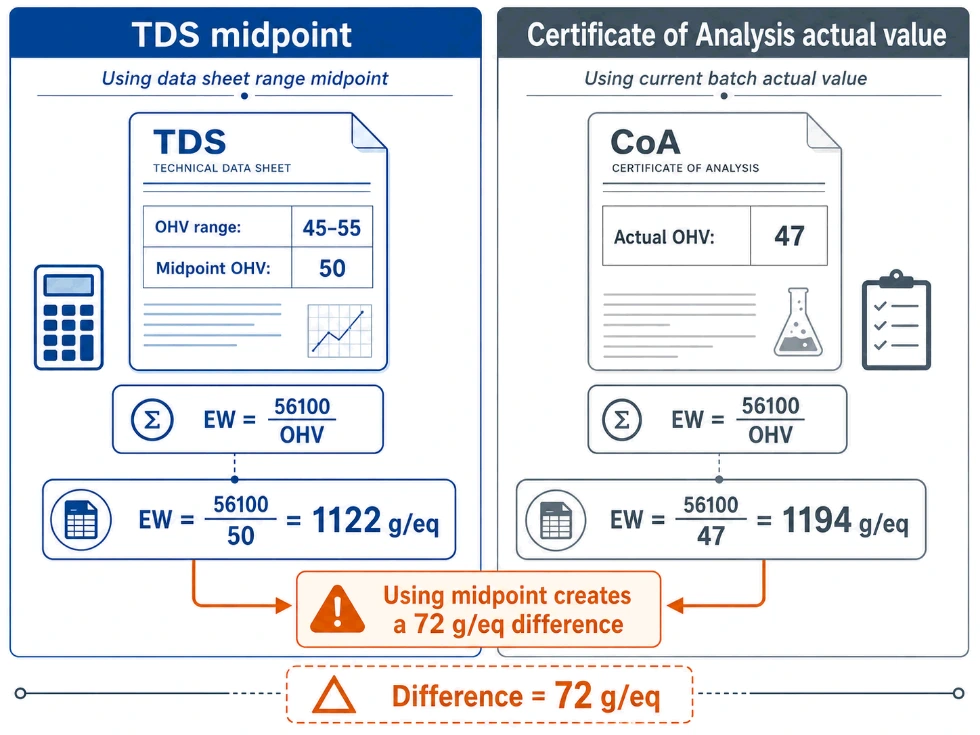
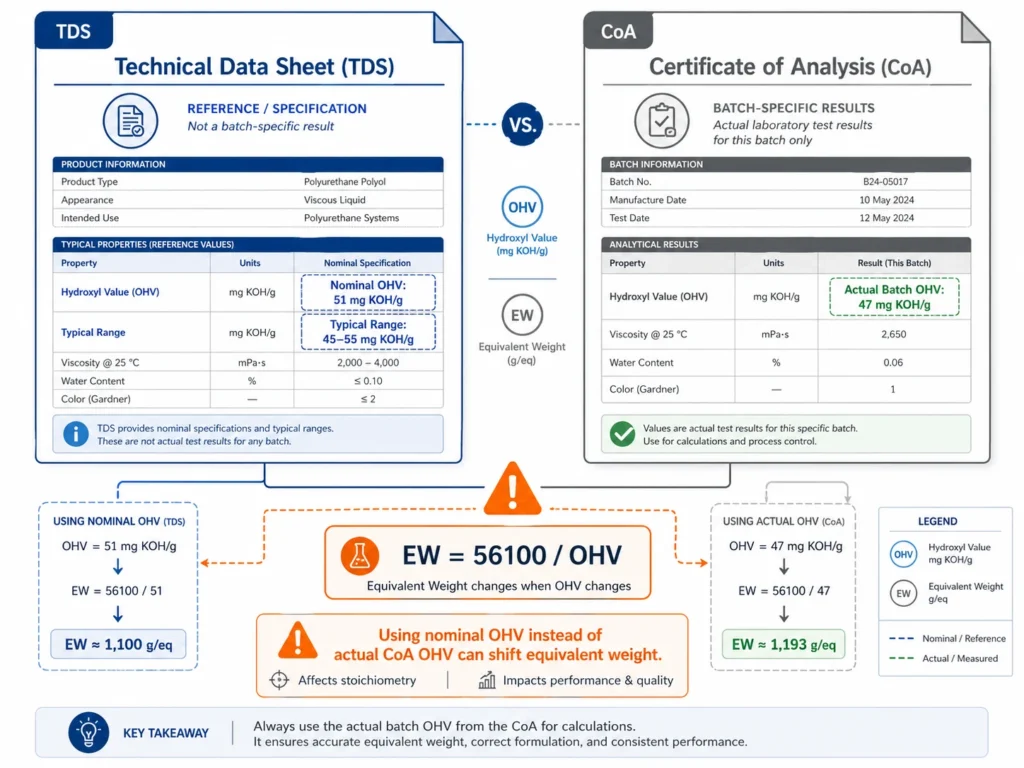
    The Technical Data Sheet gives a specification range or typical value. It does not give the exact %NCO value of the drum currently in production.

    For example, a TDI grade may have a range of 46.8–49.8% NCO. An engineer may use the midpoint of 48.3% NCO.

    That value may be reasonable for design work, but it should not be treated as a permanent production input.

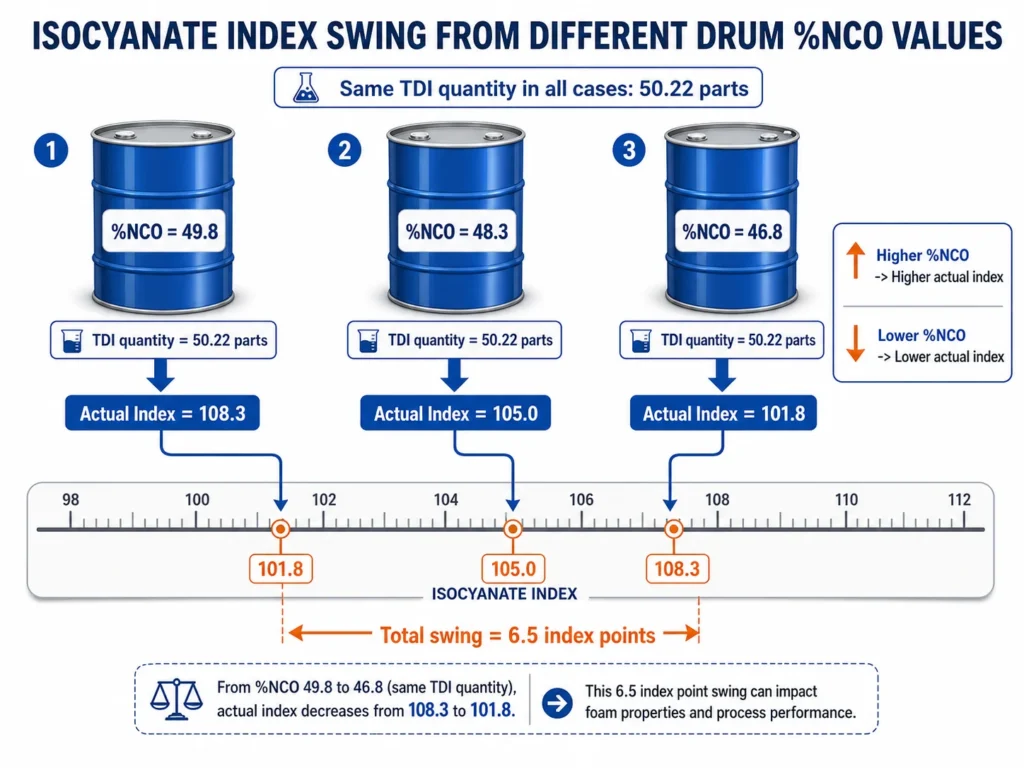
    If the actual drum CoA shows 49.8%, the same TDI weight delivers more NCO equivalents than expected. If the actual drum CoA shows 46.8%, the same TDI weight delivers fewer NCO equivalents than expected. The formula sheet may still say Index 105, but the actual running index may be different.

    %NCO ValueEW (g/eq)Same TDI QuantityActual Index Running
    49.8 (high-end CoA)84.3450.22 parts108.3
    48.3 (midpoint / design)86.9650.22 parts105.0
    46.8 (low-end CoA)89.7450.22 parts101.8

    That is about a 6.5-point total index swing from low-end to high-end %NCO, without changing the formula parts or machine settings.

    The rule is simple: the TDS value is not the production calculation value. Use the CoA %NCO.
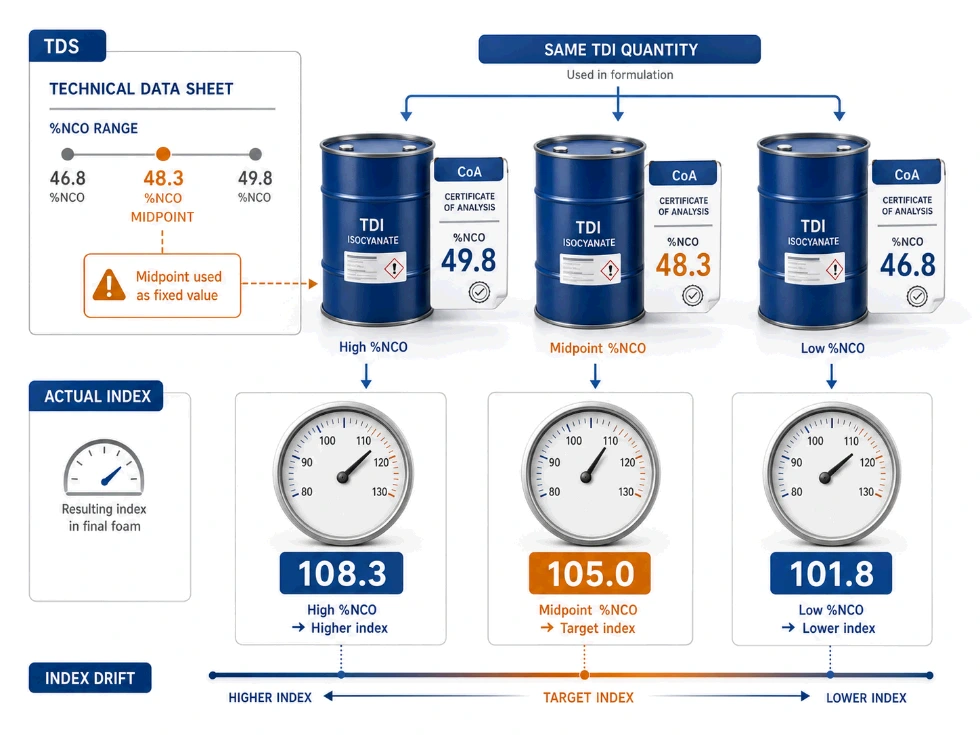
    TDS midpoint percent NCO mistake causing PU foam index drift

    Mistake 2: Not Updating %NCO After Switching Isocyanate Supplier

    A supplier change is a formulation event. It should never be treated as only a purchasing event.

    A plant may buy the same isocyanate grade from a different manufacturer and assume the formula can continue unchanged. Same grade does not always mean same actual %NCO.

    For example:

    • Old supplier CoA: 48.3% NCO
    • New supplier CoA: 47.4% NCO

    If the formula still uses 48.3%, the equivalent weight calculation is no longer correct for the new material. The foam may immediately begin running at a different actual index.

    The change may be small enough to avoid a dramatic failure, but large enough to create persistent quality drift.

    Possible symptoms include:

    • Foam slightly softer than target
    • Lower ILD
    • Compression set moving closer to limit
    • Slower troubleshooting because “the grade is the same”
    • Long-term confusion after procurement changes

    The correct rule is: every supplier switch requires a %NCO review and index recalculation. The formula spreadsheet should be updated when the first CoA from the new supplier arrives.
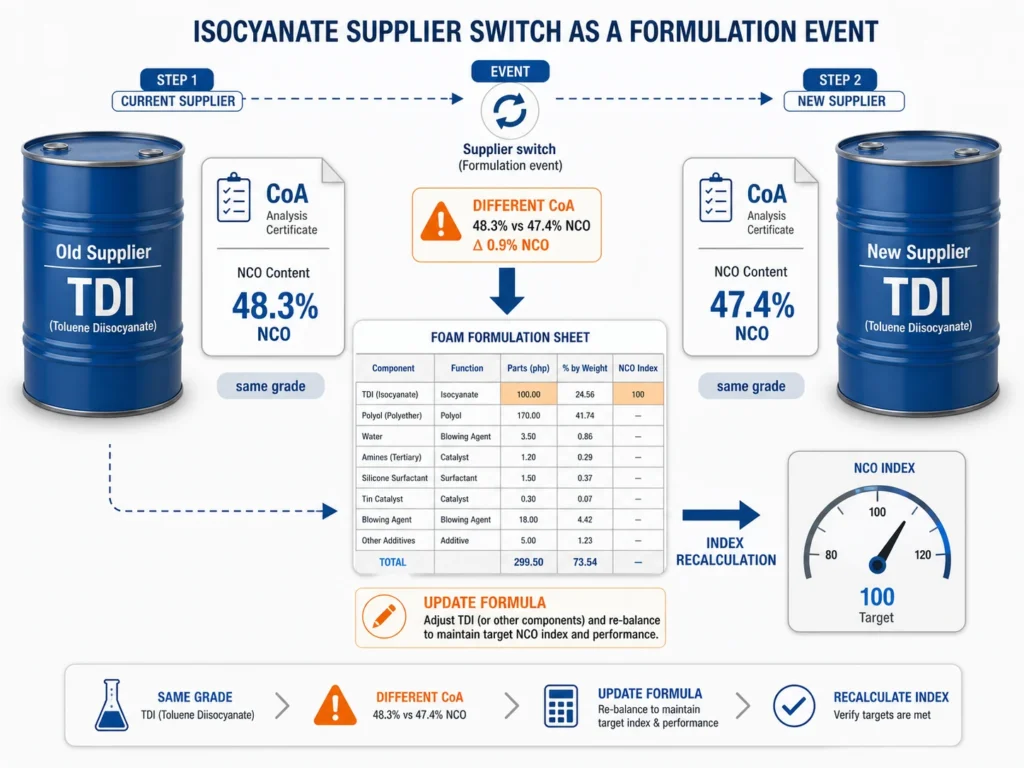
    Isocyanate supplier switch requiring percent NCO update in PU foam formula

    Mistake 3: Ignoring %NCO Drift from Moisture Exposure

    NCO groups react with water — including atmospheric moisture.

    If isocyanate drums are stored poorly, opened repeatedly, damaged, or not resealed properly, active NCO content can decrease before the material reaches the mixing head.

    The CoA may have been correct when the supplier tested the batch. But the material in the drum may no longer match that value if it has been exposed to moisture or stored under poor conditions.

    Possible risk conditions include:

    • Humid storage environment
    • Damaged drum bung
    • Poor resealing after opening
    • Long storage time after opening
    • Repeated opening and closing
    • Transfer procedures that expose isocyanate to air
    • Aged or suspect drums used in critical products

    When active %NCO decreases, the isocyanate equivalent weight increases. If the formula still assumes the original CoA value, the actual index can drop.

    This can appear as softer foam, lower ILD, weaker recovery, compression set risk, inconsistent results from older drums, or quality differences between fresh and aged material.

    For critical production, aged or suspect drums should be verified before use. In-house %NCO titration is not excessive when the product specification is tight — it is raw material risk control.
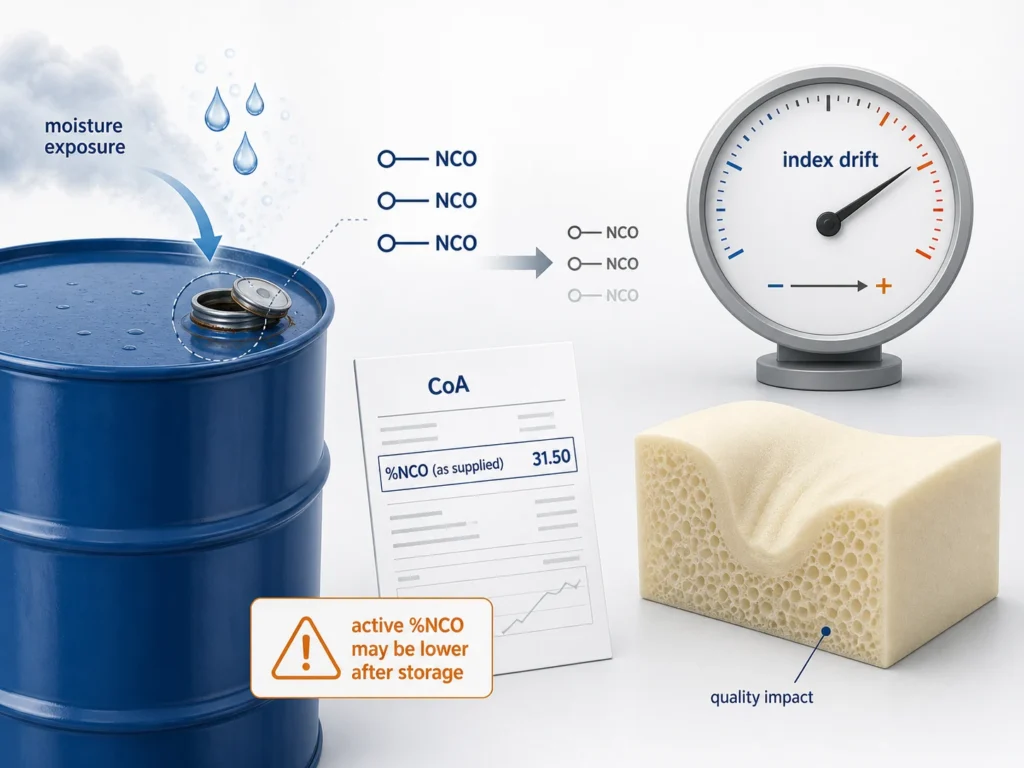
    Moisture exposure reducing NCO content in isocyanate drums for PU foam production

    Mistake 4: Assuming NCO Variation Is Only a TDI Problem

    TDI usually gets more attention because its %NCO range can create a visible index swing. But MDI users should not ignore %NCO variation.

    MDI may have a narrower specification range than TDI, but the effect is still real. The formula is the same:

    Isocyanate EW = 4,200 ÷ %NCO

    A smaller EW shift can still move the index by a few points, especially in tight-specification products.

    This matters in:

    • Automotive foam
    • Molded foam
    • High-specification furniture foam
    • Technical foam grades
    • Systems using modified or polymeric MDI
    • Formulas with tight compression set or hardness targets

    The mistake is assuming that because the range is narrower, the effect can be ignored. It should still be checked.

    The correct rule: use actual CoA %NCO for both TDI and MDI systems.
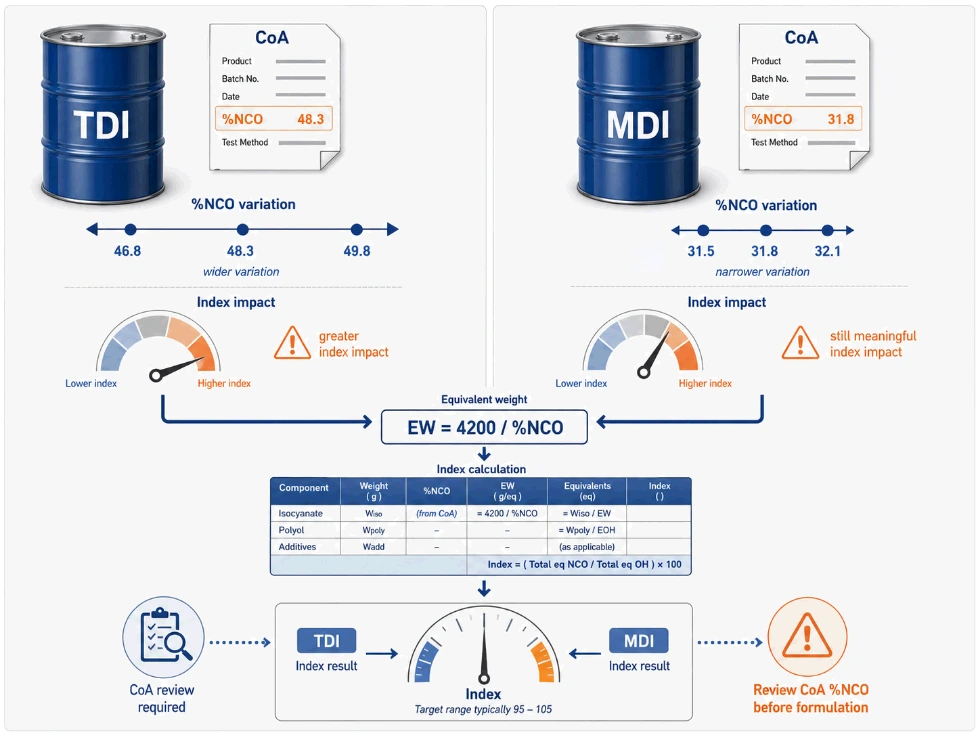
    TDI and MDI NCO content variation requiring CoA review in polyurethane foam formulation

    In-House %NCO Verification for Critical Production

    The CoA is important. But critical production may need one more layer of verification.

    For high-specification products, in-house %NCO testing can protect the plant from hidden raw material drift.

    This is especially important when:

    • The drum has been stored for a long time
    • The seal looks damaged
    • The material was exposed to humidity
    • The product has tight index tolerance
    • The foam is automotive, medical, or high-specification furniture grade
    • A new supplier is being qualified
    • Foam properties changed after a new isocyanate delivery

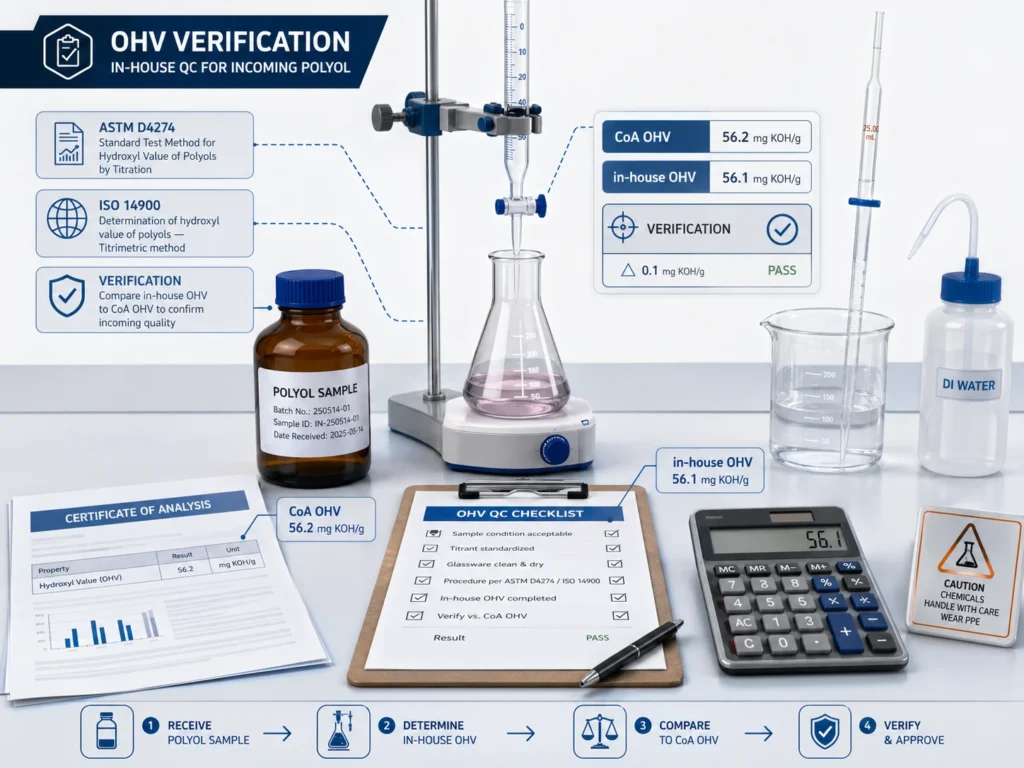
    A common method for determining isocyanate content is ASTM E222.

    For critical products, if the in-house result differs from the CoA by a meaningful amount, the drum should be held and investigated before production.

    The goal is not to distrust suppliers. The goal is to confirm that the material being used today still matches the formulation assumption.

    n-house percent NCO verification for isocyanate QC in polyurethane foam production

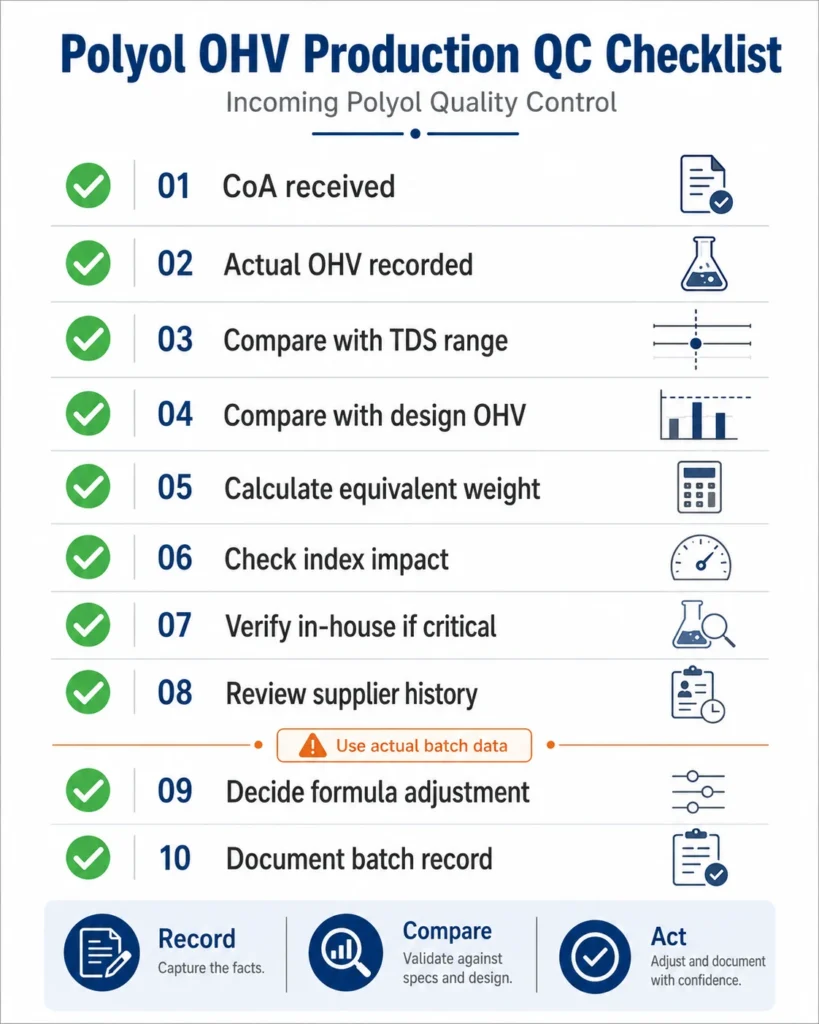
    Production QC Checklist for NCO Content

    A strong %NCO control system is simple. Use this checklist for every isocyanate delivery:

    QC CheckpointQuestion to Ask
    CoA availableIs the Certificate of Analysis available for the drum or batch?
    Actual %NCO recordedHas the actual CoA %NCO value been logged?
    TDS comparisonIs the value inside the supplier specification range?
    Design comparisonHow far is the CoA %NCO from the formula design value?
    EW calculatedHas isocyanate EW been recalculated using 4,200 ÷ %NCO?
    Index impact checkedDoes the EW change shift the actual index?
    Supplier changeIs this a new supplier or new grade source?
    Storage conditionWas the drum stored sealed, dry, and correctly?
    Moisture riskIs the drum aged, opened, damaged, or suspect?
    In-house verificationIs %NCO verification needed for this product?
    Formula decisionShould TDI or MDI quantity be adjusted before the run?
    DocumentationHas the decision been recorded?

    This checklist prevents the most common %NCO mistake: accepting the raw material as commercially conforming while failing to check whether the formula still matches the actual drum value.
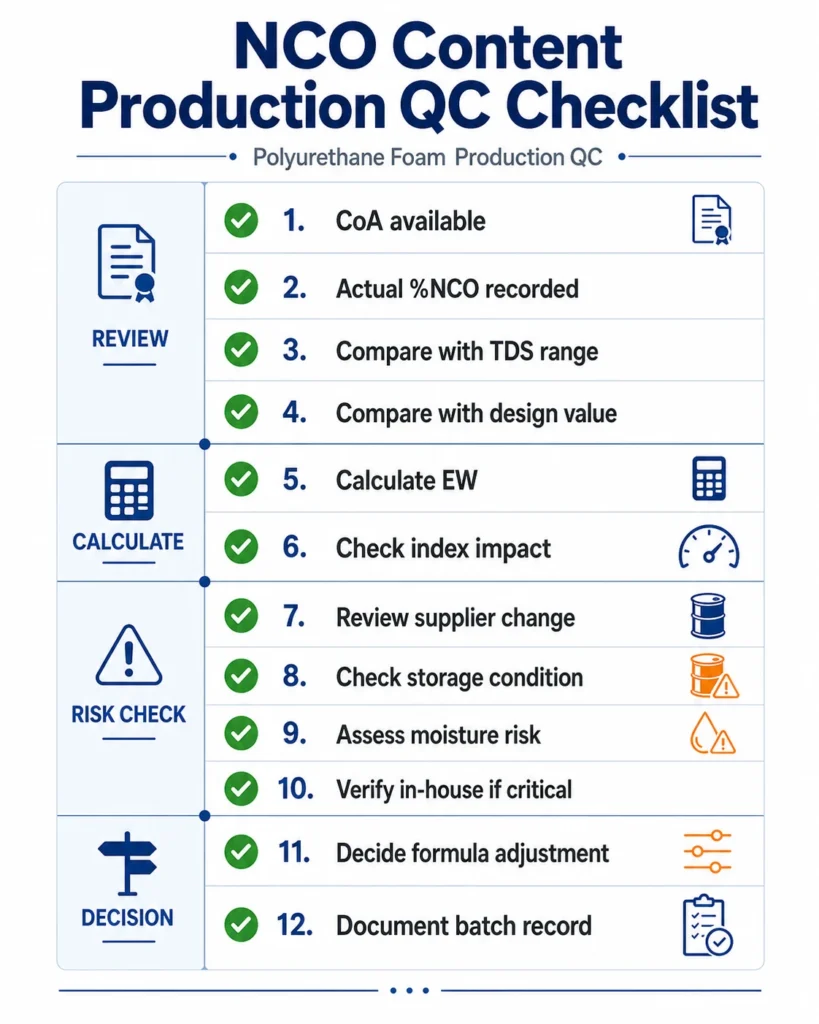
    NCO content production QC checklist for polyurethane foam isocyanate drums

    Practical Decision Thresholds for %NCO Variation

    Not every %NCO difference requires a formula change. The decision should be based on index impact.

    A practical guide:

    %NCO Deviation from DesignTypical Index ShiftAction Required
    Less than ±0.5%Around 1 pointRecord and monitor
    ±0.5% to ±1.0%Around 1–2 pointsRecalculate index and review adjustment
    More than ±1.0%3+ pointsAdjust isocyanate quantity before run

    These are practical starting thresholds. High-specification products may require tighter limits.

    The main rule: do not decide by habit. Decide by calculation.

    Correct Workflow for NCO Content Control

    A reliable %NCO workflow should include these steps:

    1. Receive CoA with every isocyanate drum or batch.
    2. Record supplier, grade, drum number, date, and actual %NCO.
    3. Calculate isocyanate EW using 4,200 ÷ %NCO.
    4. Compare the EW with the formula design value.
    5. Recalculate actual index if the difference is meaningful.
    6. Adjust TDI or MDI quantity if required.
    7. Check storage and moisture exposure risk.
    8. Verify %NCO in-house for critical or suspect drums.
    9. Record the final decision before production.

    This workflow prevents a raw material data mistake from becoming a foam property problem.

    Use the PolymerIQ NCO / TDI Index Calculator

    The PolymerIQ NCO / TDI Index Calculator helps production teams use the actual CoA %NCO value correctly.

    Use it when a new TDI or MDI drum arrives, CoA %NCO differs from the formula design value, you switch isocyanate supplier, a drum is aged or suspect, foam hardness changes after a new isocyanate batch, compression set changes without a clear process cause, or you need to confirm TDI or MDI parts for target index.

    Open the NCO / TDI Index Calculator →

    For the foundation explanation of %NCO, read NCO Content in Isocyanate: What %NCO Means in PU Foam Formulation.

    For the TDS vs CoA explanation, read TDS %NCO vs CoA %NCO: Why Your PU Foam Formula Must Use the Drum Value.

    For the complete equivalent weight guide, read Equivalent Weight in Polyurethane Foam: Complete Calculation Guide.

    For the full isocyanate index method, read Isocyanate Index Calculation Guide for PU Foam Engineers.

    FAQs

    What are the most common NCO content mistakes in PU foam production?

    The four most common mistakes are: using the TDS midpoint %NCO as a fixed formulation constant, not updating %NCO after switching isocyanate supplier, ignoring %NCO drift caused by moisture exposure during storage, and assuming NCO variation only matters for TDI when MDI is also affected.

    Why is using the TDS midpoint %NCO a problem?

    The TDS midpoint is an assumption, not a measurement. A drum at the high end and a drum at the low end of the TDS range can both be inside specification but have different equivalent weights. Using a fixed midpoint locks in an error every time the actual drum value differs from that midpoint, causing the actual running index to drift away from the formula target.

    Does switching to the same isocyanate grade from a different supplier require a formula change?

    Yes. Same grade does not always mean same actual %NCO. The new supplier may consistently deliver values closer to one end of the specification range. Even a 0.9% NCO difference (for example 48.3 vs 47.4) changes the equivalent weight and the actual running index. Every supplier switch should trigger a CoA review and index recalculation.

    Can moisture exposure really change the %NCO of a drum?

    Yes. NCO groups react with water — that’s the same blowing reaction used inside the foam. If isocyanate is exposed to atmospheric moisture through poor sealing, damaged bungs, humid storage, or repeated opening, some NCO groups can be consumed before the material reaches production. The drum may still have its original CoA value on paper, but the active %NCO entering the mixing head can be lower.

    What are the warning signs that a drum may have lost active %NCO?

    Long storage time after opening, damaged or poorly resealed bung, humid storage environment, visible discoloration or sediment, and unexpected foam softness when using older drums while fresh drums perform normally. For critical products, in-house %NCO verification is the safest way to confirm whether the drum’s active content still matches the original CoA.

    Does %NCO variation matter for MDI as well as TDI?

    Yes. MDI typically has a narrower %NCO range than TDI, but the equivalent weight formula is the same — EW = 4,200 ÷ %NCO — so any change in %NCO still changes EW. In tight-specification products like automotive foam, molded foam, or high-end furniture foam, even a small %NCO shift can affect compression set, hardness, or recovery.

    What is ASTM E222?

    ASTM E222 is a standard test method for determining hydroxyl groups using acetic anhydride acetylation, commonly referenced in laboratory practice for isocyanate and related material analysis. It’s one of the methods plants use for in-house verification of isocyanate %NCO when supplier CoA values need to be confirmed before production. The exact in-house method should follow the supplier’s recommendation and applicable laboratory standards.

    When should I verify isocyanate %NCO in-house instead of relying on the CoA?

    For high-specification products (automotive, medical, technical foam), tight-tolerance grades, drums that have been stored for a long time, drums with damaged seals or visible humidity exposure, after switching isocyanate suppliers, or when foam properties have changed unexpectedly after a new isocyanate delivery. In-house verification is risk control, not distrust.

    How much %NCO change is enough to require formula adjustment?

    Practical thresholds: less than ±0.5% deviation from design typically produces about 1 index point shift and can be monitored. ±0.5% to ±1.0% deviation produces 1–2 index points and should be reviewed for adjustment. More than ±1.0% deviation produces 3+ index points and generally requires adjusting the isocyanate quantity before the run. Tight-spec products may need stricter limits.

    What’s the simplest QC change a foam plant can make to prevent these mistakes?

    Add one step to incoming QC: when an isocyanate drum arrives, record the actual CoA %NCO, calculate the equivalent weight using EW = 4,200 ÷ %NCO, and compare it to the formula design value. If the difference is significant, recalculate the index before the drum enters production. This single discipline prevents most %NCO-related index drift.

    Key Takeaways

    NCO content mistakes can quietly corrupt PU foam index calculations.

    The four most important mistakes are:

    1. Using the TDS midpoint %NCO as a formulation constant.
    2. Not updating %NCO after switching isocyanate supplier.
    3. Ignoring %NCO drift from moisture exposure.
    4. Assuming NCO variation matters only for TDI and not MDI.

    The %NCO value controls isocyanate equivalent weight:

    Isocyanate EW = 4,200 ÷ %NCO

    If %NCO changes, equivalent weight changes. If equivalent weight changes, the same isocyanate parts deliver different NCO equivalents. That changes the actual running index.

    The safest production habit is to read the CoA, record the actual %NCO, calculate EW, check index impact, and adjust the formula when required.

    For critical products, aged drums, suspect storage, or supplier changes, in-house verification should be considered before the material enters production.

    Conclusion

    If your foam quality is shifting from batch to batch and the process data does not explain it, the cause may be inside the isocyanate CoA or storage history.

    PolymersIQ can help audit your %NCO assumptions, calculate the true equivalent weight, verify index impact, and identify whether isocyanate variation is affecting your production baseline.

    To get accurate support, please share:

    • Isocyanate type, supplier, and grade
    • CoA %NCO values for recent drums (last 5–10 if available)
    • Design %NCO used in your original formulation
    • Storage conditions and any aged or suspect drums in inventory
    • Target index and observed foam properties (ILD, compression set)
    • Description of the production issue and any adjustments already tried

    Contact PolymerIQ for an isocyanate formulation audit →

  • TDS %NCO vs CoA %NCO: Use the Drum Value in PU Foam

    TDS %NCO vs CoA %NCO: Use the Drum Value in PU Foam


    Introduction

    Every drum of isocyanate that arrives at a foam plant can have a different %NCO value.

    Most plants still use the same number for all of them.

    That number usually comes from the Technical Data Sheet. It is entered into the formulation spreadsheet, used in the equivalent weight calculation, and treated as if it is a fixed property of the isocyanate grade.

    But the TDS value is not the actual value inside the drum.

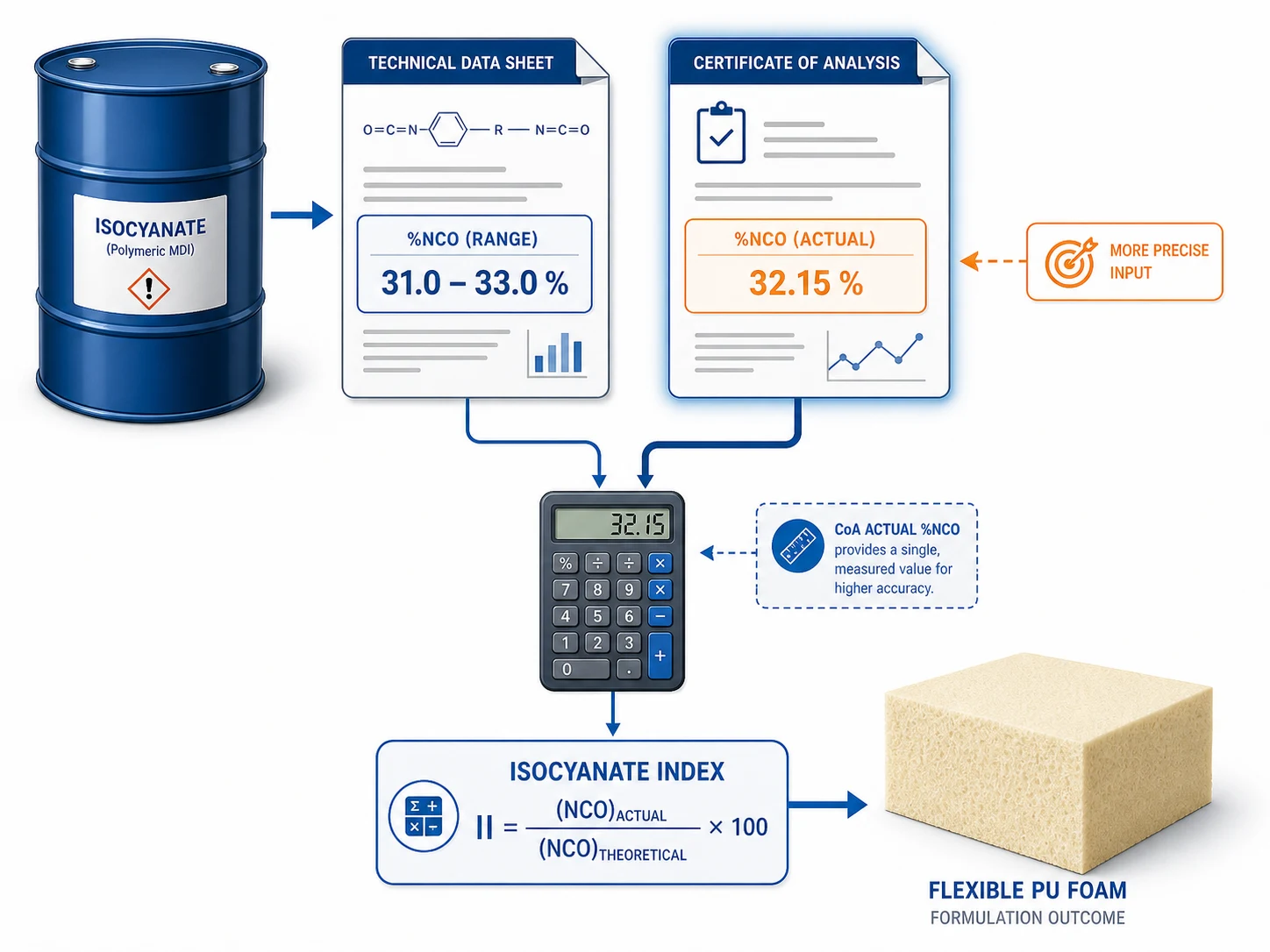
    The Technical Data Sheet gives a specification range or typical value. It tells you what the supplier considers acceptable for that grade. The Certificate of Analysis gives the actual %NCO value for the specific batch or drum delivered to your plant.

    That difference matters.

    The %NCO value controls isocyanate equivalent weight. Equivalent weight controls NCO equivalents. NCO equivalents control the isocyanate index. And the index affects foam hardness, compression set, resilience, cure behaviour, and batch consistency.

    If your formula uses the TDS midpoint while the drum has a different CoA value, the formula may not be running at the index shown on the sheet.

    This article explains why the CoA %NCO value belongs in your formulation calculation, why the TDS value is not enough, and how drum-to-drum variation creates real PU foam quality drift.

    What Is the Difference Between TDS %NCO and CoA %NCO?

    The Technical Data Sheet gives a general specification for the isocyanate grade. It may show typical %NCO value, acceptable %NCO range, viscosity range, appearance, storage guidance, and general product properties.

    The TDS is useful for understanding the product grade. But it does not tell you the exact %NCO value of the drum sitting in your plant.

    The Certificate of Analysis gives the batch-specific or drum-specific value. That is the number measured for the actual material delivered.

    For formulation calculation, the difference is simple:

    DocumentWhat It GivesHow It Should Be Used
    TDSSpecification range or typical valueProduct reference only
    CoAActual batch or drum valueFormulation calculation input

    The isocyanate index calculation needs one specific %NCO value. A range is not enough. A midpoint is only an assumption. The CoA value is the correct production input.

     Technical Data Sheet range compared with Certificate of Analysis actual NCO value

    Why the TDS %NCO Value Is Not a Formulation Input

    The TDS %NCO range is a commercial specification window.

    It defines the range within which the supplier considers the product acceptable. It does not define the exact value that should be used in your foam formula.

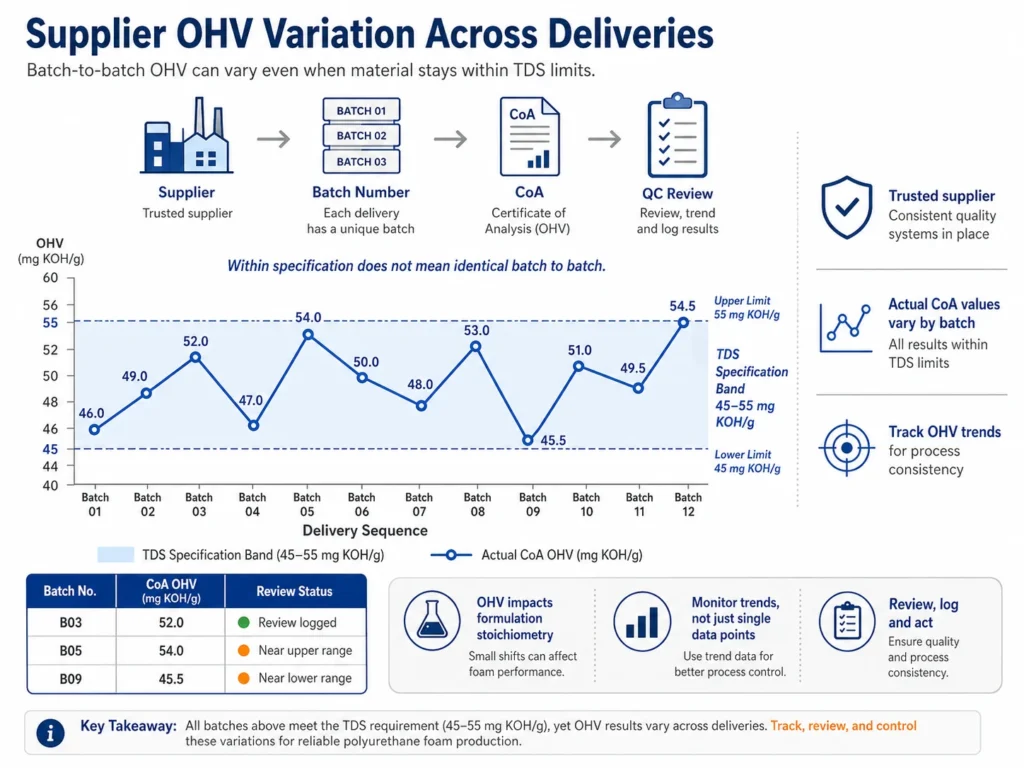
    For example, a TDI grade may have a %NCO specification range. A drum at the high end and a drum at the low end can both be accepted. Both can be within specification. Both can be shipped correctly.

    But they will not have the same equivalent weight. They will not deliver the same NCO equivalents per part. And if the same isocyanate quantity is used for both drums, they will not produce the same actual index.

    That is why the TDS midpoint should not be locked into the formulation spreadsheet as a permanent constant.

    The TDS helps identify the product. The CoA controls the calculation.

    How %NCO Controls Isocyanate Equivalent Weight

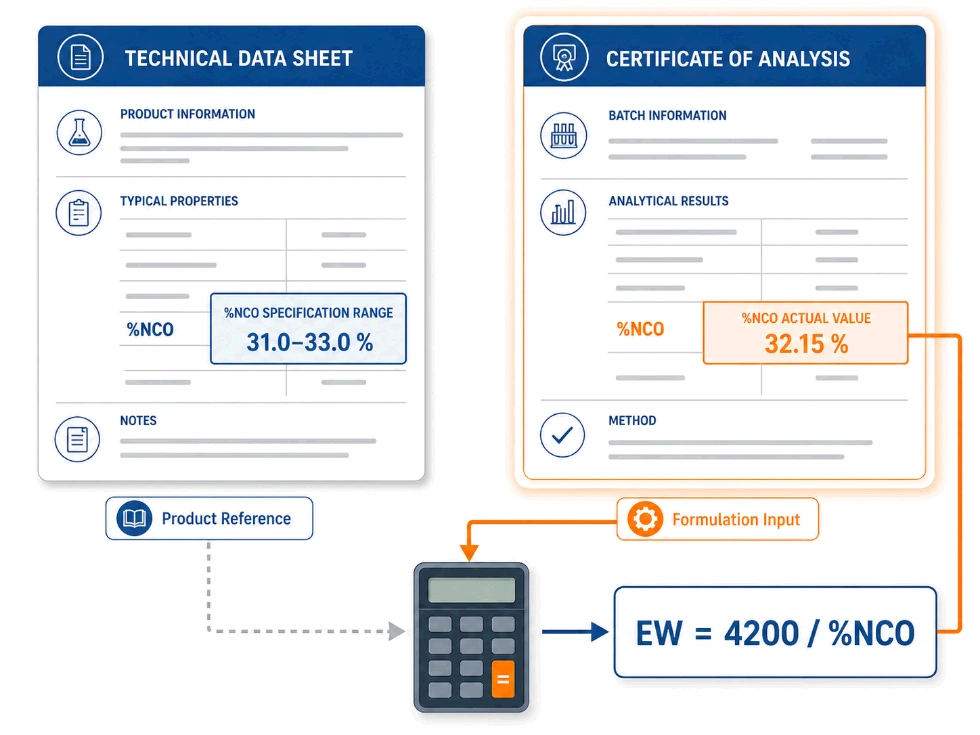
    The isocyanate equivalent weight formula is:

    Isocyanate EW = 4,200 ÷ %NCO

    The constant 4,200 comes from the molecular weight of the NCO group (42 g/mol) multiplied by 100. The only variable is %NCO.

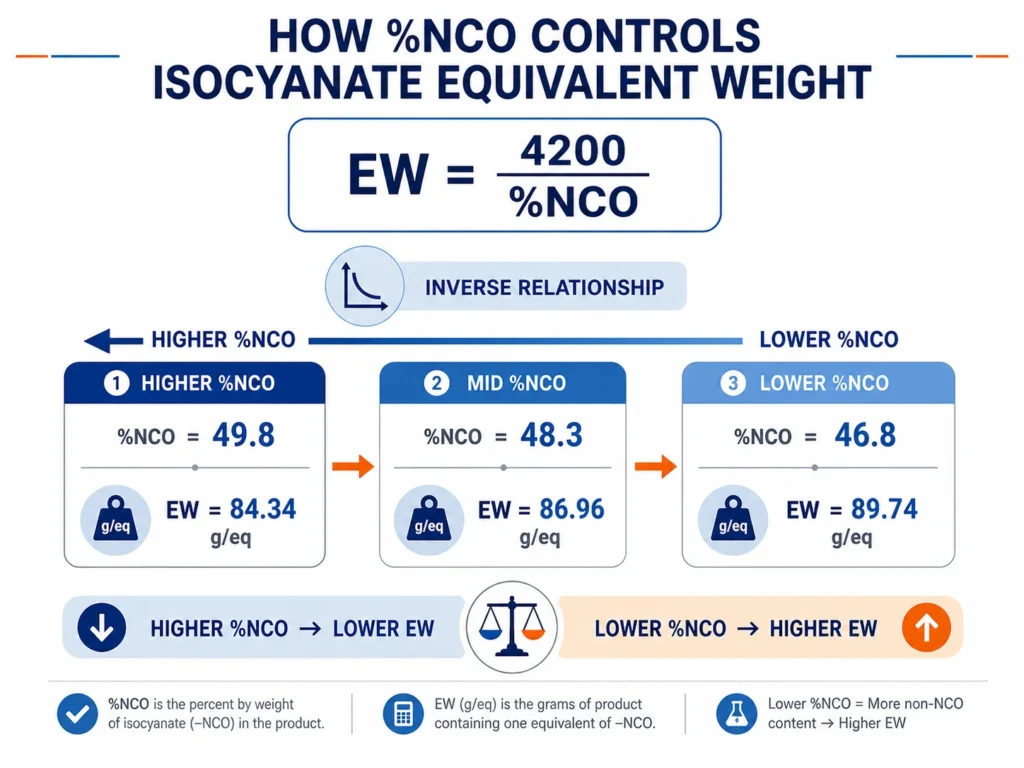
    If %NCO changes, equivalent weight changes. If equivalent weight changes, the same TDI or MDI parts deliver different NCO equivalents.

    %NCO ValueIsocyanate EW (g/eq)
    49.884.34
    48.386.96
    46.889.74

    Higher %NCO gives lower equivalent weight. Lower %NCO gives higher equivalent weight.

    This is the reason drum-to-drum %NCO variation becomes index variation.

    Percent NCO controlling isocyanate equivalent weight in polyurethane foam formulation

    The Index Swing Caused by Using One TDI Value for Every Drum

    Now look at what happens when the formula uses the same TDI quantity for drums with different actual %NCO values.

    Example TDI range:

    %NCO ValueEW (g/eq)TDI QuantityActual Index Running
    49.8 (high-end CoA)84.3450.22 parts108.3
    48.3 (midpoint / design)86.9650.22 parts105.0
    46.8 (low-end CoA)89.7450.22 parts101.8

    Same TDI quantity. Same foam formula. Same machine settings. Different actual index.

    From 101.8 to 108.3, the formula can experience about a 6.5 index point total swing only because the actual %NCO value changed.

    That is enough to affect foam properties.

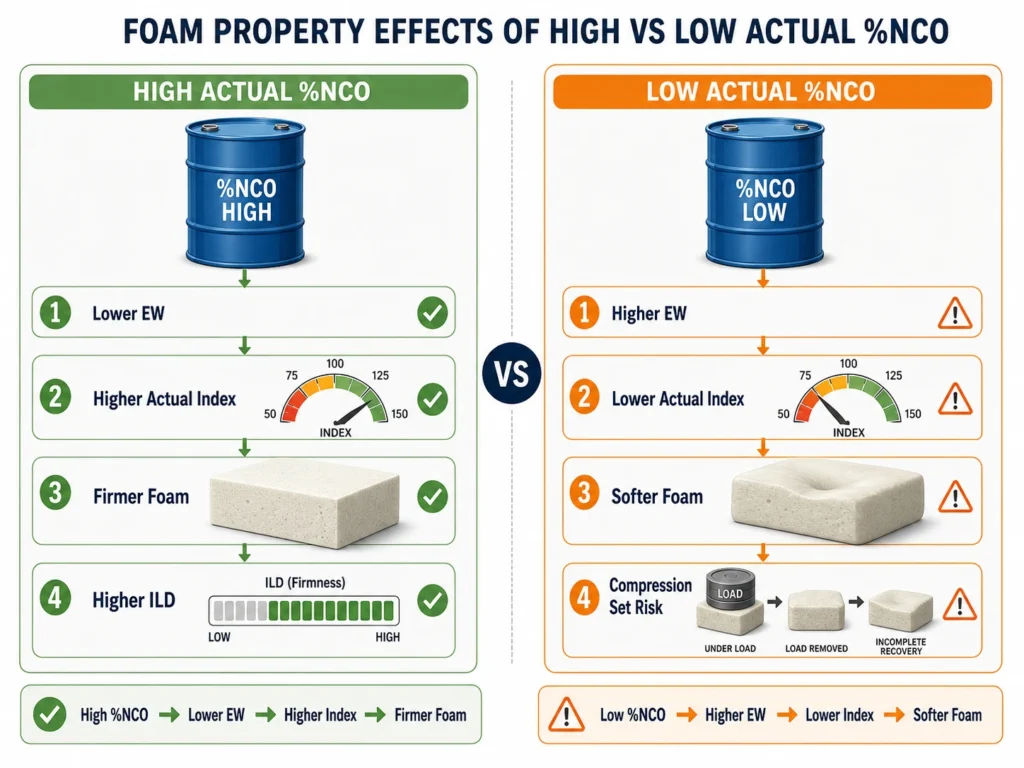
    • At the high %NCO end, the same TDI parts deliver more NCO equivalents. The foam may run firmer than expected.
    • At the low %NCO end, the same TDI parts deliver fewer NCO equivalents. The foam may run softer than expected.

    If the plant is using only the TDS midpoint, this variation can be misdiagnosed as a process issue. But the cause is inside the raw material data.

    Drum-to-drum NCO variation causing isocyanate index swing in polyurethane foam

    How This Shows Up in Foam Quality

    A wrong %NCO assumption can appear as ordinary foam quality variation.

    If the actual %NCO is higher than the formula assumption, the real index can rise. Possible symptoms include:

    • Higher hardness
    • Firmer hand feel
    • Higher ILD
    • Tighter compression set
    • Reduced softness
    • Possible brittleness if the shift is large

    If the actual %NCO is lower than the formula assumption, the real index can drop. Possible symptoms include:

    • Softer foam
    • Lower ILD
    • Weaker recovery
    • Compression set risk
    • Lower network development
    • Customer complaints about feel or durability

    The foam plant may look for the problem in catalyst, silicone, temperature, or machine calibration. Those checks are useful, but they do not answer the first question:

    Was the actual CoA %NCO value used in the formula?

    If the answer is no, troubleshooting is starting from an uncertain index baseline.

     High and low NCO content effects on polyurethane foam hardness and compression set

    Why CoA Logging Builds Better Formulation Control

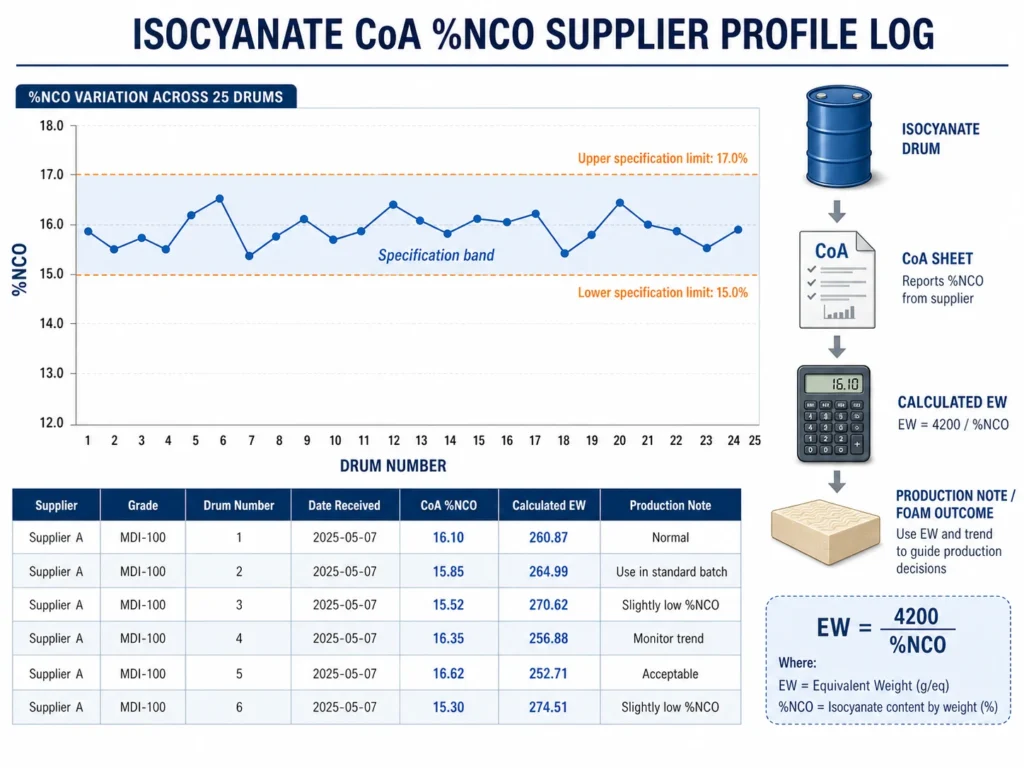
    Using the CoA value for one drum is good. Logging CoA values over time is better.

    Every isocyanate delivery should be recorded with:

    • Supplier name
    • Product grade
    • Drum or batch number
    • Date received
    • CoA %NCO
    • Calculated equivalent weight
    • Formula or production run used
    • Any foam quality observation

    After 20 to 30 drums, patterns become visible. Some suppliers may deliver very tight values close to the design target. Others may move across a wider part of the specification range. This supplier profile helps the foam plant understand real delivery behaviour, not just published specification limits.

    A supplier profile can answer questions like:

    • Is this supplier consistently high or low in %NCO?
    • Does the value drift by production batch?
    • Are quality issues linked to certain %NCO ranges?
    • Does a supplier switch require formula adjustment?
    • Is the formula using a realistic design value?

    This turns raw material data into production knowledge.

    Isocyanate CoA percent NCO supplier profile log for polyurethane foam production

    Correct Workflow: How to Use Drum CoA %NCO

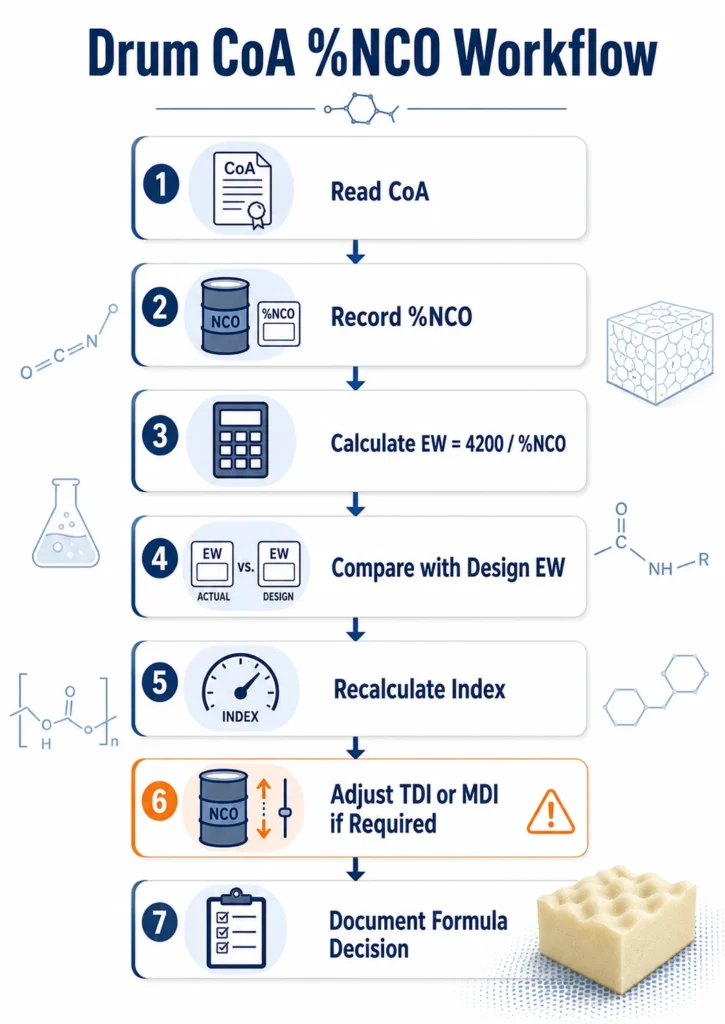
    Correct %NCO handling is a simple production workflow.

    1. Read the CoA. Before the drum enters production, check the actual %NCO value on the Certificate of Analysis.
    2. Record the value. Log supplier, grade, drum number, date, and %NCO value.
    3. Calculate isocyanate EW. Use EW = 4,200 ÷ %NCO.
    4. Compare with design EW. If the drum EW is close to the formula design value, no major change may be needed. If the difference is meaningful, review the index impact.
    5. Recalculate the index. Use the actual EW value in the full index calculation.
    6. Adjust isocyanate parts if required. If the index shift is significant, correct the TDI or MDI quantity before production.
    7. Document the formula decision. Record whether the run used the original formula or a corrected value based on CoA %NCO.

    This workflow prevents a TDS assumption from becoming a production quality issue.

    Workflow for using drum CoA percent NCO in polyurethane foam formulation

    Practical Decision Thresholds for %NCO Variation

    Not every %NCO difference requires a formula adjustment. The decision depends on the effect on equivalent weight and index.

    A practical guide:

    %NCO Deviation from DesignTypical Index ShiftAction Required
    Less than ±0.5%Around 1 pointRecord and monitor
    ±0.5% to ±1.0%Around 1–2 pointsRecalculate index and review adjustment
    More than ±1.0%3+ pointsAdjust isocyanate quantity before run

    These are practical production thresholds, not universal laws. High-specification products may require tighter control.

    The key point is that the decision should be based on calculation, not assumption.

    Use the PolymersIQ NCO / TDI Index Calculator

    The PolymersIQ NCO / TDI Index Calculator helps you calculate the correct isocyanate quantity using the actual CoA %NCO value.

    Use it when a new TDI or MDI drum arrives, the CoA %NCO differs from the design value, you switch isocyanate supplier, foam hardness shifts without a clear process reason, compression set changes after a new isocyanate batch, or you want to confirm the real index before production.

    Open the NCO / TDI Index Calculator →

    For the foundation explanation of %NCO, read NCO Content in Isocyanate: What %NCO Means in PU Foam Formulation.

    For common NCO handling mistakes, read 4 NCO Content Mistakes That Corrupt PU Foam Index Calculations.

    For the complete equivalent weight guide, read Equivalent Weight in Polyurethane Foam: Complete Calculation Guide.

    For the full isocyanate index calculation method, read Isocyanate Index Calculation Guide for PU Foam Engineers.

    FAQs

    What is the difference between TDS %NCO and CoA %NCO?

    The TDS (Technical Data Sheet) gives a general specification range or typical value for the isocyanate grade — it tells you what the supplier considers acceptable for that product. The CoA (Certificate of Analysis) gives the actual measured %NCO value for the specific batch or drum delivered to your plant. The TDS is for product reference; the CoA is for formulation calculation.

    Why shouldn’t I just use the TDS midpoint in my formula?

    The TDS midpoint is an assumption, not a measurement. A drum at the high end and a drum at the low end of the TDS range can both be inside specification, but they will have different equivalent weights and deliver different NCO equivalents per part. Using a fixed midpoint locks in an error every time the actual drum value differs from that midpoint.

    How much can the actual index swing due to drum-to-drum %NCO variation?

    For a typical TDI grade with a normal specification range, using one fixed TDI quantity across drums at the low and high ends of %NCO can produce about a 6.5-point total index swing. For example, the same 50.22 parts of TDI can deliver an actual index of 101.8 with a low-%NCO drum and 108.3 with a high-%NCO drum. That’s a meaningful difference in foam properties.

    Can a drum within TDS specification still cause foam quality problems?

    Yes. Being within specification means the supplier delivered acceptable material, but it does not mean the material matches your formulation baseline. If your formula was designed around one %NCO value and the delivered drum has a different value (still within range), the same isocyanate quantity will produce a different running index. Foam properties can drift even though the raw material is technically compliant.

    How do I calculate the index impact when %NCO changes?

    Use EW = 4,200 ÷ %NCO to calculate the new equivalent weight, then plug it into the full index calculation. The change in EW alters how many NCO equivalents the same TDI or MDI parts deliver, which moves the actual running index. If the index shift is significant, the isocyanate quantity should be adjusted before production.

    Should I always recalculate the index when a new drum arrives?

    For meaningful changes in CoA %NCO, yes. Small variations within ±0.5% of the design value can typically be monitored without immediate adjustment. Variations of ±0.5% to ±1.0% should be reviewed for index impact. Variations greater than ±1.0% generally justify adjusting the isocyanate quantity before the production run.

    What’s the benefit of logging CoA %NCO values over time?

    A supplier profile reveals delivery patterns that are not visible from a single drum. Some suppliers consistently deliver near the high end of the specification range, others near the low end, others at the midpoint. After 20–30 drums, you can see whether your formula’s design value matches what your supplier actually delivers — or whether the design value should be updated to match real delivery behaviour.

    Can supplier switches cause foam quality problems even with the same product grade?

    Yes. The same generic product grade from different suppliers can have different actual %NCO ranges, different batch-to-batch variation patterns, and different real delivery values. Switching suppliers without verifying CoA %NCO and recalculating the index can introduce unexpected foam quality drift. A supplier change should always trigger a formulation review.

    How does this rule apply to MDI and polymeric MDI?

    The same rule applies — only the %NCO range is different. MDI typically has %NCO around 31.5, polymeric MDI may have different values, and modified isocyanates have their own ranges. The formula EW = 4,200 ÷ %NCO is universal, and the same logic about TDS vs CoA applies to all isocyanate types.

    What’s the simplest QC change a foam plant can make to prevent this problem?

    Add one step to incoming QC: when a new isocyanate drum arrives, record the actual CoA %NCO, calculate the equivalent weight, and compare it to the formula design value. If the difference is significant, recalculate the index before the drum enters production. This single discipline prevents most %NCO-related index drift.

    Key Takeaways

    The TDS %NCO value is not the same as the CoA %NCO value. The TDS gives a specification range or typical value. The CoA gives the actual value for the delivered drum or batch.

    PU foam formulas should use the actual CoA %NCO value whenever available.

    %NCO controls isocyanate equivalent weight through:

    EW = 4,200 ÷ %NCO

    If %NCO changes, equivalent weight changes. If equivalent weight changes, the same isocyanate parts deliver different NCO equivalents. That changes the actual running index.

    Across a typical TDI range, using one fixed TDI quantity can create about a 6.5-point total index swing from low-end to high-end %NCO. This can appear as hardness drift, compression set variation, or inconsistent foam feel.

    The solution is simple: read the CoA, record the actual %NCO, calculate EW, recalculate index, and adjust isocyanate quantity when required.

    Conclusion

    If your foam quality is varying and the process data does not explain it, the cause may be in the isocyanate CoA.

    A formulation audit can identify whether the %NCO value in your formula matches what your supplier is actually delivering.

    PolymersIQ can help review your CoA data, calculate the true equivalent weight, and correct the index baseline before more production runs compound the error.

    To get accurate support, please share:

    • Isocyanate type, supplier, and grade
    • Recent CoA %NCO values (last 5–10 drums if available)
    • Design %NCO used in your original formulation
    • TDI or MDI quantity in current formula
    • Target index and observed foam properties (ILD, compression set)
    • Description of the production issue you are facing

    Contact PolymerIQ for an isocyanate formulation audit →

  • NCO Content in Isocyanate: What %NCO Means in PU Foam

    NCO Content in Isocyanate: What %NCO Means in PU Foam


    Introduction

    NCO content is one of the most important raw material values in polyurethane foam formulation.

    It tells you how much reactive isocyanate functionality is available in a given isocyanate material. That value directly affects equivalent weight, isocyanate demand, index calculation, and final foam properties.

    Most foam plants understand that TDI or MDI reacts with polyol, water, crosslinkers, and chain extenders. But many plants treat the %NCO value as if it is fixed for a grade.

    It is not fixed.

    Every drum or batch can have a specific %NCO value. That value is normally reported on the Certificate of Analysis. If the formulation uses a general Technical Data Sheet value instead of the actual drum value, the index calculation may not reflect what is really being fed to the mixing head.

    A small %NCO difference can change the isocyanate equivalent weight. Once equivalent weight changes, the same isocyanate parts no longer deliver exactly the same NCO equivalents.

    This article explains what NCO content means, how to calculate isocyanate equivalent weight, why %NCO varies, and why this value must be treated as a live formulation input.

    What Is NCO Content?

    NCO content is the mass percentage of reactive isocyanate groups present in an isocyanate material. It is usually written as %NCO.

    In practical terms, %NCO tells you how much of the isocyanate material is chemically available to react with active hydrogen components in the foam formula. Those reactive components may include:

    • Polyol hydroxyl groups
    • Water
    • Crosslinkers
    • Chain extenders
    • Amine-functional additives
    • Other active hydrogen sources

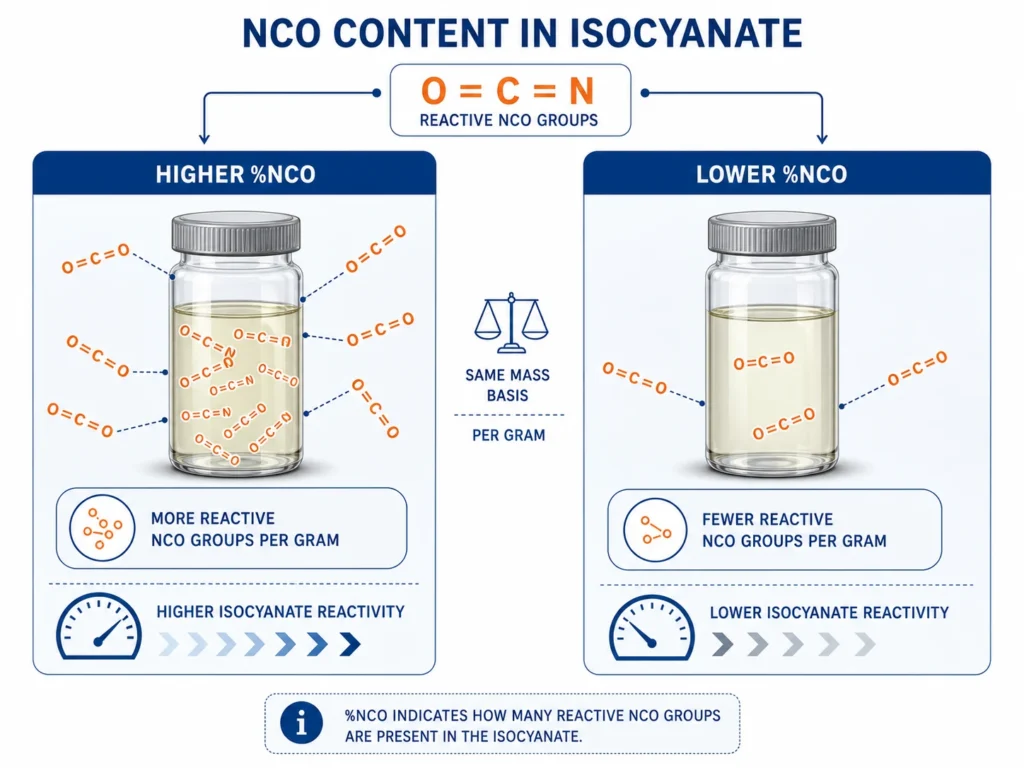
    A higher %NCO means more reactive NCO groups per gram of material. A lower %NCO means fewer reactive NCO groups per gram of material.

    This matters because polyurethane formulation is not only about how many parts of TDI or MDI are added. It is about how many reactive NCO equivalents are delivered to the system.

    Two isocyanate batches can have the same product name and still carry slightly different %NCO values. If the formula does not reflect that difference, the foam may not run at the intended index.

    Diagram explaining NCO content as reactive isocyanate groups per gram of material

    Why %NCO Matters in PU Foam Formulation

    The isocyanate index depends on the relationship between NCO equivalents and reactive hydrogen equivalents.

    If %NCO changes, the equivalent weight of the isocyanate changes. If equivalent weight changes, the number of NCO equivalents delivered by the same isocyanate parts changes.

    This can affect:

    • Actual isocyanate index
    • Foam hardness
    • Compression set
    • Resilience
    • Cure behaviour
    • Crosslink density
    • Batch-to-batch consistency
    • Foam feel and performance

    For example, if the %NCO is higher than the value used in the formula, the same weight of isocyanate delivers more NCO equivalents than expected. If the %NCO is lower than the value used in the formula, the same weight of isocyanate delivers fewer NCO equivalents than expected.

    This is why %NCO is not only a supplier data point — it is a formulation control value.

    Isocyanate Equivalent Weight Formula

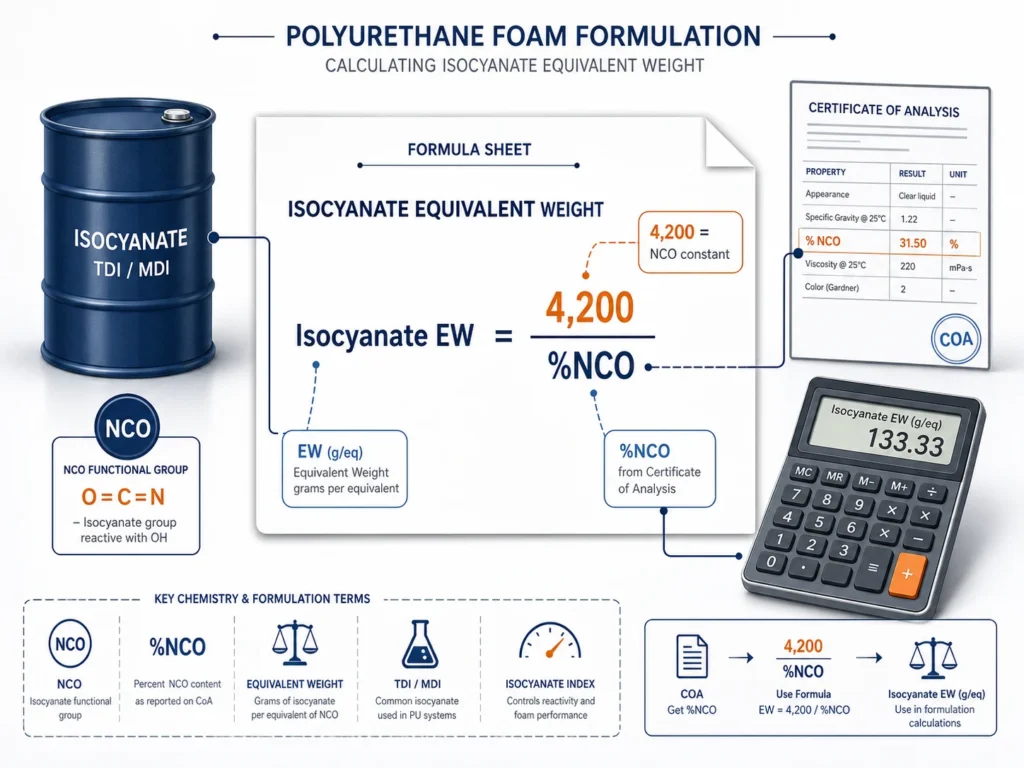
    Isocyanate equivalent weight is calculated from %NCO. The formula is:

    Isocyanate Equivalent Weight = 4,200 ÷ %NCO

    Where:

    • Equivalent weight is expressed in g/eq
    • %NCO is the actual NCO content of the isocyanate
    • 4,200 is the molecular weight of the NCO group (42 g/mol) multiplied by 100

    The constant 4,200 does not change. The variable is %NCO.

    This formula applies to TDI, MDI, polymeric MDI, and modified isocyanates, as long as the actual %NCO value is known.

    Isocyanate equivalent weight formula using percent NCO in polyurethane foam formulation

    Worked Examples: TDI and MDI Equivalent Weight

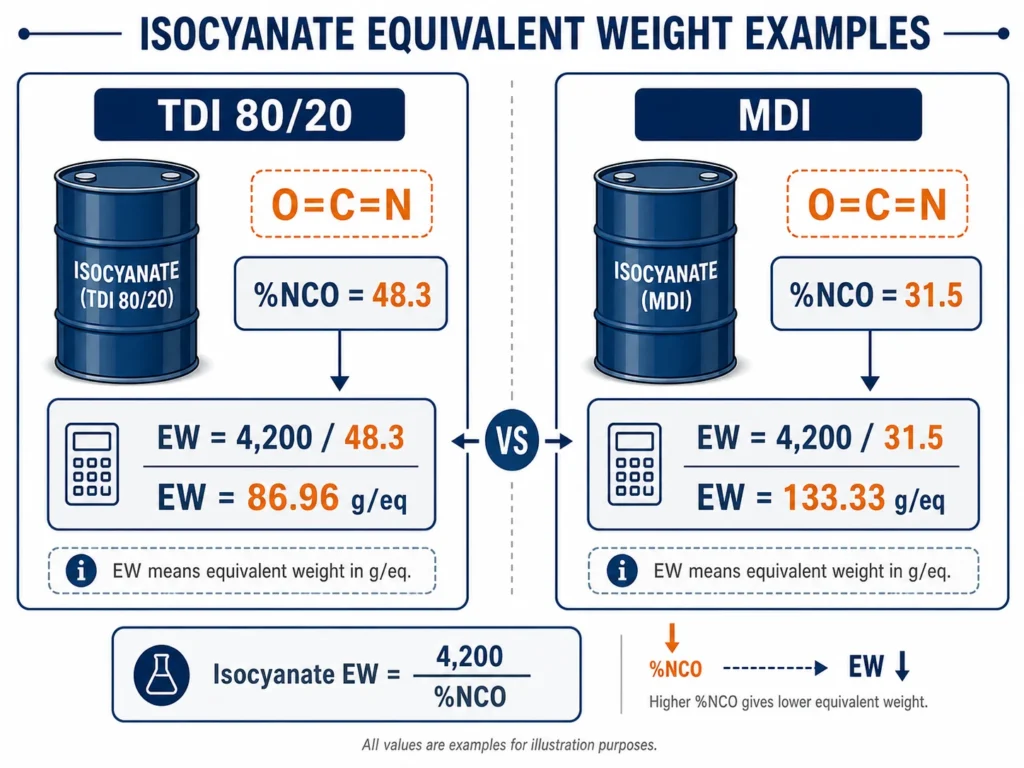
    Example 1: TDI 80/20

    If a TDI drum has %NCO = 48.3:

    EW = 4,200 ÷ 48.3 = 86.96 g/eq

    So the isocyanate equivalent weight is approximately 87 g/eq.

    Example 2: MDI

    If an MDI material has %NCO = 31.5:

    EW = 4,200 ÷ 31.5 = 133.33 g/eq

    So the isocyanate equivalent weight is approximately 133 g/eq.

    The calculation method is the same. Only the %NCO value changes.

    This is why the actual %NCO value from the drum or batch is important. The formula should not assume that every drum has exactly the same reactive content.

    TDI and MDI equivalent weight examples from percent NCO values

    How %NCO Changes Isocyanate Equivalent Weight

    The relationship between %NCO and equivalent weight is inverse:

    • If %NCO increases, equivalent weight decreases.
    • If %NCO decreases, equivalent weight increases.

    That means higher %NCO material delivers more reactive NCO per gram. Lower %NCO material delivers less reactive NCO per gram.

    %NCO ValueIsocyanate EW (g/eq)
    49.884.34
    48.386.96
    46.889.74

    These numbers show why %NCO variation matters. The isocyanate material may still be inside supplier specification, but the equivalent weight is not identical across the range.

    If the same isocyanate parts are used for every drum, the actual NCO equivalents delivered to the formula can shift. That shift can move the real running index away from the target.

    Relationship between NCO content and isocyanate equivalent weight in polyurethane formulation

    Why Every Drum Can Have a Different %NCO Value

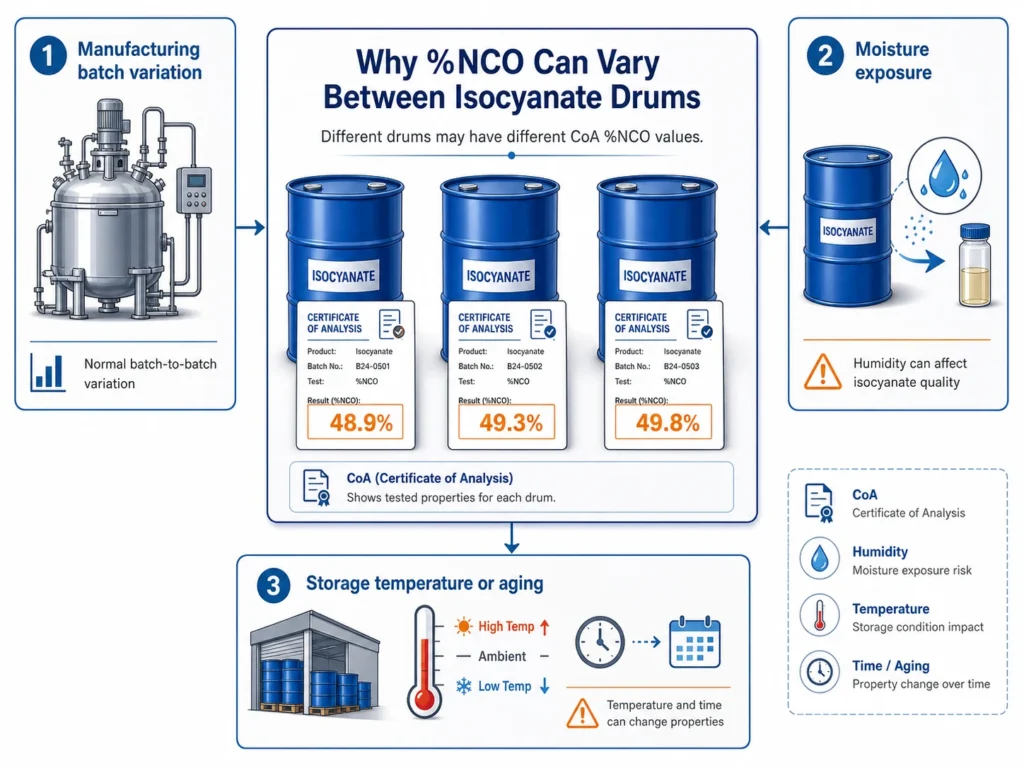
    %NCO can vary from drum to drum even when the product grade is the same. This does not automatically mean the material is defective. It usually means the material is inside the supplier’s allowed specification range, but the exact reactive content is not identical.

    Common reasons include:

    1. Manufacturing batch variation

    Isocyanate production depends on feedstock quality, reactor conditions, process control, and final product handling. Even well-controlled production can produce small %NCO variation within specification.

    2. Moisture exposure

    NCO groups react with water. If isocyanate is exposed to atmospheric moisture, some reactive NCO groups may be consumed before the material reaches the mixing head. This can lower active %NCO.

    Moisture exposure can occur through poor drum sealing, damaged bungs, humid storage conditions, repeated opening and closing, and improper handling during transfer.

    3. Storage temperature and aging

    Storage conditions can affect reactive isocyanate quality over time. Elevated temperature and long storage periods can contribute to chemical changes that reduce active NCO availability. The degree of change depends on material type, storage conditions, handling history, and supplier guidance.

    The practical point is simple: the %NCO value should be checked as a drum-specific or batch-specific value, not treated as a permanent constant.

    Reasons why NCO content varies between isocyanate drums in polyurethane foam production

    Why the Certificate of Analysis Matters

    The Technical Data Sheet usually gives a specification range or typical value. The Certificate of Analysis gives the actual value for a specific batch or drum.

    For formulation control, the CoA value is the more important number. The formula calculation needs one actual value, not a broad specification range.

    If the formulation uses a general TDS value but the drum’s CoA value is different, the equivalent weight calculation may be wrong. That can shift the real running index.

    The proper production habit is:

    1. Read the drum or batch CoA.
    2. Record the actual %NCO value.
    3. Calculate isocyanate EW using 4,200 ÷ %NCO.
    4. Recalculate the isocyanate index if the EW differs from the design value.
    5. Adjust isocyanate quantity if the index shift is significant.

    This does not mean every tiny %NCO movement requires a major formula change. It means the plant should know the effect before production starts.

    Workflow from Certificate of Analysis percent NCO to equivalent weight and isocyanate index calculation

    How %NCO Affects Foam Properties

    %NCO does not affect foam properties directly by itself. It affects foam properties through the index calculation.

    If the formula assumes the wrong %NCO value, the same isocyanate parts may deliver a different number of NCO equivalents than expected. That can shift the actual index.

    A higher actual index can move the foam toward:

    • Higher hardness
    • Higher crosslink density
    • Firmer feel
    • Lower softness
    • Possible brittleness if excessive

    A lower actual index can move the foam toward:

    • Softer hardness
    • Lower ILD
    • Weaker recovery
    • Compression set risk
    • Lower network development

    This is why %NCO should be treated as part of foam property control. A small raw material value can become a visible foam quality issue.

    Practical Rules for Using %NCO Correctly

    Use these rules in production:

    1. Do not treat %NCO as fixed. It can vary drum to drum or batch to batch.
    2. Use CoA %NCO for calculation. The CoA value is the specific value for the delivered material.
    3. Calculate isocyanate EW from the actual value. Use EW = 4,200 ÷ %NCO.
    4. Recalculate index when %NCO changes meaningfully. The same isocyanate parts may not deliver the same index if EW changes.
    5. Be careful after supplier changes. The same grade from a different supplier can have a different actual %NCO value.
    6. Protect isocyanate from moisture. Moisture consumes NCO and can reduce active reactive content.
    7. Check aged or suspect drums before production. If storage or sealing was poor, verify before using the material in critical foam.

    Use the PolymerIQ NCO / TDI Index Calculator

    The PolymeraIQ NCO / TDI Index Calculator helps you use the actual %NCO value in the index calculation.

    Use it when a new TDI or MDI drum arrives, the CoA %NCO differs from the design value, you switch isocyanate supplier, foam hardness changes without a clear process reason, a drum has been stored for a long period, or you need to confirm required isocyanate parts for target index.

    Open the NCO / TDI Index Calculator →

    For the deeper article on TDS versus CoA values, read TDS %NCO vs CoA %NCO: Why Your PU Foam Formula Must Use the Drum Value.

    For common NCO handling mistakes, read 4 NCO Content Mistakes That Corrupt PU Foam Index Calculations.

    For the complete equivalent weight guide, read Equivalent Weight in Polyurethane Foam: Complete Calculation Guide.

    For the full index calculation method, read Isocyanate Index Calculation Guide for PU Foam Engineers.

    FAQs

    What is NCO content in polyurethane foam formulation?

    NCO content is the mass percentage of reactive isocyanate groups in an isocyanate material, written as %NCO. It tells you how much of the isocyanate is chemically available to react with polyol, water, crosslinkers, and chain extenders during foam formation. Higher %NCO means more reactive NCO groups per gram of material.

    How is isocyanate equivalent weight calculated?

    Use EW = 4,200 ÷ %NCO, where %NCO is the actual NCO content from the Certificate of Analysis. The constant 4,200 comes from the NCO group molecular weight (42 g/mol) multiplied by 100. This formula applies to TDI, MDI, polymeric MDI, and modified isocyanates.

    What is the typical %NCO for TDI and MDI?

    TDI 80/20 typically has %NCO around 48.3, giving an equivalent weight of about 87 g/eq. MDI typically has %NCO around 31.5, giving an equivalent weight of about 133 g/eq. Polymeric MDI and modified isocyanates have their own typical ranges. The exact value for any specific drum should always be taken from its Certificate of Analysis.

    Why does %NCO vary between drums of the same product?

    Three main reasons: manufacturing batch variation (small differences in feedstock, reactor conditions, and process control), moisture exposure during storage or handling (NCO reacts with water), and storage temperature and aging. Even drums with the same product name can have slightly different %NCO values, all within the supplier’s specification range.

    Should I use %NCO from the TDS or the Certificate of Analysis?

    Always use the actual %NCO from the Certificate of Analysis for the specific drum or batch in production. The TDS gives a specification range, which is a commercial conformance window, not a precise formulation input. Equivalent weight is calculated directly from %NCO, so using a wrong %NCO creates a wrong EW and a wrong isocyanate balance.

    How does %NCO affect foam hardness?

    %NCO affects hardness indirectly through the index calculation. If the actual %NCO is higher than the formula assumes, the same isocyanate parts deliver more NCO equivalents than expected, the actual running index rises, and foam can become harder. If %NCO is lower than assumed, the index drops and foam can become softer. The effect on foam properties always goes through the index.

    Can moisture exposure really change %NCO?

    Yes. NCO groups react with water — that’s the same blowing reaction used inside the foam. If isocyanate is exposed to atmospheric moisture through poor drum sealing, damaged bungs, humid storage, or repeated opening and closing, some NCO groups can be consumed before the material reaches production. The active %NCO reaching the mixing head is then lower than the original CoA value.

    What happens if I keep using the same %NCO value when the drum changes?

    The formula sheet still shows the design index, but the actual running index drifts every time the new drum’s %NCO differs from the assumed value. Over many drums, this can produce inconsistent foam properties, batch-to-batch hardness drift, compression set variation, and confusing troubleshooting. The fix is to recalculate isocyanate EW for each drum’s actual %NCO.

    Should I recalculate the isocyanate index every time %NCO changes?

    For meaningful changes — yes. A small %NCO variation may produce a small index shift that’s within normal production variation. But a larger %NCO change (for example, after switching suppliers, opening a drum from long storage, or receiving a batch at the edge of the specification range) can produce a meaningful index shift that justifies recalculating the isocyanate quantity before production.

    Does the same rule apply to TDI, MDI, and polymeric MDI?

    Yes. The formula EW = 4,200 ÷ %NCO applies to all standard isocyanates because the constant 4,200 is the NCO group’s molecular weight contribution, which doesn’t depend on the specific isocyanate type. Only the %NCO value differs between TDI, MDI, polymeric MDI, and modified grades.

    Key Takeaways

    NCO content is the mass percentage of reactive isocyanate groups in an isocyanate material, usually written as %NCO.

    • Higher %NCO means more reactive NCO groups per gram.
    • Lower %NCO means fewer reactive NCO groups per gram.

    Isocyanate equivalent weight is calculated as:

    EW = 4,200 ÷ %NCO

    The %NCO value should be taken from the actual Certificate of Analysis when available, not treated as a fixed value from the TDS.

    Every drum or batch can carry a slightly different %NCO value. That variation changes equivalent weight, which can change the actual running index. If the actual index changes, foam hardness, compression set, recovery, and consistency can also change.

    Correct %NCO handling is a basic part of polyurethane foam formulation control.

    Conclusion

    If your foam properties are shifting from batch to batch and the process looks stable, the issue may be in the raw material data.

    The isocyanate drum may not be delivering the same %NCO value your formula assumes.

    PolymersIQ can help review your CoA data, calculate the correct isocyanate equivalent weight, and identify whether %NCO variation is shifting your index baseline.

    To get accurate support, please share:

    • Isocyanate type, supplier, and grade
    • Recent CoA %NCO values (last 5–10 drums if available)
    • Design %NCO used in your original formulation
    • Polyol grade, OHV, water level, and any crosslinkers
    • Target index and observed foam properties (ILD, compression set)
    • Description of the production issue you are facing

    Contact PolymerIQ for an isocyanate formulation audit →

  • 4 Water Adjustment Mistakes in PU Foam Production

    4 Water Adjustment Mistakes in PU Foam Production


    Introduction

    Water is one of the most powerful variables in flexible polyurethane foam formulation. It is also one of the most misunderstood.

    Many foam plants treat water as a density control dial. If density is too high, water is increased. If density is too low, water is reduced. The adjustment looks simple, and in many cases, the density moves in the expected direction.

    But water does not only control density.

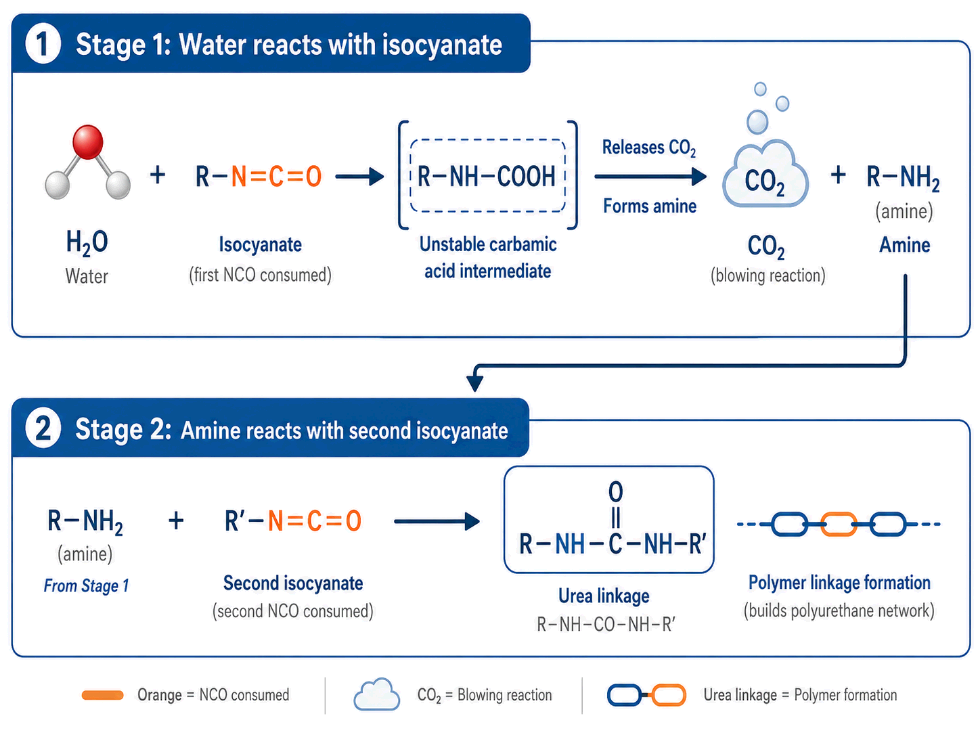
    Water generates CO₂, consumes NCO, forms amine intermediates, creates urea linkages, changes the isocyanate index, affects hardness, influences compression set, and increases exotherm. That means every water adjustment affects several foam properties at once.

    A plant may reduce water to fix density and later face compression set failures. Another plant may increase water for low-density foam and later see core discoloration or scorch risk. A production team may change water without recalculating the index and then spend weeks troubleshooting soft foam or hardness drift.

    The mistake is not adjusting water. Water adjustment is part of normal foam formulation. The mistake is treating water as an independent single-function variable.

    This article explains four common water adjustment mistakes that cause PU foam quality problems and how to control them before they reach the customer.

    Why Water Adjustments Create Hidden Problems

    Water has two connected roles in polyurethane foam.

    First, it reacts with isocyanate to generate CO₂. This gas expands the foam and affects density. Second, the same reaction produces an amine, which reacts with another isocyanate group to form a urea linkage. These urea hard segments affect the foam network.

    So every water adjustment changes:

    • CO₂ generation
    • Foam expansion and density
    • NCO consumption and isocyanate index
    • Urea formation
    • Hardness / ILD
    • Compression set
    • Exotherm

    This is why a water change can appear successful at first and still create a delayed quality problem. The production team may only measure the immediate result, such as density. But the network-related effects may appear later through compression set, recovery, hardness drift, or customer complaints.

    Water should be treated as a reactive formulation variable, not just a blowing-agent adjustment.

    Mistake 1: Changing Water Level Without Recalculating the Index

    Water consumes NCO. That means water is part of the isocyanate index calculation.

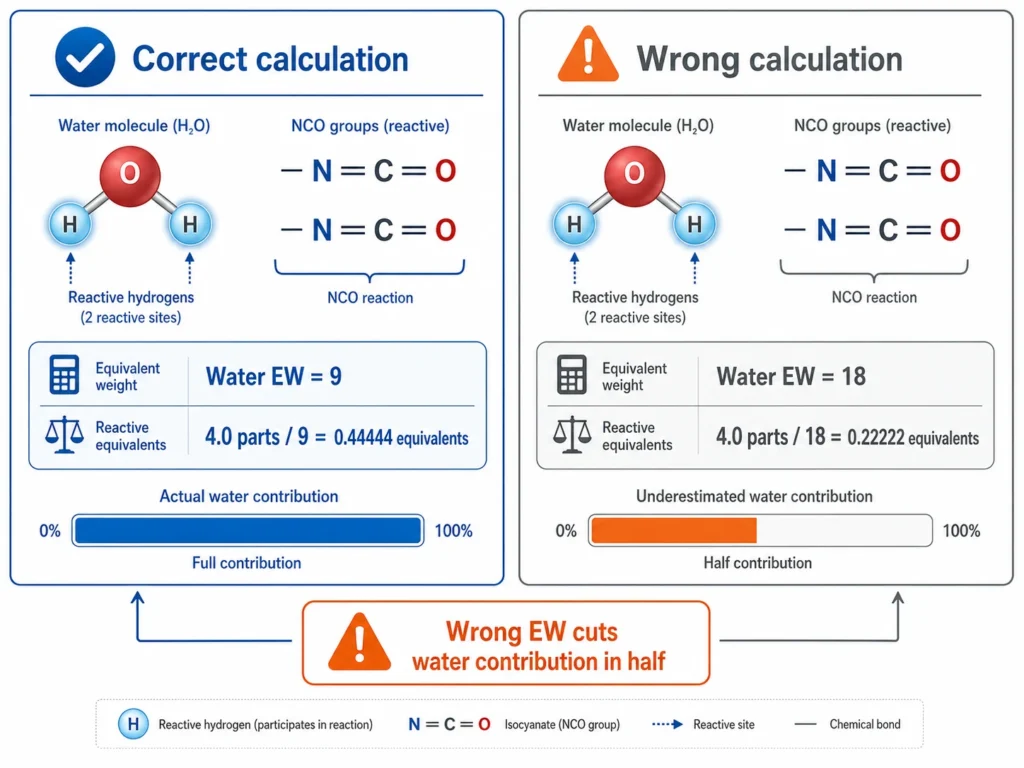
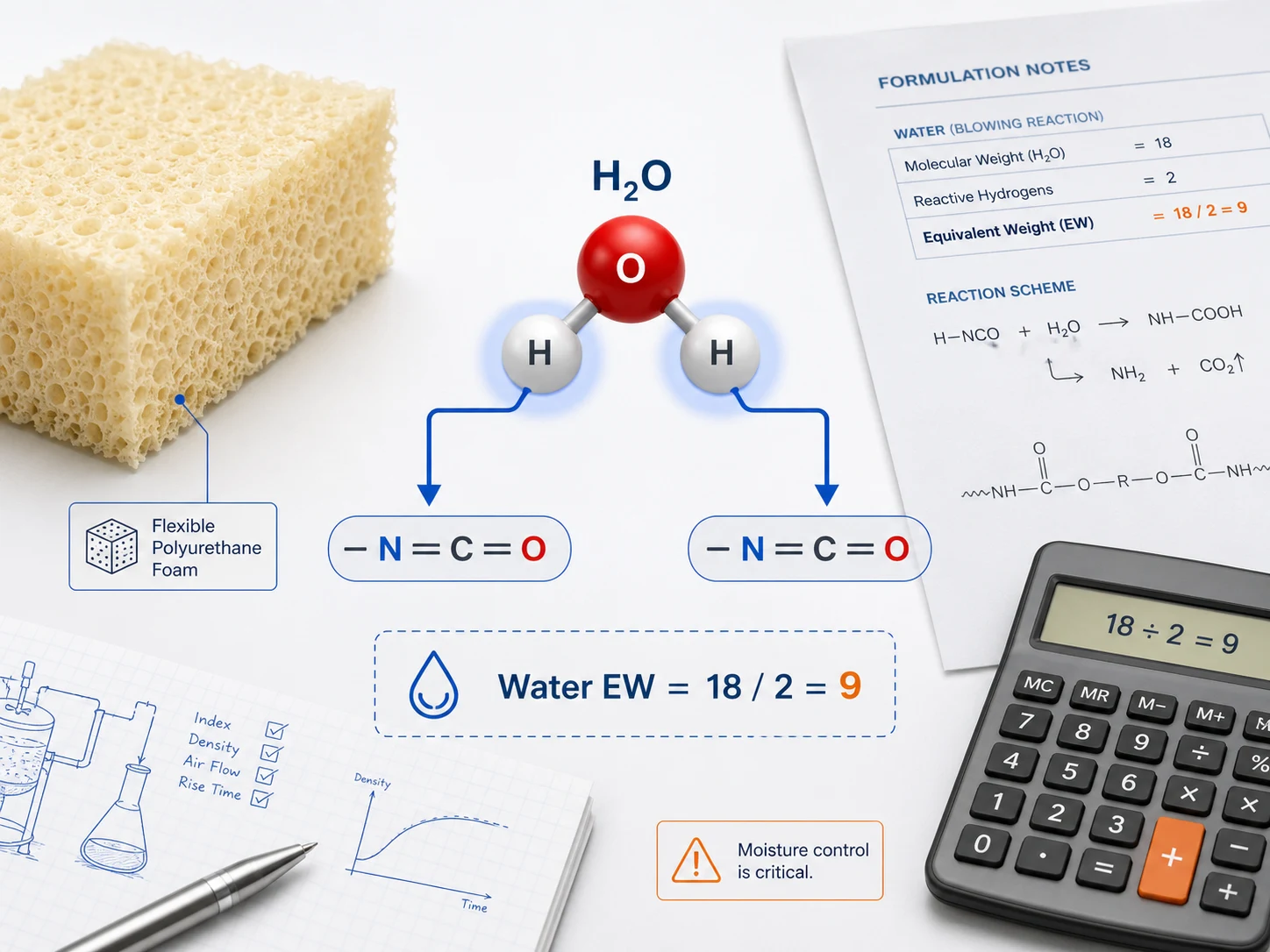
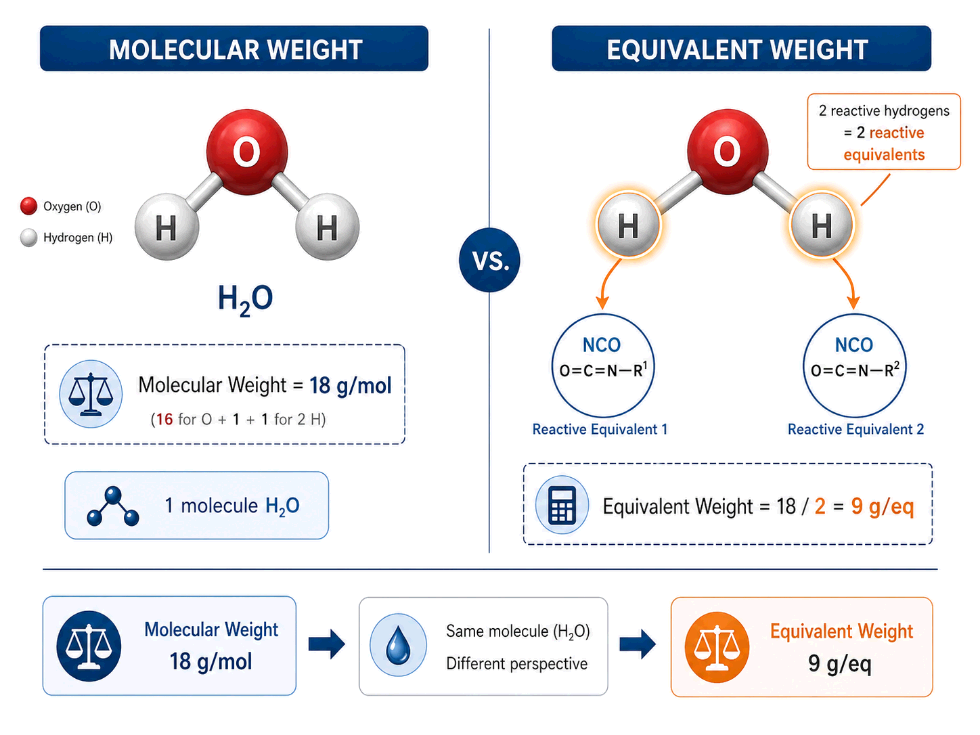
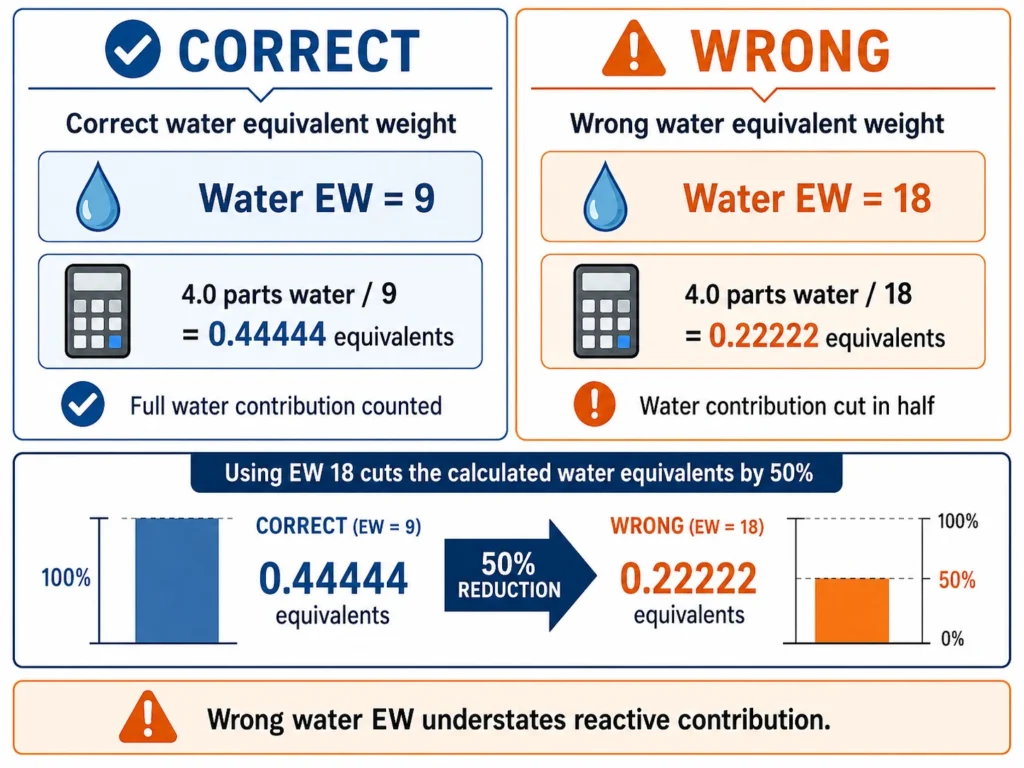
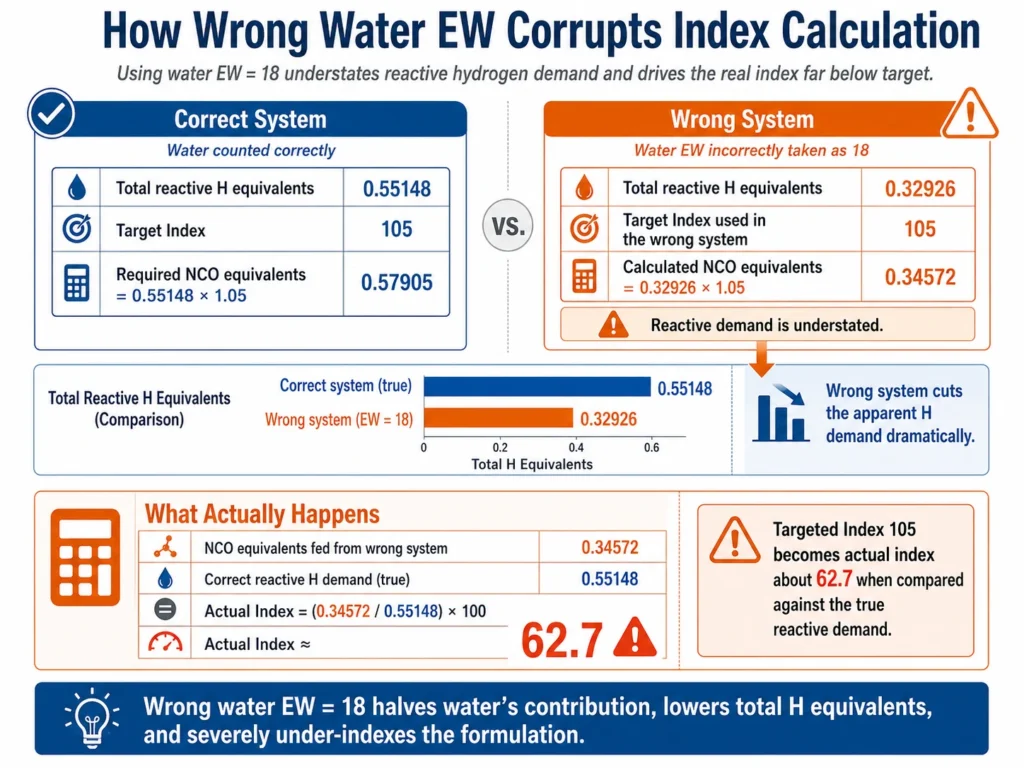
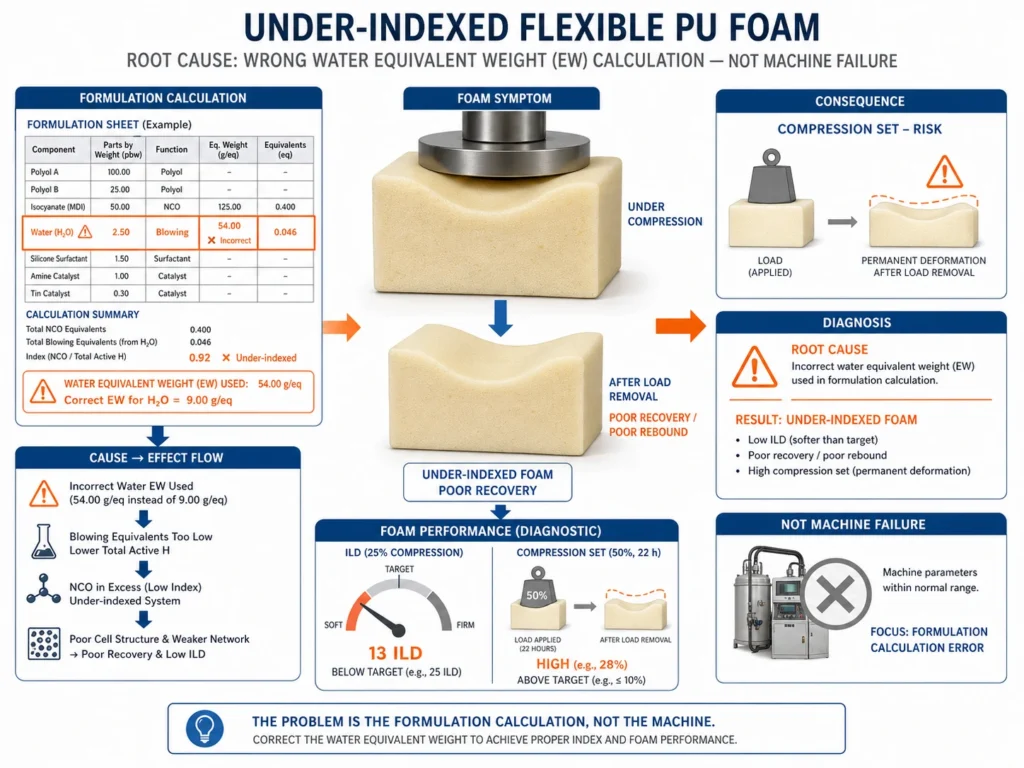
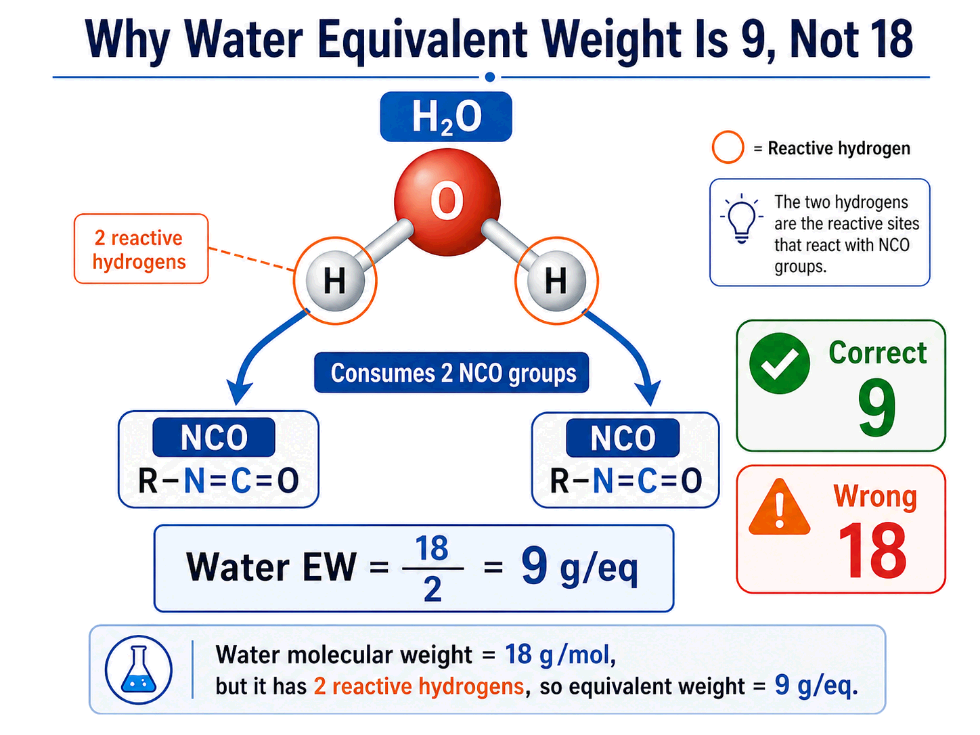
    The equivalent weight of water in polyurethane foam is 9 g/eq. So when water level changes, total reactive hydrogen equivalents change. If the isocyanate amount is not recalculated, the real running index changes immediately.

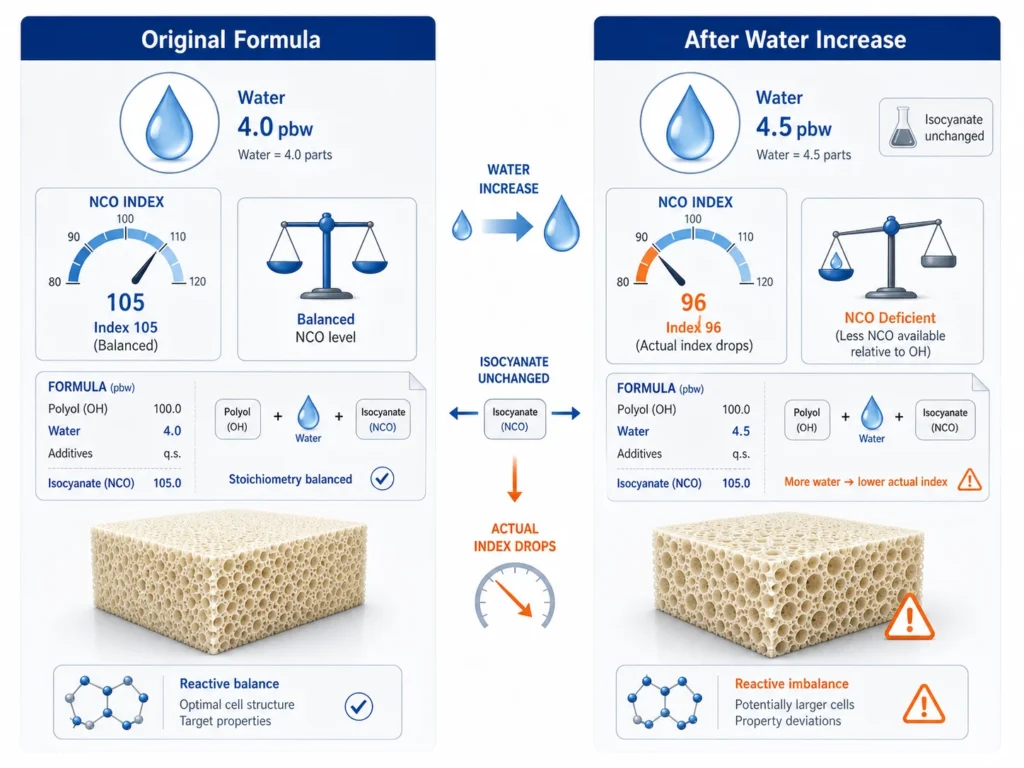
    For example, if a standard flexible slabstock formula increases water from 4.0 parts to 4.5 parts but the isocyanate quantity is left unchanged, the actual index can drop significantly. This type of change can move the index from 105 to about 95.4.

    That is not a small adjustment. The engineer may think only water was changed. In reality, the formula now has a different index.

    Possible results include:

    • Softer foam than expected
    • Lower ILD
    • Poorer compression set
    • Weaker recovery
    • Slower cure
    • Different foam feel
    • Confusing production troubleshooting

    Every water change requires a fresh index calculation. No exception.

    Water level change causing isocyanate index shift in PU foam formulation

    Mistake 2: Correcting Density with Water but Ignoring Compression Set

    Density correction is one of the most common reasons engineers adjust water.

    If the foam is too dense, increasing water may lower density. If the foam is too light, reducing water may increase density. That part is understandable.

    The mistake is stopping the evaluation at density.

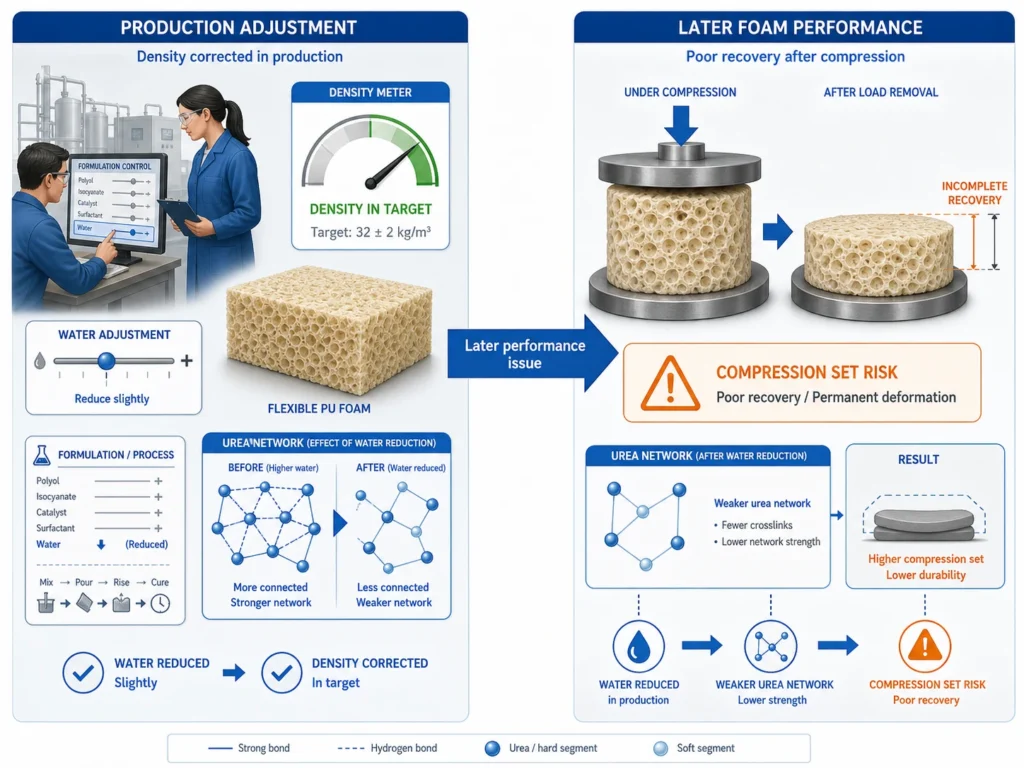
    Water also affects urea formation. Urea linkages help build the hard-segment network that supports recovery and compression set performance. If water is reduced to correct density, urea formation also decreases.

    The foam may pass production density checks. It may cut normally. It may look acceptable on the floor. But the reduced urea network can weaken long-term recovery.

    The problem may appear later as:

    • Higher compression set
    • Poorer recovery after sustained load
    • Mattress or cushion returns
    • Field complaints
    • Customer reports of permanent deformation

    This is dangerous because the failure may appear weeks or months after the original water adjustment. By then, the water change may be forgotten. The plant may treat compression set failure as a new problem — but chemically, it may be connected to the earlier water adjustment.

    A density correction should always be validated against compression set.

    Water reduction fixing foam density but increasing compression set risk in polyurethane foam

    Mistake 3: Running High Water Levels Without Managing Exotherm

    High water levels can help produce lower-density foam.

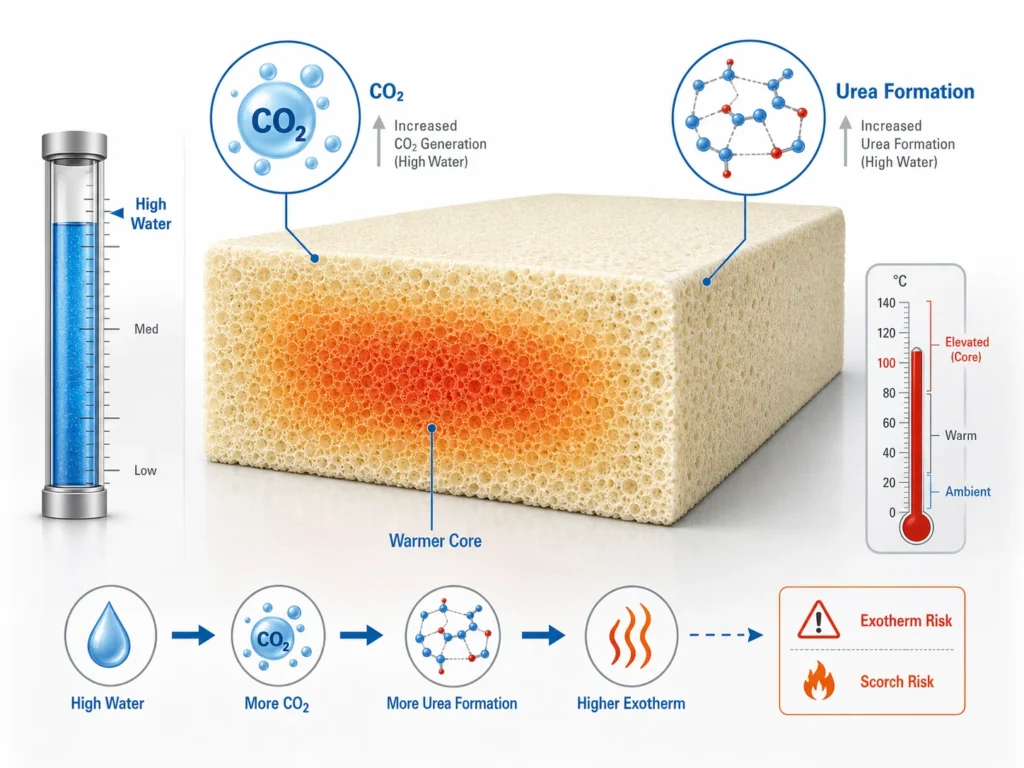
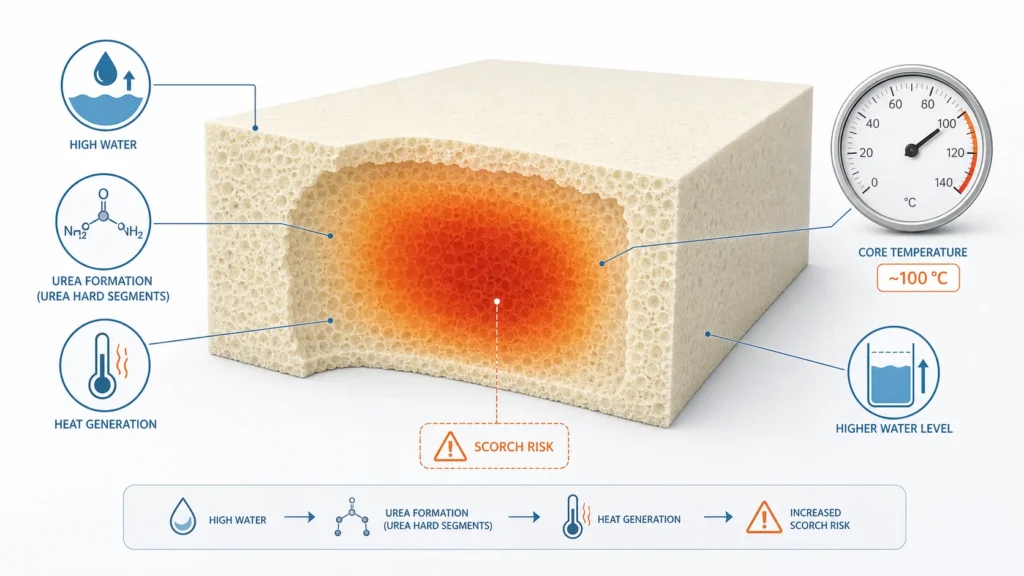
    But higher water also increases urea formation and heat release. At higher water levels — especially around and above 4.5 parts — exotherm can become a serious risk in flexible slabstock foam, depending on the formula and block geometry.

    Large blocks are especially sensitive because heat dissipates slowly from the core. The surface may look normal while the center of the block experiences excessive temperature.

    Possible signs of high exotherm include:

    • Core discoloration
    • Scorch risk
    • Internal cell irregularity
    • Reduced tensile strength in the core
    • Uneven physical properties
    • Processing instability
    • Odor or degradation symptoms in severe cases

    High water formulas need more than a density target — they require thermal management.

    Important checks include block height, pour profile, water level, catalyst balance, foam density, ventilation, raw material temperature, cooling time, and core temperature risk.

    Pushing water to achieve ultra-low density without considering exotherm can create a core-quality problem that is not visible from the outside.

    High water level causing exotherm and scorch risk in polyurethane foam slabstock core

    Mistake 4: Treating Water as an Independent Variable

    There is no such thing as “just changing water” in polyurethane foam.

    Every water adjustment changes multiple formulation relationships at once.

    ChangeWhat Happens
    Water increasesMore CO₂, lower density, higher NCO demand, index drops if iso is unchanged, more urea formation, more exotherm, complex hardness response
    Water decreasesLess CO₂, higher density, lower NCO demand, index rises if iso is unchanged, less urea formation, compression set risk, recovery may change

    Water is connected to the whole foam system. It interacts with isocyanate index, catalyst balance, silicone surfactant, polyol functionality, crosslinker level, density target, compression set requirement, and block size / exotherm management.

    This is why water should never be adjusted in isolation. A correct water adjustment requires a formulation review, not just a machine setting change.

    Water is not an independent variable in PU foam formulation because it affects index, density, hardness, compression set, and exotherm

    What Water Adjustment Problems Look Like in Production

    Water adjustment mistakes can look like unrelated production problems. That is why they are often misdiagnosed.

    A plant may experience:

    • Density corrected but compression set later failing
    • Foam becoming softer after a water increase
    • Hardness changing more than expected
    • High-water formula showing core discoloration
    • Catalyst changes giving only temporary improvement
    • Foam passing density but failing long-term recovery
    • Different results after small water changes
    • Customer complaints appearing weeks after production adjustment

    These problems can be confusing because the original water change may not look suspicious. The team may say “the formula did not change.”

    But the formula did change. Water changed. And water is a reactive formulation component.

    The first troubleshooting question should be: Was water changed recently, and was the index recalculated afterward?

    PU foam troubleshooting symptoms caused by water adjustment mistakes

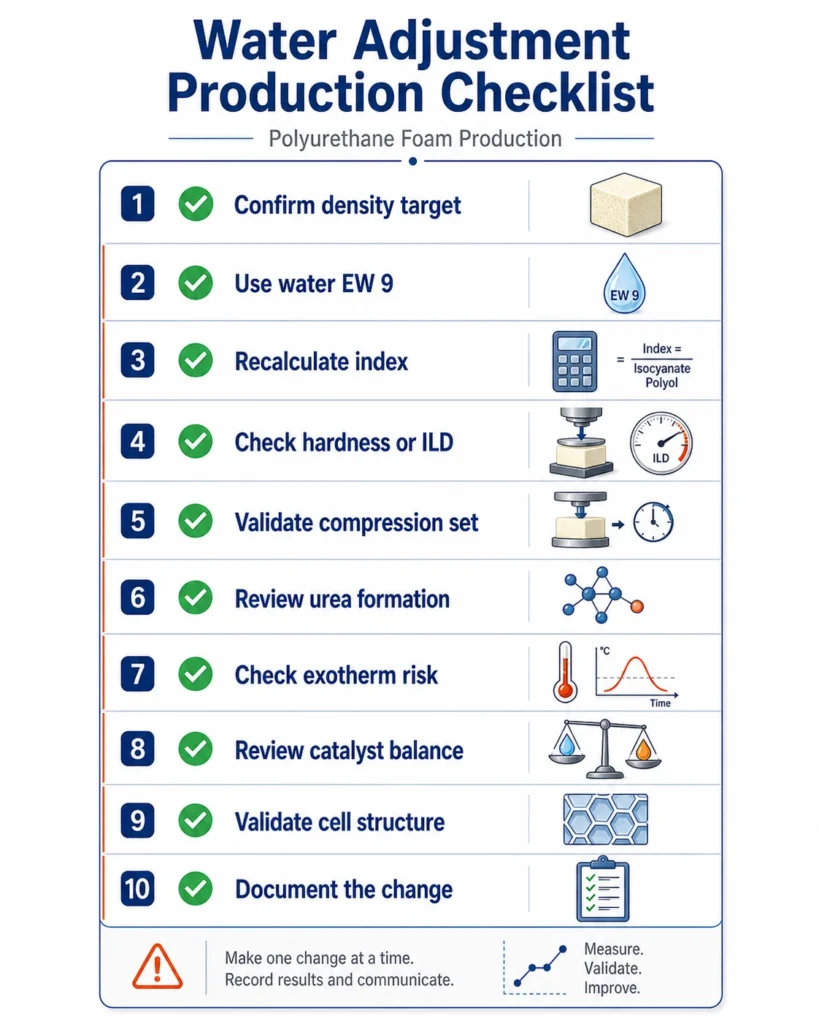
    Production Checklist Before Changing Water Level

    Before changing water in a PU foam formulation, review the full effect using this checklist:

    CheckpointQuestion
    Density targetWhat density change is expected?
    Water EWIs water calculated as EW = 9?
    Index recalculationHas TDI or MDI demand been recalculated?
    Hardness / ILDWill hardness still meet target?
    Compression setWill recovery performance remain acceptable?
    Urea formationDoes the change reduce or increase network contribution?
    ExothermIs core temperature risk acceptable?
    Catalyst balanceDoes the reaction profile still match the new water level?
    Cell structureCan the surfactant system support the new expansion?
    Trial validationWill density, ILD, compression set, and core condition be tested?
    DocumentationHas the water change been recorded with date and reason?

    A water change should never be approved only because density improved. It should be approved because the full foam property balance remains acceptable.

    Water adjustment production checklist for polyurethane foam formulation

    Correct Workflow for Water Adjustment

    A safer water adjustment workflow follows this sequence:

    1. Define the reason for the water change.
    2. Estimate the density effect.
    3. Calculate water reactive equivalents using EW = 9.
    4. Recalculate total reactive hydrogen equivalents.
    5. Recalculate required isocyanate for the target index.
    6. Review hardness and ILD risk.
    7. Review compression set risk.
    8. Review exotherm risk, especially for high-water formulas.
    9. Run a controlled production trial.
    10. Test density, ILD, compression set, and core condition.
    11. Document the final formula and reason for the change.

    This keeps water changes controlled and traceable. It also prevents the common problem of solving one visible issue while creating a hidden performance issue.

    Use the PolymerIQ Calculators

    Because water consumes NCO, every water adjustment should be checked through the index calculation. The PolymersIQ Isocyanate Index Calculator helps verify the corrected isocyanate requirement after changing water level. Use it when water level changes, TDI or MDI parts need recalculation, foam becomes softer or harder after adjustment, compression set changes after density correction, or a legacy formula has undocumented water changes.

    Open the Isocyanate Index Calculator →

    Water is often changed to correct density. The PolymersIQ Foam Density Estimator helps estimate density impact before a water adjustment reaches production. Use it when increasing or reducing water, comparing water level options, reviewing low-density grades, or checking whether a density correction may create additional formulation risks.

    Open the Foam Density Estimator →

    For the chemistry behind water’s dual role, read The Dual Role of Water in Polyurethane Foam: Blowing Agent and Urea Network Builder.

    For water’s effect on density, hardness, compression set, and exotherm, read How Water Level Affects PU Foam Density, Hardness, Compression Set, and Exotherm.

    For the water equivalent weight calculation, read Why the Equivalent Weight of Water Is 9 in Polyurethane Foam.

    FAQs

    What are the most common water adjustment mistakes in PU foam production?

    The four most common mistakes are: changing water level without recalculating the index, correcting density with water but ignoring compression set, running high water levels without managing exotherm, and treating water as an independent variable when it actually affects density, index, hardness, compression set, and exotherm at once.

    Why does changing water affect the isocyanate index?

    Water reacts with isocyanate and consumes NCO during the blowing reaction. Water’s equivalent weight is 9, which makes it a major contributor to total reactive hydrogen equivalents. When water level changes, reactive equivalents change, and the isocyanate quantity required to maintain the target index changes too. Leaving the isocyanate unchanged after a water adjustment shifts the actual running index.

    Can a water reduction cause compression set failure later?

    Yes. Reducing water reduces both CO₂ generation and urea formation. Urea hard segments help build the network that supports recovery. If water is reduced to fix density but the formula is not rebalanced, the network may be weaker — and compression set complaints can appear weeks or months later.

    How much can the index change if I increase water by 0.5 parts and don’t adjust isocyanate?

    The shift can be significant. For a typical flexible slabstock formula, increasing water from 4.0 to 4.5 parts without changing isocyanate can drop the actual index from around 105 to about 95.4. That’s not a small drift — it can move the foam well below the target performance window.

    When does high water become an exotherm risk?

    At water levels around and above 4.5 parts, the urea-forming reaction releases enough heat that core temperature can become a concern, especially in large slabstock blocks. The exact threshold depends on block size, density, formulation, ventilation, and ambient conditions. Larger blocks dissipate heat more slowly from the core, which makes them more sensitive.

    What are the signs of high exotherm in slabstock foam?

    Core discoloration (yellowing or browning at the center), scorch marks, internal cell irregularity, reduced tensile strength in the core, uneven physical properties between surface and center, processing instability, and in severe cases odor or degradation symptoms. The outside of the block may look completely normal while the core is compromised.

    Why is water described as a “reactive formulation variable” instead of a blowing agent?

    Because water does both jobs at once — it reacts chemically with isocyanate (consuming NCO and creating urea linkages) and also generates CO₂ for foam expansion. Calling it just a blowing agent suggests it only affects density, which understates its role. Treating water as a reactive component reminds engineers that it changes the whole foam system, not just the cell structure.

    Should water adjustments be documented?

    Yes. Water changes should be recorded with date, reason for the change, old and new water levels, recalculated index, recalculated isocyanate quantity, and trial results (density, ILD, compression set, core condition). Without documentation, undocumented water changes can become a hidden source of formulation drift months later.

    What’s the first thing to check when foam properties drift after recent production adjustments?

    Check whether water level was changed recently. If yes, check whether the index was recalculated and the isocyanate quantity adjusted. Many “mysterious” foam quality problems trace back to a water change that was made for one reason (often density) but didn’t include a full formulation review.

    Can I just adjust catalyst to compensate for a water change?

    No — catalyst adjustment cannot fix a stoichiometric imbalance. If water changed and the index drifted, no amount of catalyst tuning will restore the network structure that the missing or excess NCO would have built. Catalyst adjustments may temporarily mask one symptom while leaving the underlying chemistry unbalanced. The correct fix is to recalculate the index and adjust isocyanate.

    Key Takeaways

    Water adjustment is never a single-property change.

    The four most common mistakes are:

    1. Changing water level without recalculating the index.
    2. Correcting density with water but ignoring compression set.
    3. Running high water levels without managing exotherm.
    4. Treating water as an independent variable.

    Water generates CO₂, consumes NCO, forms urea linkages, changes index balance, affects hardness, influences compression set, and increases thermal load. If water changes, the formula changes.

    Every water adjustment should be recalculated, documented, and validated through density, ILD, compression set, and exotherm review. A density fix is not complete until the rest of the foam property balance is confirmed.

    Conclusion

    If your plant has used water changes to correct density but later faced compression set failure, hardness drift, or core heat problems, the issue may not be random.

    Water may have solved one problem while creating another.

    PolymersIQ can help review your water adjustment history, recalculate the index impact, evaluate density and compression set risk, and identify whether your current formulation balance needs correction.

    To get accurate support, please share:

    • Current water level and any recent changes (with dates if possible)
    • Foam density target and recent density results
    • Polyol grade, OHV, and isocyanate %NCO
    • Target index and observed foam properties (ILD, compression set)
    • Block size and any core temperature observations
    • Description of the production issue and any adjustments already tried

    Contact PolymerIQ for a water-level formulation audit →

  • How Water Level Effects PU Foam Properties

    How Water Level Effects PU Foam Properties


    Introduction

    Water level is one of the most powerful variables in flexible polyurethane foam formulation.

    Most engineers understand its effect on density. Increase water — more carbon dioxide is generated, more gas expands the foam matrix, density usually decreases. Reduce water — less CO₂, less expansion, density usually increases.

    That part is simple.

    The problem is that water does not control only density.

    Water also affects urea formation, hardness, compression set, resilience, exotherm, and isocyanate demand. A water adjustment made for one reason can quietly create a second problem somewhere else in the foam. This is why a density correction can later become a compression set complaint.

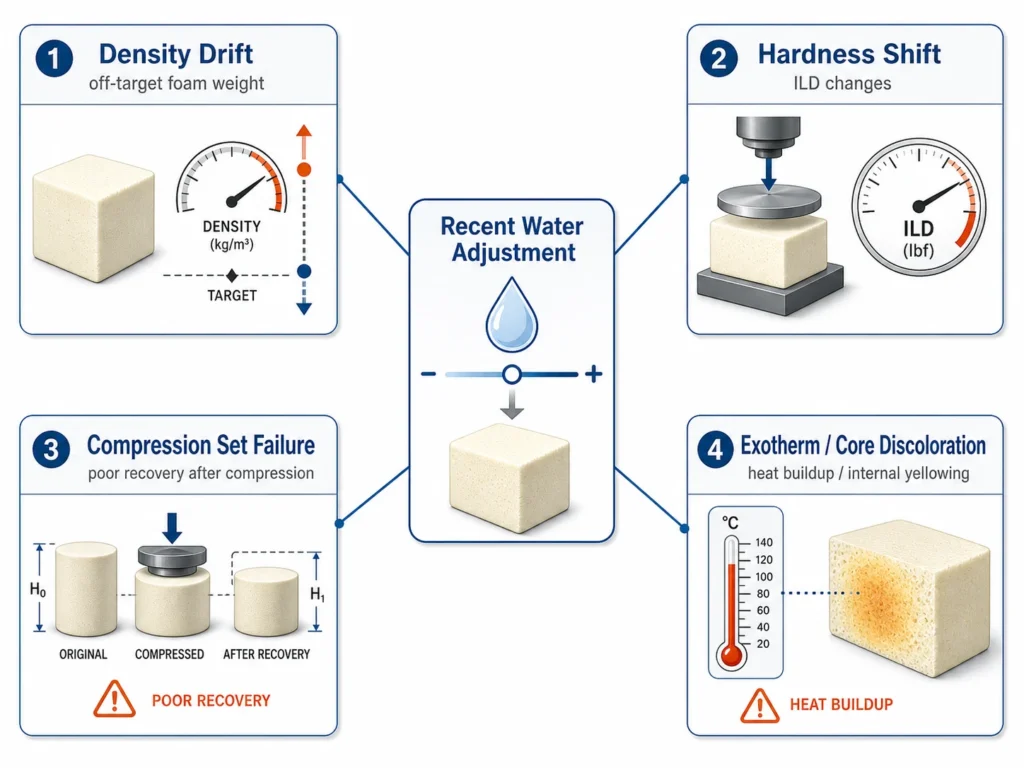
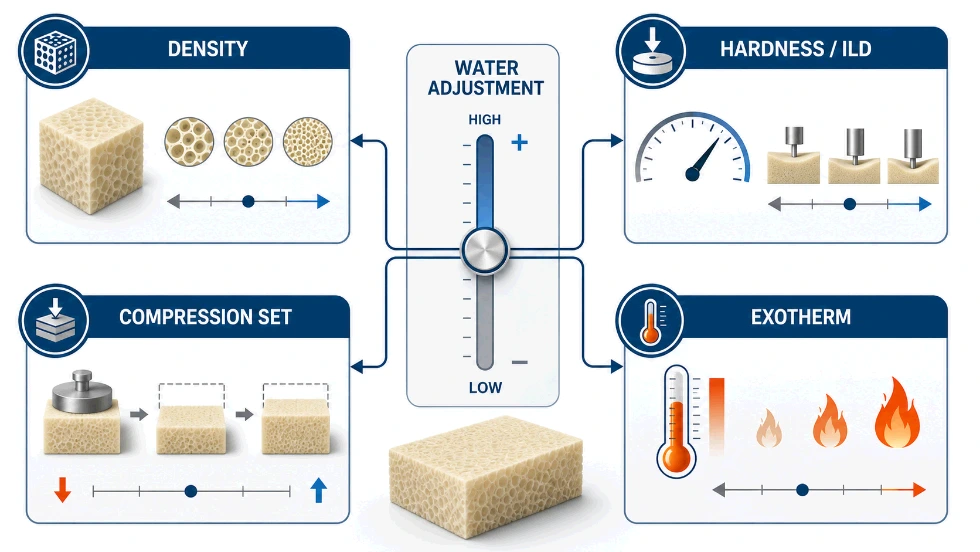
    Water level changes four major properties at the same time:

    1. Density
    2. Hardness / ILD
    3. Compression set
    4. Exotherm

    This article explains how each property responds to water level and why water should never be treated as a single-function density control variable.

    Water Controls More Than Density

    Water is often adjusted to control foam density. That is understandable, because water reacts with isocyanate to generate carbon dioxide. The CO₂ expands the foam and helps create the cellular structure.

    But water also produces an amine intermediate, which reacts with another isocyanate group to form urea linkages. Those urea linkages become hard segments in the foam network.

    So every water change has two chemical consequences:

    • It changes gas generation (affecting density).
    • It changes urea formation (affecting hardness, recovery, compression set, and heat generation).

    This means water is not just a blowing-agent variable — it is also a structure-building variable.

    A plant that watches only density after a water change is only watching half of the effect.

    Water level in polyurethane foam changing CO2 generation and urea network formation

    Property 1: Density

    Density is the most visible property affected by water level.

    When water reacts with isocyanate, carbon dioxide is released. This gas expands the foam mass and creates the cellular structure.

    • More water → more CO₂ → more expansion → lower density
    • Less water → less CO₂ → less expansion → higher density

    In flexible slabstock foam, a water increase can noticeably reduce density. As a practical rule, each 0.5 part increase in water may produce a meaningful density reduction, often in the range of several percent depending on the full formulation and process conditions.

    However, density response is not controlled by water alone. It also depends on:

    • Polyol type
    • Isocyanate index
    • Catalyst balance
    • Silicone surfactant
    • Cream time and rise profile
    • Cell opening
    • Block height
    • Production temperature
    • Machine mixing efficiency

    Water can be used to adjust density, but it should not be treated as a simple linear dial. A density correction must also be checked against the other property changes caused by water.

    Water level effect on polyurethane foam density through CO2 generation

    Property 2: Hardness / ILD

    Water also affects foam hardness. This is where troubleshooting often becomes confusing.

    When water level increases, density usually decreases — and lower density often tends to reduce load-bearing. But water also increases urea formation, and urea hard segments can stiffen the polymer network and raise hardness or ILD.

    So water can create two opposing effects:

    • More CO₂ → lower density (tends to reduce hardness)
    • More urea formation → stiffer network (tends to increase hardness)

    Which effect dominates depends on the formulation. The final hardness response depends on:

    • Index
    • Polyol functionality
    • Water level
    • Crosslinker level
    • Catalyst balance
    • Foam density
    • Cell structure
    • Cure condition

    This is why two formulas may respond differently to the same water adjustment. In one formula, increasing water may mainly reduce density and soften the foam. In another formula, the increased urea formation may partially offset the density effect and keep ILD higher than expected.

    Hardness should be tested after every meaningful water adjustment. Do not assume density movement alone predicts hardness movement.

    Water level effect on PU foam hardness and ILD through density and urea formation

    Property 3: Compression Set

    Compression set is one of the most important long-term performance properties affected by water level.

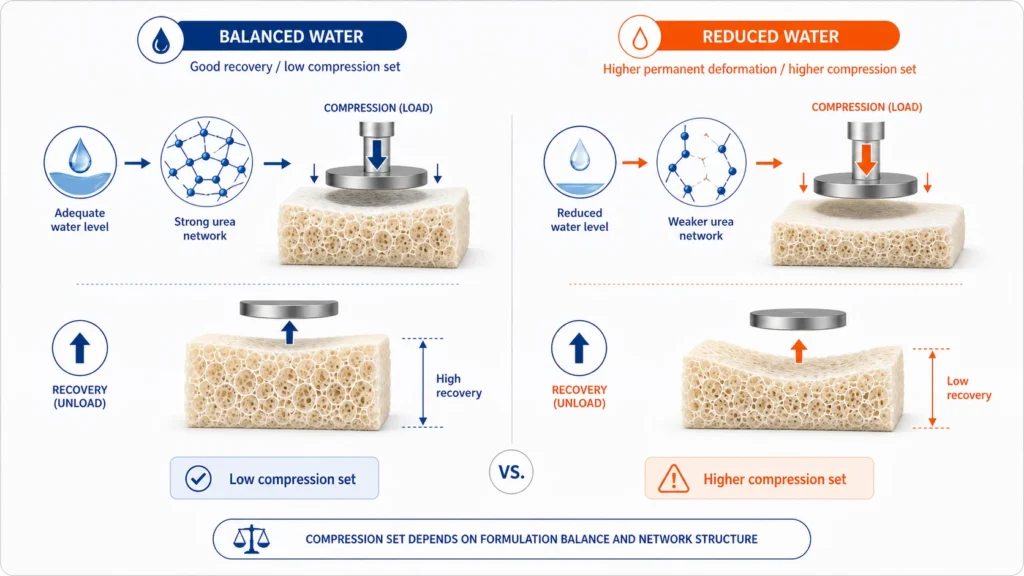
    Compression set measures how well foam recovers after being held under compression for a defined time and condition. Water affects compression set because water contributes to urea hard-segment formation. Urea linkages help build the foam network, and a stronger network usually improves resistance to permanent deformation.

    If water is reduced to fix a density issue, urea formation is also reduced. The foam may meet density target, and it may look acceptable during production, but the network may be weaker than intended.

    That weakness may appear later as:

    • Higher permanent deformation
    • Poorer recovery
    • Mattress or cushion complaints
    • Field returns after sustained load
    • Compression set values above specification

    This is why water reductions should be reviewed carefully. A water reduction can solve a density problem today and create a compression set problem later. The two problems may appear separated by weeks or months, but chemically they are connected.

    Water level affecting compression set in polyurethane foam through urea network formation

    Property 4: Exotherm

    Water also affects exotherm.

    The reaction sequence that forms urea linkages releases heat. As water level increases, the amount of urea formation increases, and the thermal load in the foam block can increase as well.

    This becomes especially important in high-water flexible slabstock formulas. At higher water levels — particularly around and above 4.5 parts — the risk of excessive core temperature becomes more serious, depending on block size, density, formulation, and ventilation.

    High exotherm can contribute to:

    • Core discoloration
    • Scorch risk
    • Cell structure irregularities
    • Reduced tensile strength in the block center
    • Internal property variation
    • Processing instability

    Large slabstock blocks are especially sensitive because heat dissipates slowly from the core. The outside of the block may look normal while the center experiences a much higher thermal load.

    This is why high-water formulas require thermal management, not only density calculation. Important factors include water level, block height, pour profile, catalyst package, foam density, ambient temperature, ventilation, cooling time, and raw material temperature.

    Water level is therefore also a heat-management variable.

    High water level causing exotherm and scorch risk in polyurethane foam slabstock core

    Why One Water Adjustment Moves Four Properties

    The four effects of water are connected because they come from the same chemistry.

    PropertyMain Reason
    DensityCO₂ generation changes foam expansion
    Hardness / ILDUrea hard segments change network stiffness
    Compression setUrea network affects long-term recovery
    ExothermUrea-forming reaction increases heat generation

    This is why “just changing water” is never just changing water. A small adjustment may be necessary and correct, but it should be treated as a full formulation change.

    When water is increased, check: Density reduction, index impact, hardness response, compression set, exotherm risk, and cell structure stability.

    When water is reduced, check: Density increase, index impact, urea network reduction, compression set risk, recovery and resilience, and customer performance requirements.

    Water can solve one production issue and create another if only one property is monitored.

    One water adjustment changing four polyurethane foam properties at once

    Practical Water Adjustment Checklist

    Before changing water level in a PU foam formula, review the full formulation impact.

    CheckpointQuestion
    DensityWhat density change is expected?
    IndexHas the isocyanate requirement been recalculated?
    Water EWIs water treated as EW = 9?
    Hardness / ILDWill the urea change affect hardness?
    Compression setWill the network still meet recovery requirements?
    ExothermIs the water level high enough to create core heat risk?
    Cell structureWill the surfactant and catalyst package still support stable cells?
    Production validationWill the trial include hardness, density, compression set, and core inspection?

    This checklist prevents a common production mistake: fixing the visible issue while creating a hidden performance problem.

    Example: A Density Fix That Creates Compression Set Risk

    A production team reduces water by 0.3 parts to correct a density issue.

    The next run looks better. Density is closer to target. The adjustment is considered successful.

    But the water reduction also reduces urea formation. If the formula is not rebalanced, the foam network may become weaker. The effect may not show up immediately during production.

    Weeks later, compression set complaints appear.

    The team may treat this as a new problem, but it is connected to the earlier water adjustment. This is why water changes should be documented, recalculated, and validated against more than density.

    A water adjustment should be accepted only after checking density, ILD, compression set, index, cure behaviour, exotherm, and customer application requirement.

    Use the PolymerIQ Calculators

    The PolymerIQ Foam Density Estimator can help estimate the density impact of water level changes before they reach production. Use it when increasing or reducing water, comparing different water levels, reviewing low-density foam formulas, or checking whether a density correction may create other risks.

    Open the Foam Density Estimator →

    Because water consumes NCO, every water change affects the index. The PolymerIQ Isocyanate Index Calculator helps verify the corrected isocyanate requirement after a water adjustment. Use it when water level changes, TDI or MDI quantity needs recalculation, compression set changes after a water adjustment, foam hardness changes unexpectedly, or a formula has been adjusted without full recalculation.

    Open the Isocyanate Index Calculator →

    For the chemistry behind water’s dual role, read The Dual Role of Water in Polyurethane Foam: Blowing Agent and Urea Network Builder.

    For the water equivalent weight calculation, read Why the Equivalent Weight of Water Is 9 in Polyurethane Foam.

    For the full index calculation guide, read Isocyanate Index Calculation Guide for PU Foam Engineers.

    FAQs

    How does water level affect PU foam density?

    Water reacts with isocyanate to generate CO₂. More water generates more CO₂, which increases foam expansion and lowers density. As a practical rule, each 0.5 part increase in water can produce a meaningful density reduction, but the exact response depends on polyol type, index, catalyst balance, silicone, block height, and process conditions.

    Why does water affect foam hardness in two directions?

    Water has two opposing effects. More water lowers density (which tends to reduce hardness), but more water also increases urea hard-segment formation (which tends to stiffen the network and raise hardness). Which effect dominates depends on the full formulation. This is why hardness should be tested after every water adjustment — density alone does not predict it.

    How does water level affect compression set?

    Water contributes to urea linkage formation, and urea hard segments help build the foam network. A stronger network resists permanent deformation better. If water is reduced to fix density, urea formation also drops, and the network may be weaker. Compression set problems can appear weeks or months later as a result.

    Why does high water level increase exotherm risk?

    The reaction sequence that forms urea linkages releases heat. More water means more urea formation, which means more heat generated during the rise and cure. In large slabstock blocks, this heat dissipates slowly from the core, and at high water levels (particularly around or above 4.5 parts) the core can reach temperatures that risk discoloration, scorch, or cell structure problems.

    Can a water reduction cause compression set failure?

    Yes. Reducing water reduces both CO₂ generation and urea formation. If the isocyanate level and overall formulation are not rebalanced, the foam network can be weaker than intended. The density may meet target, but compression set, recovery, and long-term performance may suffer. This is one of the most common hidden consequences of a “simple” density correction.

    Should I recalculate the isocyanate index every time I change water?

    Yes. Water is a reactive component. Every water change alters the total reactive hydrogen equivalents in the formula, which means the isocyanate demand changes. If the isocyanate quantity is not recalculated, the actual running index drifts away from the target — even if the formula sheet still shows the original number.

    Why does the same water adjustment behave differently in different formulas?

    Because water’s effects depend on the rest of the formulation. Polyol type, functionality, crosslinker level, catalyst balance, silicone, density, and cure conditions all influence how the foam responds to a water change. A formula that softens with more water may stiffen in another system where urea formation dominates.

    What’s the maximum safe water level in flexible slabstock?

    There is no universal limit — it depends on block size, density target, formulation, ventilation, and process conditions. Many flexible slabstock formulas operate up to around 4.0–4.5 parts water without major exotherm concerns. Above this level, thermal management becomes increasingly important. The combination of high water, large block size, and low density poses the highest scorch risk.

    How do I troubleshoot foam that’s too soft after a water change?

    First, check whether the actual running index is correct after the water adjustment — water consumes NCO, so an unadjusted isocyanate quantity creates an under-indexed system. Second, check whether the urea contribution change is large enough to affect network stiffness. Third, verify that catalyst, silicone, and crosslinker levels still match the new water level.

    What should I check before increasing water to lower density?

    Check density target, expected index after recalculation, hardness response, compression set requirements, exotherm and core heat risk, surfactant and catalyst compatibility at the new water level, and customer performance specifications. A water increase is rarely a single-property change — it should be approached as a full formulation review.

    Key Takeaways

    Water level affects much more than foam density. It controls four major foam properties at the same time:

    1. Density — through CO₂ generation
    2. Hardness / ILD — through urea hard-segment formation
    3. Compression set — through urea network contribution
    4. Exotherm — through heat from the urea-forming reaction

    Water generates CO₂, which affects foam expansion and density. Water also creates urea linkages, which affect hardness, recovery, compression set, and heat generation.

    A water adjustment made only for density can change foam performance in ways that appear later. Higher water can reduce density but increase urea formation and exotherm risk. Lower water can increase density but reduce urea network contribution and increase compression set risk if the formula is not rebalanced.

    Every water adjustment should include index recalculation, density review, hardness testing, compression set validation, and exotherm awareness.

    Conclusion

    If your plant has used water adjustments to fix density but later faced hardness drift, compression set failure, or core heat problems, the issue may not be random.

    Water moves several properties at once.

    PolymersIQ can help review your water level, index balance, density target, compression set performance, and exotherm risk to identify where the formulation balance is off.

    To get accurate support, please share:

    • Current and target foam density
    • Water level (recent and historical)
    • Polyol grade, OHV, and isocyanate %NCO
    • Target index and observed foam properties (ILD, compression set)
    • Block size and any core temperature observations
    • Description of the production issue and any adjustments already tried

    Contact PolymerIQ for a water-level formulation audit →
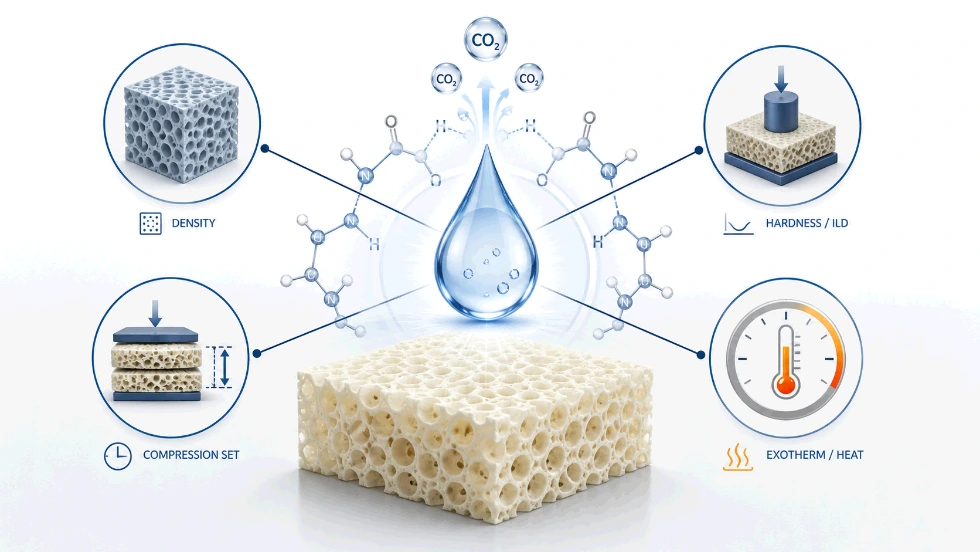

  • 5 Equivalent Weight Mistakes in PU Foam Production

    5 Equivalent Weight Mistakes in PU Foam Production


    Introduction

    Equivalent weight mistakes are some of the hardest formulation problems to diagnose in polyurethane foam production.

    They rarely create an obvious machine failure. The foam may rise normally. The block may look acceptable. The operator may not see anything unusual during production. But the physical properties tell a different story — soft foam, failed compression set, dropping resilience, hardness drift between batches.

    The production team responds with the usual adjustments: catalyst, silicone, water level, crosslinker dosage, cure temperature, machine settings. Some adjustments help temporarily. But if the equivalent weight values in the formula sheet are wrong, the root cause remains untouched.

    Equivalent weight is the foundation of the isocyanate index calculation. If one EW value is wrong, the index becomes unreliable. If two or more EW values are wrong, the foam can fail in several properties at once, making the problem look like a complicated production issue when it is really a calculation issue.

    This article covers five equivalent weight mistakes commonly found in PU foam production formulas and explains why a stoichiometric audit is often the only reliable way to find them.

    Why Equivalent Weight Mistakes Are Hard to Diagnose

    Equivalent weight errors live at the calculation layer. Most production troubleshooting starts at the production layer. That is why these mistakes are often missed.

    When foam properties are wrong, the first checks usually include machine calibration, mixing pressure, catalyst balance, silicone performance, water level, raw material temperature, ambient humidity, cure profile, and density variation. All of these checks are important — but none of them will find a wrong equivalent weight value in a spreadsheet.

    If water is entered as EW 18 instead of 9, the machine will still run. If polyol EW is copied from an older formula, the spreadsheet may still look professional. If DEOA is calculated from OHV alone and its amine hydrogen is missed, the error may be small enough to hide inside normal production variation.

    The problem is not that engineers are careless. The problem is that the formula sheet can look correct while the stoichiometric foundation is wrong.

    This is why equivalent weight must be audited as a system. Every reactive component must be checked. Every EW value must be verified. Every equivalent calculation must match the chemistry, not just the previous version of the formula.

    Mistake 1: Using Water EW = 18 Instead of 9

    This is the most damaging single equivalent weight mistake in flexible PU foam formulation.

    Water has a molecular weight of 18 g/mol — but its equivalent weight in polyurethane foam is not 18. Water has two reactive hydrogens involved in the isocyanate reaction sequence. One water molecule ultimately consumes two NCO groups.

    Water EW = 18 ÷ 2 = 9 g/eq

    Using 18 instead of 9 cuts the calculated water contribution in half:

    Water LevelEW UsedWater Equivalents
    4.0 parts9 (correct)0.44444
    4.0 parts18 (wrong)0.22222

    That is not a small rounding error. It changes the entire index calculation. If the formula calculates isocyanate demand using water EW = 18, the spreadsheet may show the intended target index while the actual chemistry runs much lower.

    This can create soft foam, ILD below target, poor compression set, weak recovery, tacky early cure, poor aging performance, and confusing response to catalyst changes.

    The rule is simple: water EW is 9. Never 18.

    Water equivalent weight mistake showing EW 18 versus correct EW 9 in PU foam formulation
    Using water EW = 18 cuts the calculated water contribution in half and corrupts the index calculation.

    Mistake 2: Copying EW Values from the Previous Formula

    This mistake is very common in production plants. An engineer opens an old formula sheet, copies the equivalent weight values, changes the raw material names or parts, and sends the formula to production. It feels efficient — but it can be wrong.

    Equivalent weight is not a number that should be copied blindly. It must be calculated from the actual raw material data.

    For polyol: Polyol EW = 56,100 ÷ OHV. If the new polyol batch has a different OHV, the EW changes.

    For isocyanate: Isocyanate EW = 4,200 ÷ %NCO. If the new isocyanate batch has a different %NCO, the EW changes.

    Copying last month’s EW value into this month’s formula may create a hidden index error. This problem is especially dangerous because the copied value may have been correct at one time. That makes it look trustworthy. But a value that was correct for one batch may not be correct for the next batch.

    The rule: do not copy EW values from old formulas without recalculating them from current CoA data.

    Copying old equivalent weight values from previous formula causing PU foam calculation error
    Equivalent weight values should be recalculated from current raw material data, not copied from old formulas.

    Mistake 3: Using TDS Midpoint Instead of CoA Actual Value

    The Technical Data Sheet gives a specification range. The Certificate of Analysis gives the actual batch value. These are not the same thing.

    A polyol TDS may show OHV range: 45–55 mg KOH/g. A formulator may choose the midpoint (OHV 50) and calculate:

    EW = 56,100 ÷ 50 = 1,122 g/eq

    But if the actual CoA OHV is 47:

    EW = 56,100 ÷ 47 = 1,194 g/eq

    That is a difference of 72 g/eq. The batch is still inside the TDS range, but the equivalent weight is meaningfully different from the formula assumption.

    The same principle applies to isocyanate %NCO. The TDS may give a range, but the CoA gives the value for the specific batch or drum being used.

    Using TDS midpoint values can create a formula that looks reasonable but does not match the actual raw materials in production.

    The rule: use CoA actual values for EW calculation whenever batch-specific data is available.

    Mistake 4: Calculating DEOA Equivalent Weight from OHV Alone

    DEOA is a common crosslinker in flexible foam formulation — and a common source of equivalent weight error.

    DEOA contains:

    • Two hydroxyl groups
    • One reactive amine hydrogen

    If the equivalent weight is calculated from OHV alone, the hydroxyl contribution is counted, but the amine hydrogen can be missed. That creates an incomplete reactive equivalent calculation.

    Using only the OHV-based approach may give an equivalent weight around 52.6 g/eq. But if all three reactive groups are considered:

    DEOA EW = Molecular Weight ÷ Reactive Group Count = 105.14 ÷ 3 = 35.0 g/eq

    That difference matters. DEOA is often used at low levels, so the error may not look dramatic in the formula. But it can still affect crosslink density and index accuracy. The larger problem is that the foam network may not develop as intended.

    Symptoms can include lower resilience, poorer compression set, softer foam than expected, weaker network structure, and confusing response to crosslinker adjustment.

    The rule: for amine-functional crosslinkers or chain extenders, account for all active hydrogens, not only hydroxyl value.

    DEOA equivalent weight mistake showing OHV-only calculation versus all reactive groups
    DEOA contains hydroxyl groups and a reactive amine hydrogen, so OHV-only EW can miss part of its reactivity.

    Mistake 5: Treating EW as a Fixed Constant

    This is the mindset error behind many equivalent weight mistakes.

    Equivalent weight often feels like a material property. It is not. Equivalent weight is a calculated value. For polyol, it depends on OHV. For isocyanate, it depends on %NCO. For water, it depends on molecular weight and reactive hydrogen count. For crosslinkers, it depends on their reactive functionality.

    That means some EW values are fixed, and others are batch-dependent:

    ComponentStatusReason
    WaterFixed at 9Reaction stoichiometry never changes
    PolyolBatch-dependentChanges with OHV
    IsocyanateBatch-dependentChanges with %NCO
    CrosslinkerCalculation-dependentDepends on correct reactive group count

    A formula may be correct on the day it was developed and become less accurate later as raw material batches change. This is why EW should be treated as a live calculation.

    The rule: whenever OHV or %NCO changes, equivalent weight must be recalculated.

    Equivalent weight as a live calculation based on OHV and percent NCO changes
    Equivalent weight should be recalculated when OHV or %NCO changes.

    Why Compounding EW Errors Are Hard to Diagnose

    One equivalent weight error can create a consistent property shift. Two equivalent weight errors can create a confusing foam problem.

    For example, a formula may contain water EW entered as 18 instead of 9, DEOA EW calculated from OHV alone, and polyol EW copied from an old CoA value. Each mistake changes the reactive equivalent calculation. Together, the errors can distort both the index and the foam network structure.

    The foam may show several problems at once: ILD below target, poor resilience, compression set failure, weak recovery, and property drift between batches.

    The production team may treat these as separate problems. They may increase crosslinker to improve resilience. They may change catalyst to adjust cure. They may adjust temperature to improve compression set. Each correction may partially help one symptom while disturbing another.

    This is how legacy formulas become complicated. Over time, the plant adds practical corrections on top of a wrong calculation foundation. The formula becomes harder to understand, harder to transfer, and harder to troubleshoot.

    The only reliable solution is a full stoichiometric audit.

    Stoichiometric Audit Checklist for Equivalent Weight Errors

    A proper equivalent weight audit should not only check the final index number. It should check every input behind the index.

    Audit PointWhat to Check
    Polyol EWCalculated from current CoA OHV
    Isocyanate EWCalculated from current CoA %NCO
    Water EWConfirmed as 9
    Crosslinker EWBased on correct reactive functionality
    Chain extender EWIncludes all active hydrogens
    Copied valuesNo EW copied from old formula without recalculation
    TDS vs CoACoA values used where available
    Reactive equivalentsParts divided by correct EW
    Total H equivalentsAll reactive components included
    Target indexCalculated from correct total equivalents
    Actual indexChecked against actual machine delivery
    Formula historyOld empirical corrections reviewed

    This audit should be performed whenever a formula is inherited from another plant, has been adjusted many times, shows inconsistent foam properties, fails compression set without a clear process cause, doesn’t match the formula target on hardness, faces new polyol or isocyanate batch CoA changes, or is being transferred to another production line.

    The goal is to verify the chemistry before making more production adjustments.

    Compounding equivalent weight errors requiring stoichiometric audit in PU foam production

    Use the PolymerIQ Calculators

    The PolymerIQ Equivalent Weight Calculator helps reduce manual equivalent weight mistakes. Use it whenever a new polyol batch arrives, the CoA OHV changes, you are checking old formula sheets, preparing index calculations, or verifying equivalent weight before production.

    Open the Equivalent Weight Calculator →

    The PolymerIQ Isocyanate Index Calculator helps verify whether the corrected EW values produce the intended NCO requirement and target index. Use it to check total reactive hydrogen equivalents, required NCO equivalents, TDI or MDI parts, actual running index, and the effect of correcting water EW or crosslinker EW.

    Open the Isocyanate Index Calculator →

    For the complete equivalent weight calculation guide, read Equivalent Weight in Polyurethane Foam: Complete Calculation Guide.

    For the water-specific calculation mistake, read Why the Equivalent Weight of Water Is 9 in Polyurethane Foam.

    For the full isocyanate index method, read Isocyanate Index Calculation Guide for PU Foam Engineers.

    FAQs

    What are the most common equivalent weight mistakes in PU foam production?

    The five most common mistakes are: using water EW = 18 instead of 9, copying EW values from previous formulas without recalculating, using TDS midpoint values instead of CoA actual values, calculating DEOA equivalent weight from OHV alone (missing the amine hydrogen), and treating equivalent weight as a fixed constant instead of a live calculation.

    Why is water EW always 9 in PU foam?

    Water has two reactive hydrogens that consume two NCO groups during the blowing reaction. So even though water’s molecular weight is 18, its equivalent weight is 18 ÷ 2 = 9 g/eq. This applies to flexible foam, rigid foam, HR foam, and any PU system that uses water as a blowing or reactive component.

    Can I copy equivalent weight values from an old formula sheet?

    No. Polyol EW depends on the actual OHV of the current batch, and isocyanate EW depends on the actual %NCO of the current batch. Copying old EW values can carry forward outdated raw material data into a new formula. Always recalculate from current CoA values.

    Why shouldn’t I use the TDS midpoint for equivalent weight calculation?

    The TDS gives a specification range, which is a commercial conformance window — not a formulation input. The midpoint of the range may be tens of g/eq away from the actual batch value. Using the midpoint can create a formula that looks reasonable but does not match the raw materials actually in production.

    Why does DEOA require a different EW calculation than a normal polyol?

    DEOA is amine-functional. It contains two hydroxyl groups plus one reactive amine hydrogen — three reactive groups total. An OHV-based calculation only counts the hydroxyl groups and misses the amine contribution. The correct approach is to divide molecular weight by total reactive group count: 105.14 ÷ 3 = 35.0 g/eq.

    How do I know if my formula has compounding EW errors?

    The signal is usually multiple foam properties failing at once — for example, low ILD, poor resilience, and compression set failure on the same product. Single EW errors usually create one consistent property shift. Multiple overlapping symptoms that don’t respond well to process adjustments suggest more than one calculation error in the spreadsheet.

    When should I run a stoichiometric audit on my formula?

    Run an audit when a formula is inherited from another plant, has been adjusted many times over the years, shows inconsistent foam properties, fails compression set without a clear process cause, or is being transferred to a new production line. Any time foam properties don’t match the formula target and process variables look normal, the calculation foundation should be checked.

    Will fixing equivalent weight errors solve my foam quality problem?

    If the EW errors are the root cause, yes — but the fix usually requires more than just correcting one cell. After updating EW values, the entire index must be recalculated, and the isocyanate quantity may need to change. The corrected formula should then be validated in production, because legacy formulas often contain empirical corrections layered on top of the calculation error.

    How often should equivalent weight values be checked?

    Polyol EW should be checked whenever a new polyol batch arrives or the CoA OHV is different from the design value. Isocyanate EW should be checked whenever a new isocyanate batch arrives or the CoA %NCO changes. Water EW should be confirmed as 9 once and protected against accidental changes. Crosslinker and chain extender EW should be reviewed whenever a new material is introduced.

    Is a full stoichiometric audit really necessary, or can I just fix the most obvious mistake?

    For a single isolated error, a targeted fix can work. But if the formula has been adjusted many times, multiple errors may have accumulated. A full audit is the only way to know whether the calculation foundation is sound. Skipping the audit and fixing just one cell often masks the deeper problem and leaves other errors untouched.

    Key Takeaways

    Equivalent weight mistakes can silently damage PU foam production because they corrupt the calculation foundation.

    The five most important mistakes are:

    1. Using water EW = 18 instead of 9.
    2. Copying EW values from the previous formula.
    3. Using TDS midpoint values instead of CoA actual values.
    4. Calculating DEOA equivalent weight from OHV alone.
    5. Treating EW as a fixed constant instead of a live calculation.

    Water EW is always 9 in polyurethane foam index calculation. Polyol EW must be recalculated when OHV changes. Isocyanate EW must be recalculated when %NCO changes. Amine-functional crosslinkers and chain extenders must account for all active hydrogens.

    If a formula has been adjusted many times over the years, the problem may not be the latest catalyst, silicone, or machine setting. The problem may be an old equivalent weight error that was never audited.

    Conclusion

    If your foam is consistently off target and every process adjustment only gives partial improvement, the problem may not be on the production floor.

    It may be inside the calculation foundation of the formula sheet.

    PolymersIQ can help audit every reactive component, every equivalent weight value, and every index calculation to identify hidden stoichiometric errors.

    To get accurate support, please share:

    • A copy of your current formula sheet, including EW values
    • Polyol grade, OHV, and supplier
    • Isocyanate type and current CoA %NCO
    • Water level and any crosslinkers or chain extenders in use
    • Target index and observed foam properties (ILD, compression set, density)
    • Description of the production issue and any adjustments already tried

    Contact PolymerIQ for a stoichiometric formulation audit →
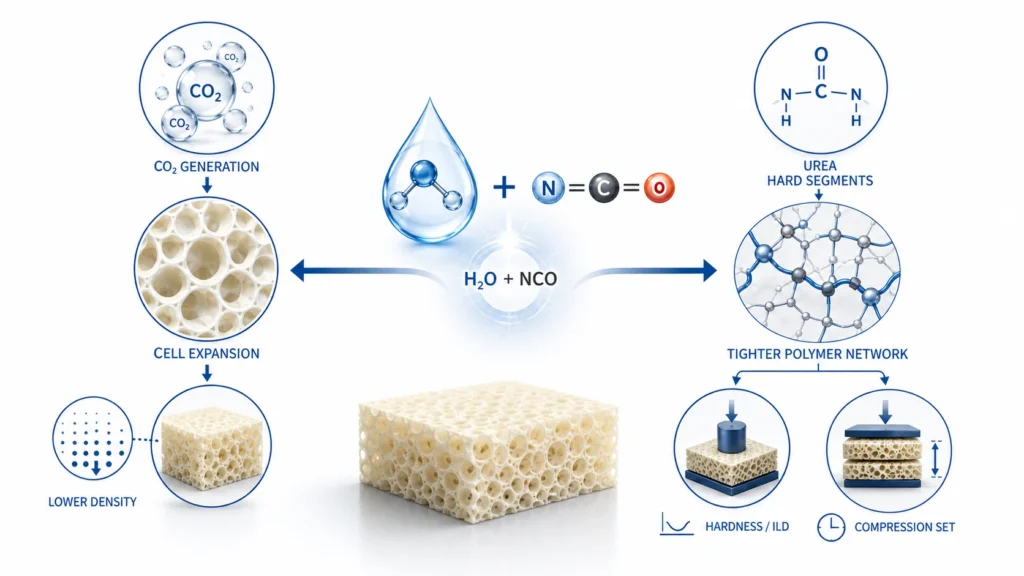

  • 4 Polyol Functionality Mistakes in PU Foam Production

    4 Polyol Functionality Mistakes in PU Foam Production


    Introduction

    Compression set failures are often treated as process problems.

    The foam plant checks catalyst balance. The engineer raises the index. Crosslinker dosage is increased. Cure temperature is reviewed. Density is checked again. Each correction may improve the foam slightly, but the compression set problem does not fully disappear.

    When this happens, the issue may not be the process. It may be polyol functionality.

    Polyol functionality controls how many reactive hydroxyl groups each molecule contributes to the polymer network. It controls branching, junction points, network architecture, creep resistance, and compression set performance.

    • Hydroxyl value tells you how much isocyanate the polyol needs.
    • Functionality tells you what kind of network the polyol can build.

    Confusing these two values leads to the wrong correction. A foam plant may keep adjusting OHV, catalyst, crosslinker, or index while the real problem is insufficient network architecture.

    This article explains four polyol functionality mistakes that create PU foam compression set problems and how to avoid them in formulation review.

    Why Functionality Mistakes Are Difficult to Diagnose

    Polyol functionality problems are difficult to diagnose because they can look like other foam problems.

    A low-functionality network may show:

    • High compression set
    • Poor recovery
    • Creep under sustained load
    • Lower durability
    • Marginal resilience
    • Field complaints after use
    • Partial response to crosslinker increase
    • Partial response to index adjustment

    These symptoms can make the plant believe the issue is catalyst, cure, crosslinker, density, or index. Those variables matter, but they do not always solve the root cause.

    If the base polyol system does not provide enough branching, the foam network is structurally limited before production begins.

    This is why functionality should be reviewed whenever compression set problems persist after normal process and index corrections.

    Mistake 1: Raising OHV to Fix a Functionality Problem

    The first mistake is trying to fix compression set by raising OHV when the real problem is functionality.

    This happens because engineers often associate higher OHV with stronger foam.

    But OHV and functionality are not the same:

    • OHV measures reactive hydroxyl groups per gram.
    • Functionality measures reactive hydroxyl groups per molecule.

    Changing OHV changes equivalent weight and isocyanate demand. It does not automatically create more network branch points.

    ParameterPolyol APolyol B
    OHV5156
    Functionality3.03.0
    Equivalent Weight1,1001,002
    Molecular Weight3,3003,006
    Network Junctions Per Molecule33

    The higher-OHV polyol changes stoichiometry, but the functionality remains the same. The number of junction points per molecule has not improved.

    If the compression set problem is caused by insufficient branching, simply raising OHV may not solve it. It may only create a new index-calculation requirement.

    The rule is simple:

    • Do not use OHV to solve a functionality problem.
    • Use OHV for equivalent weight and index calculation.
    • Use functionality to evaluate network architecture.
    Raising hydroxyl value does not fix low polyol functionality in PU foam formulation

    Mistake 2: Not Calculating Average Functionality in Blended Polyol Systems

    Most flexible foam formulas use more than one polyol. A formulation may include:

    • Base polyol
    • Polymer polyol
    • Specialty polyol
    • Graft polyol
    • High-functionality modifier
    • Softening polyol

    Each component can have a different functionality.

    The mistake is using the base polyol functionality as if it represents the whole polyol system. It does not. The blend has its own average functionality.

    If the formula uses blended polyols, average functionality must be calculated. A simplified formula is:

    Average Functionality = Total OH Equivalents ÷ Total Moles of Polyol

    Or: f_avg = Σ(parts ÷ EW) ÷ Σ(parts ÷ MW)

    Example blend:

    PolyolPartsFunctionalityEWMW
    Base polyol603.01,1003,300
    SAN polymer polyol402.52,0005,000

    Calculation:

    • Base OH equivalents: 60 ÷ 1,100 = 0.05455
    • SAN OH equivalents: 40 ÷ 2,000 = 0.02000
    • Total OH equivalents: 0.07455
    • Base moles: 60 ÷ 3,300 = 0.01818
    • SAN moles: 40 ÷ 5,000 = 0.00800
    • Total moles: 0.02618
    • Average functionality: 0.07455 ÷ 0.02618 = 2.85

    The system may appear to use a trifunctional base polyol, but the actual blended average is 2.85. That matters for compression set and recovery.

    Average functionality calculation for blended polyol systems in polyurethane foam

    Why Average Functionality Matters

    A blended polyol system can have a lower effective functionality than expected. This can happen even when the base polyol looks correct.

    If the average functionality drops too low, the foam network may become less branched. That can increase creep and compression set risk.

    A system around f = 2.85 may still work in many flexible foam applications, but it may sit closer to the edge of compression set requirements than a system closer to f = 3.0.

    The key point is not that every blend must have the highest possible functionality. The key point is that the engineer must know the actual blend functionality before diagnosing compression set problems.

    Without this calculation, the plant may keep correcting symptoms instead of understanding the network limitation.

    Average functionality impact on polyurethane foam network strength and compression set

    Mistake 3: Trusting Polymer Polyol TDS Functionality Blindly

    Polymer polyols can make functionality interpretation more complicated.

    A polymer polyol Technical Data Sheet may list a nominal functionality value. But that number may not fully describe the effective network contribution of the material in your blend.

    Polymer polyols can contain:

    • Carrier polyol
    • SAN solids
    • Molecular weight distribution effects
    • Different effective reactive contribution
    • Blend behaviour that differs from the simple TDS number

    This does not mean the TDS is useless. It means the TDS is the starting point, not the full formulation answer.

    For blended systems, the engineer should calculate the effective average functionality from the actual formulation components. If a polymer polyol makes up a large part of the formula, its effective contribution matters.

    Using only the base polyol functionality can overestimate the network quality of the blend.

    The rule is: for blended polyol systems, calculate average functionality from the blend. Do not assume it from one TDS value.

    [IMAGE 5 — POLYMER POLYOL TDS VS BLEND] Placement: After the section “Mistake 3”, before “Mistake 4”. Filename: polymer-polyol-tds-functionality-blend-mistake.jpg ALT text: Polymer polyol TDS functionality mistake in blended polyurethane foam systems Caption: Polymer polyol TDS functionality should be checked against the effective functionality of the full blend. ChatGPT image prompt: “Create a clean side-by-side technical infographic showing polymer polyol TDS functionality versus effective blend functionality. Left side: Polymer Polyol TDS showing nominal functionality. Right side: real blend calculation including base polyol, polymer polyol, parts, EW, MW, and resulting average functionality. Add a warning that the TDS value is a starting point, not the full blend answer. Professional industrial consultancy style, white background, blue and grey palette with subtle orange highlights. No logos. No brand names.”

    Polymer polyol TDS functionality mistake in blended polyurethane foam systems

    Mistake 4: Switching Polyol Supplier Without Verifying Functionality

    A supplier switch can change foam performance even when OHV appears unchanged. This is one of the most dangerous functionality mistakes.

    A new supplier may offer a replacement polyol with the same OHV and similar viscosity. Incoming QC may pass. Equivalent weight may be the same. The index calculation may not change.

    But functionality may be different.

    PropertyOriginal PolyolReplacement Polyol
    OHV5151
    Equivalent Weight1,1001,100
    Functionality3.02.6
    Index CalculationSameSame
    Network ArchitectureStronger branchingLower branching

    The formula may look unchanged. But the foam network is different.

    The issue may not appear immediately on the production floor. It may show up later through compression set, creep, or field returns.

    This is why a supplier switch is a formulation event. It should trigger:

    • OHV review
    • Equivalent weight calculation
    • Functionality verification
    • Average functionality review
    • Trial validation
    • Compression set testing
    • Recovery testing
    • Final formulation approval

    Same OHV does not guarantee same network architecture.

    Polyol supplier switch with same OHV but different functionality causing foam compression set risk

    What These Mistakes Look Like in Production

    Functionality mistakes often appear as persistent foam problems that do not respond cleanly to normal corrections.

    Common symptoms include:

    • Compression set remains high
    • Crosslinker helps only slightly
    • Index increase helps temporarily but does not solve the issue
    • Foam creeps under sustained load
    • Recovery weakens after aging
    • Customer complaints appear weeks after production
    • Supplier change happened before the issue
    • Blended polyol system was never reviewed
    • Average functionality is unknown
    • OHV looks correct but foam performance changed

    The key warning sign is this: the formula looks stoichiometrically correct, but the foam network behaves incorrectly.

    That is when functionality must be reviewed.

     Diagnostic checklist for polyol functionality mistakes causing PU foam compression set problems

    Production Checklist for Polyol Functionality Review

    Use this checklist when reviewing functionality-related foam problems:

    Review PointQuestion
    OHV vs functionalityAre these being treated as separate values?
    Base polyolWhat is the functionality of the base polyol?
    Polymer polyolWhat is the functionality and effective contribution?
    Blend calculationHas average functionality been calculated?
    Supplier changeDid functionality change with a new supplier?
    Same OHV checkAre two same-OHV polyols being assumed equivalent?
    Compression setIs failure continuing after normal corrections?
    Crosslinker responseDoes crosslinker only partially improve the result?
    Index statusIs the index correct but performance still weak?
    Network architectureDoes the polyol system have enough branching?
    Trial validationWere compression set and recovery tested after any supplier or blend change?

    This checklist helps separate stoichiometric problems from network architecture problems.

    Correct Workflow for Functionality Troubleshooting

    When compression set persists, use this workflow:

    1. Confirm compression set test method and result.
    2. Verify density, cure, index, and water level.
    3. Confirm OHV and equivalent weight.
    4. Review base polyol functionality.
    5. Review polymer polyol functionality.
    6. Calculate average functionality for the blend.
    7. Check whether a supplier switch occurred.
    8. Compare same-OHV polyols for functionality differences.
    9. Review whether crosslinker is compensating for low branching.
    10. Decide whether the correction requires a formulation change.

    The goal is to avoid endless process adjustments when the real issue is polyol architecture.

    Use the PolymerIQ Equivalent Weight Calculator

    The PolymersIQ Equivalent Weight Calculator helps calculate EW from OHV so you can build accurate functionality and blend calculations.

    Use it when reviewing polyol OHV, comparing same-OHV polyols, preparing average functionality calculations, checking formula stoichiometry, or reviewing supplier changes.

    Open the Equivalent Weight Calculator →

    For the foundation explanation of polyol functionality, read Polyol Functionality in Polyurethane Foam: What It Means and Why It Matters.

    For the technical network article, read How Polyol Functionality Controls Crosslink Density and Compression Set.

    For the OHV explanation, read Hydroxyl Value in Polyurethane Foam: What OHV Means and How to Calculate Equivalent Weight.

    For the complete equivalent weight guide, read Equivalent Weight in Polyurethane Foam: Complete Calculation Guide.

    FAQs

    What are the most common polyol functionality mistakes in PU foam production?

    The four most common mistakes are: raising OHV to fix a functionality problem (these are different values that solve different problems), not calculating average functionality in blended polyol systems, trusting polymer polyol TDS functionality blindly without verifying its effective contribution to the blend, and switching polyol supplier without verifying that the replacement has the same functionality as the original.

    Why doesn’t raising OHV solve compression set problems caused by low functionality?

    OHV controls equivalent weight and isocyanate demand. Functionality controls how many junction points each polyol molecule contributes to the network. A higher-OHV polyol with the same functionality has a smaller molecule, but the number of branch points per molecule is unchanged. If compression set fails because the network has too few branch points, increasing OHV alone won’t add the missing branching — it will only change the stoichiometry.

    How do I calculate average functionality in a blended polyol system?

    Use this formula: f_avg = Σ(parts ÷ EW) ÷ Σ(parts ÷ MW). For each polyol in the blend, calculate OH equivalents (parts ÷ EW) and moles (parts ÷ MW). Sum each across all polyols, then divide total OH equivalents by total moles. The result is the actual average functionality of the blend, which can be different from the base polyol’s nominal functionality.

    Can a 60/40 base/polymer polyol blend have lower functionality than the base polyol?

    Yes. If the polymer polyol has lower functionality than the base polyol (e.g., 2.5 vs 3.0), the blended average will sit between the two values, weighted by mole contribution. A 60/40 blend of f=3.0 base polyol and f=2.5 polymer polyol typically gives an average around f=2.85, not 3.0. This drop can be enough to push the network closer to compression set risk in tight-spec applications.

    Why is polymer polyol functionality complicated to interpret?

    Polymer polyols contain a carrier polyol plus dispersed solids (SAN, PHD, or similar). The TDS may list a nominal functionality value, but the effective contribution to the network depends on the carrier’s functionality, the solids content, the molecular weight distribution, and how the system reacts during foam formation. The TDS number is a starting point, not the complete answer for blend calculations.

    Can a same-OHV polyol from a different supplier really change foam performance?

    Yes — this is one of the most dangerous functionality mistakes. Two polyols with the same OHV (e.g., 51 mg KOH/g) and the same equivalent weight (1,100 g/eq) can have different functionalities (for example 3.0 vs 2.6). The index calculation looks identical, but the network architecture is different. The replacement polyol may produce foam that meets initial hardness targets but fails compression set due to weaker branching.

    What should I do when switching polyol suppliers?

    Treat the supplier switch as a formulation event, not just a purchasing event. Verify OHV and EW, but also verify functionality. Calculate average functionality if the system is blended. Run a production trial that includes compression set and recovery testing — not just density and ILD. Approve the new formula only after confirming foam performance, not just stoichiometric numbers.

    When should I suspect a polyol functionality mistake?

    Suspect functionality when compression set remains high after standard corrections, when crosslinker increase only partially helps, when foam creeps under sustained load despite a correct index, when the formula looks stoichiometrically correct but performance has changed, when a supplier switch occurred before the issue appeared, or when the blended polyol system has never had its average functionality calculated.

    Can I fix a low-functionality blend with crosslinker?

    Crosslinkers can add local junction density and may give partial improvement, but they cannot fully replace the architecture of the base polyol system. The long polyol chains in the blend still carry their original structure. If the underlying average functionality is too low for the application, crosslinker tweaks treat the symptom while leaving the architecture problem in place. The better fix is usually to adjust the polyol grade or blend ratio.

    Does this matter for HR foam and high-performance grades more than standard slabstock?

    Yes. HR foam, automotive foam, molded foam, and high-load applications depend heavily on network architecture for compression set, creep, and durability. These foam grades are usually designed around tighter functionality targets, so functionality mistakes have larger consequences. Standard flexible slabstock with relaxed compression set requirements has more tolerance for functionality variation, but tight-spec products do not.

    Key Takeaways

    Polyol functionality mistakes can create compression set problems that process adjustments cannot fully solve.

    The four most important mistakes are:

    1. Raising OHV to fix a functionality problem.
    2. Not calculating average functionality in blended polyol systems.
    3. Trusting polymer polyol TDS functionality blindly.
    4. Switching polyol supplier without verifying functionality.

    OHV and functionality are not interchangeable:

    • OHV controls equivalent weight and isocyanate demand.
    • Functionality controls network architecture and branching.

    A same-OHV replacement polyol can still create different foam performance if functionality changes. Blended systems need average functionality calculation.

    If compression set keeps failing after catalyst, index, cure, and crosslinker corrections, the polyol system architecture should be reviewed.

    Conclusion

    If your foam is failing compression set and every process correction only gives partial improvement, the issue may be average polyol functionality.

    PolymersIQ can help review your base polyol, polymer polyol, blend ratio, and effective network architecture to identify whether the formulation is structurally capable of meeting your compression set target.

    To get accurate support, please share:

    • Polyol grade(s), supplier(s), OHV, and reported functionality
    • Polymer polyol type and TDS data
    • Blend ratios and component parts
    • Target compression set and observed test results
    • Recent supplier switches or grade changes
    • Description of the foam quality issue and adjustments already tried

    Contact PolymerIQ for a polyol functionality review →


  • Why Water Equivalent Weight Is 9 in Polyurethane Foam

    Why Water Equivalent Weight Is 9 in Polyurethane Foam


    Introduction

    The equivalent weight of water in polyurethane foam is 9, not 18.

    This is one of the most important rules in PU foam formulation — and one of the most damaging mistakes when entered incorrectly.

    Water has a molecular weight of 18 g/mol. Because of that, many engineers assume the equivalent weight of water is also 18. That assumption is wrong in polyurethane chemistry.

    In PU foam, one water molecule ultimately consumes two NCO groups through the blowing reaction sequence. That is why the equivalent weight is calculated as:

    Water EW = 18 ÷ 2 = 9 g/eq

    If a formula spreadsheet uses 18 instead of 9, the water contribution is cut in half. The total reactive hydrogen equivalents become wrong. The calculated isocyanate demand becomes wrong. The index shown on the formula sheet no longer matches the chemistry in the reactor.

    This article explains why water EW is 9, how the water-isocyanate reaction works, what happens when 18 is used by mistake, and how this error appears in foam production.

    Why Water Equivalent Weight Is Not 18

    Water has a molecular weight of 18 g/mol. But equivalent weight is not always the same as molecular weight.

    Equivalent weight means the mass of material that contains one equivalent of reactive functionality.

    In polyurethane foam, water has two reactive hydrogens involved in the isocyanate reaction sequence. That means one mole of water provides two equivalents of reactivity toward NCO.

    So the calculation is:

    Water EW = Molecular Weight ÷ Reactive Hydrogen Count = 18 ÷ 2 = 9 g/eq

    For polyurethane foam index calculation, the correct value is Water EW = 9, not 18.

    Using 18 treats water as if it had only one reactive hydrogen. That cuts the water contribution in half and corrupts the index calculation.

    Water molecular weight 18 versus equivalent weight 9 in polyurethane formulation
    Water molecular weight is 18, but its equivalent weight in PU foam is 9 because it provides two reactive equivalents.

    How Water Reacts with Isocyanate in PU Foam

    Water reacts with isocyanate in two main stages.

    Stage 1: Water reacts with NCO. Water reacts with an isocyanate group to form an unstable carbamic acid intermediate. This intermediate quickly decomposes, releasing carbon dioxide (which blows the foam and forms cells) and producing a primary amine.

    Stage 2: The amine reacts with another NCO group. The amine formed in Stage 1 is reactive. It reacts with a second isocyanate group to form a urea linkage.

    This means one water molecule ultimately consumes two NCO groups:

    • One NCO in the initial water reaction
    • One NCO in the amine-to-urea reaction

    This is the chemical reason water equivalent weight is 9. It is not an approximation or a rule of thumb — it comes directly from the reaction mechanism.

    Water reaction with isocyanate showing two NCO groups consumed in polyurethane foam
    One water molecule reacts through a sequence that ultimately consumes two NCO groups.

    The Correct Water EW Calculation

    The calculation is simple:

    • Water molecular weight = 18 g/mol
    • Reactive hydrogens = 2
    • Water EW = 18 ÷ 2 = 9 g/eq

    This means 9 grams of water contain one equivalent of reactive hydrogen functionality for the PU foam index calculation.

    When calculating water equivalents in a formulation:

    Water Equivalents = Water Parts ÷ 9

    For example, if a flexible foam formula contains 4.0 parts water:

    4.0 ÷ 9 = 0.44444 equivalents

    If the formula uses EW = 18 instead:

    4.0 ÷ 18 = 0.22222 equivalents

    That is exactly half the correct value. The formula spreadsheet now believes there is much less reactive hydrogen demand than the chemistry actually has.

    Correct and wrong water equivalent weight calculation in PU foam formula
    Using EW = 18 cuts the calculated water equivalents in half compared with the correct EW = 9.

    Worked Example: How EW Water = 18 Corrupts the Index

    Let’s see how this mistake changes the full formula calculation.

    Example flexible slabstock formula:

    ComponentPartsCorrect EWCorrect Equiv.Wrong EWWrong Equiv.
    Polyol1001,1000.090911,1000.09091
    Water4.090.44444180.22222
    DEOA0.5310.01613310.01613
    Total H equiv.0.551480.32926

    The correct total reactive hydrogen equivalents are 0.55148. Using water EW = 18 gives 0.32926.

    Now assume the engineer targets Index 105 using the wrong equivalent system. NCO equivalents calculated from the wrong system:

    0.32926 × 1.05 = 0.34572

    But the actual correct reactive hydrogen equivalents are 0.55148. So the real running index is:

    0.34572 ÷ 0.55148 × 100 = 62.7

    The formula sheet says Index 105. The chemistry is running at approximately Index 62.7.

    This is not a small error. It is a completely wrong stoichiometric foundation.

    Water EW 18 causing wrong isocyanate index calculation in polyurethane foam
    Using water EW = 18 can make the formula sheet show Index 105 while the actual chemistry runs much lower.

    What This Error Looks Like in Production

    A water equivalent weight error does not always create a dramatic visual failure. The foam may still rise. The block may still form. Operators may not immediately see the problem at the machine.

    But the properties can be seriously wrong.

    If water is entered as 18 instead of 9 and the isocyanate quantity is calculated from that wrong value, the foam can be severely under-indexed.

    Common symptoms include:

    • Softer foam than expected
    • ILD below target
    • Poor compression set
    • Weak recovery
    • Slower or weaker cure
    • Tacky feel during early cure
    • Poor aging performance
    • Customer complaints after use
    • Confusing response to catalyst adjustments

    This kind of problem can be difficult to diagnose because it looks like a process issue. The team may adjust catalyst, silicone, cure temperature, water level, or crosslinker dosage. Some changes may improve one symptom temporarily. But the root cause remains inside the calculation.

    The spreadsheet must be checked.

    Production symptoms from wrong water equivalent weight causing under-indexed PU foam
    Wrong water EW can appear as soft foam, poor compression set, weak recovery, and confusing process variation.

    Why This Mistake Stays Hidden

    The water EW mistake stays hidden because the formula sheet often looks internally consistent.

    The numbers may be formatted correctly. The index cell may show the target value. The spreadsheet may have been used for years.

    But the spreadsheet is only as accurate as the assumptions inside it. If water EW is entered as 18, every downstream calculation built on that value becomes wrong.

    This mistake is especially common in legacy formulas because:

    • Water molecular weight is commonly remembered as 18
    • Engineers may copy old spreadsheets without checking the chemistry
    • The formula may have been empirically adjusted over time
    • Production teams may trust a formula because it has been used for years
    • Troubleshooting often focuses on machine and process variables first
    • The equivalent weight layer is rarely audited

    This is why a formula can carry the same error for months or years. The plant may keep adding practical corrections on top of a wrong calculation foundation. That creates a formula that works only by accident — and becomes difficult to transfer, scale, or troubleshoot.

    How to Check Your Formula Today

    Checking for this mistake is simple.

    Open your formula sheet and find the equivalent weight value used for water. It should be 9, not 18.

    Then check how the water equivalents are calculated:

    • Correct: Water equivalents = Water parts ÷ 9 (e.g., 4.0 ÷ 9 = 0.44444)
    • Wrong: Water equivalents = Water parts ÷ 18 (e.g., 4.0 ÷ 18 = 0.22222)

    After correcting the water equivalent weight, the full index must be recalculated. Do not change only the water EW cell and assume the formula is now production-ready. The isocyanate quantity may also need to be recalculated based on the correct total reactive hydrogen equivalents and target index.

    A safe review should include:

    1. Confirm water EW = 9
    2. Confirm polyol EW from actual OHV
    3. Confirm isocyanate EW from actual %NCO
    4. Confirm all crosslinkers and chain extenders are included
    5. Recalculate total reactive hydrogen equivalents
    6. Recalculate required NCO equivalents
    7. Recalculate TDI or MDI parts
    8. Compare the corrected formula against current production results
    Checklist for checking water equivalent weight in PU foam formula spreadsheet
    The first check is simple: water equivalent weight must be 9 in PU foam index calculations.

    Use the PolymerIQ Isocyanate Index Calculator

    Manual calculation is important because engineers should understand why water EW is 9. But in production, the calculation must also be checked quickly and consistently.

    The PolymersIQ Isocyanate Index Calculator can help verify whether your formula is using the correct equivalent weights and delivering the intended index.

    Use it to check water equivalent weight, total reactive hydrogen equivalents, required NCO equivalents, TDI or MDI parts, actual running index, and the effect of correcting EW errors.

    Open the Isocyanate Index Calculator →

    For the complete equivalent weight calculation guide, read Equivalent Weight in Polyurethane Foam: Complete Calculation Guide.

    For common production spreadsheet mistakes, read 5 Equivalent Weight Mistakes That Damage PU Foam Production.

    For the full isocyanate index calculation method, read Isocyanate Index Calculation Guide for PU Foam Engineers.

    FAQs

    Why is the equivalent weight of water 9 and not 18?

    Water has a molecular weight of 18 g/mol, but each water molecule has two reactive hydrogens and consumes two NCO groups during the blowing reaction. So the equivalent weight is 18 ÷ 2 = 9 g/eq. Equivalent weight measures the mass per reactive equivalent — not the mass per molecule — so the divisor matters.

    How does water actually consume two NCO groups?

    The reaction happens in two stages. First, water reacts with one NCO group to form an unstable carbamic acid that releases CO₂ (the blowing gas) and forms a primary amine. Second, the amine reacts with another NCO group to form a urea linkage. The result: one water molecule consumes two NCO groups.

    What happens if I use water EW = 18 by mistake?

    Using 18 cuts the calculated water equivalents in half. The total reactive hydrogen equivalents become wrong, the calculated isocyanate demand becomes wrong, and the actual running index can be much lower than the formula sheet shows. The foam may still rise but will likely be under-indexed.

    What does under-indexed foam look like in production?

    Common symptoms include softer foam than expected, ILD below target, poor compression set, weak recovery, slower or weaker cure, tacky feel during early cure, and poor aging performance. The foam may rise normally, which is why this error often stays hidden for a long time.

    Can this error explain unexplained compression set failures?

    Yes. If water EW is wrong and the foam is under-indexed, crosslink density is lower than designed, which directly affects compression set, recovery, and aging stability. Compression set problems that don’t respond to catalyst or silicone changes should trigger an EW audit.

    How do I check if my formula has this mistake?

    Open your formula sheet and find the equivalent weight value used for water. If it shows 18 instead of 9, the calculation is wrong. Also check the equivalents formula: it should be water parts ÷ 9, not water parts ÷ 18.

    Should I just change the water EW cell from 18 to 9?

    No — that alone is not enough. After correcting water EW, the entire index must be recalculated, and the isocyanate quantity may need to change as well. Changing only the water EW cell without recalculating the rest of the formula may create new imbalances.

    Why has this mistake stayed in some formula sheets for years?

    Because the formula sheet looks internally consistent. The index cell shows the target value, the math is formatted correctly, and the spreadsheet has been used for a long time. Troubleshooting usually focuses on machines and process variables, and the equivalent weight layer is rarely audited.

    Does this rule apply to flexible foam, rigid foam, and elastomers?

    Yes. Water has the same chemistry — two reactive hydrogens, two NCO groups consumed — regardless of the polyurethane system. Water EW = 9 applies to flexible slabstock, HR foam, rigid foam, elastomers, and any PU system that uses water as a blowing agent or reactive component.

    Does the water purity or temperature change the equivalent weight?

    No. The equivalent weight comes from the reaction stoichiometry, not from physical conditions. As long as the water is participating in the standard PU blowing reaction, EW = 9 is the correct value to use.

    Key Takeaways

    The equivalent weight of water in polyurethane foam is 9, not 18.

    Water has a molecular weight of 18, but it has two reactive hydrogens involved in the isocyanate reaction sequence:

    Water EW = 18 ÷ 2 = 9 g/eq

    Using 18 instead of 9 cuts the calculated water equivalents in half. This can severely corrupt the isocyanate index calculation and cause the actual running index to be much lower than the formula sheet suggests.

    The foam may still rise and look normal, but it can show soft hardness, poor compression set, weak recovery, and confusing production behaviour.

    Every PU foam formulation spreadsheet should be checked to confirm that water equivalent weight is entered as 9. A single wrong number can silently damage the entire stoichiometric calculation.

    Conclusion

    If your foam is consistently soft, failing compression set, or responding unpredictably to catalyst and process adjustments, the problem may not be the machine.

    It may be the equivalent weight foundation inside the formula sheet.

    PolymersIQ can help audit your formulation, verify water EW, recalculate the true index, and identify whether a hidden stoichiometric error is affecting production.

    To get accurate support, please share:

    • A screenshot or copy of your current formula sheet (with EW values)
    • Polyol OHV and isocyanate %NCO values currently in use
    • Water level and any crosslinkers or chain extenders
    • Target index and actual foam properties (ILD, compression set, density)
    • Description of the production issue you are facing

    Contact PolymerIQ for a stoichiometric formulation audit →
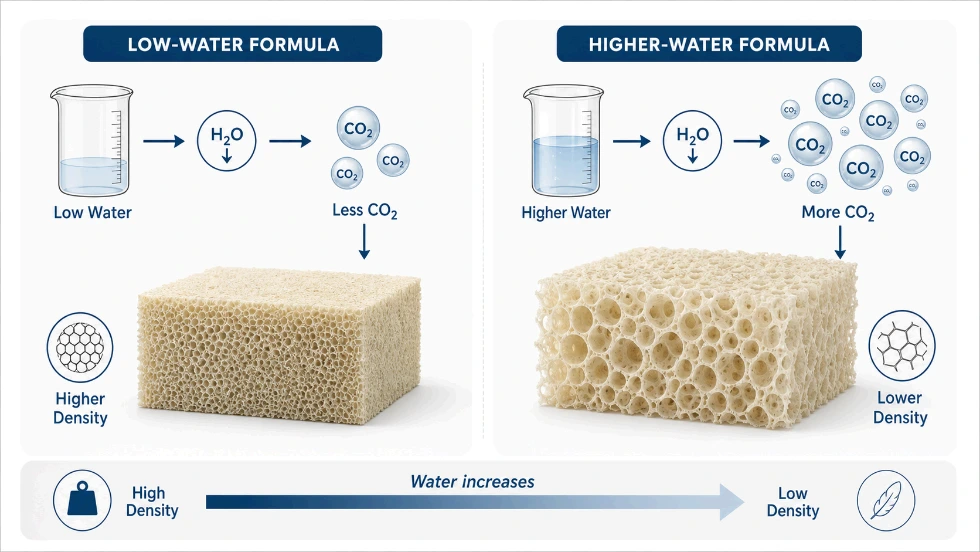

  • Equivalent Weight in PU Foam: Calculation Guide

    Equivalent Weight in PU Foam: Calculation Guide


    Introduction

    Equivalent weight is one of the most important calculation values in polyurethane foam formulation.

    It is also one of the most common sources of hidden formulation errors.

    A foam formula can look correct on paper. The index may appear correct. The raw material parts may look familiar. The production team may check catalysts, silicone, temperature, density, and machine settings. But if even one equivalent weight value is wrong, the entire stoichiometric balance can be wrong.

    This is why equivalent weight matters.

    Equivalent weight is the value that connects raw material data to polyurethane chemistry. It converts each reactive component into a common basis so the formulator can calculate isocyanate demand correctly.

    Polyol, isocyanate, water, and crosslinkers all have different structures and different reactive groups. Equivalent weight allows all of them to be compared on the same chemical basis.

    This guide explains what equivalent weight means, how it differs from molecular weight, and how to calculate equivalent weight for every major PU foam component.

    What Is Equivalent Weight?

    Equivalent weight answers one simple question:

    How many grams of this material contain one equivalent of reactive groups?

    In polyurethane formulation, equivalent weight is not just a theoretical value. It is the foundation of stoichiometric balance. It tells the formulator how much of a material is required to provide one mole-equivalent of reactive functionality.

    For example:

    • Polyol provides hydroxyl groups.
    • Isocyanate provides NCO groups.
    • Water provides reactive hydrogens.
    • Crosslinkers provide hydroxyl, amine, or other active hydrogen groups.

    Each of these materials has a different molecular weight and a different number of reactive groups. Equivalent weight normalizes them so they can be used in the same calculation system.

    Without equivalent weight, the isocyanate index calculation has no reliable foundation.

    Equivalent Weight vs Molecular Weight

    A common mistake is confusing equivalent weight with molecular weight. They are not always the same.

    • Molecular weight is the mass of one mole of complete molecules.
    • Equivalent weight is the mass that contains one mole-equivalent of reactive groups.

    For a monofunctional material, molecular weight and equivalent weight can be the same. But for materials with more than one reactive group, equivalent weight is lower than molecular weight.

    The general relationship is:

    Equivalent Weight = Molecular Weight ÷ Functionality

    For example, a trifunctional polyol with molecular weight 3,000 g/mol has three reactive hydroxyl groups per molecule.

    So:

    EW = 3,000 ÷ 3 = 1,000 g/eq

    This means 1,000 grams of that polyol contains one equivalent of hydroxyl reactivity.

    The same principle explains why water has an equivalent weight of 9, not 18. Water has a molecular weight of 18, but it has two reactive hydrogens involved in the isocyanate reaction.

    So:

    EW water = 18 ÷ 2 = 9 g/eq

    This distinction is critical. A formulation that uses molecular weight where equivalent weight is required can produce a completely wrong index calculation.

    Diagram explaining equivalent weight versus molecular weight in polyurethane formulation
    Molecular weight measures the whole molecule. Equivalent weight measures the mass per reactive group.

    Why Equivalent Weight Matters in PU Foam Formulation

    Polyurethane foam chemistry is based on the reaction between isocyanate groups and active hydrogen groups.

    The key reaction balance is:

    • NCO groups from isocyanate
    • OH groups from polyol
    • Reactive hydrogens from water
    • Reactive groups from crosslinkers or chain extenders

    The isocyanate index depends on these equivalent relationships.

    If the equivalent weight of one component is wrong, the calculated number of reactive equivalents is wrong. If the reactive equivalents are wrong, the isocyanate requirement is wrong. If the isocyanate requirement is wrong, the actual foam properties can shift.

    This can affect:

    • Foam hardness
    • Compression set
    • Resilience
    • Crosslink density
    • Cure behaviour
    • Aging stability
    • Batch-to-batch consistency

    Equivalent weight errors are dangerous because the foam may still rise and look normal. The problem usually appears later in physical testing or customer use.

    How to Calculate Polyol Equivalent Weight

    For polyols, equivalent weight is calculated from hydroxyl value.

    The formula is:

    Polyol EW = 56,100 ÷ OHV

    Where:

    • EW = equivalent weight in g/eq
    • OHV = hydroxyl value in mg KOH/g
    • 56,100 = conversion constant from the KOH titration basis

    The constant 56,100 comes from the molecular weight of potassium hydroxide (56.1 g/mol) multiplied by 1,000 for unit conversion.

    Example

    If a polyol has an OHV of 51 mg KOH/g:

    EW = 56,100 ÷ 51 = 1,100 g/eq

    So a polyol with OHV 51 has an equivalent weight of approximately 1,100 g/eq. This means 1,100 grams of that polyol contains one equivalent of reactive hydroxyl groups.

    This calculation should be done using the actual OHV from the Certificate of Analysis, not only the nominal value from the Technical Data Sheet.

    Polyol equivalent weight formula using hydroxyl value in polyurethane foam formulation
    Polyol equivalent weight is calculated from hydroxyl value using EW = 56,100 ÷ OHV.

    How to Calculate Isocyanate Equivalent Weight

    For isocyanates, equivalent weight is calculated from the percentage of NCO.

    The formula is:

    Isocyanate EW = 4,200 ÷ %NCO

    Where:

    • EW = equivalent weight in g/eq
    • %NCO = actual NCO percentage from the Certificate of Analysis
    • 4,200 = molecular weight of the NCO group (42 g/mol) multiplied by 100

    Example 1: TDI 80/20

    If TDI has a %NCO of 48.3:

    EW = 4,200 ÷ 48.3 = 86.96 g/eq

    So the TDI equivalent weight is approximately 87 g/eq.

    Example 2: MDI

    If MDI has a %NCO of 31.5:

    EW = 4,200 ÷ 31.5 = 133.33 g/eq

    So the MDI equivalent weight is approximately 133 g/eq.

    The same formula applies to TDI, MDI, polymeric MDI, and modified isocyanates. The constant does not change. The variable is the actual %NCO value.

    For production calculation, use the %NCO from the Certificate of Analysis, not only the general TDS range.

    Isocyanate equivalent weight formula using percent NCO for TDI and MDI
    Isocyanate equivalent weight is calculated from actual %NCO using EW = 4,200 ÷ %NCO.

    How to Calculate Water Equivalent Weight

    Water is one of the most important components in flexible polyurethane foam formulation. It is also one of the easiest to calculate incorrectly.

    Water has a molecular weight of 18 g/mol. But its equivalent weight in polyurethane formulation is not 18.

    Water has two reactive hydrogens involved in the isocyanate reaction sequence. One water molecule consumes two NCO groups.

    Therefore:

    Water EW = 18 ÷ 2 = 9 g/eq

    This value is fixed.

    For PU foam index calculation: water equivalent weight is 9, not 18.

    Using 18 instead of 9 cuts the calculated water contribution in half and can severely distort the isocyanate index calculation.

    The detailed water equivalent weight error and its production consequences are covered in a separate article — the water EW mistake is one of the most damaging single-number errors in PU foam formulation.

    Water equivalent weight is 9 not 18 in polyurethane foam formulation
    Water has two reactive hydrogens, so its equivalent weight in polyurethane formulation is 9 g/eq.

    How to Calculate Crosslinker Equivalent Weight

    Crosslinkers and chain extenders must also be included in equivalent weight calculations if they contain reactive groups.

    For hydroxyl-based crosslinkers, the same formula used for polyols can often be applied:

    Crosslinker EW = 56,100 ÷ OHV

    Example: Glycerol

    If glycerol has an OHV of approximately 1,827 mg KOH/g:

    EW = 56,100 ÷ 1,827 = 30.7 g/eq

    So the equivalent weight is approximately 31 g/eq.

    This is much lower than the equivalent weight of a typical flexible foam polyol. That means even small quantities of crosslinker can contribute meaningful reactive equivalents.

    Important note about amine-functional crosslinkers

    Some crosslinkers or chain extenders contain more than hydroxyl groups. For example, some amine-functional materials include reactive amine hydrogens as well. In those cases, an OHV-only calculation may not capture all reactive functionality.

    The correct approach is to account for all active hydrogen groups that react with isocyanate.

    This topic is covered in more depth in a separate article on equivalent weight mistakes, because missing reactive groups in crosslinkers can quietly distort index and network structure.

    Crosslinker equivalent weight calculation using hydroxyl value in polyurethane foam formulation
    Hydroxyl-based crosslinkers use the same EW formula as polyols, but their low EW can strongly affect reactive balance.

    Complete Equivalent Weight Reference Table

    The table below summarizes the main equivalent weight formulas used in PU foam formulation.

    ComponentEW FormulaKey VariableWorked Example
    Polyol56,100 ÷ OHVOHV from CoAOHV 51 → EW 1,100
    Isocyanate4,200 ÷ %NCO%NCO from CoA48.3% NCO → EW 86.96
    Water18 ÷ 2Fixed valueEW = 9
    Hydroxyl crosslinker56,100 ÷ OHVOHV of crosslinkerOHV 1,827 → EW 30.7

    Every number in this table can feed into the isocyanate index calculation.

    If one EW value is wrong, the index becomes unreliable. If multiple EW values are wrong, the production symptoms can become confusing and difficult to diagnose.

    How Equivalent Weight Feeds Into Isocyanate Index

    Equivalent weight is used to calculate the number of reactive equivalents in the formula.

    The general formula is:

    Reactive Equivalents = Parts by Weight ÷ Equivalent Weight

    For example, if a formulation contains 100 parts of polyol with EW 1,100:

    Polyol equivalents = 100 ÷ 1,100 = 0.09091

    If the formula contains 4 parts of water with EW 9:

    Water equivalents = 4 ÷ 9 = 0.44444

    Each reactive component is converted into equivalents. Then all reactive hydrogen equivalents are added together. The isocyanate required is calculated from that total and the target index.

    This is why equivalent weight is not an isolated calculation. It is part of the full stoichiometric system.

    Wrong EW → wrong equivalents → wrong index → wrong foam properties.

    Workflow showing equivalent weight calculation feeding into isocyanate index calculation in PU foam formulation
    Equivalent weight is the first step in calculating reactive equivalents and isocyanate index

    Practical Rules for Equivalent Weight Calculation

    Use these rules to avoid common formulation mistakes:

    1. Do not confuse molecular weight with equivalent weight. Molecular weight describes the whole molecule. Equivalent weight describes the mass per reactive group.
    2. Use actual CoA values when available. Polyol OHV and isocyanate %NCO can vary by batch.
    3. Use water EW = 9. Water has two reactive hydrogens and consumes two NCO groups.
    4. Recalculate EW when OHV changes. Polyol equivalent weight is not fixed if OHV changes.
    5. Recalculate isocyanate EW when %NCO changes. The isocyanate equivalent weight depends on actual %NCO.
    6. Include crosslinkers and chain extenders. Any reactive component must be included in the stoichiometric calculation.
    7. Check all active hydrogens. Some materials contain amine groups or other reactive functionality not captured by simple OHV alone.
    8. Audit old formula sheets. Legacy spreadsheets often contain copied EW values that may no longer match current raw material data.

    Use the PolymerIQ Equivalent Weight Calculator

    Manual calculation is useful because every foam engineer should understand the chemistry behind equivalent weight. But in production, the calculation must also be fast and consistent.

    The PolymersIQ Equivalent Weight Calculator helps you calculate equivalent weight from OHV quickly.

    Use it when:

    • A new polyol batch arrives
    • The CoA OHV is different from the design value
    • You are checking a formulation before production
    • You are preparing an isocyanate index calculation
    • You are auditing an old formula sheet

    Open the Equivalent Weight Calculator →

    For a deeper article on the water calculation error, read Why the Equivalent Weight of Water Is 9 in Polyurethane Foam.

    For common production mistakes, read 5 Equivalent Weight Mistakes That Damage PU Foam Production.

    For the full isocyanate index method, read Isocyanate Index Calculation Guide for PU Foam Engineers.

    FAQs

    What is equivalent weight in polyurethane foam formulation?

    Equivalent weight is the mass of material that contains one mole-equivalent of reactive groups. In polyurethane foam, it is used to convert each reactive component (polyol, isocyanate, water, crosslinker) into a common basis so the formulator can calculate isocyanate demand and index correctly.

    How is equivalent weight different from molecular weight?

    Molecular weight is the mass of one mole of complete molecules. Equivalent weight is the mass per reactive group. For monofunctional materials they can be the same, but for multifunctional materials, equivalent weight is lower than molecular weight. The relationship is EW = Molecular Weight ÷ Functionality.

    How do I calculate polyol equivalent weight?

    Use EW = 56,100 ÷ OHV, where OHV is the hydroxyl value in mg KOH/g. The constant 56,100 comes from the molecular weight of potassium hydroxide (56.1 g/mol) multiplied by 1,000 for unit conversion. Always use the actual OHV from the Certificate of Analysis, not the nominal TDS value.

    How do I calculate isocyanate equivalent weight?

    Use EW = 4,200 ÷ %NCO, where %NCO is the percentage of NCO groups by weight. The constant 4,200 comes from the NCO group molecular weight (42 g/mol) multiplied by 100. The same formula applies to TDI, MDI, polymeric MDI, and modified isocyanates — only the %NCO value changes.

    Why is the equivalent weight of water 9 and not 18?

    Water has a molecular weight of 18, but each water molecule has two reactive hydrogens and consumes two NCO groups during the blowing reaction. So the equivalent weight is 18 ÷ 2 = 9 g/eq. Using 18 instead of 9 cuts the calculated water contribution in half and severely distorts the isocyanate index.

    Do I need to calculate equivalent weight for crosslinkers?

    Yes. Hydroxyl-based crosslinkers use the same formula as polyols (EW = 56,100 ÷ OHV). Glycerol, for example, has an OHV around 1,827 mg KOH/g, giving an EW of about 31 g/eq. Because crosslinker EW is much lower than polyol EW, even small amounts contribute meaningful reactive equivalents to the calculation.

    What about amine-functional crosslinkers and chain extenders?

    Materials with amine groups or other active hydrogens cannot be captured by an OHV-only calculation. The correct approach is to account for all active hydrogen groups that react with isocyanate. Missing reactive groups in crosslinkers can silently distort the index and the polymer network.

    How does equivalent weight feed into the isocyanate index?

    Reactive equivalents are calculated as Parts ÷ Equivalent Weight for each component. All reactive hydrogen equivalents are summed, then multiplied by the target index to determine required NCO equivalents. The isocyanate quantity is then calculated as Required NCO equivalents × Isocyanate EW. Wrong EW values create wrong equivalents and wrong index.

    Should I recalculate equivalent weight when raw material batches change?

    Yes. Polyol EW changes when OHV changes. Isocyanate EW changes when %NCO changes. Treating EW as a fixed value copied from an old formula sheet is one of the most common causes of hidden formulation drift.

    What’s the most common equivalent weight mistake in PU foam formulation?

    Using water EW as 18 instead of 9. Because water is usually one of the largest contributors to reactive hydrogen equivalents in flexible foam, getting this single value wrong can shift the running index by many points and produce foam that is significantly harder than expected.

    Key Takeaways

    Equivalent weight is the mass of material that contains one equivalent of reactive groups. It is not always the same as molecular weight.

    In polyurethane foam formulation, equivalent weight is needed for every reactive component because the isocyanate index depends on reactive equivalents.

    The main formulas are:

    • Polyol EW = 56,100 ÷ OHV
    • Isocyanate EW = 4,200 ÷ %NCO
    • Water EW = 18 ÷ 2 = 9
    • Hydroxyl crosslinker EW = 56,100 ÷ OHV

    Equivalent weight should be treated as a live calculation, not a fixed value copied from an old formula sheet.

    • If OHV changes, polyol EW changes.
    • If %NCO changes, isocyanate EW changes.
    • If water is entered as 18 instead of 9, the index calculation becomes seriously wrong.

    A correct equivalent weight system is the foundation of a correct isocyanate index calculation.

    Conclusion

    If your foam formula has been adjusted many times over the years, the equivalent weight values in the spreadsheet may no longer be correct.

    PolymersIQ can help review your formulation, check every equivalent weight value, and identify whether hidden stoichiometric errors are affecting foam quality.

    To get accurate support, please share:

    • Polyol grade, OHV, and supplier
    • Isocyanate type and %NCO from the Certificate of Analysis
    • Water level and any crosslinkers or chain extenders in use
    • Current EW values used in the formula sheet
    • Description of the foam quality issue (if any)

    Contact PolymerIQ for a stoichiometric formulation audit →
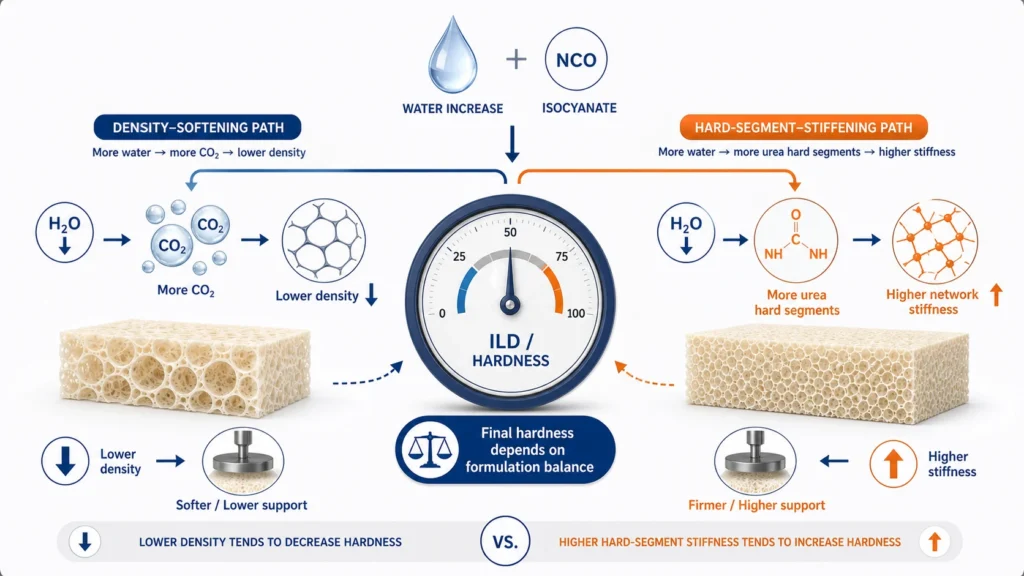

  • 5 Hydroxyl Value Mistakes That Create PU Foam Production Problems

    5 Hydroxyl Value Mistakes That Create PU Foam Production Problems


    Introduction

    Hydroxyl value mistakes are dangerous because they rarely look like hydroxyl value mistakes.

    They usually appear as ordinary foam production problems.

    The foam is harder than expected. The next batch is softer. Compression set becomes marginal. The same formula behaves differently after a new polyol delivery. Operators blame the machine. Engineers adjust catalyst. The team checks temperature, mixing pressure, silicone, and water.

    But the cause may be much simpler.

    The incoming polyol OHV changed, and nobody used the new value correctly.

    Hydroxyl value affects equivalent weight. Equivalent weight affects isocyanate demand. Isocyanate demand affects the real running index. And the real running index affects foam hardness, compression set, resilience, aging, and batch consistency.

    This article covers the five hydroxyl value mistakes that turn raw material variation into PU foam production problems — and the QC checklist every foam plant should use to prevent them.

    Why OHV Mistakes Are So Costly

    Hydroxyl value is not just a raw material specification.

    It is a formulation control value.

    A polyol can arrive fully inside the supplier’s TDS specification range and still require a formulation review. The batch may be commercially acceptable, but that does not automatically mean it matches the formulation baseline used in your plant.

    This is where many production problems begin.

    If the formula was designed around OHV 51, but the incoming batch arrives at OHV 47, the equivalent weight changes. If the isocyanate quantity is not recalculated, the real running index changes. The formula sheet may still look correct. The foam chemistry is no longer the same.

    This is why OHV mistakes create silent production drift. They do not usually stop the machine. They do not always cause collapse. They often produce foam that looks normal but tests outside the target specification.

    Mistake 1: Using the TDS Nominal Value Instead of the CoA Actual Value

    The first mistake is using the nominal OHV from the Technical Data Sheet instead of the actual OHV from the Certificate of Analysis.

    The TDS gives a specification range or nominal value. It tells you what the supplier considers acceptable for that grade.

    But the CoA gives the actual value for the delivered batch. Those are not the same thing.

    For example, a polyol TDS may show:

    OHV range: 45–55 mg KOH/g

    The formula may have been designed around OHV 51. But the latest delivery may arrive at OHV 47. Both values may be inside the acceptable TDS range. But they produce different equivalent weights:

    OHV UsedEquivalent Weight
    51 mg KOH/g1,100 g/eq
    47 mg KOH/g1,194 g/eq

    If the plant continues using the old design value, the calculation baseline is wrong.

    Every production adjustment made after that — catalyst changes, water changes, temperature changes — may be built on a false formulation baseline.

    The fix is simple: use the actual CoA OHV value for every batch.

    TDS nominal hydroxyl value versus Certificate of Analysis actual OHV mistake in PU foam formulation
    The TDS value is not enough for production calculation. Use the actual CoA OHV for each batch.

    Mistake 2: Assuming Supplier Consistency

    A long supplier relationship is useful. But it is not a QC system.

    A foam plant may say:

    “We have been buying this polyol from the same supplier for years.”

    That does not mean every batch has the same OHV.

    Polyol OHV can vary within specification because of raw material variation, reactor conditions, blending differences, and supplier production control. A supplier can deliver a batch near the lower end of the specification range today and near the higher end later.

    Both batches may be accepted. Both may pass incoming QC. But they may not behave the same in your formula.

    This is why every CoA should be treated as new formulation information.

    Do not assume that last month’s OHV value applies to this month’s delivery. A trusted supplier still needs batch-by-batch data review.

    Supplier OHV variation showing why batch-by-batch hydroxyl value checking is required
    A long supplier relationship does not remove the need for batch-by-batch OHV review.

    Mistake 3: Trusting the CoA Without Independent Verification

    The Certificate of Analysis is important. But for serious production control, it should not be the only layer of verification.

    The CoA is produced by the supplier’s QC system. In most cases, it is reliable. But mistakes can happen.

    Possible issues include:

    • Instrument calibration drift
    • Transcription errors
    • Batch documentation mistakes
    • Drum labelling errors
    • Sampling differences
    • Handling or storage issues

    For high-volume production or critical foam grades, incoming OHV should be verified in-house using an approved method such as ASTM D4274 or ISO 14900.

    This does not mean every plant must distrust every supplier. It means critical raw material data should be verified when the production risk is high.

    A practical approach:

    • Verify every batch for critical products.
    • Verify every third batch for stable, high-volume suppliers.
    • Hold and investigate if in-house OHV differs from CoA by more than 2 mg KOH/g.
    • Contact the supplier before using the batch if the difference is significant.

    Independent OHV verification is not extra paperwork. It is protection against avoidable production loss.

    In-house OHV verification for incoming polyol QC in polyurethane foam production
    For critical products, in-house OHV verification helps confirm the supplier CoA before production.

    Mistake 4: Confusing OHV with Functionality

    Hydroxyl value and functionality are related to formulation chemistry, but they are not the same parameter.

    This mistake can create serious formulation confusion.

    ParameterWhat It MeasuresUnits
    Hydroxyl value (OHV)Concentration of reactive hydroxyl groups per gram of polyolmg KOH/g
    FunctionalityAverage number of hydroxyl groups per moleculeOH groups per molecule

    A polyol can have:

    • High OHV and lower functionality
    • Lower OHV and higher functionality
    • Similar OHV but different functionality
    • Similar functionality but different OHV

    These differences matter because OHV mainly affects equivalent weight and isocyanate demand, while functionality affects network structure and crosslinking behaviour.

    If a formulator confuses the two, the troubleshooting direction can be wrong.

    For example, a foam hardness issue caused by OHV drift may be treated as a functionality or crosslink density issue. The team may change the wrong formulation variable and create a second problem.

    The rule is simple: do not use OHV and functionality interchangeably. They are different formulation values, and both must be understood correctly.

    Difference between hydroxyl value and functionality in polyurethane polyol formulation
    OHV measures reactive site concentration per gram, while functionality measures average OH groups per molecule.

    Mistake 5: Treating Equivalent Weight as a One-Time Calculation

    Equivalent weight is often calculated once during formula development and then left unchanged.

    That is a mistake.

    Equivalent weight is not a permanent constant. It is calculated from OHV:

    EW = 56,100 ÷ OHV

    If OHV changes, equivalent weight changes. If equivalent weight changes, the isocyanate requirement changes. If the isocyanate requirement changes and the formula is not updated, the actual running index can drift away from the intended target.

    This is one of the most common causes of hidden formulation drift.

    A formula may start correctly. Then new polyol batches arrive. OHV changes slightly each time. The plant keeps using the original EW. Over time, the formula sheet becomes less connected to actual production chemistry.

    This can cause:

    • Hardness drift
    • Softer or firmer batches
    • Compression set variation
    • Poor recovery
    • Troubleshooting confusion
    • Unnecessary catalyst adjustments
    • Supplier disputes that do not solve the real problem

    The fix is fast: recalculate equivalent weight every time a new polyol batch arrives.

    Polyol OHV production QC checklist for polyurethane foam plants
    A batch-by-batch OHV checklist helps prevent raw material variation from becoming foam quality variation.

    Production QC Checklist for OHV Control

    A good OHV control system is simple.

    It does not require complicated software. It requires discipline.

    Use this checklist for every incoming polyol batch:

    QC CheckpointQuestion to Ask
    CoA receivedIs the Certificate of Analysis available for this batch?
    Actual OHV recordedHas the actual batch OHV been logged?
    TDS comparisonIs the value inside the supplier specification range?
    Design comparisonHow far is the OHV from the formula design value?
    EW calculatedHas equivalent weight been recalculated from actual OHV?
    Index impact checkedDoes the EW change affect isocyanate index?
    In-house verificationIs this batch verified internally if the product is critical?
    Supplier historyDoes this batch fit the supplier’s normal OHV pattern?
    Formula decisionIs adjustment required before production?
    Batch recordHas the final decision been documented?

    This checklist prevents a common mistake: accepting the raw material commercially, but failing to check whether the formula still needs adjustment.

    Incoming QC should not stop at “inside specification.” It should also ask: does this batch match the formulation baseline?

    Polyol OHV Production QC Checklist
    A batch-by-batch OHV checklist helps prevent raw material variation from becoming foam quality variation.

    When OHV Variation Requires Formula Adjustment

    Not every OHV change requires a full formula adjustment.

    The practical question is how much the equivalent weight has moved away from the design value.

    For standard flexible slabstock formulations, this decision table can be used:

    EW Difference from DesignAction Required
    ≤30 g/eqRecord and monitor
    30–70 g/eqRecalculate index impact and review adjustment
    >70 g/eqAdjust formula before production

    These are practical production thresholds, not universal laws. HR foam, rigid foam, high-specification automotive foam, and tightly controlled specialty grades may need stricter limits.

    The principle is the same: the plant should know the equivalent weight difference before production starts, not after the foam fails testing.

    Correct OHV Handling Workflow

    A reliable OHV workflow has four parts.

    1. Record every CoA OHV value

    Every incoming polyol batch should be logged with:

    • Supplier
    • Grade
    • Batch number
    • Date received
    • CoA OHV
    • Calculated equivalent weight
    • Production result or comment

    Over time, this builds a supplier profile.

    2. Recalculate equivalent weight on every batch

    Use EW = 56,100 ÷ OHV.

    This should be done before the material moves into production.

    3. Verify OHV in-house when required

    For critical products or high-volume suppliers, run internal OHV verification using an approved method. If the CoA and in-house result do not match closely, investigate before production.

    4. Decide whether formula adjustment is needed

    Compare the new EW to the formula design EW. If the difference is significant, recalculate the index and adjust isocyanate quantity if required.

    This workflow is simple, but it eliminates one of the biggest sources of hidden formulation variation.

    Use the PolymerIQ Equivalent Weight Calculator

    The PolymerIQ Equivalent Weight Calculator helps production teams convert OHV into equivalent weight quickly.

    Use it when:

    • A new polyol batch arrives
    • The CoA OHV differs from the design value
    • Foam hardness changes unexpectedly
    • You need to check possible index drift
    • You are deciding whether formula adjustment is required

    Open the Equivalent Weight Calculator →
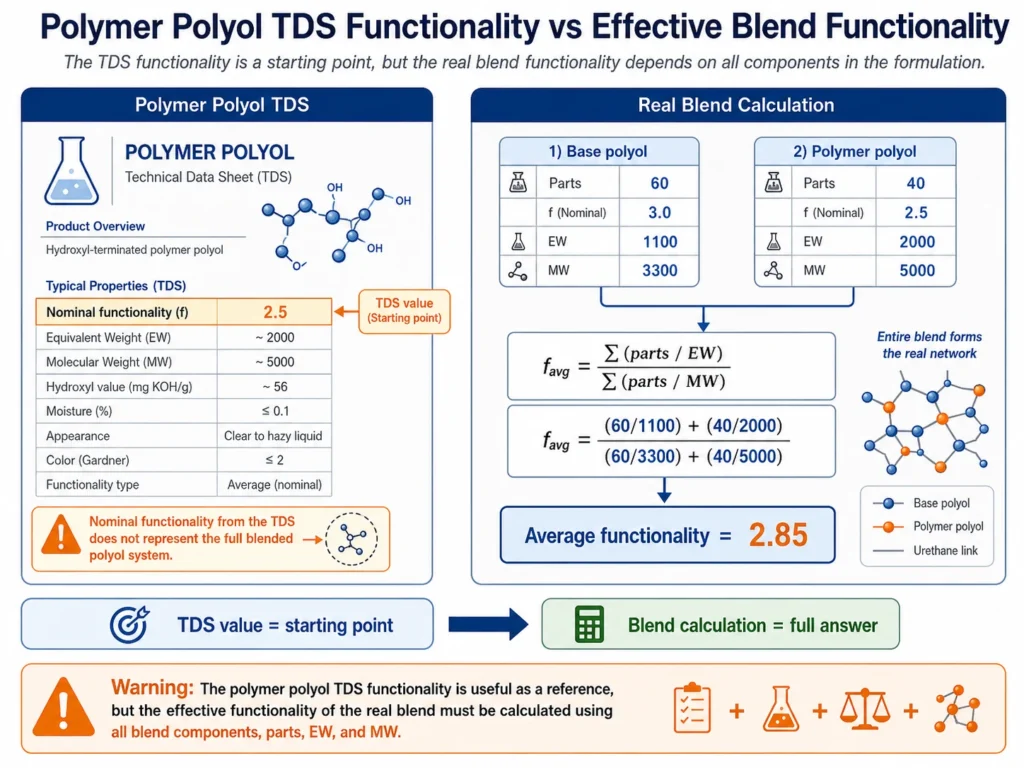
    For the basic explanation of hydroxyl value and equivalent weight calculation, read Hydroxyl Value in Polyurethane Foam: What OHV Means and How to Calculate Equivalent Weight.

    For OHV variation and foam quality effects, read Why Polyol OHV Variation Causes PU Foam Quality Problems.

    For the full isocyanate index calculation method, read Isocyanate Index Calculation Guide for PU Foam Engineers.

    FAQs

    What are the most common hydroxyl value mistakes in PU foam production?

    The five most common mistakes are: using the TDS nominal value instead of the CoA actual value, assuming supplier consistency without checking every batch, trusting the CoA without independent verification for critical products, confusing OHV with functionality, and treating equivalent weight as a one-time calculation.

    Why should I use OHV from the CoA instead of the TDS?

    The TDS gives a specification range that tells you what the supplier is allowed to ship. The CoA gives the actual OHV value of the specific batch in your plant. Equivalent weight is calculated directly from OHV using EW = 56,100 ÷ OHV, so a wrong OHV creates a wrong equivalent weight and a wrong isocyanate balance — even if the batch is technically inside specification.

    Can a trusted supplier still cause OHV-related foam problems?

    Yes. Even a reliable, long-term supplier can deliver batches with different OHV values within the specification range. A batch at OHV 47 and a batch at OHV 55 may both pass commercial QC but produce different equivalent weights, different isocyanate balance, and different foam properties if the formula is not recalculated.

    When should I verify polyol OHV in-house instead of relying on the CoA?

    For critical or high-volume products, in-house OHV verification using ASTM D4274 or ISO 14900 is recommended. A practical approach is to verify every batch for critical products, every third batch for stable suppliers, and any batch where the CoA value differs unexpectedly from the supplier’s history. Investigate if the in-house OHV differs from the CoA by more than 2 mg KOH/g.

    What is the difference between OHV and functionality?

    OHV measures the concentration of reactive hydroxyl groups per gram of polyol (mg KOH/g). Functionality measures the average number of hydroxyl groups per molecule. They describe different things — OHV mainly affects equivalent weight and isocyanate demand, while functionality affects network structure and crosslinking. Confusing them can lead to wrong troubleshooting decisions.

    How often should I recalculate polyol equivalent weight?

    Every time a new polyol batch arrives. Equivalent weight is calculated from OHV (EW = 56,100 ÷ OHV), so any change in OHV changes EW. Treating equivalent weight as a one-time value is one of the most common causes of hidden formulation drift.

    How much OHV change is enough to require formula adjustment?

    For standard flexible slabstock, a practical guideline is: EW difference ≤30 g/eq can be monitored, 30–70 g/eq should be reviewed for index impact, and >70 g/eq generally requires formula adjustment. HR foam, rigid systems, and tight-spec products may need stricter limits.

    What happens if foam hardness drifts but the formula sheet looks unchanged?

    Check the incoming polyol OHV first. The most common hidden cause of unexplained hardness drift is OHV variation that was not used to recalculate equivalent weight. Direction matters: lower OHV pushes EW higher, which can raise the actual running index and harden the foam. Higher OHV does the opposite.

    Should I keep a batch-by-batch OHV log?

    Yes. A simple log with supplier, grade, batch number, date, CoA OHV, calculated EW, and production observations is one of the most valuable QC records a foam plant can keep. After 15–20 batches, supplier patterns become visible and troubleshooting becomes much faster.

    What’s the simplest QC change a foam plant can make to prevent OHV mistakes?

    Add one step to incoming QC: after confirming the batch is within TDS specification, calculate the equivalent weight from the actual CoA OHV and compare it to the formula design EW. If the difference is significant, review whether the isocyanate quantity needs adjustment before production. This single step prevents most OHV-related production problems.

    Key Takeaways

    Hydroxyl value mistakes can quietly create serious PU foam production problems.

    The five most important mistakes are:

    1. Using the TDS nominal value instead of the CoA actual value.
    2. Assuming supplier consistency without checking every batch.
    3. Trusting the CoA without independent verification for critical products.
    4. Confusing OHV with functionality.
    5. Treating equivalent weight as a one-time calculation.

    The main rule is simple: OHV must be treated as a batch-specific formulation control value.

    Every incoming polyol batch should have its actual OHV recorded, equivalent weight recalculated, index impact reviewed, and formula adjustment considered before production.

    A foam plant does not need to wait for hardness drift, compression set failure, or customer complaints before discovering OHV variation. The data is already available — it just needs to be used correctly.

    Conclusion

    If your foam plant is experiencing unexplained hardness variation, compression set issues, or different behaviour after new polyol deliveries, OHV handling should be reviewed early.

    PolymersIQ can help audit your formulation baseline, review incoming polyol data, calculate equivalent weight impact, and identify whether OHV variation is affecting your production quality.

    To get accurate support, please share:

    • Polyol grade and supplier
    • CoA OHV values from recent batches (last 5–10 if available)
    • Design OHV used in your original formulation
    • Isocyanate type and %NCO
    • Description of the quality issue you are facing
    • Any in-house OHV verification results, if available

    Contact PolymerIQ for a formulation audit →