
Introduction
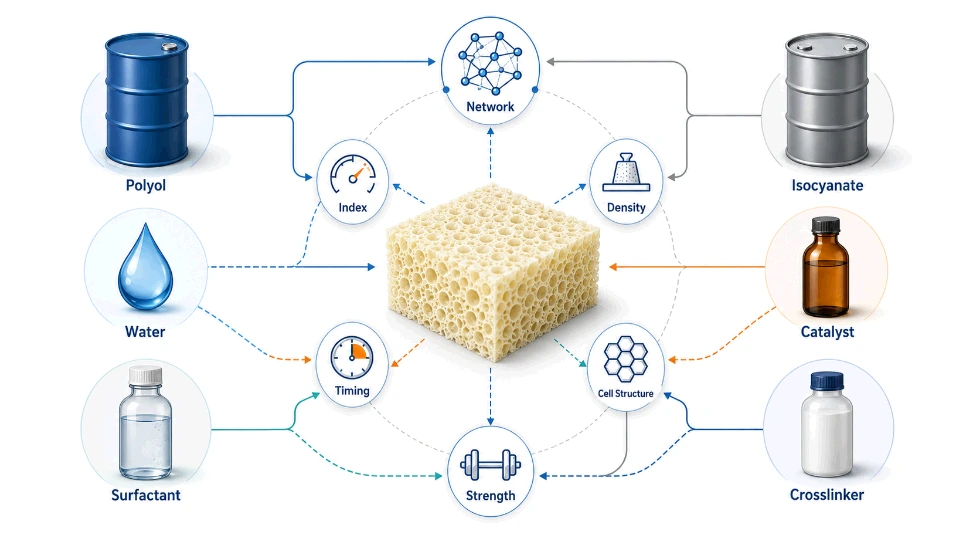
PU foam raw materials are the foundation of every polyurethane foam formulation. Whether the final product is a soft mattress foam or a rigid insulation foam, the performance starts with the same six material families.
Six raw materials can create millions of different polyurethane foams.
The foam in a luxury mattress and the foam insulating a cold storage warehouse do not look the same. One is soft and flexible. The other is rigid and closed-cell. One is designed for comfort. The other is designed to stop heat transfer.
But the raw-material architecture is similar.
Most polyurethane foam systems are built from six main material families:
- Polyol
- Isocyanate
- Water
- Catalyst
- Surfactant
- Crosslinker
What makes one foam different from another is not only which ingredients are present. It is the grade of each ingredient, the amount used, the equivalent weight, the functionality, the index, the catalyst balance, the surfactant package, and the processing window.
This article covers the foundation: what each of the six raw materials is, what each one does, and how the two main reactive components — polyol and isocyanate — build the polyurethane foam network. The technical distinctions between reactive and non-reactive components, and how raw materials interact in production troubleshooting, are covered in the next articles in this series.
The Six Raw Materials in a PU Foam Formula
A polyurethane foam formula is not just a list of ingredients. It is a connected chemical and physical system.
Each raw material has a different job.
| Raw Material | Main Function | Main Property It Controls |
|---|---|---|
| Polyol | Builds the polymer backbone | Foam type, flexibility, rigidity, compression set, durability |
| Isocyanate | Reacts with OH and water | Index, network formation, hardness, cure, exotherm |
| Water | Chemical blowing agent | Density, CO₂ generation, urea formation, hardness, exotherm |
| Catalyst | Controls reaction speed | Cream time, gel time, rise time, cure timing |
| Surfactant | Stabilizes cells | Cell size, cell uniformity, cell opening, collapse resistance |
| Crosslinker | Adds network junctions | Hardness, compression set, load-bearing, network strength |
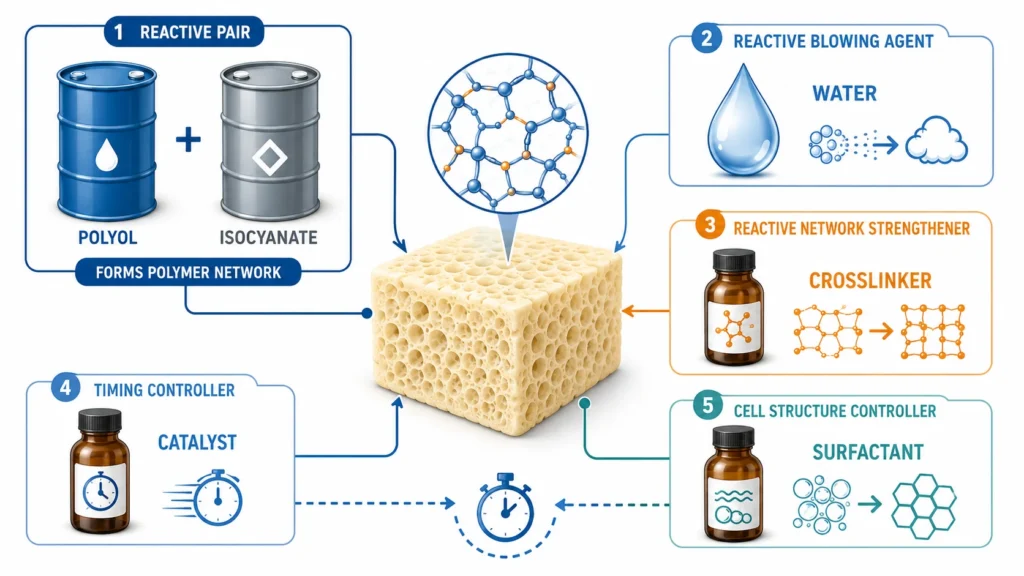
The first three materials define most of the chemical foundation: polyol, isocyanate, and water. Crosslinker is also a reactive component when present. These components must be included in equivalent and index calculations.
Catalyst and surfactant are different. Catalyst controls timing. Surfactant controls foam stability and cell structure. They are critical, but they normally do not contribute reactive equivalents to the index calculation.
This article focuses on the two main reactive partners — polyol and isocyanate — and provides a brief introduction to the remaining four. Each receives deeper treatment in the next articles in this sub-cluster.
1. Polyol: The Foundation of the Foam Network
Polyol is the foundation of polyurethane foam.
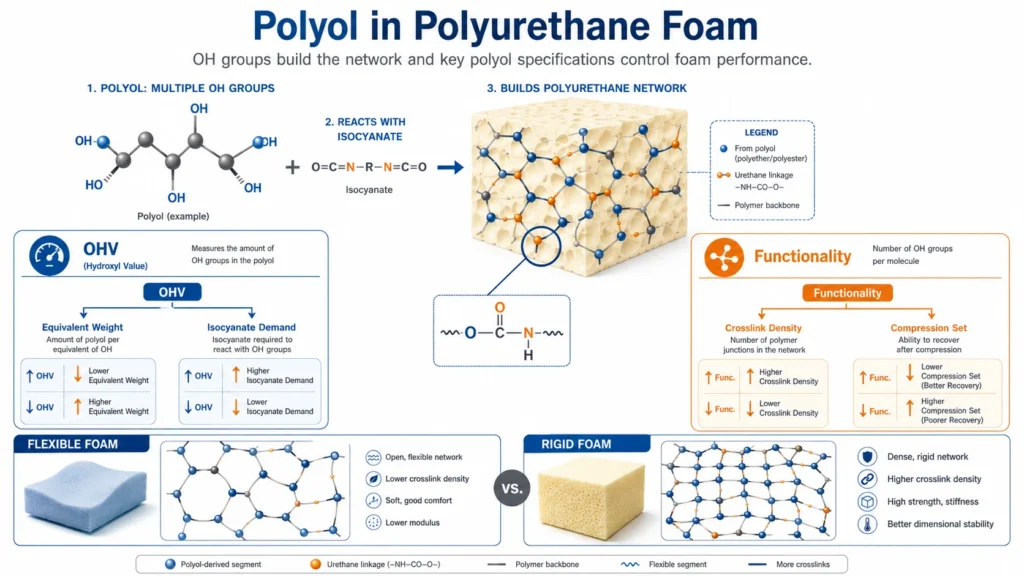
It is a molecule with multiple hydroxyl groups that react with isocyanate to form urethane linkages. These linkages build the polymer network that defines whether the foam is flexible, rigid, soft, firm, elastic, brittle, durable, or weak.
Polyol is usually the largest component by weight in flexible foam formulas. That is why polyol selection has such a large effect on final foam performance.
Polyol controls:
- Foam type
- Flexibility / rigidity
- Softness / hardness potential
- Compression set
- Recovery
- Network durability
- Load-bearing behavior
- Hydrolysis resistance
- Processing viscosity
The first key polyol number is OHV (hydroxyl value). OHV tells you how many reactive hydroxyl groups are present per gram of polyol.
- Higher OHV usually means shorter chain length, lower equivalent weight, and a more rigid network.
- Lower OHV usually means longer chain length, higher equivalent weight, and a more flexible foam.
| Foam Type | Typical Polyol OHV Direction |
|---|---|
| Flexible foam | Lower OHV, often around 28–56 mg KOH/g |
| Rigid foam | Higher OHV, often around 300–600 mg KOH/g |
The second key polyol number is functionality. Functionality tells you how many reactive OH groups exist per molecule.
Two polyols can have the same OHV but different functionality. That means the index calculation may look similar, but the foam network can behave differently.
This is why polyol cannot be substituted based only on OHV. A polyol change is a network change.
2. Isocyanate: The Reactive Partner That Makes the Foam
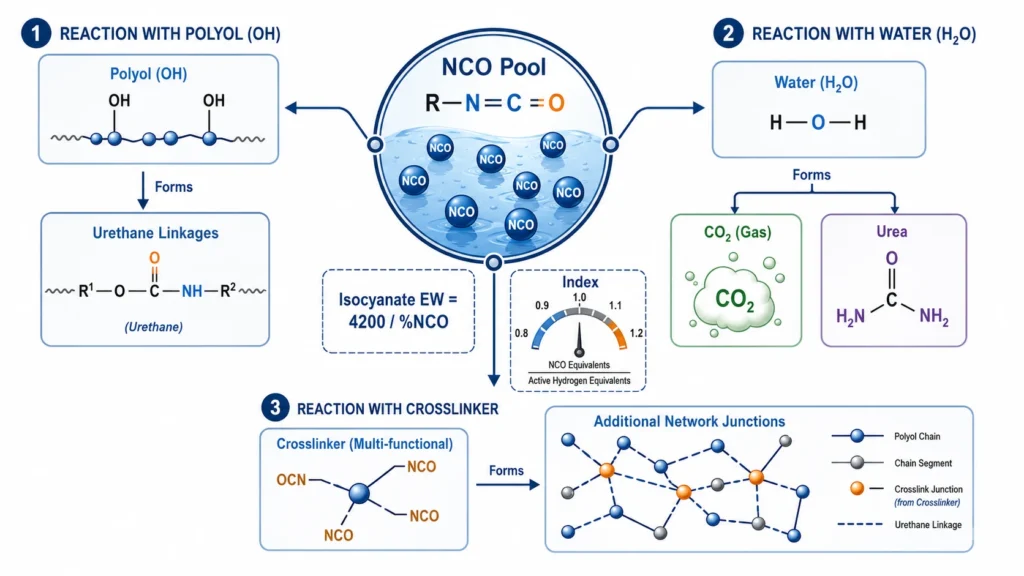
Isocyanate is the reactive partner in polyurethane foam. It contains NCO groups that react with hydroxyl groups from polyol, with water, and with reactive crosslinkers. Without isocyanate, the foam does not form.
Isocyanate participates in several reactions at the same time:
- NCO + polyol OH forms urethane linkages
- NCO + water generates CO₂ and amine
- Amine + NCO forms urea linkages
- NCO + crosslinker creates additional network junctions
These reactions compete for the same NCO pool. That is why isocyanate level is controlled through the isocyanate index.
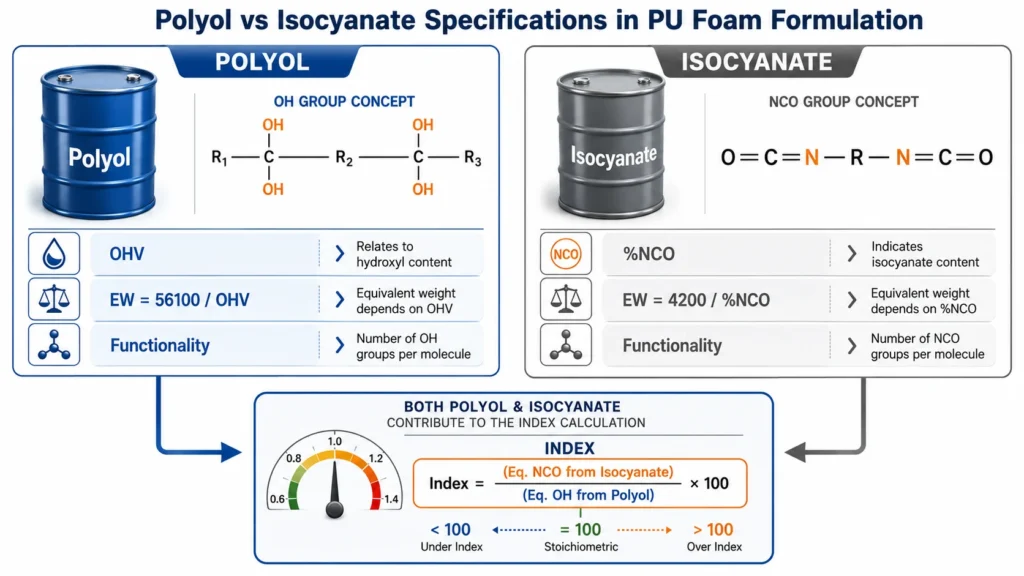
The isocyanate index compares NCO equivalents to reactive hydrogen equivalents:
Index 100 = stoichiometric balance
Index 105 = 5% excess NCO
The index affects hardness, cure, network formation, compression set, exotherm, cell stability, and final properties.
The key isocyanate specification is %NCO. For TDI, a common value is around 48.3% NCO.
Isocyanate EW = 4,200 ÷ %NCO
For 48.3% NCO: EW = 4,200 ÷ 48.3 = 86.96 g/eq
Use g/eq, not g/mol, when using equivalent weight in formulation calculations. The %NCO value should be taken from the current CoA whenever possible, not blindly from an old TDS.
Isocyanate is also moisture sensitive. If an isocyanate drum is exposed to humidity, NCO groups can react with water. Over time, this can reduce active %NCO and shift the real index, depending on exposure conditions, humidity, time, and handling.
A formula does not run at the intended index. It runs at the actual index created by the raw materials on the production floor.
3. Water (Brief Introduction)
Water is one of the smallest ingredients by weight in many flexible foam formulas. But chemically, it is one of the most powerful.
Water is the main chemical blowing agent in many flexible polyurethane foam systems. It reacts with isocyanate to generate CO₂ gas, which expands the foam and creates the cellular structure.
Water has a very low equivalent weight:
Water EW = 9 g/eq
That means a small amount of water can contribute a large share of reactive hydrogen equivalents in a flexible foam formula. Water is treated in detail in the next article in this sub-cluster, where its dual role as blowing agent and urea network builder is explained.
4. Catalyst (Brief Introduction)
Catalyst controls reaction timing. It does not change the stoichiometric ratio of the formula.
In polyurethane foam, catalyst balance controls cream time, gel time, rise time, tack-free time, and the gelling-versus-blowing balance. Two main categories are used: amine catalysts (which can favour blowing or gelling depending on grade) and tin catalysts (which mainly accelerate gelling).
Catalyst does not enter the index calculation in normal PU foam formulation. It is critical for foam quality but cannot fix wrong stoichiometry. Catalyst is covered in detail alongside water in the next article.
5. Surfactant (Brief Introduction)
Surfactant controls foam cell structure. In polyurethane foam, the surfactant is usually a silicone-based additive that stabilizes bubbles while the foam rises.
Without surfactant, CO₂ bubbles can merge, rupture, or escape before the polymer network has enough strength to hold the foam — leading to collapse, coarse cells, or holes. Surfactant controls cell size, cell uniformity, and cell opening.
Surfactant normally does not enter the index calculation. Surfactant grade selection and dosage limits are covered alongside crosslinker in the next article.
6. Crosslinker (Brief Introduction)
A crosslinker is a small reactive molecule that adds network junctions. It usually contains multiple hydroxyl or amine groups. Because it has reactive groups, it must be included in equivalent and index calculations.
The most common flexible foam crosslinker is DEOA (diethanolamine). DEOA has three reactive groups, giving an equivalent weight of 35.0 g/eq:
DEOA EW = 105.14 ÷ 3 = 35.0 g/eq
Crosslinker is reactive, low in equivalent weight, and powerful even at small dosages. It is treated in detail alongside surfactant in the next article in this series.
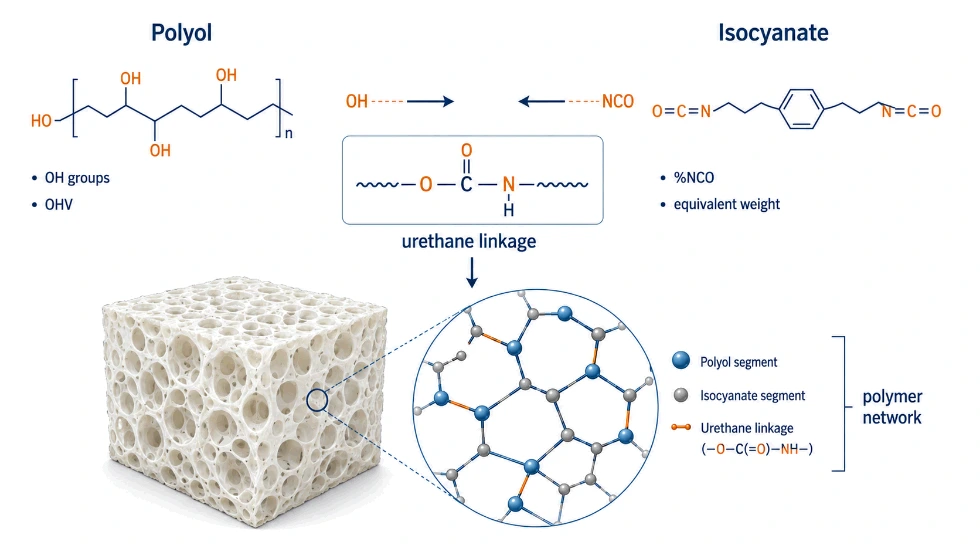
How Polyol and Isocyanate Build the Foam Network
Polyol and isocyanate are the two main reactive partners. The polymer network is built from urethane linkages formed when polyol OH groups react with isocyanate NCO groups.
The basic reaction:
Polyol OH + Isocyanate NCO → Urethane linkage
When this reaction repeats across thousands of molecules, the result is a three-dimensional polymer network — the polyurethane backbone of the foam.
The character of that backbone depends on:
- Polyol OHV — controls equivalent weight and isocyanate demand
- Polyol functionality — controls how many connection points each molecule contributes
- Isocyanate %NCO — controls how many reactive NCO groups are available per gram
- Isocyanate index — controls whether NCO is in stoichiometric balance, deficit, or excess
- Polyol type (polyether or polyester) — affects hydrolysis resistance, durability, and feel
A correctly designed reactive pair gives the foam its fundamental performance: flexibility or rigidity, resilience, hardness potential, compression set behavior, and durability. A mismatched pair — wrong OHV for the application, wrong index, or incompatible functionality — limits everything else, regardless of catalyst, surfactant, or process tuning.
This is why polyol and isocyanate are reviewed first when reformulating, qualifying a new product, or troubleshooting persistent foam quality problems.
Polyol and Isocyanate at a Glance
| Specification | Polyol | Isocyanate |
|---|---|---|
| Reactive group | Hydroxyl (OH) | Isocyanate (NCO) |
| Key spec value | OHV (mg KOH/g) | %NCO |
| Equivalent weight formula | EW = 56,100 ÷ OHV | EW = 4,200 ÷ %NCO |
| Architecture variable | Functionality (OH per molecule) | Functionality (NCO per molecule) |
| Index role | Provides reactive H equivalents | Provides NCO equivalents |
| Storage sensitivity | Hygroscopic in some grades | Strongly moisture sensitive |
| Common grades | Polyether triol, polymer polyol, polyester polyol | TDI 80/20, MDI, polymeric MDI |
| Source of variation | OHV drift, functionality, supplier change | %NCO drift, moisture exposure, supplier change |
The two columns share a structure: both have an equivalent weight formula tied to a key specification (OHV or %NCO), both have a functionality value, and both contribute to the index calculation. Reading them as a paired system is more accurate than reading them in isolation.
Why Polyol-Isocyanate Selection Matters Most
Polyol and isocyanate together represent most of the formula by weight, and they define almost every foam property that depends on the polymer backbone.
A polyol change can affect:
- Foam flexibility or rigidity
- Hardness potential
- Compression set
- Recovery and resilience
- Hydrolysis resistance
- Processing viscosity
- Cell wall strength
- Long-term durability
An isocyanate change can affect:
- Reaction rate
- Cure profile
- Hardness
- Index calculation
- Exotherm
- Moisture sensitivity
- Compatibility with catalyst package
- Network completeness
When both move together — for example, switching to a different polyol grade with a new isocyanate supplier at the same time — production troubleshooting becomes very difficult because the variables are entangled.
The rule is simple: change one major raw material at a time, and verify the index, equivalent weight, and foam performance before changing another.
Use the PolymerIQ Calculators
Polyol and isocyanate calculations depend on accurate specification values. The PolymerIQ Equivalent Weight Calculator helps verify polyol EW from current OHV and isocyanate EW from current %NCO. Use it when reviewing a new grade, comparing CoA values, updating raw material data, or auditing a formulation sheet.
Open the Equivalent Weight Calculator →
The PolymerIQ NCO / TDI Index Calculator helps confirm whether the polyol-isocyanate pair is balanced at the intended index. Use it when changing polyol OHV, switching isocyanate supplier, updating %NCO from CoA, or validating actual index against target index.
Open the NCO / TDI Index Calculator →
For the technical article on which raw materials enter the index calculation, read Reactive vs Non-Reactive Components in PU Foam: Which Raw Materials Enter the Index Calculation.
For the troubleshooting article on raw material interactions, read Why Changing One PU Foam Raw Material Changes the Whole Formula.
For the deep guide on hydroxyl value and equivalent weight, read Hydroxyl Value in Polyurethane Foam: What OHV Means and How to Calculate Equivalent Weight.
For the foundation article on NCO content, read NCO Content in Isocyanate: What %NCO Means in PU Foam Formulation.
For the polyol functionality guide, read Polyol Functionality in Polyurethane Foam: What It Means and Why It Matters.
For the formulation sheet guide, read How to Read a Polyurethane Formulation Sheet.
FAQs
What are the six main raw materials in polyurethane foam?
Polyurethane foam systems are built from six main raw-material families: polyol, isocyanate, water, catalyst, surfactant, and crosslinker. Polyol and isocyanate form the polymer network. Water acts as a chemical blowing agent and contributes to urea hard segments. Catalyst controls reaction timing. Surfactant controls cell structure. Crosslinker adds network junctions.
Why are polyol and isocyanate considered the main reactive pair?
Polyol provides hydroxyl (OH) groups and isocyanate provides isocyanate (NCO) groups. When OH and NCO react, they form urethane linkages — the chemical backbone of polyurethane. This reaction repeated thousands of times builds the three-dimensional polymer network that defines whether the foam is flexible, rigid, soft, firm, durable, or short-lived. Without this reactive pair, polyurethane foam does not form.
What is OHV and how is it used in polyol selection?
OHV (hydroxyl value) is the concentration of reactive hydroxyl groups per gram of polyol, measured in mg KOH/g. Higher OHV usually means shorter polyol chains and a more rigid network. Lower OHV usually means longer chains and more flexible foam. OHV is also used to calculate polyol equivalent weight: EW = 56,100 ÷ OHV. Different foam types require different OHV ranges — flexible slabstock typically uses 28–56, while rigid foam uses 300–600.
What is %NCO and why does it matter for isocyanate?
%NCO is the mass percentage of reactive NCO groups in the isocyanate material. It controls how many reactive NCO groups are available per gram of material. The equivalent weight formula is EW = 4,200 ÷ %NCO. For TDI 80/20 with 48.3% NCO, the equivalent weight is 86.96 g/eq. Always use the actual CoA %NCO, not the TDS midpoint, because drum-to-drum variation can shift the real running index.
Can two polyols with the same OHV behave differently in foam?
Yes. OHV measures concentration of reactive groups per gram, but two polyols with the same OHV can have different functionality (number of OH groups per molecule), different molecular weight, different polyether vs polyester structure, or different impurity profiles. They will calculate the same equivalent weight but can build different foam networks. This is why polyol cannot be substituted on OHV alone — supplier and grade matter.
Why is isocyanate moisture sensitive?
NCO groups react chemically with water. That is the same reaction used inside the foam (water + NCO → CO₂ + amine), so atmospheric moisture exposure during storage can consume some of the active NCO before the material reaches production. Moisture exposure can occur through poor drum sealing, damaged bungs, humid storage, or repeated opening. A drum’s CoA may have been correct at the supplier, but the active %NCO entering the mixing head can be lower if storage is poor.
What is the difference between polyether and polyester polyols?
Polyether polyols (the most common type in flexible foam) are based on propylene oxide and ethylene oxide chemistry. They offer good hydrolysis resistance, low viscosity, and broad processing windows. Polyester polyols are based on diacid-diol chemistry, offer higher tensile strength and certain durability advantages, but are more sensitive to hydrolysis. The choice depends on the application — automotive, comfort, technical, or specialty foam.
How is the isocyanate index calculated?
Index = NCO equivalents ÷ Total reactive H equivalents × 100. Index 100 means stoichiometric balance — exactly enough NCO to react with all reactive hydrogens. Index 105 means 5% excess NCO. Reactive H equivalents include polyol OH, water (EW = 9), and any crosslinker reactive groups. The index controls hardness, cure, network completeness, compression set, exotherm, and overall foam properties.
What’s the most common mistake when changing polyol or isocyanate supplier?
The most common mistake is approving the change based on the product name or TDS specification, without verifying the actual delivered material. A “same grade” polyol from another supplier can have different functionality, different impurity profile, or a CoA at a different end of the OHV range. A “same grade” isocyanate can have a different CoA %NCO. Both changes shift the index calculation. Approval should require CoA review, EW recalculation, index verification, and a controlled production trial.
Should I change polyol and isocyanate at the same time?
No — change one major reactive component at a time and verify foam performance before changing another. If polyol and isocyanate change simultaneously, troubleshooting becomes much harder because the variables are entangled. Production teams cannot tell whether a hardness drift, compression set change, or cure problem comes from the polyol shift, the isocyanate shift, or the interaction. The cleanest approach is sequential change with full validation between each step.
Key Takeaways
Every polyurethane foam formula is built from six raw-material families: polyol, isocyanate, water, catalyst, surfactant, and crosslinker.
The two main reactive partners are polyol and isocyanate. Together they form the urethane linkages that build the polyurethane polymer network.
- Polyol provides reactive OH groups, controls flexibility/rigidity, and is characterized by OHV and functionality.
- Isocyanate provides reactive NCO groups, controls cure and network completeness, and is characterized by %NCO and the index.
Both share a paired structure: each has a key specification, an equivalent weight formula, and a functionality value.
Equivalent weight formulas:
Polyol EW = 56,100 ÷ OHV
Isocyanate EW = 4,200 ÷ %NCO
Polyol and isocyanate together represent most of the formula by weight and define the polymer backbone. Polyol-isocyanate selection should be reviewed first when reformulating, qualifying new products, or troubleshooting persistent foam problems.
Conclusion
If your foam quality problem starts with the polymer network — flexibility, hardness, cure, or compression set — the polyol-isocyanate pair is where troubleshooting should begin.
PolymersIQ can help review your polyol grade, OHV, functionality, isocyanate type, current %NCO, and index calculation to identify whether the reactive pair is correctly specified for your foam target.
To get accurate support, please share:
- Polyol grade, OHV, functionality, and supplier
- Isocyanate type and current CoA %NCO
- Target foam type, density, and hardness
- Current isocyanate index
- Description of the foam quality issue and adjustments already tried
Contact PolymersIQ for a polyol and isocyanate review →