
Introduction
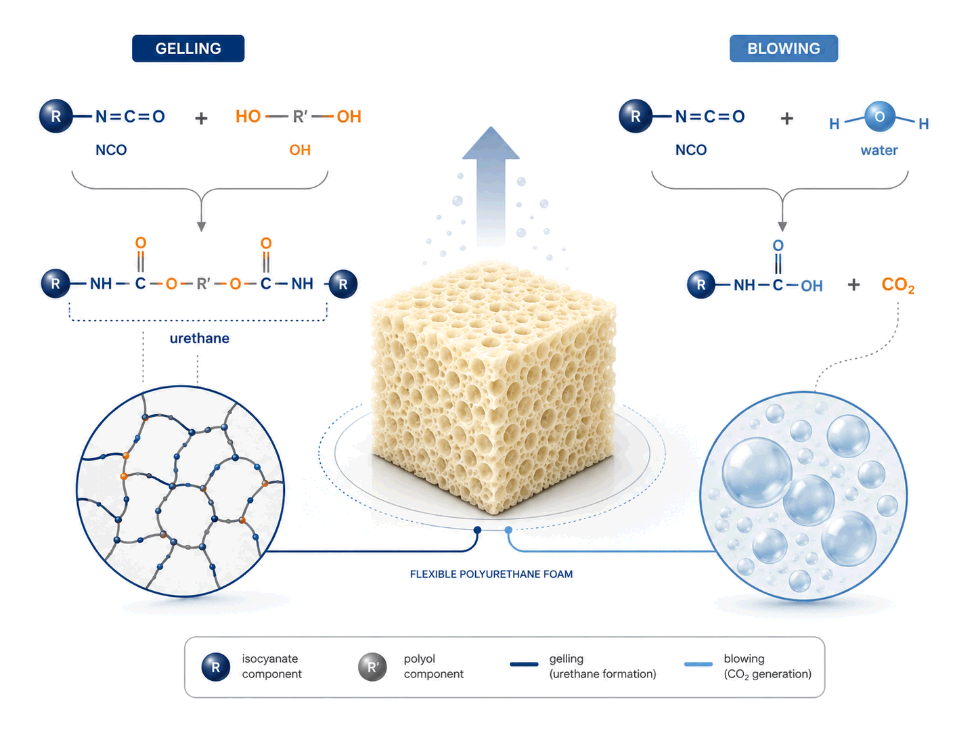
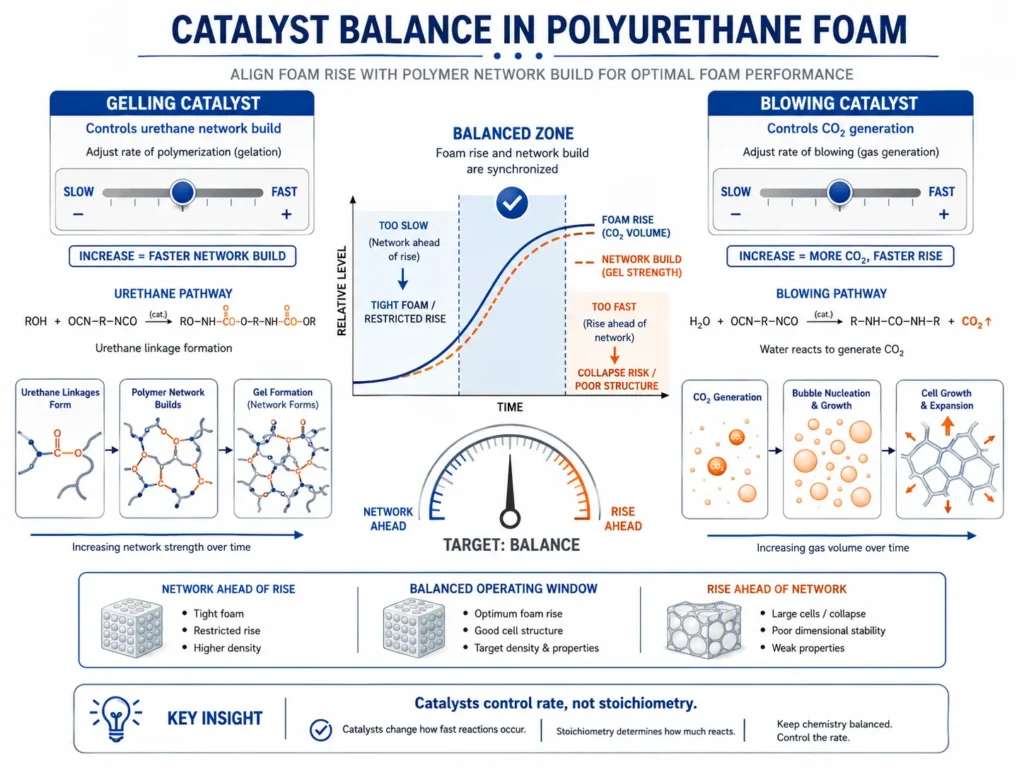
Gelling vs blowing reaction balance is one of the most important controls in polyurethane foam because it determines whether foam rise and polymer strength develop together.
Every polyurethane foam formula depends on two major reactions happening at the same time.
One reaction builds the polymer network. The other reaction generates the gas that expands the foam.
These are known as the gelling reaction and the blowing reaction.
The gelling reaction gives the foam structure. The blowing reaction gives the foam volume. If the two reactions do not track each other properly, the foam can collapse, become tight-celled, under-rise, split, or show irregular cell structure.
This is why catalyst balance matters. Not just catalyst level.
A foam formula can contain the right raw materials and still fail if the gelling and blowing reactions are not balanced during the rise profile.
- Too much blowing ahead of gelling, and the foam expands before the network is strong enough to hold it.
- Too much gelling ahead of blowing, and the network locks before the foam can fully expand.
The result is not random. It is reaction balance.
This article explains what each reaction does, how both consume NCO, and why they must be controlled together in polyurethane foam production.
What Is the Gelling Reaction?
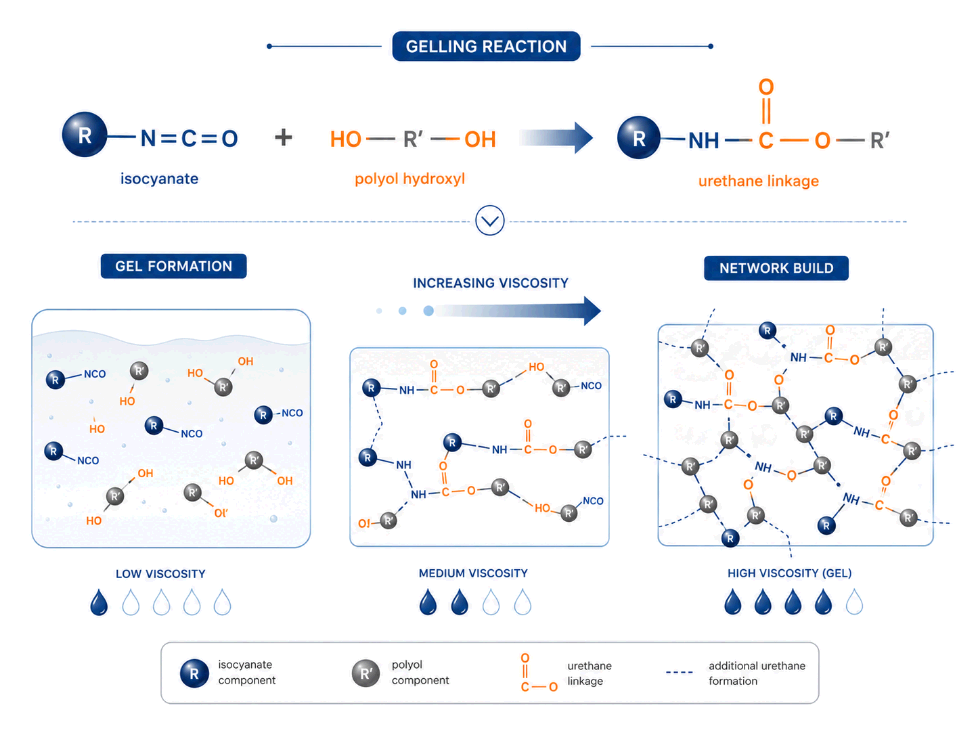
The gelling reaction is the reaction between isocyanate groups and polyol hydroxyl groups.
R–NCO + R′–OH → R–NH–COO–R′
This forms a urethane linkage.
Urethane linkages build the polymer backbone of the foam. As the reaction progresses, the liquid system becomes more viscous. It thickens, gels, and eventually forms a solid foam network.
This reaction is responsible for building the structure that holds the foam shape.
Without enough gelling, the foam does not have enough strength to hold the gas generated by the blowing reaction.
In production terms, the gelling reaction affects:
- Viscosity build
- Gel time
- Network strength
- Foam structure
- Load-bearing development
- Cell stability
- Final cure
The gelling reaction is not only about making the foam hard. It is about creating the structure that allows the foam to hold its shape while it expands.
If gelling is too slow, the foam may rise but then collapse or settle because the network is not strong enough. If gelling is too fast, the foam can lock too early and prevent full expansion.
What Is the Blowing Reaction?
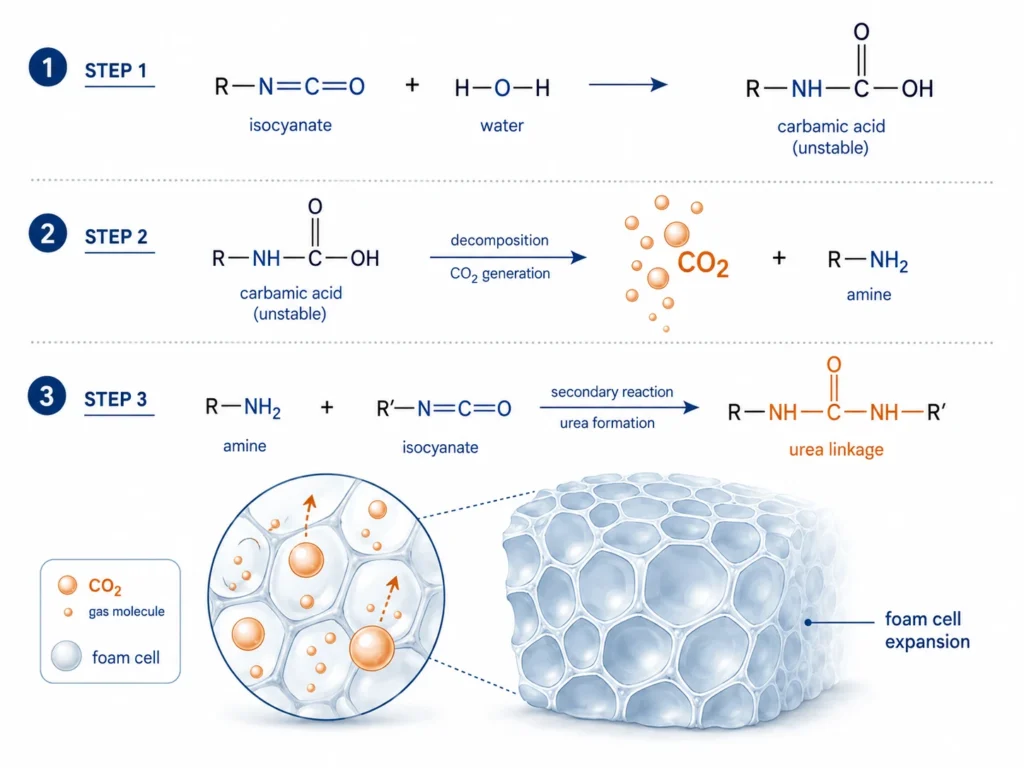
The blowing reaction is mainly the reaction between isocyanate and water.
Water reacts with an isocyanate group and produces an unstable carbamic acid intermediate. That intermediate decomposes quickly to form carbon dioxide and an amine.
H₂O + R–NCO → R–NH–COOH
R–NH–COOH → R–NH₂ + CO₂
The carbon dioxide expands the foam and creates the cellular structure. This is why water is called a chemical blowing agent in flexible polyurethane foam.
But the blowing reaction does not stop at CO₂.
The amine formed during the reaction reacts with another isocyanate group to form a urea linkage:
R–NH₂ + R′–NCO → R–NH–CO–NH–R′
That means the blowing reaction also contributes to urea hard segments in the polymer network.
So water has two connected effects:
- It generates CO₂ for expansion.
- It forms urea linkages that affect foam structure and properties.
This is why the blowing reaction is not only a gas-generation reaction. It is also linked to network development.
Why the Two Reactions Cannot Be Separated
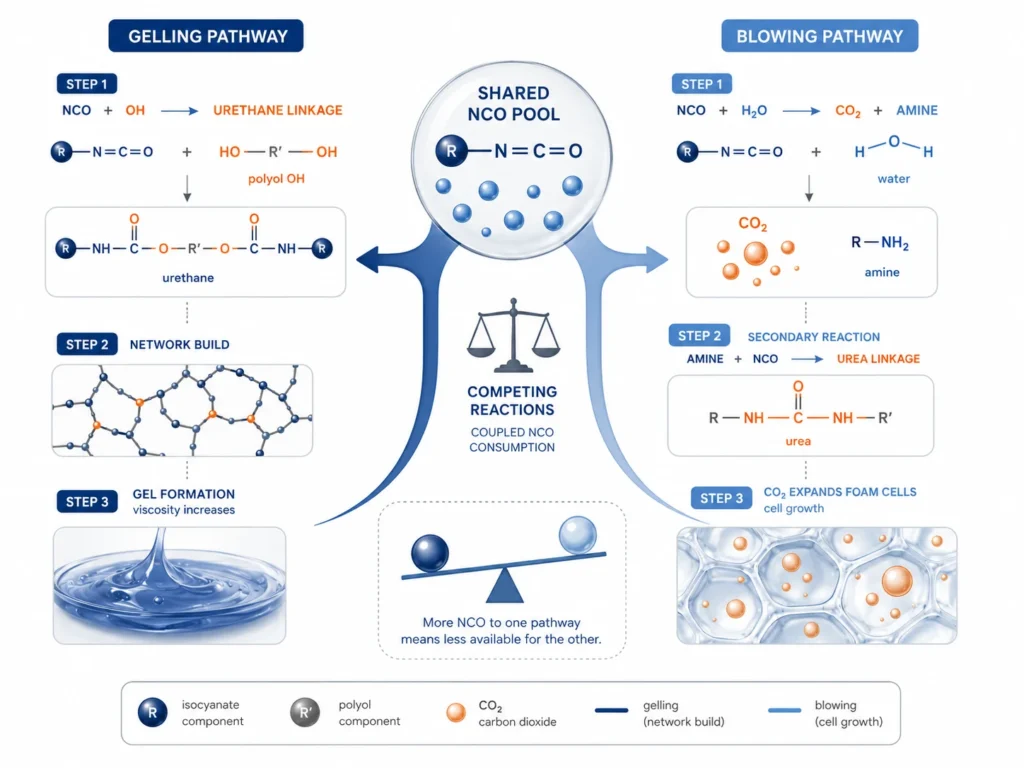
The gelling and blowing reactions happen at the same time. Neither reaction waits for the other.
As soon as isocyanate contacts the reactive components in the mixing head, the chemistry begins.
- The gelling reaction consumes NCO through reaction with polyol hydroxyl groups.
- The blowing reaction consumes NCO through reaction with water and then through amine-to-urea formation.
Both reactions need isocyanate. That means both reactions draw from the same finite NCO pool.
- Every NCO group consumed by water is not available for polyol.
- Every NCO group consumed by polyol is not available for water.
This does not mean the reactions are fighting in a bad way. It means they are coupled. The formula is designed around that coupling. But if one side changes, the balance changes.
For example:
- Increase water, and the blowing side consumes more NCO.
- Change index, and both reactions may be affected.
- Change catalyst balance, and one reaction may accelerate more than the other.
- Change temperature, and the reaction rates may shift differently.
- Change polyol or %NCO values, and the stoichiometric balance may move.
The foam result depends on how these reactions track each other during the rise.
The Role of Catalyst Balance
Catalysts do not change the basic stoichiometry of the formula. They change reaction speed. That is a critical distinction.
A catalyst package controls how quickly the gelling and blowing reactions happen relative to each other.
- A gelling catalyst accelerates urethane formation and network build.
- A blowing catalyst accelerates the water-isocyanate reaction and CO₂ generation.
A balanced catalyst package keeps the rise profile controlled so that gas generation and network strength develop together.
If the catalyst balance is wrong, the foam can fail even if the raw material parts are correct.
| Imbalance | Possible Result |
|---|---|
| Too much blowing relative to gelling | Collapse or settling |
| Too much gelling relative to blowing | Tight cells, high density, under-rise |
| Too much total catalyst | Reaction too fast to control |
| Too little total catalyst | Sluggish rise and poor structure |
This is why catalyst troubleshooting should start with the reaction balance, not random dosage changes.
A catalyst is not a magic correction. It is a timing tool.
What Happens When Blowing Runs Ahead of Gelling?
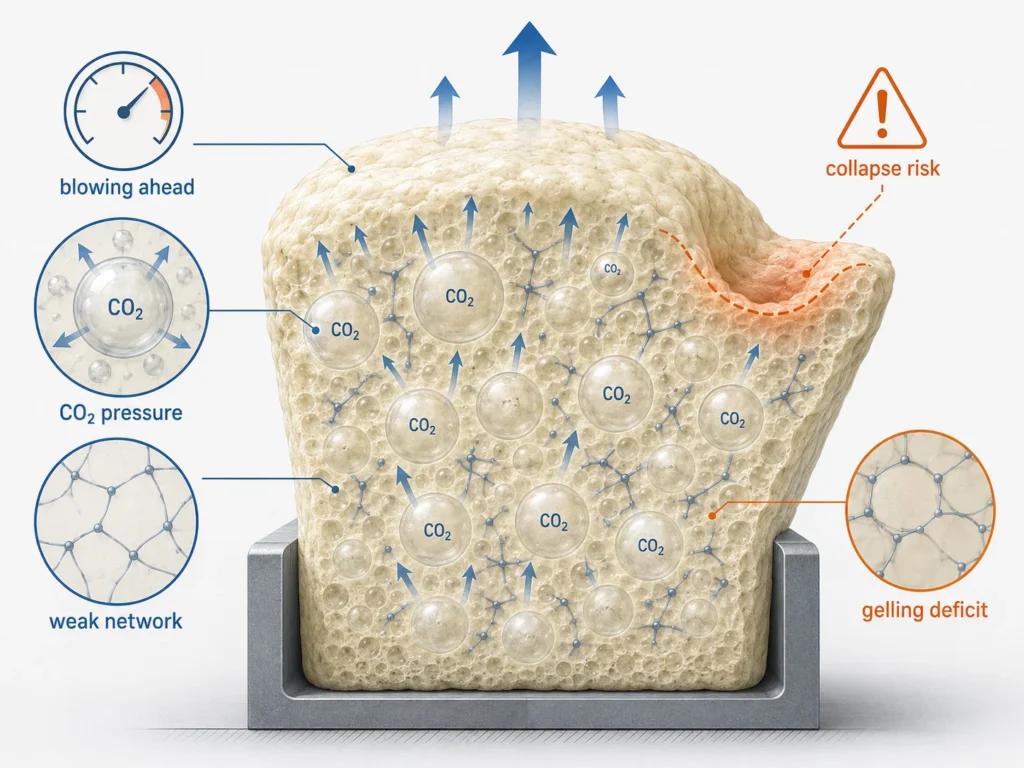
Blowing runs ahead of gelling when CO₂ generation and foam expansion happen faster than the network can build strength.
In this case, the foam may expand quickly, but the polymer network is not strong enough to support the expanding structure.
The result can be:
- Foam collapse
- Subsidence
- Irregular top surface
- Large cells
- Voids
- Weak top skin
- Uneven density
- Poor final structure
This is often described as a gelling deficit. The foam is generating gas before it has enough structure to hold that gas.
In this case, the correction usually belongs on the gelling side — after verifying that the index, water level, and equivalent weights are correct.
Possible correction directions may include:
- Increasing gelling catalyst
- Adjusting tin catalyst carefully
- Reviewing index
- Checking water level
- Checking raw material temperature
- Verifying mixing quality
The key is not to accelerate blowing further. If blowing is already ahead, increasing the wrong blowing amine can make the defect worse.
What Happens When Gelling Runs Ahead of Blowing?
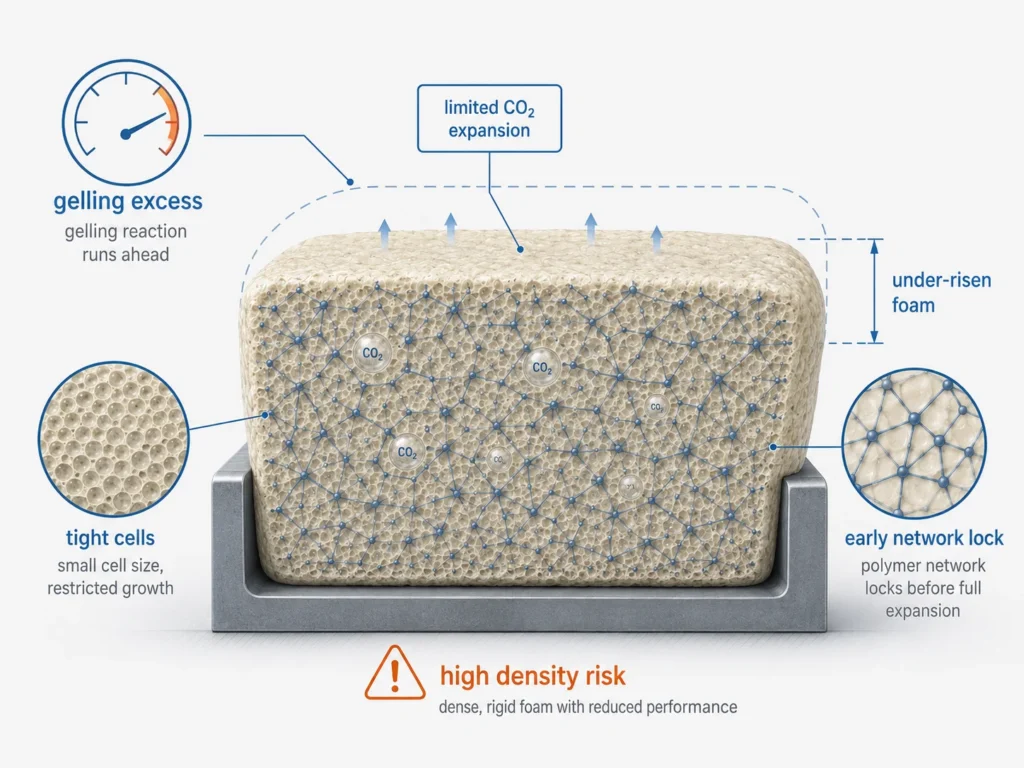
Gelling runs ahead of blowing when the polymer network builds too quickly before the foam has fully expanded.
In this case, viscosity rises early and the network begins to lock while gas generation and expansion are still developing.
The result can be:
- Tight cells
- Under-risen foam
- Higher density
- Poor cell opening
- Split surface
- Internal pressure marks
- Irregular cell structure
- Harsh or tight foam feel
This is often described as gelling excess. The foam has structure too early. Instead of holding the final expanded shape, the network restricts expansion.
In this case, the correction may require reducing gelling acceleration or improving the blowing side — but only after verifying that the formula is stoichiometrically correct.
Possible correction directions may include:
- Reducing gelling catalyst
- Reducing tin catalyst
- Adjusting blowing catalyst
- Checking silicone surfactant
- Reviewing water level
- Checking raw material temperature
- Reviewing index
Again, the important point is diagnosis before adjustment. If gelling is already excessive, increasing tin catalyst will usually move the formula in the wrong direction.
Why Gelling and Blowing Must Track During Rise
The gelling and blowing reactions do not need to happen at identical rates. They need to track each other within the correct window.
The foam must generate enough gas to expand, but the network must build enough strength to hold that expansion.
This balance changes across the rise profile:
- At cream time, gas generation becomes visible.
- During rise, CO₂ expands the foam.
- During gel development, viscosity builds and the structure begins to hold.
- At peak rise, expansion reaches maximum height.
- At tack-free time, the surface has enough integrity for handling.
The correct balance is dynamic. It is not one fixed number.
A good rise profile means the foam expands and builds network strength together. A poor rise profile means one reaction has moved too far ahead of the other.
This is why timing measurements such as cream time, gel time, rise time, and tack-free time are useful. They help show whether the gelling and blowing reactions are tracking correctly.
Practical Rules Before Adjusting Catalysts
Before changing any catalyst, check the foundation first.
Use this order:
- Verify the actual index from current CoA values.
- Confirm water equivalent weight is 9.
- Confirm polyol EW from current OHV.
- Confirm isocyanate EW from current %NCO.
- Record cream time, gel time, rise time, and tack-free time.
- Compare gel time and rise time.
- Identify whether gelling or blowing is out of balance.
- Adjust the catalyst that addresses the actual deficit.
This prevents the most common error: changing catalyst before knowing which reaction is actually wrong.
If the problem is stoichiometry, catalyst adjustment may only mask it. If the problem is reaction balance, the right catalyst adjustment depends on whether gelling or blowing is ahead.
Use the PolymersIQ Calculators
Before adjusting catalyst balance, verify the index. The PolymersIQ NCO / TDI Index Calculator helps confirm whether the formula is actually running at the intended index using current OHV, %NCO, water level, and reactive components. Use it when foam collapses unexpectedly, gel time shifts without obvious cause, a new TDI or MDI drum is used, water level changes, catalyst adjustments are not solving the defect, or a formula has not been recalculated from current CoA values.
Open the NCO / TDI Index Calculator →
When the blowing reaction runs ahead of gelling, actual density may differ from predicted density. The PolymersIQ Foam Density Estimator can help compare expected density against actual production density after water-level or reaction-balance changes. Use it when density is higher than expected, foam collapse changes final density, water level is adjusted, rise profile looks unstable, or low-density foam becomes difficult to control.
Open the Foam Density Estimator →
For the chemistry behind water’s role in blowing and urea formation, read The Dual Role of Water in Polyurethane Foam: Blowing Agent and Urea Network Builder.
For how water affects density, hardness, compression set, and exotherm, read How Water Level Affects PU Foam Density, Hardness, Compression Set, and Exotherm.
For the full isocyanate index method, read Isocyanate Index Calculation Guide for PU Foam Engineers.
For the next diagnostic article, read Gel Time vs Rise Time in PU Foam: How to Read the Reaction Balance Gap.
For catalyst mistakes and troubleshooting, read 5 Catalyst Adjustment Mistakes That Damage PU Foam Reaction Balance.
FAQs
What is the difference between the gelling and blowing reactions in PU foam?
The gelling reaction is the reaction between isocyanate (NCO) and polyol hydroxyl (OH) groups, forming urethane linkages that build the polymer network and structural integrity. The blowing reaction is the reaction between isocyanate and water, forming CO₂ gas (which expands the foam) and an amine intermediate that reacts with more NCO to form urea linkages. Gelling builds structure; blowing creates volume. Both happen simultaneously and both consume NCO from the same pool.
Why do both reactions consume NCO?
Both reactions require isocyanate. Gelling consumes NCO through urethane formation (NCO + OH → urethane). Blowing consumes NCO through two steps: first NCO + H₂O → carbamic acid → CO₂ + amine, then amine + NCO → urea. Each water molecule actually consumes two NCO equivalents across the full blowing pathway. This is why water has an equivalent weight of 9 g/eq (18 ÷ 2) and why both reactions are coupled — they draw from the same finite NCO pool.
What happens if blowing runs ahead of gelling?
The foam expands before the polymer network is strong enough to hold the expansion. The result can be foam collapse, subsidence, irregular top surface, large cells, voids, weak top skin, uneven density, or poor final structure. This is called a gelling deficit. The correction usually involves accelerating the gelling reaction (after verifying index, water level, and EW values) — not adding more blowing catalyst, which would make the imbalance worse.
What happens if gelling runs ahead of blowing?
The polymer network builds too quickly before the foam has fully expanded. Viscosity rises early and the network locks while gas generation is still developing. The result can be tight cells, under-risen foam, higher density, poor cell opening, splits, internal pressure marks, or harsh foam feel. This is called gelling excess. The correction may require reducing gelling acceleration or improving the blowing side — but only after confirming the formula is stoichiometrically correct.
Do catalysts change the stoichiometry of the formula?
No. Catalysts only change reaction speed. They control how quickly the gelling and blowing reactions happen relative to each other and to the rise profile. Catalysts cannot correct a wrong index, wrong %NCO, wrong polyol OHV, or wrong water level. If the underlying stoichiometry is wrong, catalyst adjustment may mask the symptoms temporarily but will not fix the root cause.
What is a gelling catalyst vs a blowing catalyst?
A gelling catalyst (often a tin compound or specific gelling-selective amine) accelerates the urethane-forming reaction between NCO and polyol OH, building viscosity and network strength faster. A blowing catalyst (typically a blowing-selective amine) accelerates the water-isocyanate reaction, increasing CO₂ generation and foam expansion rate. Many real catalyst packages use a combination of gelling-selective amine, blowing-selective amine, and tin catalyst to balance the rise profile.
How do I tell whether gelling or blowing is out of balance?
Use timing data: cream time, gel time, rise time, and tack-free time. Compare gel time and rise time. If the foam reaches full rise before gel develops, blowing is ahead. If the foam stops rising while still tacky and viscosity has already climbed, gelling is ahead. Visual symptoms also help: collapse and subsidence suggest blowing ahead; tight cells, under-rise, and splits suggest gelling ahead. The diagnostic comes before any catalyst change.
Should I adjust catalyst before or after checking the index?
After. Always verify index, water level, polyol EW from current OHV, and isocyanate EW from current %NCO before changing catalyst. Many problems that appear to be catalyst-related are actually stoichiometric — wrong %NCO from a new drum, wrong water EW (18 instead of 9), or an outdated polyol OHV. Adjusting catalyst on top of a stoichiometric error usually creates new problems instead of fixing the original one.
Why does gel time matter more than absolute reaction speed?
Gel time tells you when the polymer network reaches a critical viscosity — when it can hold the expanding foam. Absolute reaction speed (cream time alone, for example) does not tell you whether gelling and blowing are tracking. The relationship between gel time and rise time is what reveals reaction balance. A gel time that occurs near the end of rise usually indicates good balance. A gel time that occurs much earlier or much later than rise time signals an imbalance that needs investigation.
Can I have a foam where gelling and blowing happen at perfectly equal rates?
Not exactly. The reactions do not need identical rates — they need to track each other within the correct window across the rise profile. Early in the rise, blowing dominates (CO₂ generation drives expansion). Mid-rise, gelling builds viscosity. Late rise and tack-free, gelling dominates (network locks the structure). The correct balance is dynamic, changing across the rise profile, not a single fixed ratio.
Key Takeaways
Polyurethane foam depends on two major reactions happening together:
- The gelling reaction builds urethane linkages and forms the polymer network.
- The blowing reaction generates CO₂ for expansion and also forms urea linkages through the water-isocyanate pathway.
Both reactions consume NCO. That means they are coupled, not independent.
Catalysts control reaction speed, not stoichiometry.
- If blowing runs ahead of gelling, the foam may collapse or settle because the network is too weak to hold expansion.
- If gelling runs ahead of blowing, the foam may become tight-celled, dense, under-risen, or split because the network locks too early.
Gelling and blowing do not need to be identical. They need to track correctly through the rise profile.
Before adjusting catalysts, verify index, equivalent weights, water level, and timing data.
A correct catalyst adjustment starts with knowing which reaction is actually out of balance.
Conclusion
If your foam collapses, tightens, under-rises, or changes density after repeated catalyst adjustments, the issue may not be the catalyst level alone.
It may be the balance between gelling and blowing.
PolymersIQ can help review your index, water level, equivalent weights, catalyst package, and rise profile timing to identify which reaction is out of balance before the next production run repeats the same defect.
To get accurate support, please share:
- Polyol grade, OHV, and supplier
- Isocyanate type and current CoA %NCO
- Water level and any recent changes
- Catalyst package (amine and tin) and dosages
- Cream time, gel time, rise time, and tack-free time data
- Target foam density and observed defect
- Description of the production issue and adjustments already tried
Contact PolymerIQ for a reaction balance review →